
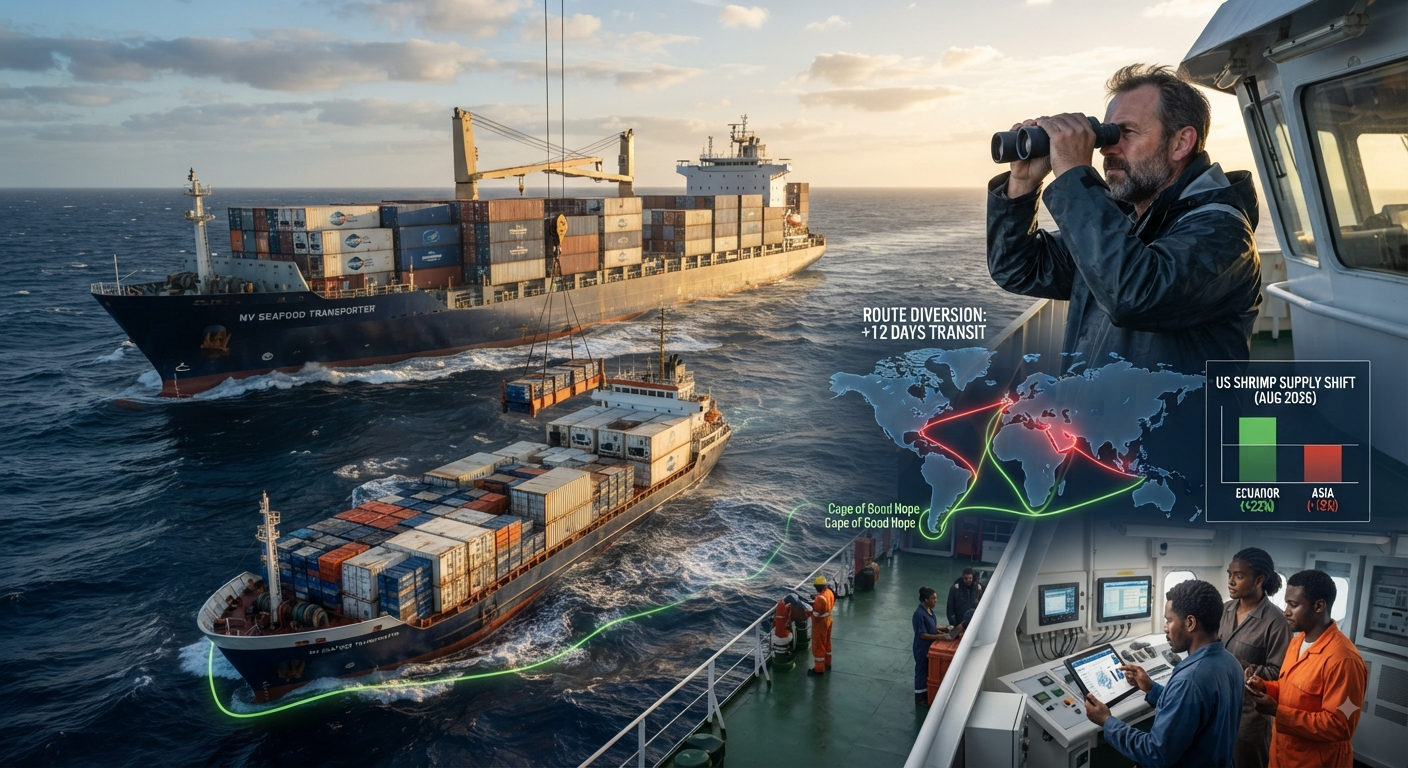

Wars, tariffs, and shipping chokepoint attacks have pushed seafood exporters into longer routes and new markets, and industry analysts say the reshuffling is becoming a permanent feature of the trade rather than a temporary disruption.
Shipping Routes Have Fundamentally Lengthened
The Strait of Hormuz, a corridor that carried roughly a quarter of the world’s seaborne crude oil and petroleum trade in 2025, has been effectively closed to routine commercial shipping since late July, following the collapse of a brief reopening under a June US-Iran agreement after renewed attacks on commercial vessels. Gulf ports including Jebel Ali, Dammam, and Jubail remain affected, pushing rerouted cargo toward a handful of alternative entry points like Jeddah and Salalah that are now absorbing significant congestion.
The Red Sea corridor tells a similar story. Houthi attacks on commercial shipping, ongoing since late 2023 despite coalition naval operations, have made the route effectively uninsurable at standard rates for most carriers, forcing widespread diversion around the Cape of Good Hope. That reroute adds roughly 8 to 12 days of transit time and has pushed full-container-load rates up an estimated 30% to 60% on affected lanes. Geopolitical economist Dr. Nomi Prins, speaking at Seafood Expo Global in Barcelona, put a finer point on the seafood-specific impact, noting shipments from India and Southeast Asia can now take 10 to 14 days longer to reach destination markets, adding fuel costs, storage costs, and fresh refrigeration risk to cargo already loaded and in transit.
Tariffs Are Redrawing Who Supplies The US
Trade policy has become as disruptive to sourcing patterns as the shipping disruptions themselves. Rabobank seafood analyst Gorjan Nikolik points to the shrimp trade as the clearest example: higher US tariffs on Asian producing nations gave Ecuador a near-overnight competitive edge, given the country’s existing advantages in lower mortality rates, larger production scale, proximity to the US, and dollarized economy. The result, in Nikolik’s words, is that Ecuador has moved from the second- to the first-largest shrimp supplier to the US market in a short span.
That advantage isn’t without cost for Ecuador itself, though. The country’s National Chamber of Aquaculture estimates its shrimp producers are now paying roughly $20 million per month under a 15% US tariff that took effect August 7, with total 2026 tariff payments already reaching an estimated $45 million. Because many Ecuador-US shrimp contracts are structured as Delivered Duty Paid, exporters — not US buyers — are absorbing those costs directly, including cash bonds posted at US customs to guarantee tariff payment, creating a real liquidity strain even as the country gains overall market share.
Whitefish And Shrimp Markets Are Reshuffling Globally
Beyond tariffs, sanctions have restructured entire product categories. Russia’s gradual decoupling from Western seafood markets has redirected pollock that once flowed into Europe and North America toward China and domestic Russian consumption, while the US has effectively removed Russian whitefish from its market altogether. Nikolik describes the result as a broad redistribution of global whitefish supply that has created clear winners — American whitefish producers now operate in a less crowded domestic market, and Norwegian cod farmers may be benefiting from higher European whitefish prices tied to the added cost and complexity of importing Russian product.
Shrimp exporters have pursued similar redirection where tariffs or sanctions closed off traditional markets. India has increasingly shifted shrimp exports toward China, though Nikolik notes this comes at a real cost: Indian exporters “leave a lot of money on the table” moving from highly processed, higher-value US-bound product to less-processed shipments commanding lower margins in China. Indonesia has stepped up shrimp exports to France and Spain, and Norway has expanded sales to Japan and China to reduce US market dependence — in each case, analysts note exporters have leaned into markets where existing relationships and positioning already existed rather than building entirely new ones from scratch.
Processing And Infrastructure Investment Are Slowing
The trade disruption is also reshaping where seafood gets processed. European processors, traditionally significant suppliers of smoked, breaded, and other value-added seafood to North America, now face tariff disadvantages relative to direct shipments from Nordic producers, weakening the economic case for processing within mainland Europe before export to the US.
More broadly, Nikolik says businesses are increasingly postponing investment in new processing facilities, cold storage, and distribution infrastructure because they can no longer confidently forecast future trading conditions well enough to justify the capital commitment — a cooling-off in US market development that he says was much more active before the current wave of disruption began.
Cost Increases Take Years To Fully Surface
One of the less visible dynamics Nikolik flagged is how slowly higher input costs move through seafood production before reaching consumers. Elevated fuel prices affect not just shipping but fishing operations, the fertilizer used to grow aquafeed ingredients like soy, and processing costs throughout the chain. Because farmed shrimp reach market in roughly three months while farmed salmon takes about two and a half years, a geopolitical shock today can continue pushing costs through the supply chain for years afterward, with retail contracts, inventory cycles, and feed production all acting to slow the transmission further.
Technology And Traceability Are Becoming Non-Negotiable
Both Nikolik and Prins point to technology investment — refrigeration, digital traceability, packaging innovation, and AI — as increasingly essential rather than optional as supply chains stretch longer and more complex. Regulatory pressure is reinforcing that shift directly: Europe’s CATCH system, now covering the import of all wild-caught seafood, is pushing exporters toward digital systems capable of documenting sourcing and movement across the full supply chain, adding compliance requirements on top of the logistics challenge itself.
Buyer And Procurement Implications
For F&B buyers and importers, the tariff-driven shift toward Ecuadorian shrimp is likely to continue, but buyers should watch for potential price pass-through as Ecuadorian exporters absorb mounting tariff costs under DDP contract structures — that cost pressure may eventually surface in negotiated pricing even though it isn’t showing up as a direct surcharge today. Buyers with existing Russian whitefish supply chains, or downstream contracts tied to that product, should treat current sourcing patterns as effectively permanent rather than temporary, given the structural nature of the market’s decoupling from Western buyers.
Procurement teams should also build longer lead times into contracts touching Middle East or Red Sea shipping lanes, given that the current 8-to-14-day transit extensions show no near-term sign of reversing, and should confirm with suppliers whether temperature-sensitive cargo has adequate cold-chain coverage for the extended Cape of Good Hope routing. Given that cost increases from today’s disruptions may not fully surface in pricing for up to two to three years — particularly for longer-cycle species like salmon — buyers negotiating multi-year contracts should factor in a wider cost-escalation buffer than historical patterns would suggest is necessary.
FAQ
Why are seafood shipments taking longer to reach markets?
Attacks on commercial vessels in the Red Sea and the effective closure of the Strait of Hormuz have forced many carriers to reroute around the Cape of Good Hope, adding roughly 8 to 14 days of transit time depending on the origin and destination, along with higher fuel, storage, and refrigeration costs.
How have US tariffs changed shrimp sourcing?
Higher tariffs on Asian shrimp producers have made Ecuador significantly more competitive, pushing it from the second- to the first-largest shrimp supplier to the US. However, Ecuadorian exporters are now absorbing an estimated $20 million per month in tariff costs themselves under common contract structures.
Why do geopolitical shocks affect seafood prices for years afterward?
Rising fuel and input costs work their way slowly through the supply chain via feed production, farming cycles, and retail contracts. Because shrimp reach market in about three months but salmon takes roughly two and a half years to raise, a single disruption can continue affecting prices for several years after the initial event.
Sources
- Responsible Seafood Advocate, “Longer routes, smarter logistics: how the seafood trade is adapting in an era of geopolitical chaos,” by Rob Fletcher, Aug. 11, 2026
- SeafoodSource, “US tariffs costing Ecuadorian shrimp producers USD 20 million a month, national aquaculture chamber claims”
- CNBC, “Strait of Hormuz and drone threats to global shipping”
- Congress.gov / CRS, “The Strait of Hormuz: Security Developments and Impacts on Oil, Gas, and Other Commodities”
- Suaid Global, “Red Sea Shipping Crisis 2026: Rates, Reroute, Transit”
- WTO, “Strait of Hormuz and global trade”