
Grocery spending has stopped tracking inflation and wages the way it used to, and Acosta says retailers are now operating in a “new affordability era” with no clear end date.
Why The Old Economic Signals Stopped Working
For years, grocers could reasonably predict shopper behavior by watching inflation cool and wages rise. That relationship has broken down. Acosta’s basket-cost tracking shows the price of a large grocery basket climbed nearly 27% between 2020 and 2026, reaching $366, while median hourly earnings rose even faster, up 29% to almost $31 over the same stretch. Food inflation itself has moderated since its 2021–2023 spike.
By the traditional math, consumers should feel flush. They don’t act that way. Shoppers are still chasing promotions, comparing products closely, and switching brands at rates that mirror 2023, one of the most value-driven years in recent memory. Acosta’s conclusion is that households have stopped reacting to short-term affordability swings and have instead settled into fixed habits built during the hardest years of the price run-up. Those habits aren’t loosening just because the underlying numbers have improved.
What’s Actually Driving The Behavior
The report points to pressure points outside the grocery aisle as a major factor. Healthcare and housing costs continue to squeeze household budgets, and gas prices have climbed again in recent months, pushing the national average above $4 a gallon. Separate Purdue University survey data backs this up: the large majority of consumers changed their shopping behavior in 2025, mostly by seeking discounts, trading down to cheaper brands, and cutting nonessential purchases, with food prices cited as the top driver.
What’s notable is how few shoppers expect those changes to be temporary. Most who adjusted their habits don’t plan to revert even as conditions ease, which is the core of Acosta’s argument: this isn’t a cyclical dip, it’s a behavioral reset. That view lines up with broader retail forecasting. Moody’s Ratings projects real consumer spending growth slowing to roughly 1.5% in 2026, with a softening labor market and cooling wage gains eroding household consumption further, and flags multitiered pricing and value-aligned retailers as the ones most likely to hold up.
How Grocers Are Responding
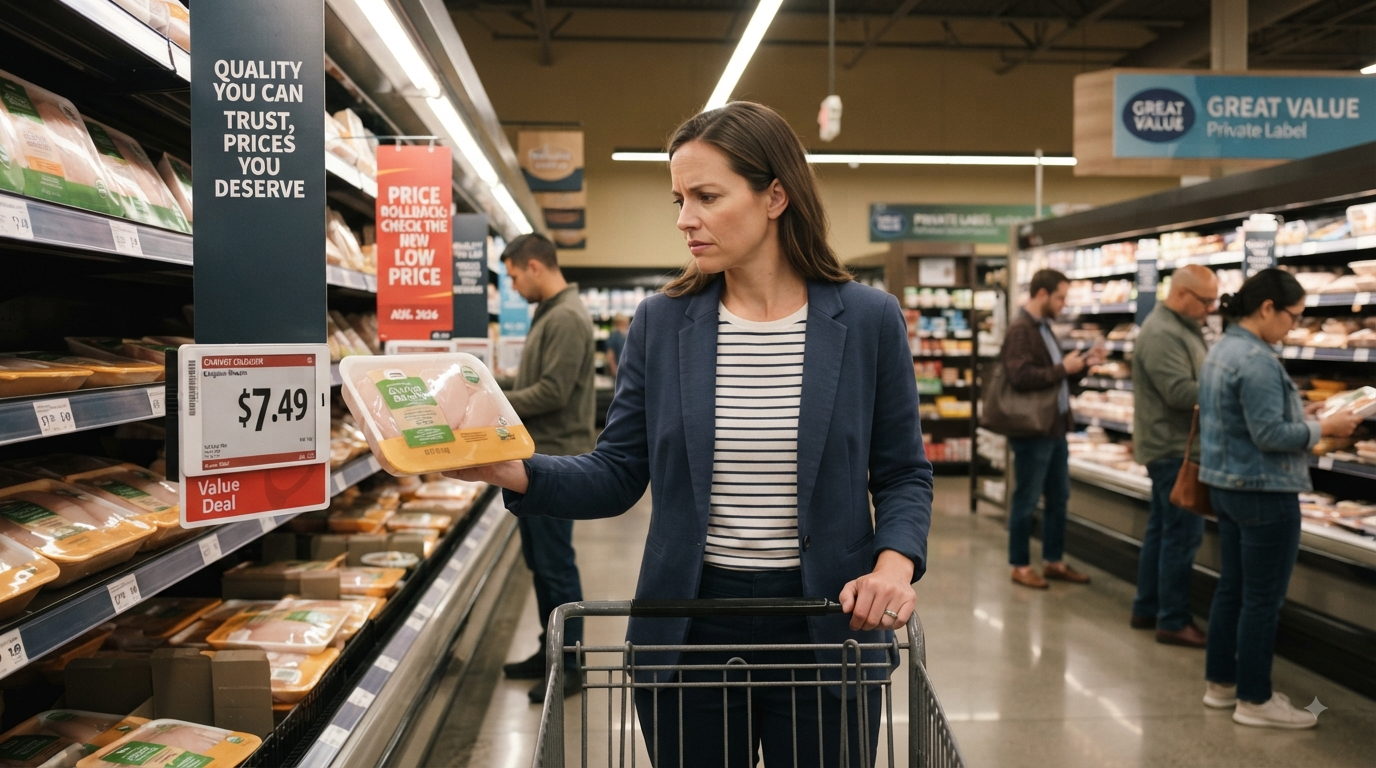
Acosta’s framing for retailers isn’t just “get cheaper” — it’s about giving shoppers confidence that what they’re buying is worth the money, regardless of where prices sit. That’s a quality-and-trust play layered on top of a price play, and grocers are already moving on both fronts.
Recent moves include freshness guarantees, expanded health and wellness initiatives, and new ready-to-eat meal programs sitting alongside traditional savings programs. Some chains are working both angles at once. Walmart’s overhaul of its Great Value private label is a bet that shoppers will pay attention to quality signaling even on a budget tier, while Kroger’s reworked loyalty program is aimed at rewarding the frequent, price-conscious shopper with deeper, more targeted discounts rather than blanket promotions. Industry-wide, Circana’s 2026 outlook expects flat-to-slightly-negative volume growth with price/mix doing the heavy lifting, and identifies affordability, channel flexibility, and personalization as the traits separating retailers that grow from those that don’t.
Buyer And Procurement Implications
For F&B suppliers and category managers, the signal here is that retailer resets around private label, promotions, and loyalty tiers aren’t short-term reactions — they reflect a belief that value-seeking behavior is now structural. Suppliers negotiating shelf space or promotional calendars with grocers should expect continued pressure on price architecture and deeper interest in private label partnerships, since retailers are treating trusted, quality-positioned private label as a direct lever against value-seeking churn.
Procurement teams supplying private label programs should also anticipate more scrutiny on ingredient quality and sourcing transparency, not just cost, since retailers are explicitly trying to pair affordability with a credible quality story. Vendors who can support both a competitive cost basis and a clear quality or freshness narrative will be better positioned in these conversations than those competing on price alone.
FAQ
What is Acosta’s “new affordability era”?
It’s Acosta’s term for a shift in consumer grocery behavior where spending habits no longer move in step with inflation or wage data, and instead reflect fixed routines shoppers built during recent years of high prices.
Are grocery prices still rising in 2026?
Food inflation has moderated since its 2021–2023 peak, and wage growth has outpaced grocery basket cost increases since 2020, but overall consumer spending growth is still expected to slow through 2026.
How are grocers responding to sustained value-seeking behavior?
Retailers are combining savings programs with freshness guarantees, health initiatives, revamped private label brands, and updated loyalty programs aimed at building shopper confidence in both price and quality.
Sources
- Food Dive, “Grocers have entered a ‘new affordability era,’ report notes,” Aug. 10, 2026
- Grocery Dive, “Grocers have entered a ‘new affordability era,’ report notes,” Aug. 7, 2026
- Purdue University Center for Food Demand Analysis and Sustainability, Consumer Food Insights Report, December 2025
- Moody’s Ratings, U.S. consumer spending outlook, 2026
- Circana, 2026 Food & Beverage Outlook