
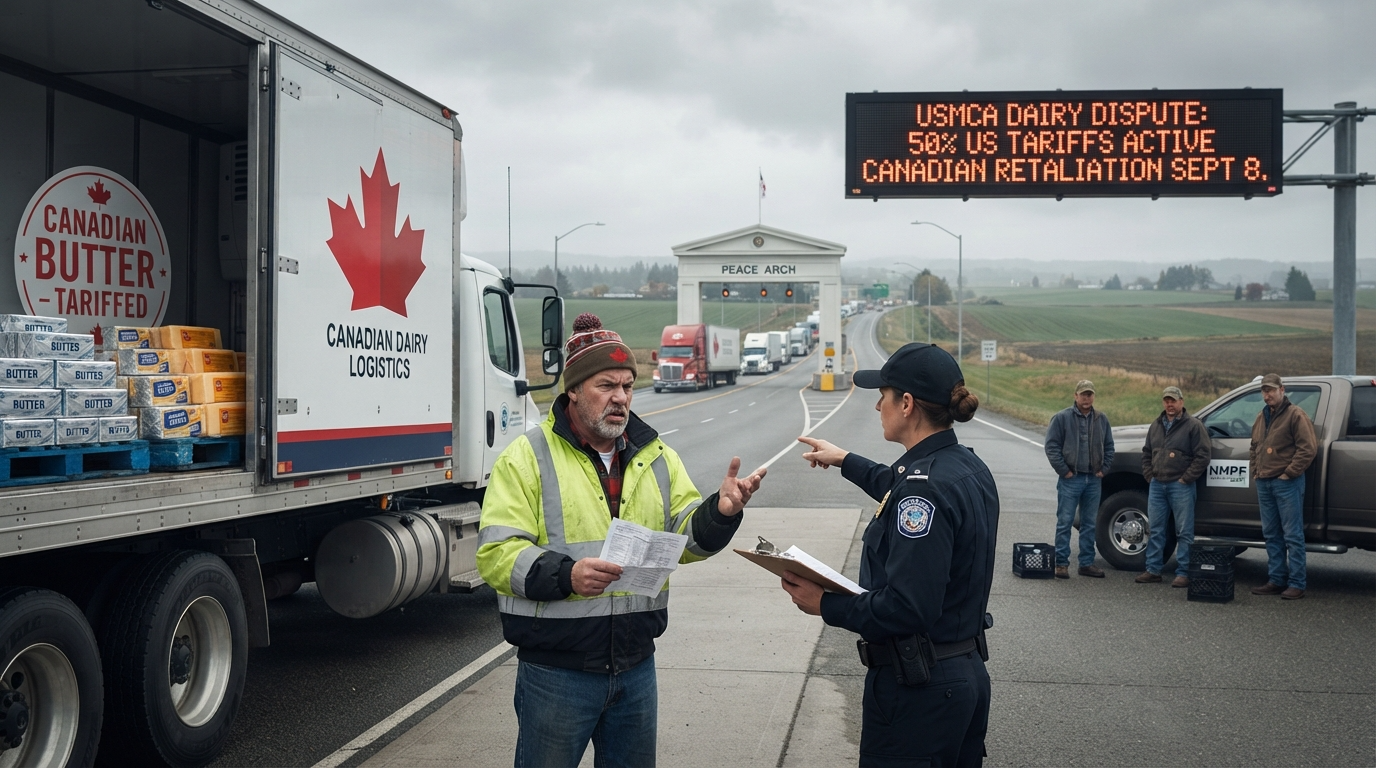

The US-Canada dairy trade war escalated into a formal tariff confrontation on August 22, 2026, when the Trump administration imposed 50% tariffs under Section 338 of the Tariff Act of 1930 on approximately $20 billion in Canadian goods, including dairy products (butter, cheese, milk, yogurt, milk powders). The unprecedented use of Section 338 in the modern tariff era triggered an immediate retaliation announcement from Canadian Prime Minister Mark Carney, who declared Canada would impose “dollar-for-dollar” retaliatory tariffs effective September 8, 2026, targeting US steel, dairy, appliances, agricultural equipment, pulp & paper, and electronics. Carney’s stark language—”You’re at war when you get attacked. We got attacked”—and characterization of the escalation as taken “reluctantly” underscored the severity of the breakdown and the threat to the integrated North American dairy supply chain that has undergone decades of just-in-time integration under NAFTA and USMCA frameworks.
Table of Contents
August-September 2026 Tariff Timeline: 50% US Levies, Dollar-for-Dollar Canadian Retaliation
Complete Tariff Escalation Timeline:
- July 20, 2026: Trump signs three Section 338 proclamations (Proclamations 11046, 11047, 11048) invoking tariff authority against Canada. Scheduled effective date: Aug 19.
- August 18, 2026: Three-day suspension granted to allow final negotiations. Effective date pushed to Aug 22, 12:01 AM ET.
- August 19-22, 2026: Intensive negotiations between US and Canadian teams. Talks collapse Friday night (Aug 22, ~11 PM), hours before tariffs take effect.
- August 22, 2026 (12:01 AM ET Saturday): Section 338 tariffs take effect on $20B Canadian goods. Dairy products affected immediately.
- August 22, 2026 (Saturday morning): PM Carney announces “dollar-for-dollar” retaliation to take effect Sept 8. Targets: steel, dairy, appliances, agricultural equipment, pulp/paper, electronics.
- August 24, 2026 (Sunday): NMPF President Doud statement affirms US concern about Canadian dairy tariff practices; calls for good-faith resolution.
- September 8, 2026 (projected): Canadian retaliatory tariffs take effect on US goods (formal Order-in-Council to be released Aug 24-27).
The rapidity of the timeline—from proclamations to formal tariff implementation in one month—reflects both the statutory requirements of Section 338 (30 days minimum) and the administration’s determination to execute tariff policy regardless of negotiation progress. The three-day suspension, formally granted on August 18, represented the last opportunity for deal-making, but talks collapsed late Friday without resolution.
Section 338 Authority: First Modern Use Since 1949
The Trump administration’s invocation of Section 338 marks an extraordinary escalation in tariff authority:
Section 338 of Tariff Act of 1930:
- Statutory Authority: 19 U.S.C. 1338
- Tariff Rate: Up to 50% ad valorem duty (maximum allowed)
- Condition for Use: Foreign country deemed to have “discriminated against the commerce of the United States”
- Last Modern Use: 1949 (77 years ago)
- Trump Administration First Use: August 22, 2026 (Section 338 resurrection)
- Statutory Minimum Implementation: 30 days after proclamation (July 20 + 30 = Aug 19 baseline)
- USMCA Exemption: No exemption (Section 338 duties apply despite USMCA trade agreement status)
Why Section 338 Instead of Section 301 or 232? Section 338 represents a distinct legal authority from other tariff tools:
- Section 301 (Trade Act of 1974): Retaliatory tariffs for intellectual property, services, investment barriers. Does provide USMCA exemption for compliant goods.
- Section 232 (Trade Expansion Act of 1962): National security tariffs on steel, aluminum. Limited scope, does not cover dairy broadly.
- Section 338: Discrimination-based authority, applies to any sector, specifically invoked for dairy/alcohol/autos, and critically—applies regardless of USMCA status.
The administration’s choice of Section 338 is strategically significant: it maximizes tariff rate (50% vs lower rates under other authorities), applies to USMCA-compliant goods (undermining the agreement’s predictability), and establishes a precedent for using an 1930s-era statute last deployed in 1949. This signals the administration views USMCA as insufficient protection of US interests and is willing to use archaic authorities to override the agreement.
Scope of US Tariffs: $20B Canadian Goods, 554 HTSUS Subheadings
The tariff scope is extraordinarily broad, spanning far beyond dairy:
Dollar Volume: ~$20 billion worth of Canadian exports affected (~5% of Canada’s annual US-bound exports)
Product Coverage: 554 HTSUS (Harmonized Tariff Schedule of the United States) subheadings across three primary proclamations:
- Proclamation 11046 (Alcoholic Beverages): Beer, wine, liquor, cider, spirits
- Proclamation 11047 (Dairy): Milk, cream, whey, lactose, butter, cheese, yogurt, milk powders
- Proclamation 11048 (Motor Vehicles): Cars, trucks, vehicle parts (with narrow exemptions for certain passenger vehicles and USMCA-qualifying parts)
Extended Product Coverage Beyond Primary Categories: The 554 HTSUS subheadings encompass products far beyond the three core categories, including:
- Wood and wood products (lumber, plywood, hockey sticks, furniture)
- Honey, seeds, tulips, orchids
- Cement, candles, wigs, clothing
- Chandeliers, ice skates, swimming pools, fishing rods
- Tongue depressors, medical devices, and numerous other goods
Exclusions from Tariffs: Notably excluded from Section 338 duties (0% additional rate):
- Energy products (oil, gas, electricity)
- Potash (fertilizer)
- Fish
- Critical minerals
- Products already under Section 232 tariffs (certain steel, aluminum)
The exclusion of energy products is particularly significant: Canada provides ~17% of US energy imports (oil, gas, electricity). Trump administration’s willingness to spare energy suggests concern that energy tariffs would create unacceptable US domestic cost increases heading into November 2026 elections.
Dairy Tariffs Specified: Butter 50%, Cheese 50%, Milk 50%, Yogurt 50%
Dairy products face the full 50% Section 338 duty on top of existing tariff rates:
Canadian Dairy Tariffs (Effective August 22, 2026):
- Butter: +50% (on top of existing 35% baseline USMCA rate) = effectively ~85-90% total
- Cheese: +50% (on top of existing baseline) = effectively ~80-85% total
- Milk (fluid): +50% (on top of existing baseline)
- Yogurt: +50% (on top of existing baseline)
- Milk powders, whey, lactose: +50% each
Impact on Canadian Dairy Exporters: Canada exports ~$3+ billion annually in dairy products to the US—representing roughly 40% of Canada’s total dairy exports by value. The 50% tariff increases make Canadian dairy uncompetitive in US wholesale markets for most products. Canadian processors (Saputo, Lactalis Canada, etc.) now face binary choices:
- Absorb tariff costs (compress margins)
- Reduce US shipments and redirect to other markets (but tariff rates will depress prices globally)
- Halt US exports until tariffs are removed
US Dairy Importers’ Position: US processors and retailers importing Canadian dairy ingredients (milk proteins, cream for processing, whey for supplements) face immediate cost increases. Tariff pass-through to US consumers likely within weeks.
Mark Carney’s Response: “At War” Language, Dollar-for-Dollar Retaliation Sept 8
Canadian PM Carney’s public response was notably confrontational in tone and substance:
Mark Carney on August 22, 2026:
“You’re at war when you get attacked. We got attacked.”
“Canada will match those tariffs dollar for dollar to protect our workers and businesses.”
“We take this step reluctantly because we recognize that some of these measures will raise costs and reduce choice for Canadians.”
“America has changed, and two countries will not return to our old relationship.”
Carney’s Key Points:
- War Metaphor: By framing tariffs as an “attack” and retaliation as “war,” Carney elevated rhetoric from trade dispute to existential conflict. This signals Canada views the situation as fundamental threat, not negotiable disagreement.
- Dollar-for-Dollar Commitment: Carney pledged Canadian tariffs would match US tariffs “dollar for dollar”—meaning if US tariffs affect ~$20B in Canadian goods, Canada will impose tariffs on ~$20B in US goods (approximately equal retaliation magnitude).
- Reluctance Emphasis: Carney repeatedly stressed the step was taken “reluctantly” and acknowledged “some of these measures will raise costs and reduce choice for Canadians.” This admission is politically important: it acknowledges citizens will bear costs of retaliation, not just Americans.
- Relationship Rupture Statement: “America has changed” and “two countries will not return to our old relationship” signals Carney views this as permanent damage to US-Canada relations, not temporary tariff dispute.
Canadian Retaliation Targets (Announced August 22, with details in “coming days”):
- Steel and aluminum (directly targeting US steel mills, aluminum smelters)
- Dairy (directly targeting US dairy exporters, processors)
- Appliances and electrical equipment
- Agricultural equipment
- Pulp and paper products
- Electronics
Notably, Canada’s retaliation explicitly targets dairy—signaling that supply-chain disruption cutting both directions is Canada’s strategy. This is particularly impactful because integrated North American dairy supply chains mean US processors relying on Canadian milk/ingredients will face tariffs on both imports (Canadian tariffs on US dairy exports) and retaliatory effects.
Negotiations Collapse: Canada’s Concessions vs. US Demands
Both sides blamed the other for the breakdown. The reality is more nuanced:
Carney’s Account of Collapsed Talks: “They asked too much and offered too little.” Carney revealed that Canada had prepared significant concessions:
- Dropping retaliatory tariffs on steel, aluminum, and autos if US substantially lowered its own
- Encouraging provinces to restore US alcohol sales in provincial liquor boards (reversing provincial retaliatory measures)
- Reopening dairy market access discussions with willingness to modify TRQ administration
Carney stated the collapse occurred because “Last-minute changes in the U.S. proposal introduced new terms that were uneconomic, unfair, and undermined the net benefits for Canada.”
US Trade Representative Greer’s Counter-Narrative: Jamieson Greer responded that the US had offered generous terms: “They’ve always had the best deal, and they still would have an even better deal, but they didn’t want that.” Greer claimed the US offered to cut tariffs on:
- Steel
- Autos
- Lumber
Greer stated: “Despite the U.S. offer to Canada to receive the best treatment of any major exporter to our market, new demands and walk backs of other commitments by Canada have upended the careful balance reached in the past days.” He characterized Canada’s Friday evening instruction to negotiators to “walk away” as a miscalculation.
Likely Reality: Both sides overestimated their leverage. Canada believed US would blink before Aug 22 deadline (precedent-setting for tariff deployment). US believed Canada would cave rather than retaliate (belief that energy sales dependency would force compliance). Neither side flinched.
USMCA Dairy Dispute: Supply-Management System & TRQ Administration
The core issue driving tariffs is Canada’s dairy supply-management system and alleged USMCA non-compliance:
Canada’s Supply-Management System (40+ years old): Canada regulates dairy, poultry, and eggs through supply-management—a system designed to stabilize production, prices, and farmer incomes through:
- Production Quotas: Provinces assign milk production quotas to individual farms
- High Tariff Protection: Out-of-quota imports face tariffs exceeding 200%:
- Butter: 298% out-of-quota tariff
- Cheese: 245% out-of-quota tariff
- Milk (fluid): 243% out-of-quota tariff
- Price Controls: Domestic producer prices maintained at premium levels relative to global markets
USMCA Dairy Access Commitments: The USMCA (predecessor NAFTA) promised US expanded dairy access:
- US TRQ (tariff rate quota): 50,000 tonnes of fluid milk tariff-free
- US TRQ: 12,500 metric tonnes of cheese tariff-free
- Out-of-quota tariffs: Reduced under USMCA but still very high (~35% baseline)
US Allegation of USMCA Non-Compliance: The Trump administration claims Canada has used regulatory loopholes to frustrate the intent of USMCA dairy access, including:
- TRQ administration allegedly biased against US exporters (favoring European/other suppliers)
- Classification of dairy products to fit into protected categories rather than quota-free categories
- Domestic support programs that effectively subsidize Canadian production, making US imports uncompetitive even within TRQ allowances
- Alleged “domestic supply” constraints used to restrict imports despite market demand
The US argument is that while Canada technically provides TRQ access, the out-of-quota tariffs and regulatory environment make meaningful US dairy export growth impossible—violating the spirit of USMCA commitments.
Why Supply-Management Matters: Canada’s supply-management system generates strong domestic political support (dairy farmers are organized, politically active) but creates trade friction internationally. US negotiators have consistently pushed Canada to liberalize dairy, but Canadian governments (regardless of party) resist due to domestic farm lobby pressure. This structural political resistance explains why USMCA dairy provisions remain contested.
Supply Chain Risk: Integrated Canada-US Dairy Ingredient Trade Disrupted
North American dairy supply chains are highly integrated, creating significant disruption risks:
⚠️ SUPPLY CHAIN DISRUPTION RISK: The tariff war threatens integrated dairy supply chains that have evolved over 30 years of NAFTA/USMCA integration. Disruption will be painful for both countries.
Cross-Border Dairy Flows (Pre-Tariff):
- Canada to US: ~$3B annually in dairy exports (milk ingredients, cream, butter, cheese) supply US processors, retailers
- US to Canada: ~$1.5-2B annually in dairy exports (specialty products, whey, lactose, dairy ingredients) supply Canadian processors, consumers
- Just-in-Time Supply: Processors on both sides operate with minimal inventory; supply interruptions create production bottlenecks within days
Affected Industries:
- US Dairy Processors: Rely on Canadian milk proteins, cream for yogurt production, ice cream, cheese manufacturing
- Canadian Dairy Processors: Export milk products to US foodservice, retail channels; face tariffs cutting US market access
- Infant Formula Manufacturers: Use Canadian milk proteins; tariffs increase input costs
- Sports Nutrition / Supplement Manufacturers: Source whey, lactose from Canada; tariffs increase costs
- Ice Cream, Yogurt, Cheese Manufacturers: Both countries use cross-border supply; tariffs disrupt production planning
Timeline for Supply Chain Pain: Tariff impacts on shelf prices likely within 2-4 weeks as inventory runs out and replacement orders face tariff costs.
Consumer Impact: Tariffs Will Raise Retail Prices in Both Countries
US Consumer Impact (September 8 when Canadian retaliation takes effect):
- Canadian dairy products: Already facing +50% US tariffs (Aug 22), Canadian products become uncompetitive in US wholesale. Expect reduced availability and higher prices for specific Canadian products (certain cheeses, butter brands).
- US dairy products sold to Canada: Sept 8 Canadian retaliation on US dairy exports will raise prices for Canadian consumers on US dairy products. Estimates suggest 10-20% retail price increases possible within weeks.
- Milk (fluid): Less affected due to perishability and regional supply chains (most US milk consumed domestically). Wholesale/ingredient markets will see bigger disruption than retail milk.
- Cheese, butter, yogurt: More affected due to longer shelf life and cross-border trade patterns. Retail prices likely to rise 5-15% within 4-8 weeks as tariff pass-through occurs.
- Specialty dairy products: Imported products hit hardest; artisanal cheeses, European-style yogurts, specialty ingredients face tariff premiums.
Canadian Consumer Impact (September 8):
- US dairy products facing retaliatory tariffs: Expect 10-20% retail price increases for imported US dairy items within weeks
- Domestic dairy product prices: Canadian retailers may increase prices preemptively to avoid margin compression from tariff-disrupted supply chains
- Consumer choice reduction: Tariffs will reduce product variety as cross-border imports become uneconomical. Carney explicitly stated some “choice will be reduced for Canadians.”
Election Timing Concern: November 2026 US midterm elections are 10 weeks away. If dairy tariffs produce visible retail price increases, they could become politically significant just before elections. Similarly, Canadian consumers will notice price increases just months into tariff war. Both governments will face domestic pressure to resolve dispute.
USMCA Renewal Status: US-Mexico Track Strengthens, US-Canada Standoff Deepens
The tariff war complicates the ongoing USMCA renewal process:
USMCA Status (August 2026):
- Agreement Renewal Timeline: USMCA Review Protocol: Agreement undergoes mandatory review every six years (originally signed 2020, with provisions for updates). 2026-2027 is active review period.
- US-Mexico Track: Progressing smoothly with positive momentum on agricultural trade, nearshoring provisions, and supply chain resilience provisions
- US-Canada Track: Stalled and deteriorating due to dairy, auto, energy disputes and tariff escalation
Risk of Asymmetric USMCA Outcome: Possibility that USMCA renewal process produces:
- Strengthened US-Mexico trade relationship (closer integration, preferential access)
- Degraded US-Canada relationship (tariff walls, reduced trade flows, weakened predictability)
- De Facto creation of a “US-Mexico trade bloc” within USMCA with Canada as peripheral member
This would represent fundamental restructuring of North American trade architecture—a shift from trilateral equilibrium to bilateral US-Mexico focus with Canada sidelined. Carney’s statement that “two countries will not return to our old relationship” suggests Canada is already preparing for this scenario.
Sources & References
| Source | URL | Publication Date |
|---|---|---|
| Zonos – Section 338 Tariffs on Canada | https://zonos.com/docs/guides/country-guides/united-states/section-338-canada-tariffs | August 22, 2026 |
| Blakes – U.S. Imposes 50% Tariffs on Canadian Products | https://www.blakes.com/insights/u-s-imposes-50-percent-tariffs-on-canadian-products-effective-august-22-2026/ | August 22, 2026 |
| GHY International – Section 338 Tariffs How Canadian Exporters Should Prepare | https://www.ghy.com/trade-compliance/section-338-tariffs-how-canadian-exporters-should-prepare-before-august-19/ | August 22, 2026 |
| CH Robinson – New 50% Section 338 Duties on Select Canadian Products | https://www.chrobinson.com/en-us/resources/insights-and-advisories/client-advisories/2026q3/08-22-26-client-advisory-new-50-percent-section-338-duties-on-select-canadian-products/ | August 22, 2026 |
| Axios – US, Canada trade talks collapse, massive tariffs to take effect | https://www.axios.com/2026/08/22/us-canada-tariffs-trade-trump-carney | August 22, 2026 |
| CNBC – As U.S.-Canada trade talks collapse, Carney says retaliatory tariffs will start Sept. 8 | https://www.cnbc.com/2026/08/22/us-canada-trade-talks-collapse-ushering-in-wave-of-new-tariffs.html | August 22, 2026 |
| NPR – As Canada readies retaliatory tariffs, Mark Carney says his nation is ‘at war’ | https://www.npr.org/2026/08/22/nx-s1-5941584/us-canada-tariffs | August 22, 2026 |
| Al Jazeera – Canada to hit US with retaliatory tariffs | https://www.aljazeera.com/news/2026/8/23/canada-to-hit-us-with-retaliatory-tariffs-as-trade-war-escalates | August 23, 2026 |
| Al Jazeera – Carney: Canada will enact retaliatory US tariffs starting September 8 | https://www.aljazeera.com/news/2026/8/22/carney-canada-will-enact-retaliatory-us-tariffs-starting-september-8 | August 22, 2026 |
| Detroit News – Canada Retaliatory Tariffs Carney Trump Trade Deal | https://www.detroitnews.com/story/business/2026/08/22/canada-retailiatory-tariffs-carney-trump-trade-deal/91422797007 | August 22, 2026 |
| NBC News – Canadian Prime Minister Mark Carney calls new U.S. tariffs ‘a miscalculation’ | https://www.nbcnews.com/business/economy/trump-canada-tariffs-carney-rcna593510 | August 22, 2026 |
| The Hill – Canada retaliates US tariffs | https://thehill.com/policy/international/6045107-canada-retaliates-us-tariffs/ | August 22, 2026 |
| BBC News – Canada to drop some of its retaliatory tariffs on the US | https://feeds.bbci.co.uk/news/articles/c5yk9dqlvygo | August 29, 2026 |
| Tariff Calculator – Canada 50% Section 338 Tariff Explainer | https://tariffcalculator2026.com/canada-50-percent-tariff-august-19-explainer | August 22, 2026 |
Frequently Asked Questions (FAQ)
❓ What is Section 338 and why is it unprecedented?
Section 338 of the Tariff Act of 1930 allows the President to impose up to 50% tariffs on any country deemed to have “discriminated against the commerce of the United States.” This statutory authority is 96 years old but hasn’t been used in the modern tariff era (last deployed in 1949, 77 years ago). Trump’s August 22 action represents the first modern use of Section 338, making it a dramatic escalation in tariff authority.
❓ Why did the US target dairy specifically?
The US claims Canada’s supply-management system and tariff rate quota (TRQ) administration violate USMCA commitments. Canada maintains tariffs exceeding 200% on out-of-quota dairy imports (butter 298%, cheese 245%, milk 243%), which the US argues makes meaningful market access impossible despite USMCA provisions. The Trump administration cited dairy as a discriminatory trade practice under Section 338.
❓ Will consumers see price increases?
Yes. In the US, expect 5-15% price increases for imported dairy products (cheese, butter, yogurt) within 4-8 weeks as tariff costs pass through retail. Canadian tariff retaliation on US dairy exports (starting Sept 8) will raise prices for Canadian consumers on US dairy items similarly. Most affected will be specialty/imported products; domestic milk supply less affected due to perishability and regional pricing.
❓ How much dairy trade between US and Canada is affected?
Canada exports ~$3+ billion annually in dairy products to the US (roughly 40% of Canada’s total dairy exports). US exports ~$1.5-2 billion annually in dairy to Canada. Combined cross-border dairy trade exceeds $4.5-5 billion annually, all subject to tariff disruption. This represents one of the most significant bilateral dairy trade relationships globally.
❓ When do Canada’s retaliatory tariffs take effect?
Canadian retaliatory tariffs are scheduled to take effect September 8, 2026, meaning a “dollar-for-dollar” tariff response matching the ~$20 billion in US tariffs on Canadian goods. Details of specific tariff items will be released “in coming days” (late August 2026) via official Canadian government Order-in-Council.
❓ What sectors will Canada target in retaliation?
Canadian retaliation will focus on: steel, dairy, appliances, agricultural equipment, pulp/paper, and electronics. These sectors were specifically announced by PM Carney on August 22. Detailed item-by-item tariff lists will follow. By targeting US dairy explicitly, Canada ensures supply-chain pain cuts both directions.
❓ Does USMCA exempt these tariffs?
No. Section 338 tariffs apply to goods regardless of USMCA status. Unlike Section 301 tariffs which provide exemptions for USMCA-qualifying goods, Section 338 duties ignore the trade agreement. This is a major escalation because it undermines USMCA predictability—even compliant goods face tariffs. This is why the administration chose Section 338 over other authorities.
❓ What did Mark Carney mean by “at war”?
Carney used war metaphor to signal that Canada views US tariff action as an attack requiring retaliation, not a negotiable trade dispute. His language (“You’re at war when you get attacked. We got attacked”) elevated rhetoric from diplomatic disagreement to existential conflict. This signals Canada will not back down and expects prolonged tariff standoff.
❓ How does this affect USMCA renewal?
The tariff war significantly complicates USMCA review/renewal process. US-Mexico negotiations are progressing smoothly, but US-Canada track is stalled. Risk exists for asymmetric outcome where USMCA becomes effectively a US-Mexico agreement with Canada sidelined. This represents potential restructuring of North American trade architecture from trilateral to bilateral focus.
❓ What does Canada’s supply-management system do?
Canada’s supply-management system regulates dairy (and poultry/eggs) through production quotas, high tariff protection on imports (200%+ on out-of-quota dairy), and domestic price controls to stabilize production and farm incomes. The system generates strong domestic political support but creates trade friction internationally. US negotiators have consistently pushed for liberalization, but Canadian governments resist due to farm lobby pressure.