
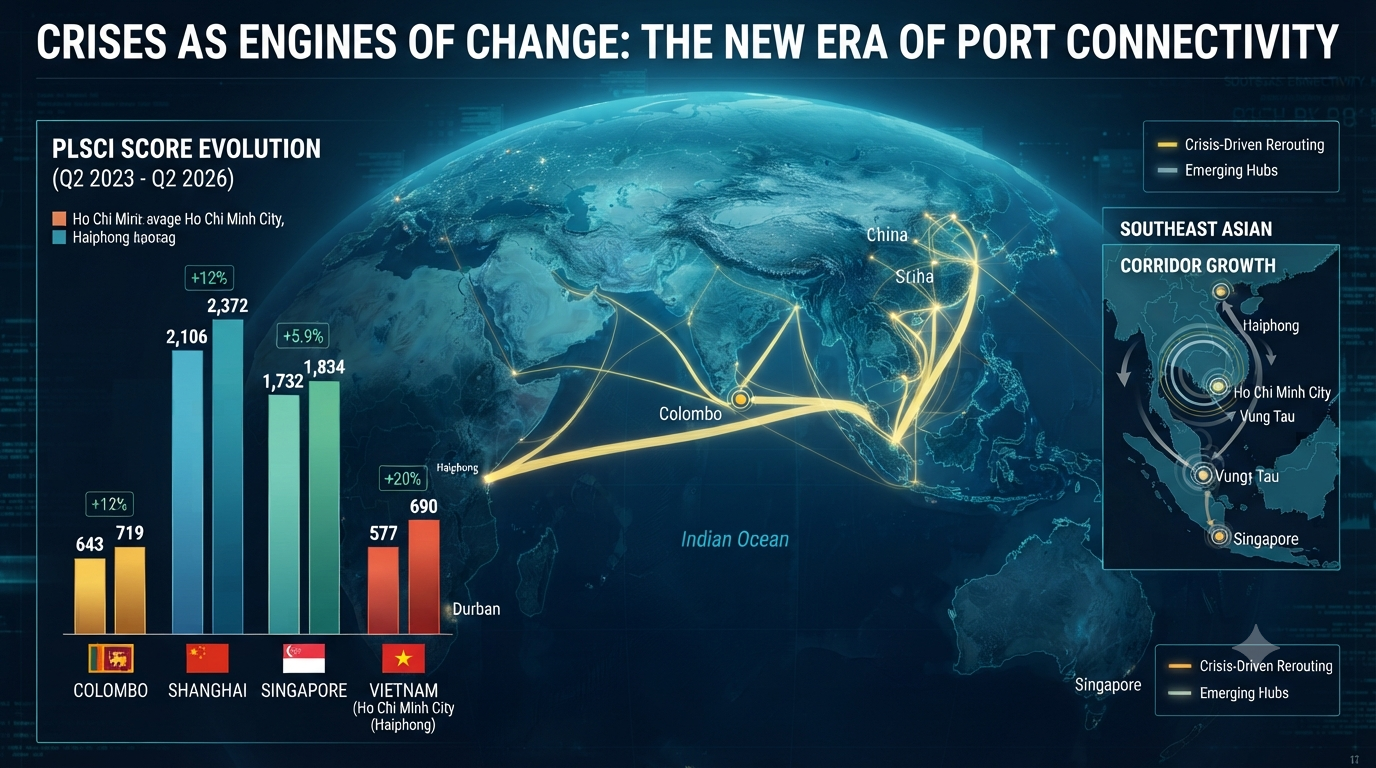

Recent analysis of the Port Liner Shipping Connectivity Index (PLSCI)—a joint development by UNCTAD and MDS Transmodal—reveals that global trading patterns have undergone a fundamental transformation. While post-COVID predictions suggested a return to “normalcy,” successive geopolitical and logistical crises have instead driven a structural redesign of shipping networks.
Table of Contents
Key Findings: The New Connectivity Landscape
- Network Refinement vs. Redrawing: Rather than fundamentally redrawing global networks, recent connectivity changes reflect a sophisticated “refinement” of existing routes.
- Stability at the Top: Global connectivity for top-tier ports remains highly stable despite ongoing crises, particularly in the Middle East.
- Shanghai: Index score increased from 2,106 to 2,372.
- Ningbo: Index score rose from 1,817 to 2,041.
- Singapore: Index score grew from 1,732 to 1,834.
- Dynamic Growth in Emerging Hubs: While established ports show stability, facilities immediately beneath them in the global hierarchy—particularly in South and Southeast Asia—are experiencing rapid, dynamic expansion.
Regional Focus: Sub-Saharan Africa
The disruption caused by the effective closure of the Red Sea and Suez Canal to most traffic since late 2023 has significantly accelerated the strategic importance of sub-Saharan Africa within global liner networks.
- Capacity Expansion: Every one of the top 10 operators serving Sub-Saharan Africa increased their capacity between July 2023 and July 2026.
- Market Leadership: MSC has solidified its position, boosting scheduled capacity by 60% to nearly 585,000 TEU/month. Maersk and CMA CGM also recorded substantial growth of 31% and 28%, respectively.
- Emerging Players: Operators with smaller initial footprints showed the highest percentage growth, with ONE increasing deployment by 102% and Evergreen by 173%.
- Strategic Investment: Abu Dhabi Ports achieved a 354% increase in capacity, highlighting an aggressive expansion of its maritime and logistics footprint on the continent.
Manufacturing Diversification and Corridor Shifts
Data indicates a persistent redistribution of connectivity toward a broader Southeast Asian corridor, moving away from a sole reliance on China’s established gateways.
- Colombo: Exemplifies “sustained multi-dimensional expansion,” with its PLSCI score rising 12% to 719 (Q2 2023 to Q2 2026). Gains were recorded across all six index components, including an increase in direct connections from 116 to 132.
- Vietnam’s Growth:
- Haiphong: Connectivity scores increased 20% to 690.
- Ho Chi Minh City: Connectivity scores rose 9% to 620.
- Vung Tau: Experienced a massive expansion in deployed capacity from 14.1m to 24.2m TEU, cementing its role as a regional transhipment hub.
Conclusion
The latest PLSCI findings suggest that crises have acted as engines of change, forcing carriers to refine their networks to account for manufacturing diversification strategies. As port and infrastructure investment continues to ramp up, regional competition is expected to intensify, further embedding these shifts into the global trade fabric.
Has global shipping returned to “normal” since the COVID-19 pandemic?
No. While some experts once predicted a return to pre-pandemic norms, successive crises—including the ongoing Red Sea shipping disruptions—have fundamentally altered trading patterns and forced a permanent structural recalibration of global liner networks.
What is the “new equilibrium” in shipping connectivity?
The current phase of shipping connectivity is characterized by “incremental optimization” rather than rapid, reactionary reconfiguration. The global hierarchy at the top (e.g., Shanghai, Ningbo, Singapore) has stabilized, while dynamic growth is being absorbed by secondary regional hubs in South and Southeast Asia.
How has the Red Sea crisis impacted port connectivity?
The Red Sea crisis forced shipping lines to divert vessels, which eventually led to a shift away from traditional hub-and-spoke configurations. Carriers are now concentrating services on regional relay ports and specific export gateways, reducing reliance on major transshipment centers like the Strait of Malacca.
Are major global hubs like Singapore still growing?
Major hubs have shown signs of moderation or decline in connectivity as carriers optimize their networks. For example, Singapore’s connectivity index fell from a peak of 1,877 in Q4 2025 to 1,834 in Q2 2026, as secondary gateways in India and the Middle East began absorbing more relay volumes.
Sources
| Source Reference | Title | Publisher | Date |
| **** | A new equilibrium emerges in global liner shipping connectivity | MDS Transmodal | 2026-07-10 |
| **** | UNCTAD data shows shift in port connectivity | Port Technology International | 2026-07-03 |
| **** | The Red Sea And The Impact Of Global Events On Shipping | TecEx | 2026-03-03 |