

Section 301 Tariffs Squeeze US Seafood Importers Hard
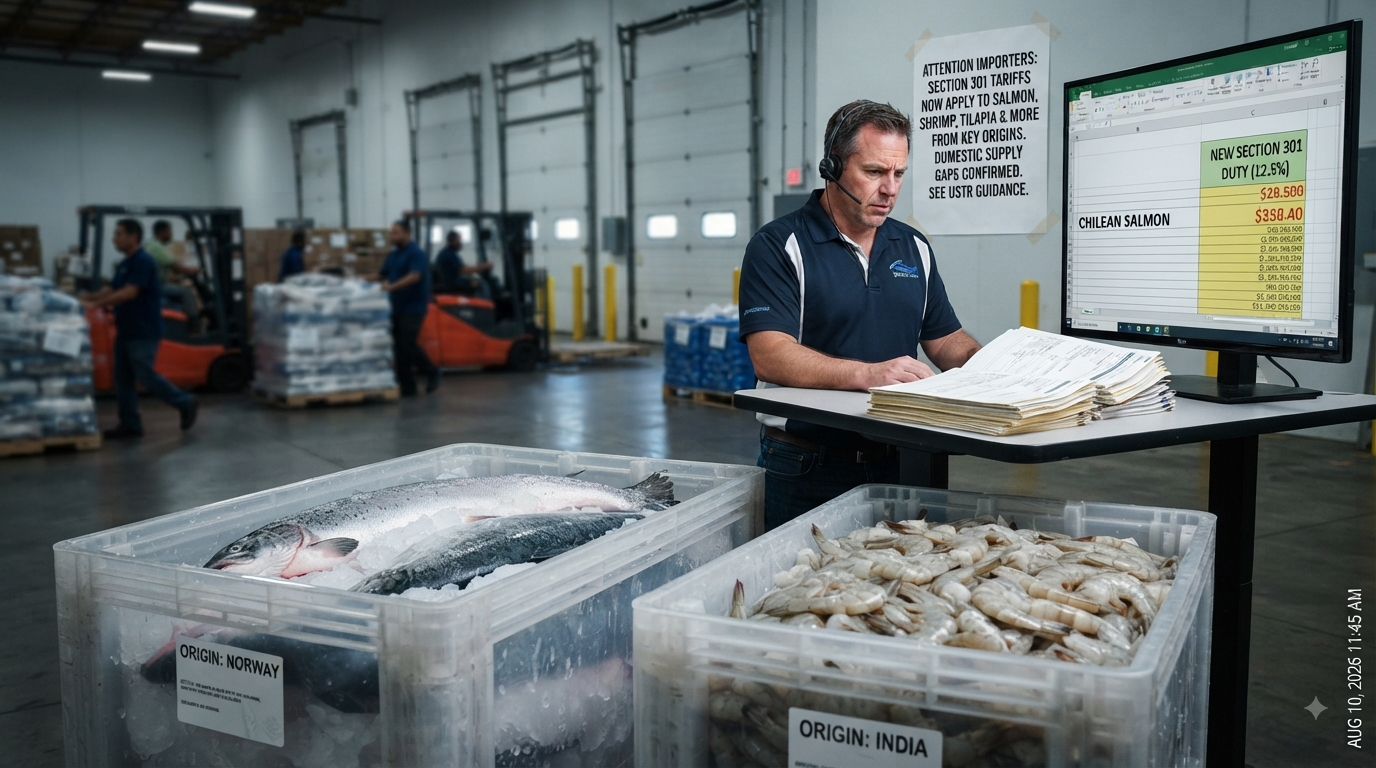
Section 301 tariffs on top salmon and shrimp suppliers are leaving US seafood importers with almost no way to dodge higher costs, since domestic production can’t cover the gap.
Which Countries And Species Are Hit
The new duties, announced by the Office of the US Trade Representative, target 60 global economies for allegedly failing to enforce prohibitions on forced-labor imports, with rates set between 10% and 12.5% depending on each country’s forced-labor commitments. The list reaches directly into the supply base US buyers depend on most: Norway, Chile, and the UK for salmon, and Ecuador, India, Indonesia, Vietnam, and Thailand for shrimp.
Shrimp tariffs break down by country. India, Ecuador, Indonesia, Argentina, Mexico, and Canada face a 10% rate — India’s was actually reduced from an initially proposed 12.5% after the country adopted forced-labor import prohibitions during the investigation. Vietnam, Thailand, Peru, and China face the steeper 12.5% rate. Beyond salmon and shrimp, tilapia from China, pangasius from Vietnam, and spiny lobster from the Bahamas all carry the 12.5% duty as well.
Why Buyers Can’t Simply Source Elsewhere
The core problem for importers is structural, not just financial. Santa Monica Seafood CEO Roger O’Brien laid out the math in a letter to the USTR before the final decision: roughly 98% of Atlantic salmon and about 90% of shrimp consumed in the US comes from imports, driven by a ban on commercial Atlantic salmon fishing domestically and limited scalability in US aquaculture. That means these tariffs can’t push meaningful volume toward domestic alternatives — there simply isn’t enough domestic supply to redirect toward.
BSF’s Mark Frisch described the shift in blunt terms for his company’s largest origin market. Chilean salmon entered the US essentially duty-free before this round, so the new 12.5% tariff isn’t an incremental increase — it’s an entirely new cost line. Norway carries the same exposure. On the shrimp side, the new duties stack on top of existing antidumping and countervailing duties already in place on some countries, along with older China-specific tariffs, which Frisch said will more than double his firm’s annual duty bill.
Industry-wide estimates put the scale in context: the National Fisheries Institute has calculated that a 12.5% tariff on $15 billion in annual finfish and shellfish imports combined with a 10% tariff on $9.3 billion in other seafood imports would generate roughly $2.86 billion in new annual tariff liability for US seafood companies.
A Pattern Of Whiplash On Trade Policy
This isn’t the first tariff shock this group of importers has absorbed. Channel Fish CEO Thomas Zaffiro said his company was a “first loser” in an earlier tariff round last year after being slow to pass along price increases, and has recovered only USD 40,000 of the roughly USD 100,000 it paid before the US Supreme Court ruled that earlier tariff mechanism illegal.
Frisch pointed to the broader instability as the real operational challenge: the tariff regime has changed four times in 18 months — original tariffs, a Supreme Court reversal, a temporary stopgap, and now this new Section 301-based program, with a refund system still being built to unwind the first round. That kind of volatility makes forward planning difficult regardless of where rates ultimately land.
There is one bright spot. Canadian snow crab and lobster remain unaffected by these duties as long as shipments qualify under the USMCA, which most Canadian seafood does — giving importers at least one stable sourcing lane while the rest of the supply chain absorbs new costs.
Buyer And Procurement Implications
For F&B procurement teams sourcing salmon, shrimp, tilapia, pangasius, or spiny lobster, the near-term reality is limited ability to avoid cost pass-through given how import-dependent these categories are. Buyers should expect suppliers to request price adjustments or surcharges tied to country of origin, and should factor tariff-driven volatility into forward contracts rather than assuming current pricing holds.
Procurement teams with flexibility in species specifications or sourcing geography have more room to manage exposure than those locked into single-origin contracts — Santa Monica Seafood’s approach of working with both vendors and customers on volume while exploring domestic sourcing where feasible is a template worth considering, even though domestic supply can’t fully replace imports in salmon and shrimp. Buyers using Canadian snow crab or lobster should confirm USMCA qualification status with suppliers now, since that remains one of the few tariff-clean sourcing lanes currently available.
FAQ
Which seafood species are most affected by the new Section 301 tariffs?
Salmon and shrimp are the primary categories affected, given the US relies on imports for roughly 98% of Atlantic salmon and 90% of shrimp consumption. Tilapia, pangasius, and spiny lobster also carry the new 12.5% duty.
Can US seafood importers avoid these tariffs by sourcing domestically?
Largely no. Domestic aquaculture and fishing capacity — including a ban on commercial Atlantic salmon fishing in the US — can’t scale to replace import volume, so tariffs are expected to reduce supply and raise prices rather than shift sourcing domestically.
Is any seafood exempt from the new tariffs?
Canadian snow crab and lobster remain unaffected as long as shipments qualify under the USMCA, which covers most Canadian seafood exports to the US.
Sources
- SeafoodSource, “Section 301 tariffs leave US seafood importers with few avenues to avoid rising costs,” Aug. 10, 2026
- Undercurrent News, “USTR gets earful on Section 301 tariffs from NFI, Chilean salmon sector, domestic shrimp, catfish producers”
- Southern Shrimp Alliance, “United States Imposes Section 301 Duties on Imported Seafood”
- Saving Seafood, “Trump administration announces new set of Section 301 tariffs against major seafood trade partners”
- TariffLens, “The Section 301 Seafood Tariff Threat: What Importers Need to Know Now”