
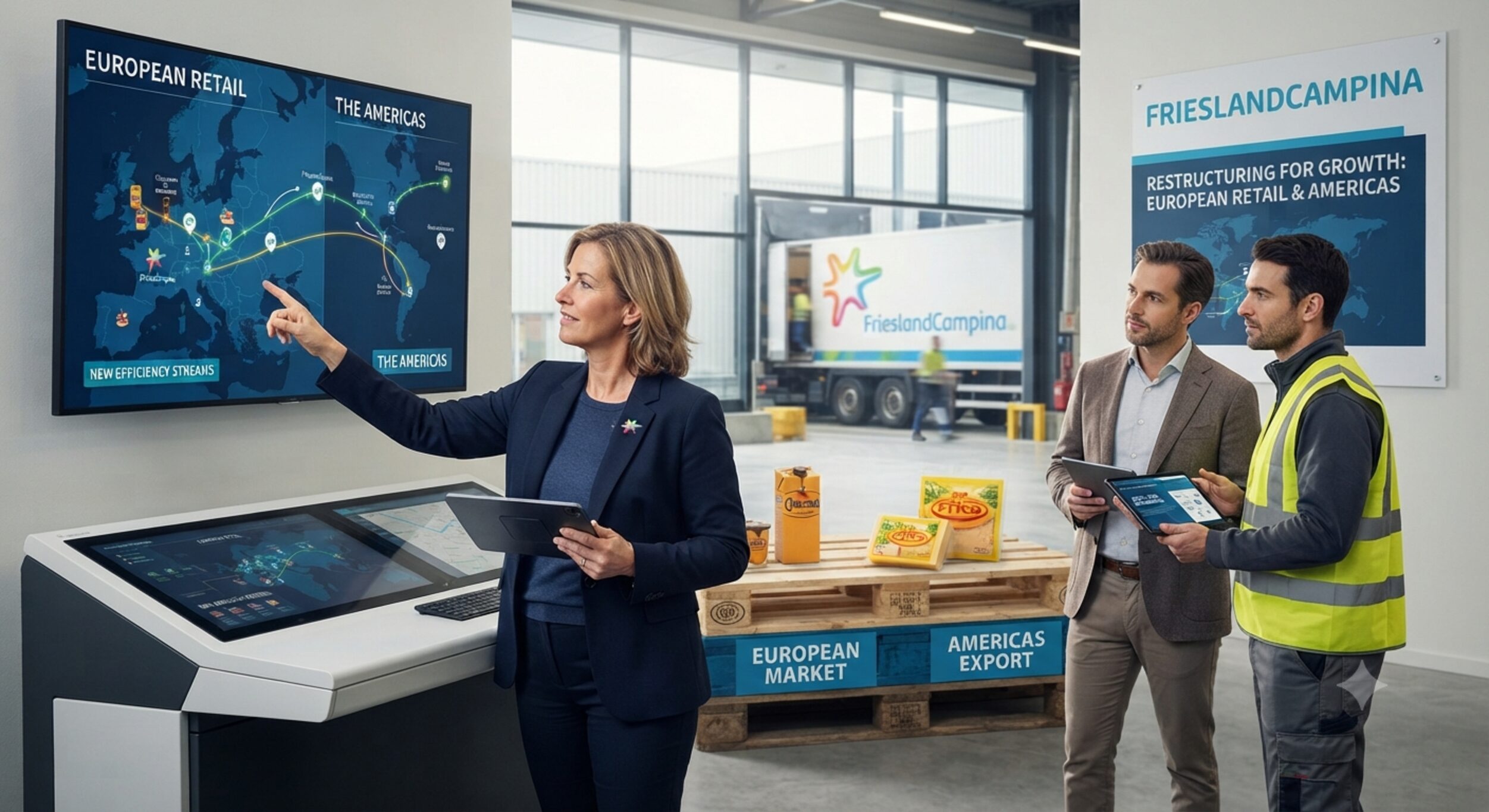

Royal FrieslandCampina, the Dutch dairy cooperative, is reshuffling its organizational structure by merging European retail activities into a single division effective January 1, 2027, and consolidating its Americas operations into a new Middle East, Pakistan & Africa business group—a reorganization aimed at simplifying corporate structure, accelerating decision-making, and leveraging scale advantages across fragmented regional markets.
European Retail Consolidation: Branded and Private Label Unite
FrieslandCampina intends to combine its European retail activities from two business groups into one, bringing together branded and private label activities under a unified Europe business group to be led by Dustin Woodward. The integration is subject to employee participation procedures and regulatory approval, but the strategic intent is clear: FrieslandCampina believes it can better serve European retail customers and respond faster to market opportunities by consolidating what are currently separate operating divisions.
The consolidation is significant because it signals FrieslandCampina’s recognition that European retail is increasingly consolidated and competitive. Retailers like Carrefour, Tesco, Schwarz Group (Lidl/Kaufland), and Aldi demand coordinated sales engagement across both premium branded products and private-label offerings. By merging these divisions, FrieslandCampina can present a unified commercial strategy, streamline negotiations with major retail chains, and reduce internal organizational friction that typically slows decision-making in multi-divisional companies.
CEO Jan Derck van Karnebeek’s statement reinforces this logic: “By bringing our retail activities closer together, we can better serve customers, respond faster to market opportunities and make better use of our scale and expertise.” This is organizational language for “we want to centralize pricing, promotional calendars, and product innovation so major retailers get consistent, coordinated engagement instead of fragmented divisional pitches.”
Americas Realignment: Emerging Markets Strategy Emerges
Simultaneously, FrieslandCampina is transferring its Americas operating company from the Retail & Americas group to the Middle East, Pakistan & Africa group, creating a new combined business group led by Tuncay Özgüner. This realignment is strategically intriguing: it suggests FrieslandCampina views the Americas, Middle East, Pakistan, and Africa as a connected emerging-markets ecosystem with similar competitive dynamics, customer profiles, and growth opportunities—rather than viewing Americas as an extension of developed-market European retail strategy.
The rationale: developed-market Americas (US, Canada) and emerging-market retail (Middle East, Africa, Pakistan) share certain characteristics that differ from Western European retail. Both regions feature:
- Fragmented retail landscapes with independent retailers and regional chains (vs. consolidated European retail)
- Growing middle-class consumer demand for premium dairy products (yogurt, cheese, specialty milk)
- Emerging direct-to-consumer and e-commerce channels (vs. mature Western European retail consolidation)
- Price sensitivity combined with willingness to pay for quality and brand recognition
- Regulatory environments where local partnerships and distribution networks matter more than scale alone
By grouping these regions together under Özgüner’s leadership, FrieslandCampina can develop coordinated strategies for emerging-market retail expansion, emerging-market foodservice growth, and emerging-market private-label partnerships—likely more efficiently than managing Americas as an appendage of European retail operations.
Leadership Changes: Succession and Organizational Clarity
Ali Khan, currently president of Middle East, Pakistan & Africa, has decided to retire. Tuncay Özgüner will lead the newly expanded Middle East, Pakistan, Africa & Americas group. This leadership transition suggests FrieslandCampina has identified Özgüner as the appropriate executive to drive growth in emerging markets and Americas, likely because of prior success in growth markets or emerging-market consumer goods management.
The retirement of Khan and elevation of Özgüner also signals organizational clarity: FrieslandCampina is not simply shuffling boxes but is making a substantive strategic bet on emerging-markets growth and consolidated Americas strategy, with new leadership positioned to execute that vision.
Why This Matters: Scale, Speed, and Retail Consolidation
FrieslandCampina’s restructuring reflects a broader trend in global dairy: as retail consolidates (especially in Europe), dairy suppliers must reorganize to match retail structure. European retail consolidation means fewer, larger retail customers (Carrefour, Tesco, Lidl, Aldi, etc.) that demand coordinated engagement across branded and private-label offerings. A single Europe business group allows FrieslandCampina to:
- Align pricing and promotions across Danone, Meadow Fresh, and private-label offerings so retailers see consistent commercial strategy
- Accelerate innovation cycles by centralizing R&D insight and product development priorities across both branded and private-label lines
- Optimize supply chain and manufacturing footprint across European operations without divisional silos
- Reduce corporate overhead by eliminating duplicate sales, finance, HR, and operations functions across previously separate divisions
The Americas realignment similarly suggests FrieslandCampina wants to build emerging-markets scale and capabilities without the overhead of Western Europe’s mature, consolidated retail model. It’s a geographic pivot, not just an organizational one.
Implications for Retail Buyers and Foodservice Operators
For European retailers and foodservice operators, FrieslandCampina’s reorganization carries several implications:
Faster Decision-Making: With consolidated European retail operations, buyers should expect quicker responses to promotional proposals, faster new-product launches, and more efficient negotiations. The single business group can authorize deals without navigating multiple divisional sign-offs.
Integrated Portfolio Engagement: Retailers will increasingly see coordinated pitches on both branded products (Président butter, Campina milk) and private-label offerings under a single commercial strategy. This could mean bundled promotional offers and category-management approaches that span both branded and private-label lines.
Supply Chain Optimization: Consolidating European retail should lead to FrieslandCampina optimizing its manufacturing footprint, potentially rationalizing production facilities and logistics networks. Retailers may see improved delivery reliability and reduced stockouts as supply chain consolidation completes.
Pricing Power: By centralizing European retail, FrieslandCampina likely aims to improve its negotiating position with consolidated retailers. However, this same consolidation also raises retail negotiating power, suggesting pricing dynamics will remain competitive.
For Americas and emerging-markets buyers, the realignment suggests FrieslandCampina will invest more aggressively in growth markets. Expect:
Regional Product Innovation: Emerging-markets customization (products designed for regional preferences, price points, and consumption occasions) will likely accelerate as Özgüner’s group focuses on emerging-market specificity rather than Western Europe standardization.
Channel Diversification: FrieslandCampina may expand beyond traditional retail into emerging-market e-commerce, direct-to-consumer, and foodservice channels where Western European retail consolidation hasn’t yet occurred.
Partnership Expansion: To compete in fragmented emerging markets, FrieslandCampina may pursue more regional partnerships, joint ventures, and distribution agreements in key emerging-market regions.
Supply Chain and Procurement Considerations
For dairy ingredient suppliers, packaging providers, and logistics partners, FrieslandCampina’s reorganization signals operational changes:
Procurement Consolidation: Merging European retail operations will likely trigger procurement consolidation across packaging, logistics, and ingredient categories. Suppliers should expect RFQ (request for quotation) processes as FrieslandCampina rationalizes supplier count and leverages consolidated volume for better pricing.
Manufacturing Footprint Rationalization: Supply chain optimization often follows organizational consolidation. FrieslandCampina may close or consolidate redundant European manufacturing facilities, which could shift demand for milk supplies, production inputs, and logistics services across regions.
Working Capital and Payment Terms: Organizational consolidation often includes finance function streamlining, which can affect supplier payment terms and working capital management. Suppliers should monitor for changes in payment cycle, invoice consolidation, or centralized vendor management platforms.
Frequently Asked Questions
When will FrieslandCampina’s reorganization take effect?
The European retail consolidation is scheduled for January 1, 2027, subject to employee participation procedures and regulatory approval. The Americas realignment to Middle East, Pakistan & Africa group will occur contemporaneously. Expect transition planning throughout 2026, with IT system integration, supply chain optimization, and organizational restructuring completing by year-end 2026.
Will FrieslandCampina divest or close manufacturing facilities as part of this restructuring?
The announcement doesn’t specify facility closures, but organizational consolidation typically triggers supply chain rationalization. European facilities with redundant capacity may be consolidated or divested. Suppliers and logistics partners should monitor for announcements regarding manufacturing footprint changes and regional supply chain optimization.
How will this affect private-label dairy products in European retail?
Consolidating European retail operations suggests FrieslandCampina will streamline and potentially expand private-label offerings under unified commercial strategy. Retailers should expect stronger private-label innovation, competitive pricing on private-label dairy, and coordinated strategy that leverages FrieslandCampina’s manufacturing scale across both branded and private-label lines.
Why is Americas being moved to an emerging-markets group?
FrieslandCampina likely views the competitive dynamics, retail consolidation patterns, and growth drivers in Americas, Middle East, Pakistan, and Africa as more similar to each other than to Western European retail. Emerging-markets customers prioritize regional adaptation, emerging-channel participation (e-commerce, direct-to-consumer), and partnership-driven growth more than Western European buyers. Consolidating these regions under unified leadership allows FrieslandCampina to develop emerging-markets-specific strategies rather than forcing Americas into a Western European retail template.
Will FrieslandCampina’s brands change pricing or promotions after the reorganization?
Reorganization doesn’t directly dictate pricing changes, but consolidation often enables better supply chain efficiency, which can support competitive pricing. However, retailers should expect more coordinated promotional calendars and potentially higher private-label margins as FrieslandCampina leverages scale. Branded product pricing will likely remain competitive but may see strategic promotional shifts as commercial strategy unifies across European retail.
Sources
| Source | URL | Details |
|---|---|---|
| FrieslandCampina Press Release | https://www.frieslandcampina.com | European retail consolidation announcement; Americas realignment; January 1, 2027 effective date |
| The Dairy Site | https://www.thedairysite.com | Global Ag Media reporting; July 20, 2026; organizational restructuring details |
| Dairy Reporter | https://www.dairyreporter.com | FrieslandCampina strategy; European retail consolidation trends; emerging-markets focus |
| Retail Dive | https://www.retaildive.com | Retail consolidation impact; dairy supplier strategy; commercial negotiations |
| Supply Chain Dive | https://www.supplychaindive.com | Supply chain implications; manufacturing footprint rationalization; procurement consolidation |
| Food Business News | https://www.foodbusinessnews.net |