
Global dairy prices are down 25% year-on-year on record US herd growth, even as Milky Mist’s ₹1,553 crore IPO opens amid tough sector conditions.
Introduction
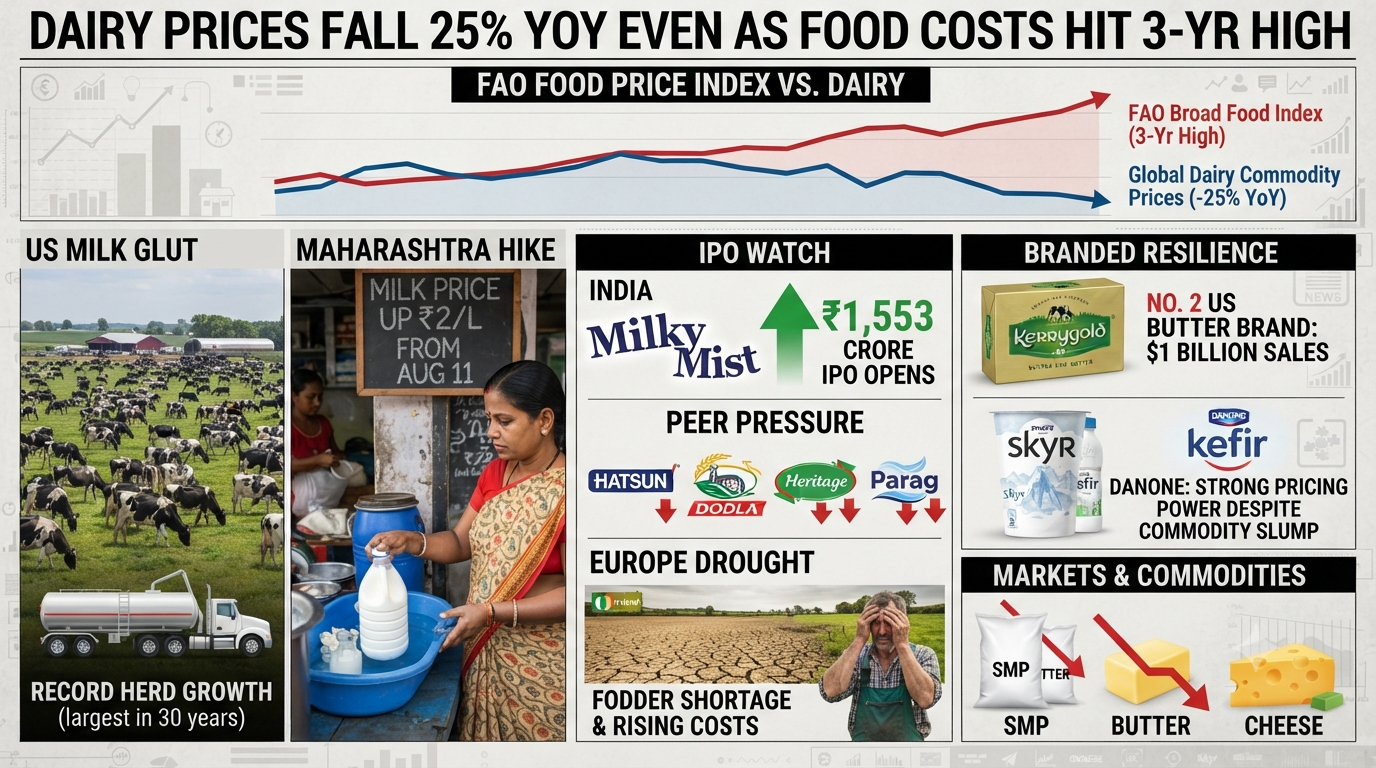
Dairy is sending a mixed signal this week. While the FAO’s broader food price index just hit a three-year high, dairy is the one major food category actually pulling the index down — global dairy commodity prices are now 25% below where they stood a year ago, driven by the largest US milk supply glut in three decades. Against that backdrop, India’s Milky Mist is pushing ahead with a ₹1,553 crore IPO, Maharashtra households are facing a fresh price hike at the till, and processors from Ireland to India are managing the same supply-versus-margin squeeze in very different ways. Here’s what matters across farm, processing and markets today.
Farm & Production
The US dairy herd has hit its largest size in more than 30 years, and it’s still growing. Rabobank’s June analysis puts the national herd at 9.677 million cows, up 192,000 head from a year earlier, with a further 100,000 heifers set to be added. US milk production is running 2.3% above last year, driven by strong retention of beef-on-dairy cross calves and continued farm profitability. The catch: USDA has already cut its all-milk price forecast for 2026 to $18.25 per hundredweight, down from $18.75, and well below the roughly $21 average seen in 2025 — a textbook case of supply growth outrunning price support.
Europe’s drought is doing the opposite: squeezing output just as costs climb. Persistent dry conditions are cutting into fodder reserves across the UK and continental Europe, threatening to slow milk deliveries even as production costs rise. In Ireland, nutritionists are advising 100-cow herds to feed at least three silage bales daily to protect milk solids and safeguard winter fodder reserves through the dry spell — a sign the drought is already forcing real changes to feeding programmes, not just a future risk.
Maharashtra milk prices rise ₹2/litre from August 11, with dairy products up to 10% costlier. The Milk Producers and Processors Welfare Association, chaired by Gopalrao Mhaske, approved the increase for both cow and buffalo milk, citing diesel costs up ₹10/litre and packaging expenses up roughly 30%. India’s government has separately ruled out a Minimum Support Price for milk, confirming pricing will stay market-driven by cooperatives and private dairies. Worth noting for regional buyers: this follows a similar move in Andhra Pradesh, suggesting cost pressure is broad enough to be moving multiple states independently.
Processing & Manufacturing
Milky Mist Dairy Food’s ₹1,553 crore IPO opens August 11 against a genuinely mixed sector backdrop. The book-built issue — ₹1,428 crore fresh issue plus a ₹125 crore offer for sale — is priced at ₹133–₹140 per share, with grey market premium running in the ₹22–26 range this week (roughly 16-19% over the upper band). Milky Mist holds real category leadership: a 19% share of India’s organised packaged paneer market, 12% of South India’s organised cheese market, and 35–40% of the organised Greek yoghurt segment. Context worth flagging: every one of its listed dairy peers is currently down for the year (Hatsun -7%, Dodla -16.5%, Heritage -27%, Parag -22%), squeezed by high milk procurement costs — this is a premium, value-added positioning betting it can outrun a sector under real margin pressure.
Parag Milk Foods is doubling down on cheese anyway. The board has approved a ₹105 crore brownfield investment to double cheese manufacturing capacity from 60 to 120 metric tonnes per day, targeting completion by FY28 and funded through internal accruals and debt. The company’s Go Cheese brand already commands roughly 35% of India’s organised cheese market, and it’s betting on real category tailwinds — India’s cheese market is projected to grow from roughly ₹12,900 crore in 2025 to ₹62,000 crore by 2034. Notably, this comes the same week Parag reported Q1 FY27 revenue up 11% YoY, even as profit after tax fell 20% on margin pressure — the capex is a bet that scale beats today’s thin margins.
Global commodity markets are telling two different stories depending on the product. FAO’s Dairy Price Index fell 0.7% in July to 116.2 points — down 25% from July 2025 — driven mainly by sliding skim milk powder, butter, and whole milk powder prices, while cheese has stayed comparatively stable. That divergence lines up with what Rabobank has flagged globally: protein-based commodities like SMP, cheese and whey are proving more resilient than fat-heavy products like butter and whole milk powder, which have absorbed the brunt of the US-driven oversupply.
Markets & Trade
Ornua’s Kerrygold brand becomes the No. 2 dairy butter seller in the US to top $1 billion in category sales. Per Circana retail tracking data for the 52 weeks ending May 17, Ornua’s US dairy butter dollar sales surpassed $1 billion, a 19% year-on-year jump, with unit sales up 2% to 139 million — this in a US dairy butter category that actually declined 3.5% overall. It’s a sharp counterpoint to the Milky Mist peer weakness: strong branding can still grow share even as the broader category and global commodity prices soften.
Danone posted 4.2% like-for-like sales growth in Q2, reaching €7.22 billion — up from the 2.7% pace in Q1. The gain split between volume/mix (+1.9%) and pricing (+2.3%), with Essential Dairy & Plant-Based specifically growing 3.8% on the back of high-protein and functional dairy demand (Skyr, Kefir, and expanding Silk Protein plant-based lines). In a quarter where global dairy commodity prices fell 25% year-on-year, Danone holding real pricing power in dairy specifically is a notable signal that branded, health-positioned dairy is more insulated from raw commodity swings than pure-play processors.
Canada’s Mark Carney reaffirmed the country’s commitment to dairy supply management during ongoing trade talks with the US, keeping a long-running point of friction over American dairy market access unresolved. Any shift here would ripple through North American dairy trade flows — worth watching as talks continue.
Conclusion
The split this week is stark: dairy commodity prices are down a quarter year-on-year on a genuinely historic US supply surge, while branded and premium players — Danone, Ornua’s Kerrygold, and Milky Mist’s IPO thesis — are all betting they can hold pricing power the raw commodity market currently can’t. Meanwhile Europe’s drought and rising Indian procurement costs are wildcards that could tighten supply and squeeze margins from the other direction just as fast as the US has loosened global pricing. For buyers, the message is to lock in favourably priced commodity dairy now if you can, but don’t assume today’s soft global pricing will hold for branded, premium, or regionally-sourced lines.