
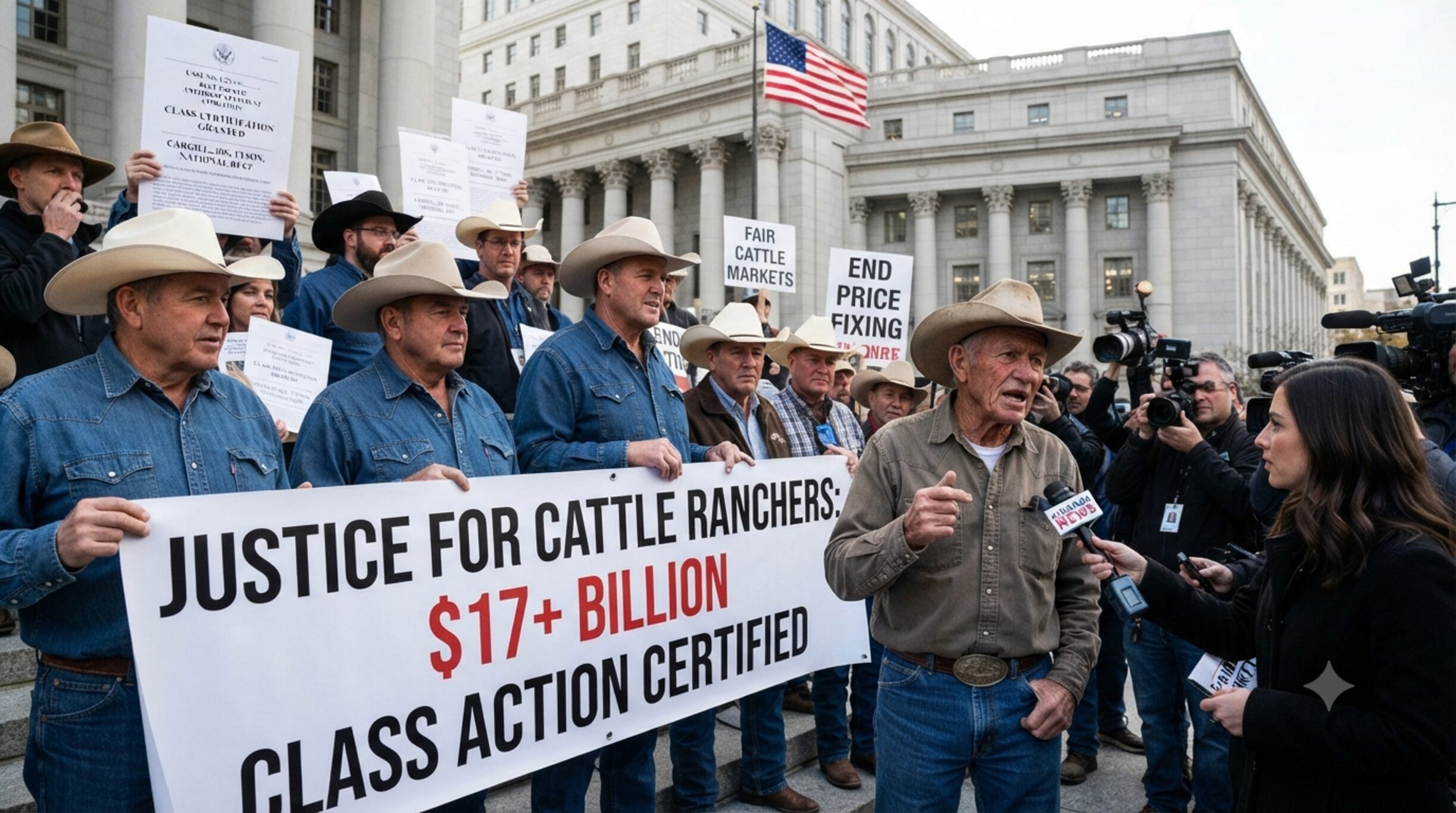

A federal judge has certified multiple beef packer antitrust class actions targeting the nation’s largest beef processors, opening the door to potentially $17+ billion in damages and transforming a seven-year legal battle into a certified consumer and commercial buyer claim—with implications for every foodservice operation and retailer sourcing beef.
Beef Packer Antitrust: Judge Tunheim Certifies Historic Class Actions
<cite index=”6-1″>U.S. District Judge John Tunheim in Minnesota granted class certification for consumers, grocers, wholesalers, restaurants and caterers alleging that Cargill, JBS, National Beef and Tyson Foods coordinated to reduce beef supplies and raise prices between 2014 and 2020.</cite>
This ruling is the most significant moment in the beef packer antitrust litigation since it began in 2019. Certification transforms individual claims into consolidated class actions—meaning millions of consumers and thousands of commercial buyers can now pursue damages collectively rather than individually.
The beef packer antitrust lawsuit targets companies that collectively control approximately 85% of all domestic cattle processing in the U.S. and sell roughly 80% of all fresh and frozen beef. For procurement teams and foodservice operators, the scale is staggering: if the beef packer antitrust allegations are proven, the market concentration they control has allegedly driven both cattle prices down (harming ranchers) and consumer beef prices up (harming buyers).
The Beef Packer Antitrust Damages: $17+ Billion at Stake
<cite index=”2-1″>Court filings estimate potential damages of approximately $13.8 billion for direct purchasers, roughly $1.9 billion for food-service buyers and nearly $2 billion for consumers.</cite> That’s a combined estimated exposure of roughly $17.7 billion—though actual damages will depend on trial outcomes and settlement negotiations.
For context: that’s nearly equivalent to the annual revenue of a major food retailer. The beef packer antitrust case has moved from theoretical litigation risk to concrete damage estimates, which shifts legal strategy and settlement calculus dramatically.
Direct purchasers (grocers, wholesalers, foodservice distributors, restaurants) face the largest damage exposure at $13.8 billion. This makes sense: if beef packer antitrust defendants restricted supplies and inflated prices, commercial buyers absorbed the markup before passing costs downstream to consumers. Foodservice operators are explicitly represented in the beef packer antitrust class, with estimated damages of $1.89 billion.
What the Beef Packer Antitrust Lawsuit Alleges
The beef packer antitrust claim centers on a coordinated strategy: the four largest processors allegedly limited their beef purchases to suppress cattle prices (enriching themselves at ranchers’ expense) while restricting production to inflate retail beef prices (extracting gains from consumers and commercial buyers).
<cite index=”8-1″>Due to the concentration of the meat packing industry, the defendants have an incentive to limit the amount of meat they buy, as this lowers the value of cattle while also increasing prices for consumers.</cite>
The beef packer antitrust lawsuit alleges the conspiracy operated between 2014 and 2020—a six-year window of alleged illegal conduct. Specific mechanisms alleged include:
- Coordinated production decisions to restrict supply
- Information sharing through industry data platforms (Agri Stats referenced in filings)
- Parallel pricing behavior that reduced cattle prices while raising consumer beef prices
- Market concentration that created mutual incentive to restrict competition
None of the beef packer antitrust defendants have admitted wrongdoing. However, judge certification indicates Tunheim found the plaintiffs plausibly pleaded facts sufficient to allow the case to proceed to trial.
Settlement Developments: Cargill and Tyson Settle, Others Remain Defendants
The beef packer antitrust litigation has already seen partial settlement movement. <cite index=”8-1″>Tyson has agreed to pay $55 million while Cargill has agreed to pay $32.5 million, with the deals being “entitled to a presumption of fairness” after having been “negotiated at arm’s length,” said U.S. District Judge John Tunheim of Minneapolis, Minn.</cite>
However, <cite index=”11-1″>JBS USA Food Company, Swift Beef Company, JBS Packerland, Inc., and National Beef Packing Company have not settled.</cite>
For beef packer antitrust claimants (grocers, restaurants, foodservice operators), this creates a two-tier litigation landscape: Cargill and Tyson represent roughly $87.5 million in immediate relief, but JBS and National Beef remain defendants. <cite index=”8-1″>Cargill and Tyson have agreed to “assist in the prosecution of the claims” against the remaining defendants in the case — JBS USA, Swift Beef, JBS Packerland and National Beef Packing — which will provide “significant value” to the plaintiffs.</cite>
This means the two settling defendants will provide evidence and testimony against the two largest remaining defendants, fundamentally shifting litigation leverage.
Beef Packer Antitrust: Market Concentration Is the Core Issue
The beef packer antitrust case is fundamentally about market concentration. Four companies control 85% of U.S. cattle processing. This concentration creates both opportunity and incentive for coordinated conduct: if a duopoly or oligopoly can reduce supply collectively, both benefit from higher prices without individual competitive loss.
The beef packer antitrust lawsuit is part of a broader wave of antitrust litigation across protein industries. Similar cases are pending for pork, poultry, and turkey processors—suggesting prosecutors and plaintiffs see endemic concentration issues across livestock industries.
For foodservice and retail procurement, the beef packer antitrust implications are clear: market structure fundamentally constrains purchasing power. Even if individual processors compete on service and quality, the limited number of suppliers available creates baseline pricing and supply vulnerability.
What Beef Packer Antitrust Means for Procurement and Foodservice Operations
Class certification transforms the beef packer antitrust case from litigation background noise into active business risk. Here’s what procurement teams need to understand:
Immediate implications:
- If you bought beef between 2014 and 2020, you’re potentially in the beef packer antitrust class. Documentation of purchases from Cargill or Tyson (now settled) or JBS or National Beef (still defending) may qualify for claims.
- Foodservice operations are explicitly included in the beef packer antitrust classes. Restaurants, catering companies, and foodservice distributors with documented beef purchases qualify.
- Settlement processes for Cargill and Tyson are beginning. Claimants with documented purchases will be able to file claims and recover a portion of the $87.5 million settlement pool.
Medium-term strategy:
- Track the beef packer antitrust litigation against JBS and National Beef. Trial or settlement developments will reshape beef sourcing dynamics and pricing transparency.
- Consider diversifying beef sourcing if your operation relies heavily on a single large processor. The beef packer antitrust case illustrates why concentrated sourcing creates risk.
- Document all beef purchases, pricing, and volume commitments. If litigation continues, detailed purchase history will support damage claims.
Long-term considerations:
- Beef packer antitrust outcomes will likely influence USDA and DOJ policy on meat industry concentration. Regulatory changes regarding processing capacity, supply transparency, or market consolidation may follow.
- The broader protein antitrust litigation (pork, poultry, turkey) will parallel beef outcomes. Expect cross-litigation precedent-setting and coordinated enforcement strategies.
Buyer and Procurement Implications of Beef Packer Antitrust
The beef packer antitrust case reveals structural market vulnerabilities that procurement teams should address independently of litigation:
- Supplier concentration is real. Four companies control your beef supply regardless of litigation outcomes. Sourcing risk is structural, not temporary.
- Price discovery is impaired. If processors can coordinate or parallel price, commodity pricing mechanisms break down. Explore direct producer relationships, regional processors, or alternative formats (ground beef vs. whole cuts) to improve price transparency.
- Long-term contracts offer protection. Fixed-price or indexed agreements reduce exposure to sudden price movements from supply manipulation. The beef packer antitrust case justifies long-term contract investment.
- Information asymmetry disadvantages buyers. Processors have better supply visibility than their customers. Demand transparent reporting on available capacity, supply schedules, and pricing methodologies.
Related
Frequently Asked Questions
Am I eligible to file a beef packer antitrust claim?
If you’re a consumer who bought beef products between 2014 and 2020, or a commercial buyer (grocer, restaurant, foodservice distributor) who purchased from Cargill, Tyson, JBS, or National Beef during that period, you’re likely in the beef packer antitrust class. Documentation of purchases strengthens your claim. For Cargill and Tyson settlements, claimants can file claims directly at the settlement website. For JBS and National Beef, claims will be processed if/when those defendants settle or lose at trial. Consult your legal team or the case website (overchargedforbeef.com) for eligibility confirmation.
Will the beef packer antitrust lawsuit actually go to trial, or will all defendants settle?
Cargill and Tyson have settled, but JBS and National Beef remain defendants and are vigorously defending the case. Both have incentive to fight—admitting guilt or paying damages signals market wrongdoing and creates shareholder and regulatory risk. However, trial likelihood decreases if Cargill and Tyson testimony and evidence favors plaintiffs. Most complex antitrust cases eventually settle to avoid trial risk, but JBS and National Beef may resist until trial nears. Expect settlement announcements in 2026–2027 as litigation costs mount.
How does beef packer antitrust affect my current sourcing decisions?
The beef packer antitrust case doesn’t change current market conditions, but it does justify defensive sourcing strategies: negotiate long-term contracts with price certainty, explore sourcing from regional or smaller processors to reduce concentration risk, document all purchases for potential claim filing, and implement inventory management to reduce beef purchase frequency (which improves negotiating leverage by reducing supplier dependency). The litigation confirms that concentrated markets create pricing and supply risk—factor that into sourcing strategy.
Sources
| Source | URL | Details |
|---|---|---|
| Meatingplace | https://meatingplace.com | “Judge Certifies Class Actions in Beef Price-Fixing Litigation”; July 2026; Judge Tunheim class certification ruling |
| PYMNTS | https://www.pymnts.com/cpi-posts/ | “US Judge Clears Path for Broad Beef Antitrust Class Actions Against Major Meatpackers”; Reuters reporting |
| Capital Press | https://capitalpress.com | “$87.5 million beef antitrust settlement” approval; Judge Tunheim ruling; May 29, 2026 |
| Feedstuffs | https://www.feedstuffs.com | “Tyson settles with retailers in beef antitrust lawsuit”; Tyson $82.5M settlement details; January 2026 |
| Overchargedforbeef.com | https://www.overchargedforbeef.com | Settlement claims website; Hagens Berman lead counsel; FAQ and eligibility information |
| Hagens Berman | https://www.hbsslaw.com/cases/beef-antitrust | In re: Cattle and Beef Antitrust Litigation case information; class action filings; historical case background |
| Farm Progress | https://www.farmprogress.com | “Class action lawsuit against beef processors proceeds”; Judge Tunheim antitrust ruling; DOJ investigation context |
| U.S. District Court, District of Minnesota | https://www.mnd.uscourts.gov | Case 0:22-md-3031; In re: Cattle and Beef Antitrust Litigation; official filings |