
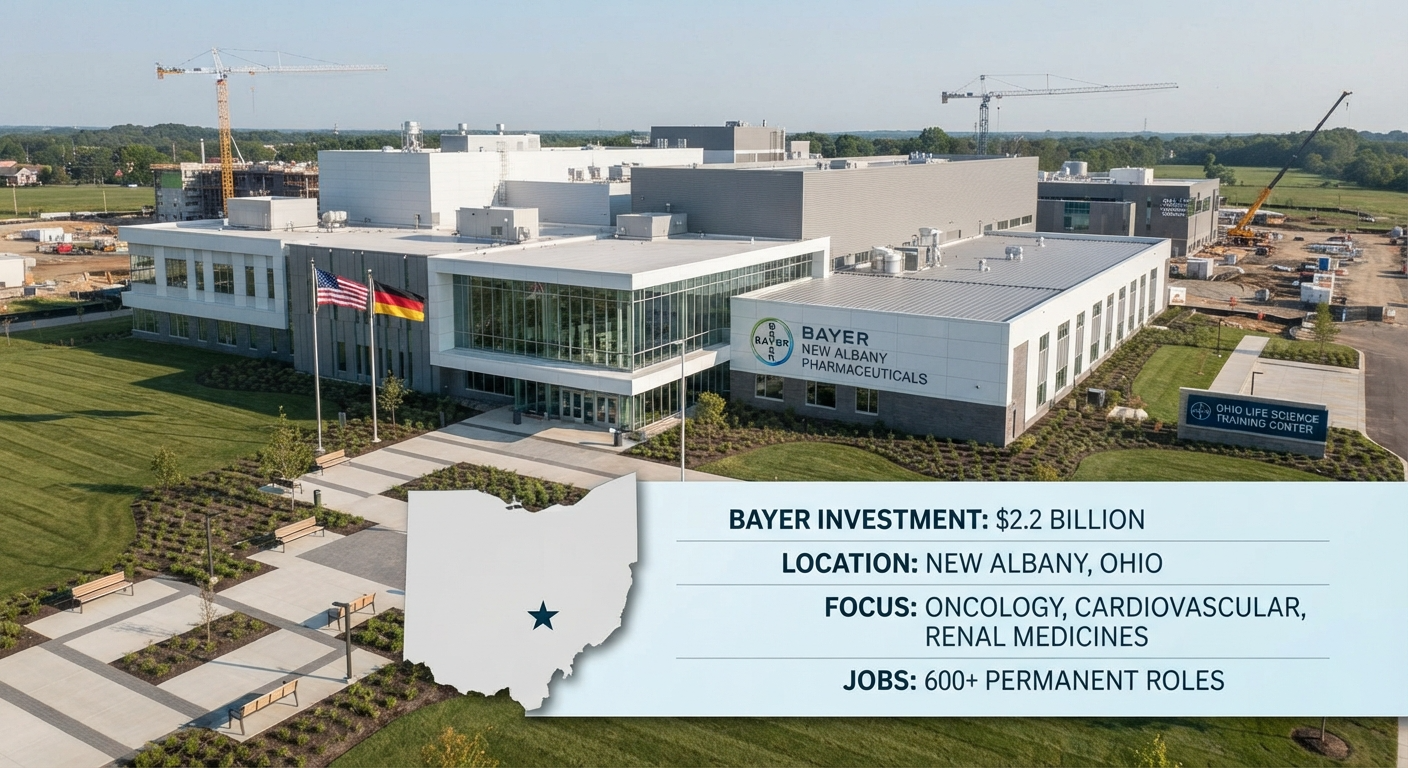

Bayer will invest $2.2bn in a new pharmaceutical plant in New Albany, Ohio, adding US capacity for oncology, cardiovascular and renal medicines.
The German group’s commitment is one of the largest pharmaceutical manufacturing investments announced in the US this year. The site will make both drug substances and finished drug products, and will serve the US and global markets.
The plant at a glance
- Investment: $2.2bn
- Location: New Albany, Ohio
- Products: Drug substances and drug products, initially for oncology, cardiovascular disease and renal care
- Jobs: About 600 high-value roles once operating, plus about 1,500 construction jobs
- Timeline: A first drug substance module is expected to be operational in 2031, with a second in 2034
Bayer also plans to install digital and automation technologies at the site.
Building the workforce
Ohio is investing in the skills the plant will need. The Ohio Life Science Training Center, due to open next summer, will train biomanufacturing operators and technicians. JobsOhio, the state’s economic development body, is putting up to $30m into the centre.
Why it matters for the supply chain
Bayer’s move fits a clear trend: large drugmakers are adding US manufacturing capacity to bring production closer to their biggest market. For the supply chain, three points stand out.
- Long lead times. First output is not expected until 2031. Today’s announcements will shape supply at the end of the decade, not next year.
- Vertical integration. Making both drug substance and drug product on one site reduces dependence on separate suppliers and cross-border shipments.
- Regional competition for talent. As more plants are announced, skilled biomanufacturing staff become a constraint. Training centres like Ohio’s are becoming part of the investment case.
What it means for suppliers and partners
Construction on this scale creates demand well before production starts: engineering, equipment, cleanroom systems, utilities and automation. Over time, an operating plant needs raw materials, consumables, packaging, cold chain logistics and quality services. Suppliers with a US footprint in the Midwest are best placed to compete for that work.
The bottom line
Bayer’s $2.2bn Ohio plant is a long-term bet on US pharmaceutical manufacturing. It will not change supply in the near term, but it adds to the growing base of domestic capacity for high-value medicines.
Frequently Asked Questions
How much is Bayer investing in Ohio? $2.2bn in a new manufacturing facility in New Albany, Ohio.
What will the plant produce? Drug substances and drug products, initially for oncology, cardiovascular disease and renal care.
When will it start production? The first drug substance module is expected to be operational in 2031, with a second in 2034.
How many jobs will it create? About 600 high-value jobs, plus about 1,500 construction roles.
What support is Ohio providing? JobsOhio is investing up to $30m in the Ohio Life Science Training Center, which will train biomanufacturing workers.
Sources
| Source | Used for |
|---|---|
| BioSpace | Investment amount, location, products, jobs and timeline |
| Pharmaceutical Technology | Investment and facility details |
| Ohio state officials and JobsOhio (as reported) | Job estimates and training centre funding |
Additional Resources
| Resource | What you’ll find |
|---|---|
| Bayer investor relations | Company announcements and capital investment plans |
| JobsOhio | Ohio economic development and life sciences projects |
| US Food and Drug Administration (FDA) | Drug manufacturing facility registration and inspections |
| International Society for Pharmaceutical Engineering (ISPE) | Pharmaceutical manufacturing and facility design guidance |
Data note: Bayer has not named the specific medicines to be made at the site. Job figures are estimates from Ohio officials.