
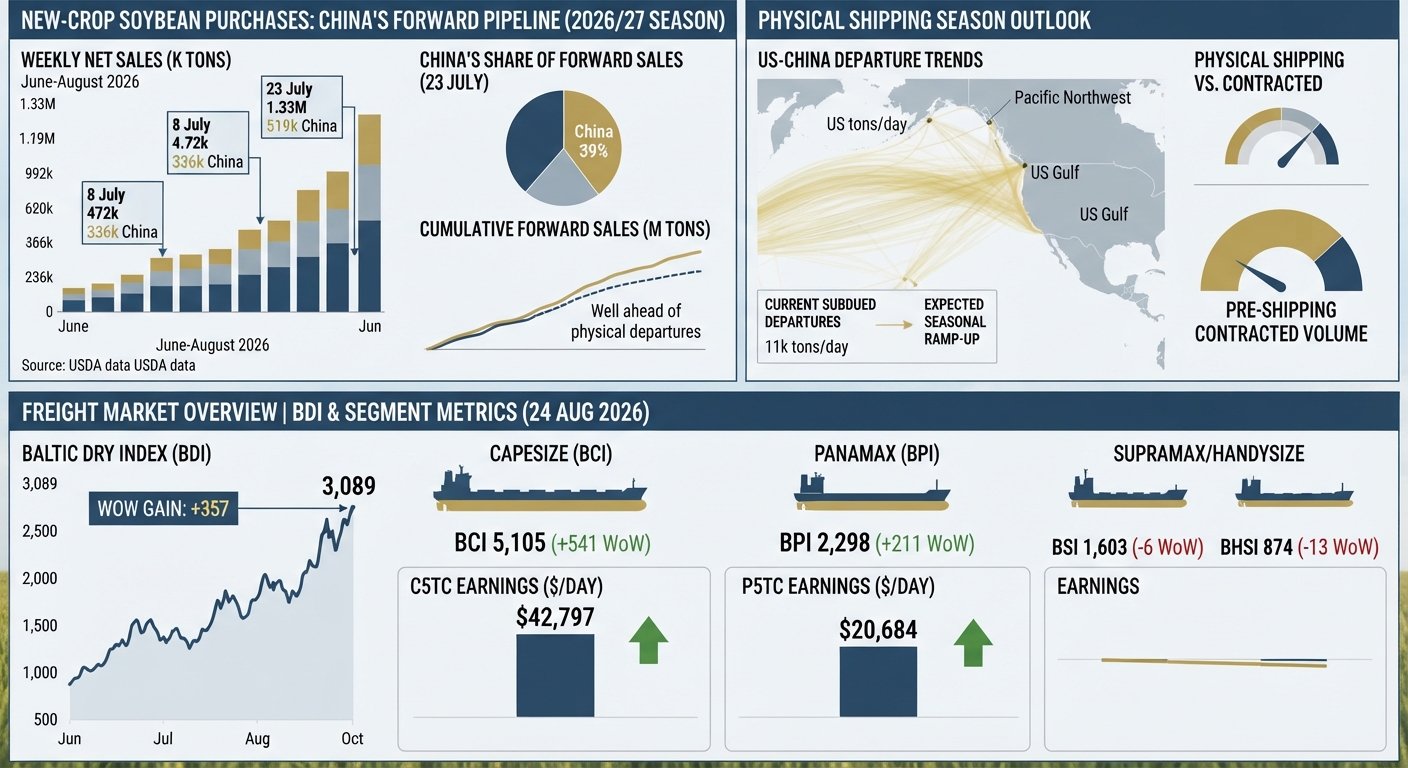
Chinese buyers are making aggressive bets on new-crop US soybeans, but forward sales are outpacing actual shipments significantly.
Why China’s Soybean Buying Spree Matters for Global Markets
The soybean trade between the United States and China just entered a critical phase. Chinese buyers have aggressively accelerated their purchases of new-crop US soybeans since late June 2026, signaling renewed confidence in American soybean supplies and building what traders call a “forward cargo pipeline.” This buying surge comes at a pivotal moment as the US export season approaches and global soybean markets remain sensitive to supply shocks.
The strategic importance of this shift cannot be overstated. For months, Chinese demand for US soybeans had been tepid, reflecting years of trade tensions and uncertainties. Now, as the 2026/27 marketing year looms, Chinese importers are re-committing to American supply with notable conviction. The buying pattern reveals sophisticated market timing—Chinese traders appear to be positioning for the main export season before transportation bottlenecks and seasonal shipping constraints kick in.
The Numbers Tell the Real Story: Record Forward Sales
USDA export-sale data provides the clearest picture of just how dramatically Chinese buying patterns have shifted. On July 8, 2026, Chinese buyers committed to a massive 472,000-ton soybean sale, with 336,000 tons designated for the 2026/27 marketing year. This single transaction signaled that China’s soybean buying drought was decisively over.
The buying momentum accelerated through July. In the week ending July 23, 2026, new-crop soybean sales totaled approximately 1.33 million tons across all buyers globally. China dominated this trading, accounting for roughly 519,000 tons—representing nearly 39% of all new-crop soybean sales that week. This concentration of purchasing power by a single nation underscores China’s strategic importance to the US soybean export economy.
Chinese importers have continued adding to their new-crop commitments through early August, though the latest weekly data (ending August 6) showed new sales easing as the old-crop marketing window closed. This pattern is textbook seasonal behavior—as one harvest window closes, traders shift attention to the incoming crop.
The Critical Mismatch: Forward Commitments vs. Physical Shipments
Here’s where the market narrative gets interesting—and slightly concerning. While Chinese buyers have been aggressive in contracting new soybeans for future delivery, actual physical shipments to China have remained seasonally subdued throughout the same period.
Real-time vessel-tracking data from the Signal Ocean Platform shows US-China soybean departures averaging approximately 11,000 tons per day at the end of July 2026. This is a relatively modest flow given the volume of forward commitments that Chinese traders have accumulated. The mathematical reality is stark: the volume of contracted soybeans significantly exceeds the rate at which cargo is actually being loaded and shipped.
What This Mismatch Really Means
This divergence between forward purchasing and physical shipment rates creates what market participants call “ahead-of-curve” positioning. In practical terms, Chinese importers have locked in soybean supplies at forward prices but haven’t yet arranged the ocean freight to move the physical product. This strategy typically makes sense when traders believe:
- Port congestion or seasonal shipping constraints will push freight rates higher
- Soybean prices will continue climbing as the export season progresses
- Transportation availability will tighten as the peak export season accelerates
The buildup of forward commitments ahead of actual vessel departures is intentional inventory management—Chinese buyers are securing supply commitments while the market window is open, then arranging physical shipment once logistics and port capacity align with their delivery schedules.
Why China Returned to the US Soybean Market Now
Chinese demand for US soybeans had been notably restrained in prior months due to ongoing trade policy uncertainties and tariff concerns. The dramatic reversal since late June suggests several converging factors have shifted Chinese trader sentiment:
Supply Security Concerns: With global soybean demand robust, Chinese importers recognize that securing US supply commitments early in the season reduces execution risk. Locking in cargoes now prevents being squeezed later when port congestion or freight constraints emerge.
Pricing Dynamics: Forward soybean prices may have offered attractive entry points for Chinese buyers planning 2026/27 inventory builds. Once committed at favorable prices, the physical shipment timing becomes a secondary logistics concern.
Reduced Trade Friction: The uptick in Chinese soybean purchases suggests traders are regaining confidence in US-China trade flows. This confidence boost has removed a psychological barrier that had dampened Chinese demand for nearly all of 2026.
Seasonal Inevitability: As the new US soybean harvest approaches, Chinese crushers and feed producers must begin sourcing material for the next marketing year. Forward buying during July and August represents normal supply chain planning rather than speculative positioning.
Ocean Freight Markets React to Building Pipeline Pressures
The surge in forward soybean commitments has concurrent implications for global shipping markets. The Baltic Dry Index, which tracks major commodity shipping rates, rose to 3,089 points in late July, gaining 32 points day-on-day and 357 points week-on-week. This rally reflects strength across all major vessel categories.
Capesize vessels, which carry the largest soybean cargoes, showed particular strength. The Capesize Index climbed to 5,105, up 541 points week-on-week, with average earnings for Capesize vessels (C5TC) reaching approximately $42,797 per day—a gain of nearly $5,000 from the prior week. Panamax vessels, the intermediate category used for some soybean routes, also strengthened materially, with the Panamax Index rising to 2,298 (+211 WoW) and daily rates averaging roughly $20,684/day, representing approximately 10% weekly growth.
Smaller vessel categories lagged this broader rally. Supramax vessels held relatively flat while Handysize tonnage softened slightly, suggesting that the strongest demand for shipping capacity is concentrated in larger vessels moving major agricultural exports like soybeans and other grains.
This freight market rally validates the forward purchasing strategy—as Chinese traders build commitments, they’re simultaneously watching ocean freight rates climb. Locking in soybean supplies early and arranging transportation once rates stabilize (or before they surge further) represents rational risk management.
What Comes Next: The Physical Shipping Season Acceleration
As August transitions into September, the US soybean export season will shift into high gear. The current mismatch between forward commitments and physical shipments will progressively resolve as:
Port Activity Accelerates: Gulf Coast and Pacific Northwest ports will experience dramatically higher soybean export volumes as new-crop deliveries begin in earnest. The buildup of forward commitments ensures robust shipping schedules through the fall.
Freight Rates Normalize: Initial strength in larger vessel categories may ease as supply catches up to the surge in demand. Alternatively, if Chinese buying continues at recent pace, freight markets could remain firm as competition for vessel space intensifies.
Chinese Delivery Schedules Compress: The forward commitments made in late June and July will mature into actual deliveries during the peak US export season (September-November). Expect significant week-to-week variation in China-bound soybean shipment volumes as contracted cargo flows into vessels.
Market Prices Reset: As actual shipments materialize and replace the forward-buying phase, soybean futures prices may stabilize around levels that reflect realistic supply-demand balance rather than the forward-buying speculative positioning of recent weeks.
FAQ: Your Questions About China’s US Soybean Purchases and the 2026/27 Export Season
Q: Why did Chinese soybean buying suddenly accelerate in late June 2026? A: Chinese importers returned to the US soybean market after months of subdued demand, likely driven by reduced trade policy concerns, upcoming 2026/27 supply needs, and attractive forward pricing. The timing aligns with typical pre-export-season purchasing patterns as Chinese crushers and feed mills plan for the new marketing year.
Q: How much have Chinese buyers committed to for 2026/27 US soybeans? A: In the week ending July 23, 2026, China purchased approximately 519,000 tons of new-crop US soybeans, representing 39% of all new-crop soybean sales globally that week. A major 472,000-ton transaction occurred on July 8, with 336,000 tons designated for 2026/27 delivery.
Q: Why are forward soybean purchases outpacing physical shipments? A: Chinese traders are employing a strategy of securing supply commitments early while actual ocean shipping and port logistics are arranged separately. This approach allows buyers to lock in favorable prices while waiting for optimal freight availability. Physical departures averaged approximately 11,000 tons per day at end of July.
Q: What does the forward-purchase buildup mean for US soybean farmers? A: The aggressive forward purchasing signals strong Chinese demand for the upcoming harvest, supporting soybean prices and providing export-market stability for American producers. However, farmer returns ultimately depend on harvest yields and final market prices when physical sales occur.
Q: How did China’s soybean purchases impact ocean freight rates? A: The surge in forward soybean commitments contributed to strength in major vessel categories. The Baltic Dry Index rose significantly, with Capesize vessels (which carry soybean cargoes) seeing average earnings climb to approximately $42,797 per day week-over-week. Panamax rates also strengthened roughly 10% week-over-week to $20,684/day.
Q: When will the forward commitments translate into actual shipments? A: As the US soybean export season accelerates through September-November 2026, the buildup of forward commitments will progressively materialize into physical cargo movements. Peak shipment volumes typically occur September through November as new-crop harvests reach elevators and ports.
Q: Are smaller vessel types benefiting from the soybean shipping demand? A: Smaller vessel categories like Supramax and Handysize showed limited gains during the period, remaining relatively flat or softening slightly. The strongest freight demand is concentrated in larger Capesize and Panamax vessels, which carry the bulk of transcontinental soybean exports.
Source Materials:
- USDA Export Sales Report (July 8 and July 23, 2026 weekly reports)
- Signal Ocean Platform Vessel Tracking Data (August 2026)
- Baltic Dry Index and Vessel Rate Data (July-August 2026)
- US Soybean Export Season Analysis (2026/27 marketing year)

