
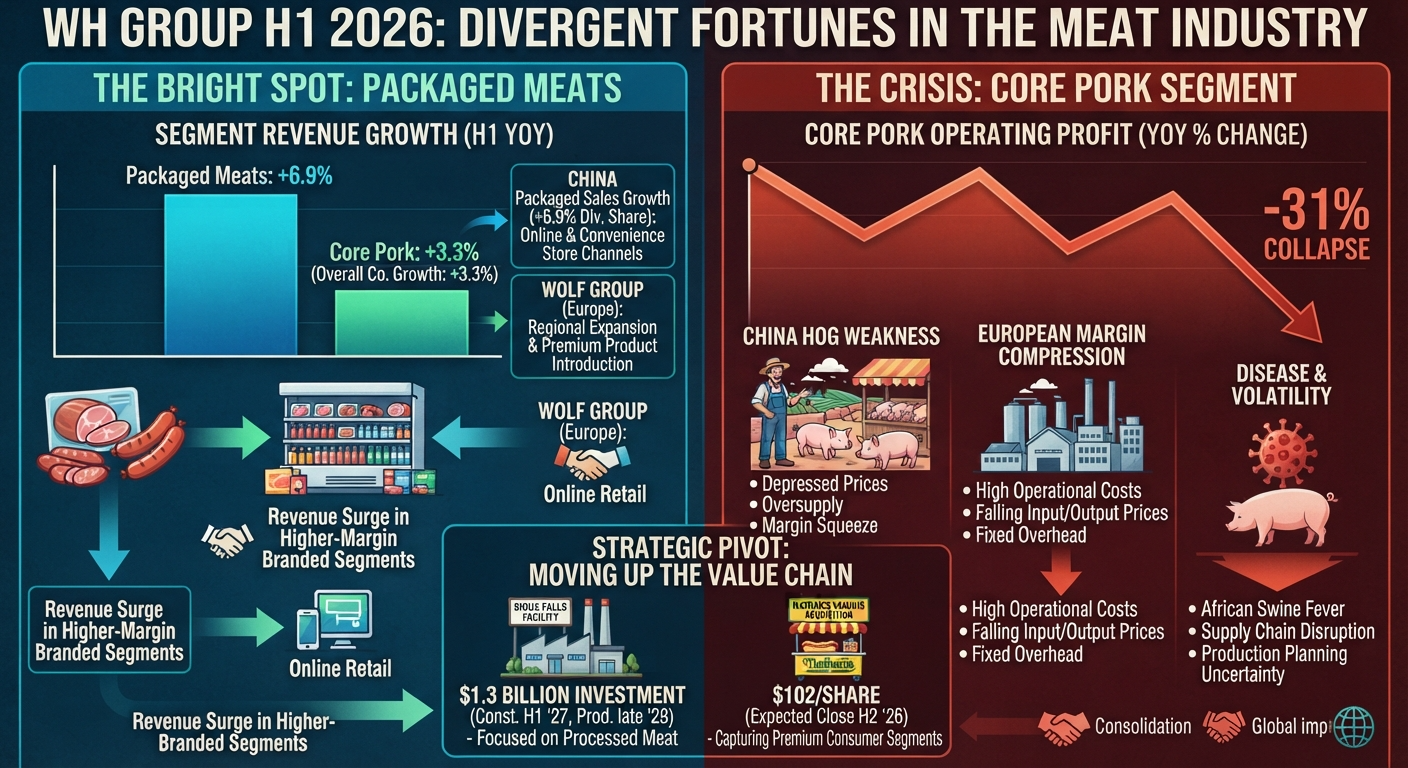

WH Group’s H1 2026 revenue climbed to $13.83 billion but pork profits collapsed 31%, exposing the weakness of global hog markets.
Why WH Group’s Mixed H1 Results Are More Telling Than They Appear
WH Group, the Hong Kong-based pork and packaged meat giant, released first-half 2026 financial results that tell two starkly different stories about the global meat industry. Total revenue climbed 3.3% year-on-year to $13.83 billion, and net income attributable to owners rose a respectable 6.6% to $773 million. But beneath these headline gains lies a more troubling reality: core pork operating profit plummeted 31%, revealing the severe strain that weak hog markets and regional production challenges are placing on the company’s primary business line.
The divergence between packaged meat strength and pork segment weakness illustrates a fundamental shift in global meat markets. Diversification into branded packaged products and premium offerings is now essential for large meat processors to offset the profitability crisis in commodity pork production. For investors, farmers, and industry participants, WH Group’s earnings represent a critical inflection point showing how commodity price weakness is reshaping the economics of industrial meat processing.
Packaged Meat Revenue Surges While Core Pork Business Implodes
The financial numbers reveal competing trends within WH Group’s portfolio. Packaged meat revenue expanded 6.9% in the first half of 2026, significantly outpacing overall corporate revenue growth of 3.3%. This acceleration reflects successful execution in higher-margin branded segments—the exact opposite of what’s happening in core hog production.
WH Group’s packaged meat division is benefiting from two distinct growth engines. First, the company has successfully expanded Chinese packaged meat sales into emerging distribution channels and customer segments. Rather than relying solely on traditional supermarket and restaurant supply chains, WH Group is penetrating online retail, convenience store networks, and foodservice channels that have been expanding as Chinese consumer behaviors evolve.
Second, the company’s Wolf Group business—its European packaged meat operations—has grown sales through regional market expansion while successfully introducing premium product lines. These higher-value offerings command better margins than commodity meat products, buffering the division against the hog market collapse that’s ravaging profitability in the primary pork segment.
The Pork Profit Crisis: A 31% Operating Profit Collapse
Here’s where WH Group’s earnings get sobering. Pork operating profit—the company’s core business—fell 31% year-on-year in the first half of 2026. This isn’t a minor margin squeeze. This is a fundamental profitability breakdown across the company’s dominant business segment.
Multiple pressures are crushing pork segment operating profit simultaneously:
China’s Hog Market Weakness: China, the world’s largest pork consuming nation and a critical market for WH Group, is experiencing severely depressed hog prices. The combination of previous animal disease pressures, increased domestic production, and weak demand has created a buyer’s market where hog procurement margins have compressed dramatically. WH Group’s Chinese pork operations are caught between locked-in processing costs and rapidly declining hog input prices—a scenario that looks profitable on paper but generates minimal actual profit due to fixed overhead requirements.
European Margin Compression: WH Group’s European pork operations face a double squeeze—lower hog prices combined with higher operational costs. Unlike commodity markets where producers can reduce volumes quickly, large meat processing facilities must operate near capacity to absorb fixed costs. When input prices fall faster than output prices, processor margins evaporate.
Disease and Supply Volatility: African Swine Fever and other animal disease pressures continue to create unpredictability in hog supplies across key regions. This volatility disrupts production planning and forces processors to pay premium prices for hog supply when disease-driven shortages spike, then face margin compression when supply normalizes.
The Strategic Pivot: Why WH Group Is Betting $1.3 Billion on Processed Meat
Understanding WH Group’s capital allocation provides insight into management’s view of the future. The company announced plans to construct a new $1.3 billion facility in Sioux Falls with construction beginning in the first half of 2027 and production commencing by the end of 2028. This investment signals that management recognizes commodity pork processing offers limited growth potential and elevated cyclical risk.
The Sioux Falls facility will focus on processed meat production rather than fresh pork processing. This strategic shift mirrors the success WH Group has already achieved with its packaged meat division—moving up the value chain from commodity hog procurement to branded, processed products commands better margins and provides insulation from hog market volatility.
What the Sioux Falls Facility Means for US Pork Markets
For US pork producers and the broader American meat industry, the $1.3 billion Sioux Falls investment represents both opportunity and disruption. The facility will increase WH Group’s capacity to process fresh pork into higher-value packaged products, increasing demand for US hog supplies while simultaneously shifting volume away from live-weight hog markets toward processed output markets.
The timing also matters. By beginning construction in H1 2027 with production in late 2028, WH Group is betting that US hog prices will recover from current depressed levels to support profitable facility operations by 2029. Alternatively, management may be front-running expected hog supply constraints as African Swine Fever continues circulating through global pork production regions.
WH Group’s Nathan’s Famous Acquisition: Capturing Premium Consumer Segments
Simultaneously, WH Group is pursuing acquisition of Nathan’s Famous, the iconic American quick-service restaurant brand, for $102 per share in cash. The transaction is expected to close in the second half of 2026, pending shareholder approval and CFIUS (Committee on Foreign Investment in the United States) authorization.
This acquisition perfectly complements WH Group’s strategic pivot toward branded, higher-margin meat products. Nathan’s Famous—famous for its hot dogs, proprietary meat products, and strong brand recognition—provides WH Group with an established consumer brand through which to sell premium-positioned meat products. Rather than selling commodity pork to restaurants and retailers, WH Group can now sell its own branded sausages, hot dogs, and processed meat through Nathan’s restaurant chain and consumer packaging channels.
The Nathan’s acquisition also represents a direct response to the commodity pork profitability crisis. By controlling both pork supply and downstream consumer brands, WH Group can capture a larger share of the meat value chain, insulating itself from the hog market volatility that’s currently crushing pork segment profits.
Global Meat Industry Implications: Consolidation and Vertical Integration
WH Group’s strategic moves—diversifying into packaged meats, investing $1.3 billion in processed meat capacity, acquiring branded food outlets—reflect broader trends reshaping global meat processing. The era of low-margin commodity meat processing is ending. Consolidation, vertical integration, and control of brand positioning are becoming competitive requirements.
For farmers and producers relying on commodity hog markets, this structural shift carries implications. Fewer, larger integrated processors with captive branded channels mean reduced bargaining power for independent pork producers. Those able to contract directly with major processors or build their own branded products will prosper; commodity producers face continued margin pressure.
For consumers, the consolidation of meat processing into fewer, larger companies with multiple branded channels could improve product quality and consistency, but may ultimately result in less price competition for retail meat products as brand premium positioning replaces commodity pricing dynamics.
What WH Group’s Results Mean for Meat Markets Through Year-End 2026
WH Group’s H1 earnings mark a clear inflection point in global meat industry economics. The numbers confirm that:
Commodity pork processing is in distress. The 31% pork profit decline reflects genuine market challenges, not temporary margin compression. Until hog prices recover significantly, pork segment profitability will remain under pressure across the industry.
Branded packaged products are the profit driver. The 6.9% packaged meat revenue growth substantially outpaces overall corporate growth, confirming that consumers and foodservice buyers are trading up from commodity to branded products—and paying higher prices for the privilege.
Vertical integration is becoming essential. Major meat companies can no longer rely on processing margins alone; they must control downstream distribution and consumer brands to capture adequate returns. Smaller processors without branded channels or foodservice partnerships face continued profitability challenges.
US hog markets will see increased investment pressure. The Sioux Falls facility investment and Nathan’s acquisition signal that major global meat companies view US pork markets as attractive for capital deployment, likely to further consolidate hog supply and reduce farmer bargaining power.
FAQ: Your Questions About WH Group H1 2026 Earnings and Meat Market Implications
Q: How much did WH Group’s revenue increase in H1 2026? A: WH Group reported first-half 2026 revenue of $13.83 billion, representing a 3.3% year-on-year increase from the prior-year period. Net income attributable to owners climbed 6.6% to $773 million.
Q: Why did pork operating profit fall 31%? A: Pork segment operating profit declined sharply due to low hog prices in key markets (particularly China), animal disease pressures affecting supply, and higher operational costs in European facilities squeezing margins. The combination of weak input prices and fixed overhead costs created severe margin compression.
Q: Which business segment is driving WH Group’s growth? A: Packaged meat revenue, which expanded 6.9% in H1 2026, is significantly outpacing overall corporate revenue growth. This segment includes branded products from China operations and Wolf Group European premium products.
Q: What is the Sioux Falls facility investment about? A: WH Group plans to invest up to $1.3 billion in a new processed meat production facility in Sioux Falls, with construction beginning H1 2027 and production commencing by end of 2028. The facility will focus on processed meat products rather than fresh pork, supporting the company’s strategic shift toward higher-margin branded offerings.
Q: How much is WH Group paying for Nathan’s Famous? A: WH Group agreed to acquire Nathan’s Famous for $102 per share in cash. The transaction is expected to close in H2 2026, pending shareholder approval and CFIUS (Committee on Foreign Investment in the United States) authorization.
Q: Why is WH Group acquiring Nathan’s Famous? A: The acquisition allows WH Group to capture downstream consumer brand exposure and channel its meat products through an established quick-service restaurant chain. Nathan’s provides WH Group with direct consumer access for branded sausages, hot dogs, and premium meat products, insulating the company from commodity hog market volatility.
Q: How is WH Group’s China packaged meat business performing? A: China packaged meat operations contributed to the 6.9% divisional growth by successfully expanding into emerging distribution channels (online retail, convenience stores, foodservice) and customer segments beyond traditional supermarket and restaurant supply.
Q: What does WH Group’s strategy mean for independent pork producers? A: The consolidation and vertical integration strategy signals that independent commodity pork producers will face continued margin pressure as major integrated companies capture larger value-chain shares through branded products and controlled distribution. Producers without direct processor contracts or premium positioning face the most risk.
Source Materials:
- WH Group H1 2026 Financial Results and Earnings Announcement (August 28, 2026)
- Reuters Reporting on WH Group Financial Performance
- WH Group Strategic Capital Allocation Announcements (Sioux Falls facility, Nathan’s Famous acquisition)
- Global Pork and Meat Industry Analysis (H1 2026)