
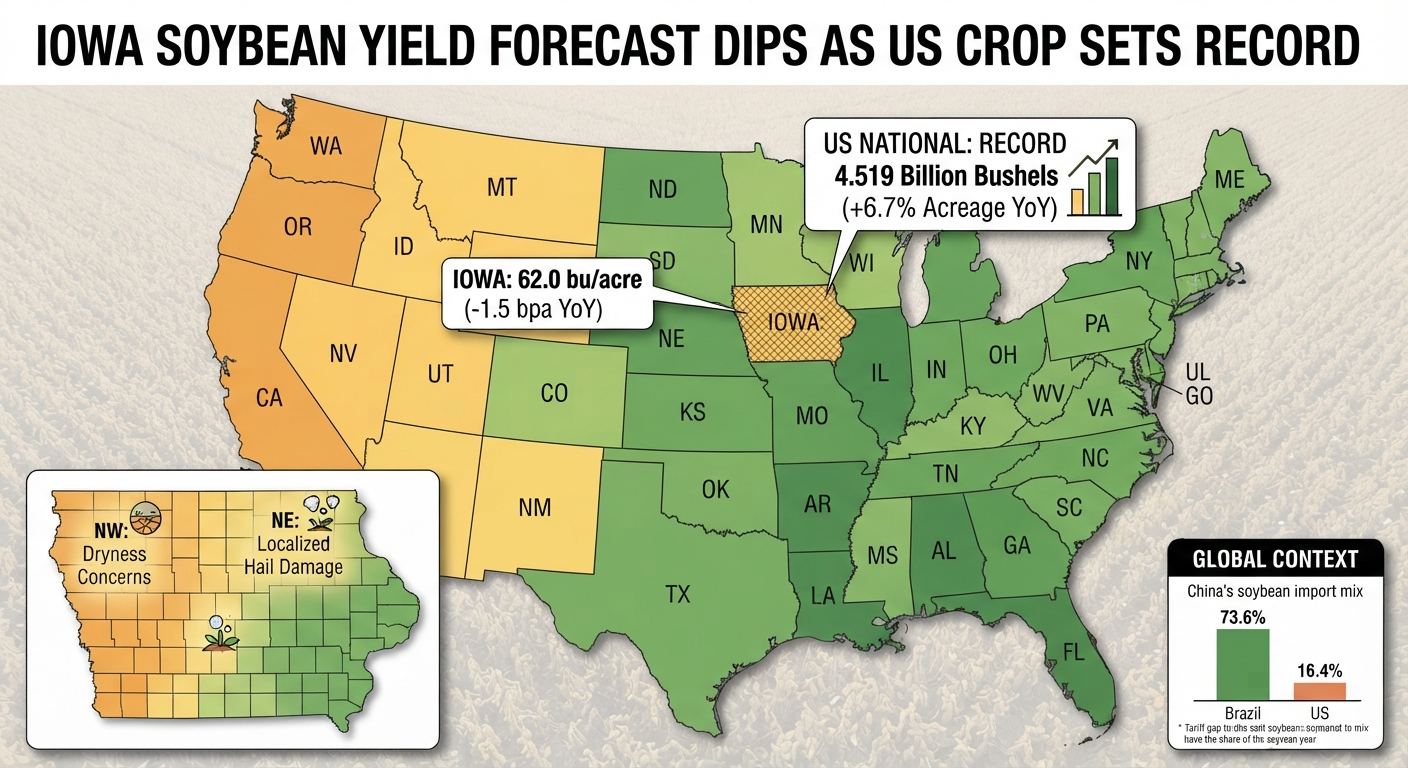

USDA sees Iowa’s 2026 soybean yield slipping from last year even as record national acreage pushes total US production to an all-time high.
Iowa’s Yield Slips While Acreage and Total Volume Climb
USDA’s August Crop Production report puts Iowa’s 2026 soybean harvest at 603.26 million bushels across 9.73 million acres, up from 595.63 million bushels on 9.38 million acres in 2025. That volume increase comes despite a lower per-acre yield: USDA forecasts Iowa soybeans averaging 62 bushels per acre this season, down 1.5 bpa from last year’s 63.5 bpa average. Iowa’s yield still sits more than 9 bpa above the national average, underscoring the state’s position as the country’s top soybean producer even in a softer year.
The state-level dip is happening against a very different national backdrop. USDA’s broader August report puts national soybean production at a record 4.519 billion bushels, driven by planted acreage up 6.8% and harvested acreage up 6.6% year over year, even though the national average yield is forecast to decline slightly to 52.7 bushels per acre. In other words, the national record is a story of more acres rather than better yields, a pattern that mirrors what’s showing up in Iowa’s own numbers.
What’s Behind the Iowa Numbers
USDA’s weekly Crop Progress report, published the same week as the yield forecast, showed 93% of Iowa’s soybean crop had reached blooming as of August 9, running about a percentage point behind the five-year average. Pod-setting reached 72%, up sharply from 61% the week before but still trailing the five-year average of 76%. Overall crop condition remained solid, with USDA rating 77% of the state’s soybeans in good or excellent condition, well ahead of the 62% good-or-excellent national rating.
Agronomists across the state describe a season shaped less by a single dominant threat and more by localized weather extremes layered on top of generally strong crop development. Central Iowa saw beneficial rainfall accompanied by wind and lodging complaints in fields with tall, dense canopies, alongside scattered low-level disease pressure from downy mildew and bacterial pustule that isn’t treatable with fungicide. Southeast Iowa reported storm damage from hail and high winds in pockets, while other counties in the same region received comparatively little rain over the same stretch. Northeast Iowa saw more significant localized hail damage concentrated in a handful of counties, even as disease pressure across the wider region stayed moderately low. In the northwest, the story flips to dryness, with agronomists flagging D0 and D1 drought conditions on lighter soils and stressing that timely rainfall during pod fill and seed set will be critical to protecting yield potential through the rest of the season.
The Global Backdrop: A Record Crop Meeting a Reshaped Export Market
Iowa’s slightly softer yield is arriving at a moment when the broader soybean trade picture looks very different than it did a decade ago. Global soybean production has climbed steadily, reaching a projected 442.25 million metric tons for the 2026-27 marketing year, up from 428 million metric tons the prior year, keeping global supply growth ahead of what would otherwise be a tightening domestic stocks-to-use picture in the US.
China, the world’s largest soybean importer, has structurally shifted its buying toward Brazil over the past several years. Brazil supplied roughly 73.6% of China’s soybean imports in 2025, up from 71% in 2024, while the US share of China’s import market has fallen to around 15% to 23% depending on the measurement period, down from roughly 40% a decade ago. The gap is largely tariff-driven: Brazilian soybeans face only a 3% Chinese import tariff, while US-origin soybeans still carry a combined tariff of around 13%, made up of a 10% retaliatory duty layered on top of a 3% most-favored-nation rate. That price differential, estimated at $30 to $75 per metric ton in Brazil’s favor, continues to steer Chinese private processors toward South American origin even after diplomatic efforts to reset the trade relationship.
Those efforts have produced some movement. Following talks between the US and Chinese governments, China committed to purchasing 12 million metric tons of US soybeans in the current marketing year, a target traders say has now been fully shipped, along with a pledge to import 25 million metric tons of US-origin soybeans in the 2026-27 marketing year. That pledge would represent roughly 22% of China’s current import volume, a meaningful reallocation, but one that would require reversing years of structural investment Brazil has made in its own export logistics, including new northern port capacity built specifically to serve Chinese demand.
Buyer and Procurement Implications
For grain buyers, processors, and exporters, Iowa’s dip in per-acre yield is unlikely to be the swing factor for either domestic supply or price this season, given that record national acreage is more than offsetting the softer yield at both the state and national level. The more consequential variable for anyone pricing new-crop soybean contracts is how much of the 25-million-metric-ton Chinese purchase pledge for 2026-27 actually materializes against Brazil’s continued tariff advantage and expanded port infrastructure. Buyers with exposure to export basis should watch new-crop export sales data closely, since commitments were already running more than double year-ago levels entering August, a signal that could either validate a genuine shift in Chinese buying patterns or simply reflect front-loaded purchases against an uncertain back half of the marketing year. Given the tight 7% stocks-to-use ratio USDA is currently projecting for old-crop soybeans, any disruption to the pace of Chinese purchases, in either direction, carries more price leverage than it would in a year with looser US supply.
FAQ
Why did Iowa’s soybean yield forecast decline while national production hit a record?
Iowa’s yield fell to 62 bushels per acre from 63.5 last year due to a mix of localized hail, wind, lodging, and dryness across different regions of the state, but national production still set a record because planted and harvested acreage both rose nearly 7% year over year, more than offsetting a slightly lower national average yield.
Why has China shifted so much of its soybean buying to Brazil?
Brazilian soybeans face just a 3% Chinese import tariff compared with roughly 13% on US-origin soybeans, a combination of a 10% retaliatory duty and a 3% standard rate, creating a structural price advantage that has pushed Brazil’s share of China’s soybean imports above 73%.
Will China’s pledge to buy more US soybeans reverse the shift toward Brazil?
China has committed to purchasing 25 million metric tons of US soybeans in the 2026-27 marketing year, roughly 22% of its current import volume, but that would require offsetting Brazil’s tariff advantage and years of port and logistics investment built specifically around Chinese demand.
Sources
- Iowa Agribusiness Radio Network / Aug. 14, 2026 crop report and agronomist roundup
- DTN Progressive Farmer, “WASDE August 2026: The Macro Trends That Matter for Grain Markets” — https://www.dtnpf.com/agriculture/web/ag/columns/another-view/article/2026/08/12/wasde-august-2026-macro-trends-grain
- IndexBox, “USDA August 2026 Crop Report: Soybean Record, Corn Strong” — https://www.indexbox.io/blog/usda-august-2026-report-record-soybean-production-strong-corn-output/
- S&P Global, “ANALYSIS: Tariff gap likely to keep China’s soybean imports anchored to Brazil” — https://www.spglobal.com/energy/en/news-research/latest-news/agriculture/021926-analysis-tariff-gap-likely-to-keep-chinas-soybean-imports-anchored-to-brazil
- CNBC, “U.S. fights with Brazil for China’s giant soybean market” — https://www.cnbc.com/2026/06/23/us-fights-with-brazil-for-chinas-giant-soybean-market.html
- The Rio Times, “The Soybean Arithmetic: Why Brazil’s 73.6% and China’s US Pledge Can’t Both Hold” — https://www.riotimesonline.com/the-soybean-arithmetic-why-brazils-73-6-and-chinas-us-pledge-cant-both-hold/