

Milk prices have stabilized, but a shifting feed market and slowing global demand growth are converging to squeeze dairy margins going into 2027.
A Global Price Retreat Is Already Underway
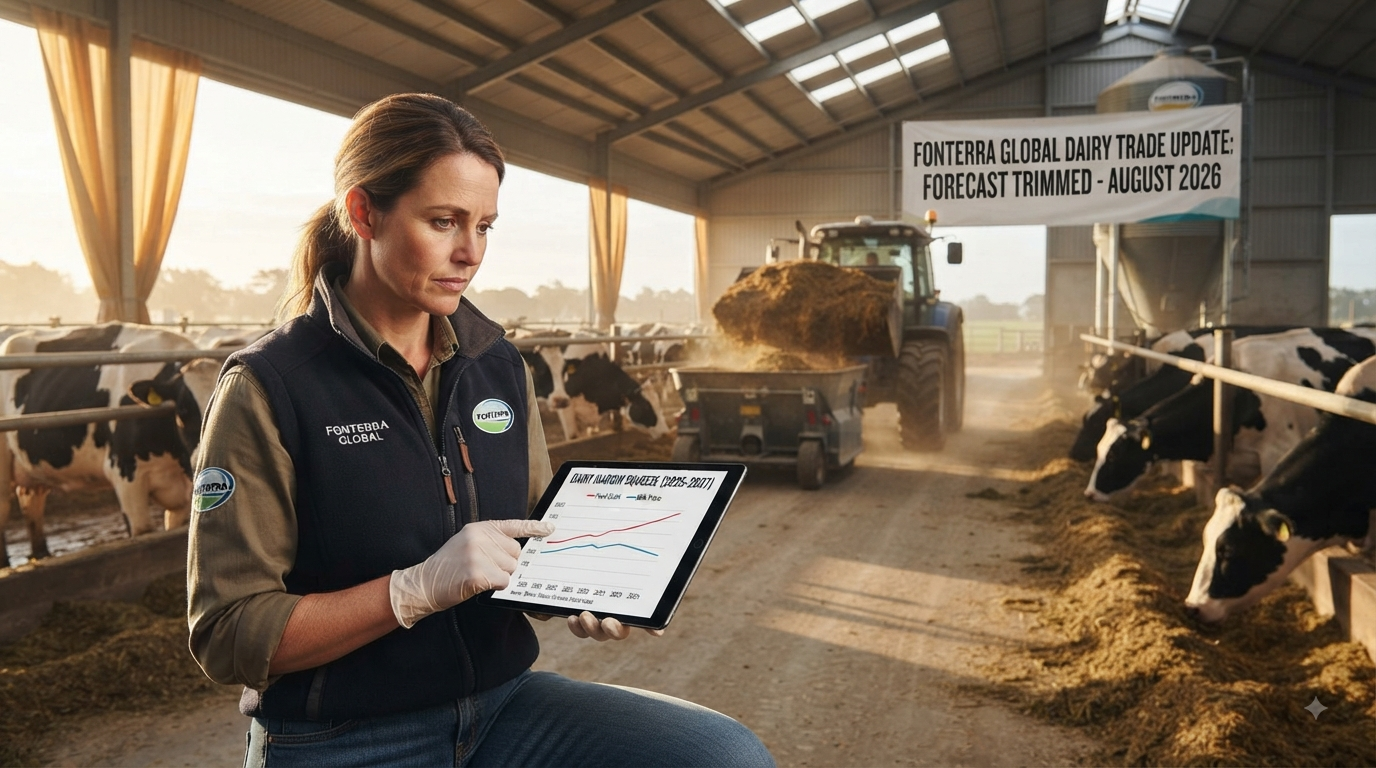
While the US milk market has settled into what analysts are calling an equilibrium range, the picture looks less comfortable elsewhere. New Zealand’s Fonterra — the world’s largest dairy exporter and a bellwether for global commodity pricing — has cut its 2026/27 farmgate milk price forecast twice in recent months, most recently trimming the range to NZ$8.00–NZ$10.50 per kilogram of milk solids from an opening NZ$8.00–NZ$11.00. The cooperative pointed to an 11% drop in Global Dairy Trade auction prices across reference products since May, driven by softer-than-expected import demand running headlong into rising production out of key exporting regions.
That’s a meaningful signal for US producers and processors, because Fonterra’s GDT results function as a leading indicator for where US export competitiveness stands. When global reference prices fall while US milk holds steady, the gap that made American cheese and milk powder attractive to overseas buyers can close quickly — exactly the dynamic that hit US nonfat dry milk exports this spring, when a rally to roughly $2.60 per pound sent importers elsewhere almost immediately.
US Milk Supply Keeps Expanding, Not Contracting
USDA’s own production forecasts have moved in the opposite direction from what tighter-margin logic would suggest. The July WASDE report raised 2026 US milk production to 236.6 billion pounds, up from 235.4 billion in May, on a larger cow herd and only a modest slowdown in output per cow — not the kind of pullback that would signal producers pulling back in response to margin pressure. That keeps the US firmly in the same “ample global milk” camp that’s weighing on Fonterra’s forecast, rather than positioned to benefit from any global tightening.
The counterweight has been demand, particularly for protein components, which has kept cash markets running well above Class III alone. But that demand-side support is doing more work than the supply side to hold prices up, which is a structurally different — and more fragile — position than a market balancing on tighter supply.
The Feed Side Has Its Own Warning Signs
USDA’s corn balance sheet has tightened notably compared with expectations earlier in the year. The department’s outlook shows 2026/27 corn supplies running smaller with greater exports and reduced ending stocks, even with yield held at 183 bushels per acre — a shift toward a snugger balance sheet than dairy producers have budgeted for in recent margin planning built around cheap grain. That’s consistent with the run-up in Decatur, Illinois soybean meal basis from negative territory a year ago to a persistent premium now, a signal that on-the-ground buyers are already pricing in tighter feed-grain conditions rather than waiting for it to show up in the headline futures price.
The seasonal calendar adds a wrinkle. Corn futures typically post their seasonal low in August, ahead of the harvest-driven supply wave, before drifting higher into fall and winter — meaning the current relatively calm price environment for feed may be the best window dairy operations get before conditions become less favorable.
Government Support Isn’t Likely To Kick In
USDA’s Dairy Margin Coverage program — which pays out when the calculated margin between milk price and feed cost falls below a producer’s elected threshold — is currently forecast to pay out $122.9 million in 2026, up from prior-year levels but still modest against the scale of the broader dairy economy. Given that feed costs have been running near five-year lows for most of 2025 into 2026, industry analysts have judged the odds of DMC payments materially expanding this year as low, even accounting for the milk price softness already built into USDA’s outlook — it would take a sharper feed-cost spike, a bigger milk-price decline, or both together to push margins under the program’s support threshold in a meaningful way.
That leaves most producers managing this cycle without a meaningful safety net kicking in, reinforcing why analysts are pointing toward proactive hedging rather than waiting to see whether support programs activate.
The Middle Of The Industry Is Most Exposed
Cost structure varies enormously by herd size, and that gap is central to how this margin squeeze will actually play out on the ground. USDA Economic Research Service cost data shows operations under 50 cows running total costs near $42.70 per hundredweight, while operations above 2,000 cows run closer to $16–$19 per hundredweight — meaning mid-size dairies caught between those extremes have the least room to absorb a feed-cost increase without matching efficiency gains already available to the largest operations. Combined with softer milk-price forecasts for the year, some farm-finance analysts have estimated the swing in operating margin for a typical 300-cow dairy at roughly $90,000 to $100,000 lower in 2026 than 2025 — even in a year when feed costs looked favorable for much of the period.
Buyer And Procurement Implications
For dairy processors and ingredient buyers, the combination of a softening global price benchmark (via Fonterra and GDT) and a still-expanding US milk supply points toward continued competitive procurement conditions for raw milk and core commodity dairy ingredients in the near term — buyers negotiating supply agreements have reasonable leverage right now, but should recognize that leverage is being generated by producer margin pressure rather than a stable structural surplus, which raises the risk of tighter supply if margins deteriorate enough to trigger herd culling later in 2026 or into 2027.
Buyers with exposure to protein-driven dairy ingredients — whey, high-protein powders, and similar categories — should expect continued firm pricing relative to broader commodity dairy, since that segment has been the primary source of premium support in an otherwise well-supplied market. On the input side, feed and ingredient buyers working with dairy suppliers should factor in the diverging cost structures across herd sizes when assessing supplier risk; mid-size dairy suppliers carry meaningfully more margin exposure to a feed-cost increase than the largest operations, which is worth flagging in any supplier continuity risk assessment heading into Q1 2027, historically the softest seasonal window for milk pricing.
FAQ
Why are global dairy prices falling even though US milk prices are stable?
Global reference prices, tracked through New Zealand’s Global Dairy Trade auctions, have dropped roughly 11% since May due to softer import demand meeting rising production in major exporting regions, while US milk prices have been supported separately by strong domestic protein demand rather than by global market strength.
Is the US Dairy Margin Coverage program likely to pay out in 2026?
It’s considered unlikely under current projections. Feed costs have remained historically low for most of the year, and even with softer milk prices forecast, the combined margin would need to deteriorate significantly further to fall below the program’s support thresholds.
Which dairy producers are most exposed to a feed-cost increase?
Mid-size operations face the most risk, since USDA cost data shows their total production costs sit well above those of large-scale dairies (2,000-plus cows) but without the smaller-scale premium pricing that can offset costs for very small herds, leaving less margin cushion if feed prices rise as some analysts expect through the rest of 2026.
Sources
- Farm Journal / AgWeb, “Feed Markets Are Getting Less Friendly for Dairy,” by Taylor Leach, Aug. 11, 2026
- Fonterra, “Fonterra revises its 2026/27 forecast Farmgate Milk Price”
- Reuters via The Cattle Site, “Fonterra cuts top end of 2026/27 milk price forecast”
- Ag Proud, “USDA milk production forecasts edge slightly higher”
- USDA Economic Research Service, “Farm Sector Income Forecast”
- The Bullvine, “Record Corn Won’t Save You: The $100K Margin Hit Coming for Mid-Size Dairies in 2026”