
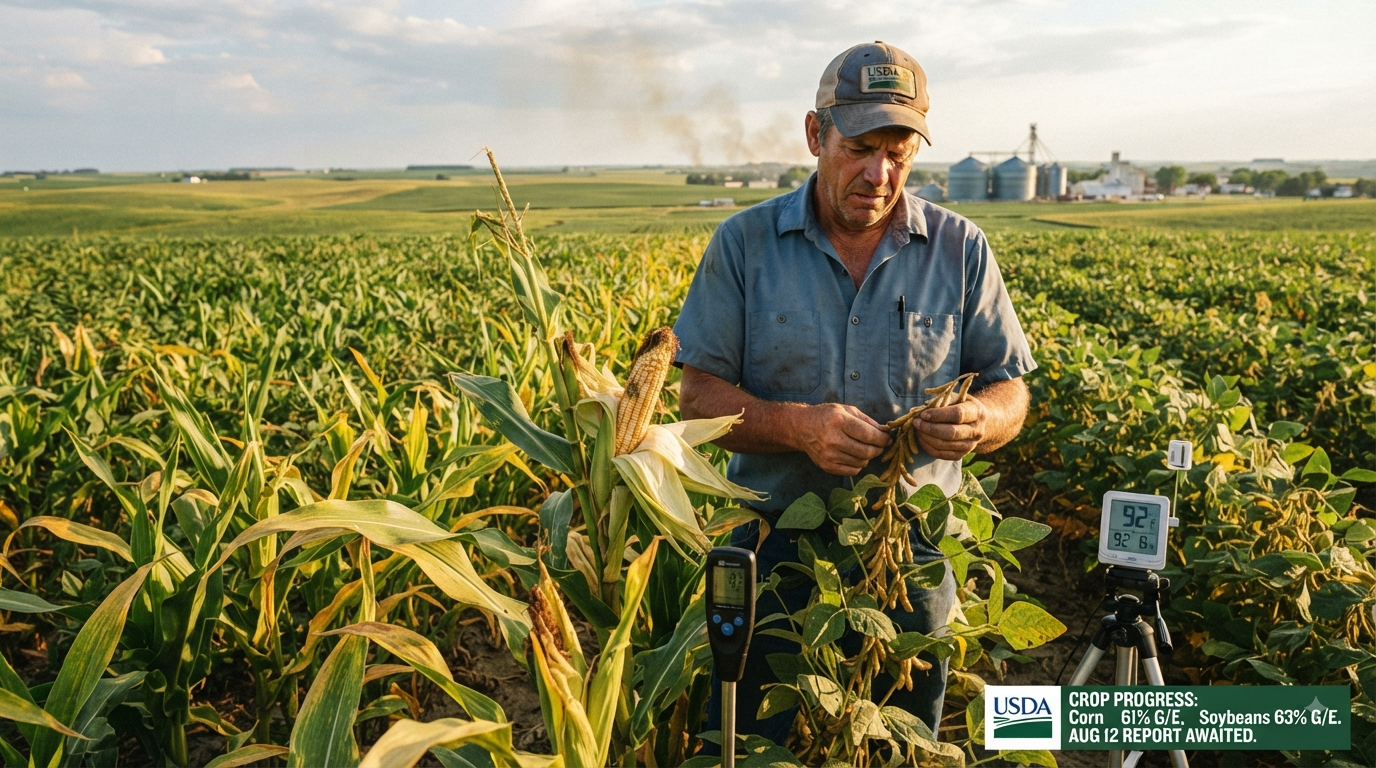

August weather will decide whether corn and soybean prices test new lows or hold, with ear-filling and pod development now underway across the Corn Belt.
Why August Is The Critical Window
Corn and soybeans reach their most weather-sensitive growth stages in late July and early August. Ear-filling for corn and pod development for soybeans determine final bushel weight, meaning conducive weather from here adds yield while dry, hot conditions can still erode a crop that looked strong earlier in the season. Soybeans have become even more weather-dependent on this window in recent years as earlier planting dates have shifted the crop’s most critical development period later into the summer relative to a decade ago.
The latest USDA Crop Progress data shows why this year’s window matters more than usual. Corn conditions have declined for two consecutive weeks, falling to 61% good-to-excellent as of early August, down from 63% the prior week and lower than year-ago levels. Soybean ratings have held steadier at 63% good-to-excellent, though that’s also below last year’s pace. Soil moisture readings from state-level reports show a mixed picture — some areas carry adequate topsoil moisture while others remain short, with irrigation activity still heavy in drier pockets of the Plains.
Where Prices Stand And What Could Move Them
December corn futures hit their season low of $4.25¾ on June 30, breaking from the pattern of the past two years, when corn didn’t bottom until August. Whether that June low holds through the rest of the season is now the central question in the corn market. If late-season rains materialize and boost the projected crop size, prices could still move lower from here despite already having set their low earlier than usual.
Soybeans have shown similar volatility, retreating below $12 after rallying above $12.50 earlier in the season. Continued improvement in crop prospects could push futures toward $11 or lower. Market analysts note it would likely take a genuine August weather scare to reignite bullish momentum in soybeans, which could then spill over into firmer wheat and corn pricing as well.
The USDA’s August 12 Crop Production report — the first survey-based yield estimate of the season, replacing the trend-yield projections used in earlier months — is being watched closely as a potential trendline-setter for both crops. Analysts have flagged wide potential swings around that report given how much this year’s yield uncertainty has grown, with contrasting weather patterns across regions making the outcome harder to predict than usual. Some private forecasters have already trimmed a bushel or two off national corn yield estimates ahead of the report, putting projections in the 181-182 bushel range, while cautioning that the September report will offer a more reliable read.
Demand-side factors are also in play. China’s state grain stockpiler has been selling down existing soybean stockpiles at auction, a move seen as clearing storage space ahead of incoming US soybean cargoes, while the USDA has continued reporting daily export sales activity into the 2026-27 marketing year.
A Balanced Marketing Approach For Uncertain Conditions
With this much uncertainty still ahead of harvest, a one-directional bet on prices carries real risk in either direction. A balanced marketing strategy typically means forward selling a portion of expected production, re-owning sold bushels with call options to retain upside exposure, and using put options to protect the value of unpriced production if prices fall further. The core discipline is preparing for multiple outcomes rather than assuming the recent price rally — or the recent price weakness — will simply continue.
Doing nothing is itself a decision with consequences, and producers are better served working through specific strategies with a market advisor, lender, and other members of their operation’s decision team before executing, rather than reacting emotionally to day-to-day price swings.
Buyer And Procurement Implications
For grain buyers and downstream F&B procurement teams, the next several weeks carry real pricing risk in both directions. The August 12 USDA report is the first hard data point of the season and has historically moved markets sharply — buyers with near-term coverage needs should have contracts or hedges in place before that release rather than waiting to react to it.
Procurement teams sourcing corn or soybean-derived ingredients should watch the gap between current crop condition ratings (below last year’s pace) and the market’s apparent expectation of a large crop, since a meaningful downside surprise in the August report could tighten supply expectations quickly. Given how unusual this year’s price pattern has already been — corn bottoming in June rather than August — buyers should treat historical seasonal patterns as a weaker guide than usual and lean more heavily on current crop progress and weather forecasts when timing purchases.
FAQ
Why does August weather matter so much for corn and soybean prices?
August covers the critical ear-filling stage for corn and pod-filling stage for soybeans, when weather conditions determine final yield. Good conditions can add bushels to an otherwise average crop, while poor conditions can still reduce a crop that looked strong earlier in the season.
Have corn and soybean prices already bottomed for 2026?
December corn futures set a season low of $4.25¾ on June 30, earlier than the past two years when prices bottomed in August. Whether that low holds depends heavily on the size of the crop confirmed by upcoming USDA reports and remaining weather through the growing season.
What can producers do to manage price risk right now?
A balanced marketing approach — forward selling a portion of production, using call options to retain upside, and buying puts to protect against further price declines — helps producers manage volatility without betting on a single price direction.
Sources
- Farm Progress, “Will August Weather Make or Break Corn and Soybean Prices?” by Bryan Doherty, Aug. 5, 2026
- DTN Progressive Farmer, “USDA Crop Progress: Corn Rated 61% Good to Excellent; Soybeans 63% Good to Excellent as of Aug. 2”
- Farm Progress, “Move on 2026 and 2027 grain prices before Aug. 12 USDA report”
- Yahoo Finance, “Wheat, Soybean, and Corn Prices Fall to Start a New Month. What to Watch Next.”
- Southeast AgNet, “August Crop Reports So Far”