
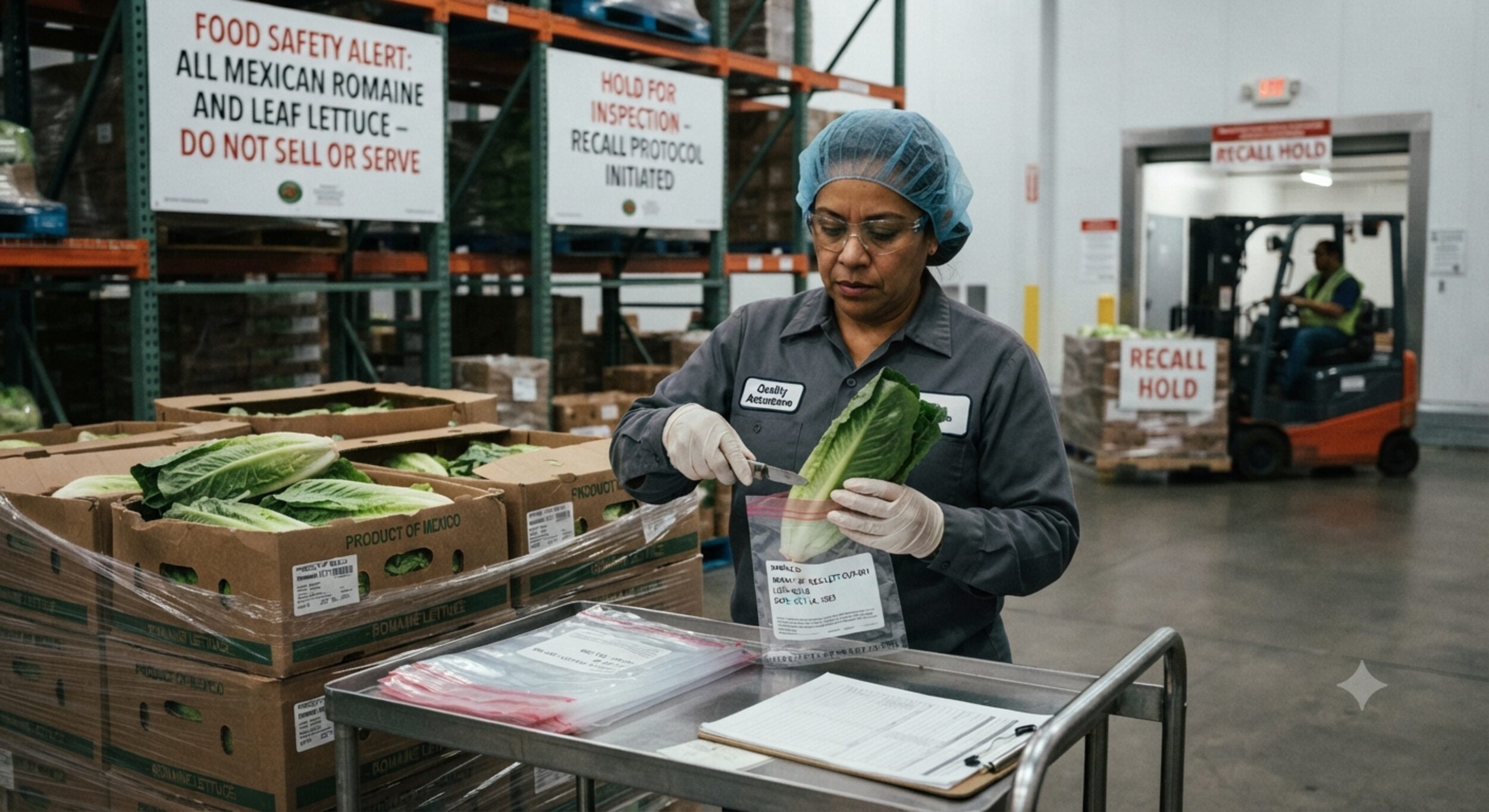
A cyclospora outbreak linked to Mexico lettuce has hospitalized approximately 100 people across five U.S. states, with traceback data pointing to shredded iceberg lettuce from Taylor Farms facilities in central Mexico—but regulatory clarity remains murky as conflicting test results cloud the investigation.
Mexico Lettuce Under Scrutiny: The Timeline and What Changed
The Mexico lettuce outbreak investigation has become a case study in how quickly food safety signals can shift. Here’s what happened:
Saturday: The FDA reported a positive sample of Mexico lettuce from Taylor Farms testing positive for cyclospora parasites.
Sunday: The agency reversed course, announcing the positive result was a false positive after re-reviewing the data.
Monday: The FDA released a statement saying its supply chain traceback investigation continues to point to Taylor Farms’ Mexico lettuce facilities as the source, despite the test reversal.
This whiplash testing pattern has created uncertainty across foodservice and retail procurement—exactly when clarity is needed most. Buyers, compliance teams, and food safety officers are now managing a situation where Mexico lettuce remains under investigation despite conflicting laboratory evidence.
The Outbreak Scope: Mexico Lettuce Affects Major Foodservice Chain
The cyclospora outbreak linked to Mexico lettuce has been traced to Taco Bell restaurants across five states: Indiana, Kentucky, Michigan, Ohio, and West Virginia. The parasitic infection causes severe diarrhea and gastrointestinal symptoms that have hospitalized approximately 100 people.
Taco Bell is owned by Yum Brands, one of the largest foodservice operators globally. A foodservice chain of that scale means:
- Supply chain complexity across multiple distribution centers and thousands of locations
- Significant media amplification and consumer awareness
- Regulatory and reputational pressure on both the operator and its suppliers
The outbreak underscores why Mexico lettuce sourcing decisions require current traceability documentation and supplier verification protocols.
What Mexico Officials Say About the Mexico Lettuce Investigation
Mexico’s Health Minister David Kershenobich stated Tuesday that “no evidence has been found to indicate that it originated there,” referring to Guanajuato, the central Mexican state where Taylor Farms operates.
However, the statement included a critical qualifier: “However, we are taking all precautions in case that were the case.”
This diplomatic language masks a more urgent reality: Mexican regulatory agencies are treating the Mexico lettuce situation seriously.
Cofepris (Mexico’s sanitary regulator) and Senasica (agricultural safety body) announced a joint “strictly preventive” inspection and traceability analysis program targeting Mexico lettuce production. The agencies are conducting audits in Guanajuato specifically to mitigate health risks—a response that suggests regulatory concern despite official statements denying Mexico lettuce as the source.
Taylor Farms’ 2013 Mexico Lettuce Precedent Matters
This isn’t Taylor Farms’ first Mexico lettuce food safety incident. In 2013, the company’s growing and processing facilities in Guanajuato were the source of a cyclospora outbreak that sickened more than 600 people across 25 states. That outbreak was traced to salad mix from Taylor Farms de Mexico.
A 13-year gap between incidents might suggest isolated events. Industry veterans, however, recognize that repeated Mexico lettuce issues from the same supplier in the same region suggests systemic growing, harvesting, or processing challenges—not random misfortune.
For procurement teams evaluating Mexico lettuce suppliers, the 2013 precedent is relevant context for sourcing risk assessment.
Drought Conditions in Mexico Lettuce Growing Regions Add Complexity
Growers in the Mexican states of Sonora and Sinaloa face severe long-term drought, with some reservoirs providing water to producers only 20% to 30% full. While these regions aren’t the primary Mexico lettuce outbreak source (Guanajuato is central, not northern Mexico), water stress across Mexican agriculture creates industry-wide vulnerability.
Stressed water supplies can compromise irrigation hygiene, increase reliance on lower-quality water sources, and create pressure to accelerate harvesting cycles. These factors indirectly raise food safety risk across Mexico lettuce and other produce categories.
For procurement professionals managing Mexico lettuce sourcing, regional drought conditions are a secondary risk factor worth monitoring alongside direct supplier audits.
What Buyers and Foodservice Operations Should Do Now
The Mexico lettuce outbreak remains under active investigation. Here’s a decision framework for procurement and food safety teams:
Immediate (this week):
- Verify your supplier’s sourcing location for any lettuce products, especially shredded iceberg from central Mexico.
- Request traceability documentation showing harvest dates, processing facilities, and distribution routing.
- Cross-reference against FDA traceback bulletins and CDC outbreak information.
Short-term (next 2–4 weeks):
- Monitor FDA and CDC updates on the Mexico lettuce investigation as testing clarifies.
- Conduct internal risk assessment: Does your operation source from Taylor Farms or use Taylor Farms lettuce in distributed products?
- Engage suppliers for written confirmation of preventive measures (water testing, sanitation protocols, employee health screening).
Ongoing:
- Maintain traceback documentation for all Mexico lettuce sourcing—regulatory requests may follow.
- Consider diversifying Mexico lettuce sources if your operation relies heavily on central Mexican suppliers.
- Document any customer inquiries or complaints related to the outbreak for legal/compliance records.
Key Considerations for Procurement Teams
The Mexico lettuce outbreak illustrates several procurement truths:
- Testing reversal is a reality. False positives happen. Don’t assume a single negative result means absence of risk—require multiple confirmations and independent verification.
- Official denials don’t equal safety. Mexico’s statement that “no evidence” points to local Mexico lettuce doesn’t eliminate the FDA’s ongoing traceback findings. Procurement should treat both signals as valid.
- Supplier history matters. Taylor Farms’ 2013 Mexico lettuce outbreak is not ancient history. Repeat issues at the same facility suggest structural problems, not one-time lapses.
- Compliance pressure will follow. Foodservice chains and retailers know regulators and litigators will scrutinize sourcing decisions. Document everything.
Related
Frequently Asked Questions
Is Mexico lettuce safe to buy right now?
Mexico lettuce from sources outside the Taylor Farms Guanajuato facilities is likely safe, but traceability is the critical variable. Request documentation proving your lettuce source is not Taylor Farms’ central Mexican operations. If your supplier cannot provide traceability or sources from Guanajuato, treat it as a red flag. The FDA investigation is ongoing, so regulatory guidance may tighten in coming weeks—stay alert to updates.
Why did the FDA change its test result from positive to false positive?
The FDA sample tested positive for cyclospora on Saturday, but re-review of the data on Sunday indicated the result was a false positive—meaning the sample didn’t actually contain the parasite. This can happen due to lab error, contamination in the testing process, or misidentification of particulates. Regardless, the reversal created uncertainty and illustrates why traceback investigation (supply chain mapping) is often more reliable than single lab results for outbreak source identification.
Should we stop buying all Mexico lettuce?
Not necessarily, but implement sourcing controls. Mexico lettuce from verified suppliers outside Guanajuato, with clear traceability documentation, carries lower risk. If your operation can’t reliably verify source location or your supplier is Taylor Farms Guanajuato, switch to domestic suppliers or alternative sources. For foodservice and retail, the reputational cost of a Mexico lettuce outbreak far exceeds the price premium for verified domestic lettuce or suppliers with unbroken safety records.
What should I ask my supplier to prove?
Request written confirmation of: (1) specific growing and processing facility locations; (2) water source testing results (pathogen screening); (3) employee health protocols; (4) harvest and shipment dates for current inventory; (5) any third-party audits (GAPs, SQF, etc.). Legitimate suppliers will provide this. Resistance to documentation is itself a signal.
Sources
| Source | URL | Details |
|---|---|---|
| The Packer | https://www.thepacker.com | Reuters reporting; Mexico lettuce cyclospora outbreak coverage, July 22, 2026 |
| FDA Official | https://www.fda.gov | Supply chain traceback investigation; Taylor Farms central Mexico lettuce; false positive reversal statement |
| U.S. Centers for Disease Control and Prevention | https://www.cdc.gov | Cyclospora outbreak epidemiology; 100+ hospitalizations; state-by-state case tracking |
| Cofepris (Mexico Sanitary Regulator) | https://www.gob.mx/cofepris | Joint statement with Senasica; preventive inspections and traceability analysis in Guanajuato |
| Senasica (Mexico Agricultural Safety) | https://www.senasica.gob.mx | Agricultural inspection authority; Mexico lettuce facility audits |
| CDC 2013 Outbreak Archive | https://www.cdc.gov | Historical cyclospora outbreak, Taylor Farms de Mexico Guanajuato, 600+ cases, 25 states |
| The Packer Related Coverage | https://www.thepacker.com | “FDA Says Data Continues to Support Taylor Farms’ Lettuce as Cyclospora Source”; “Taylor Farms Pulls Iceberg Lettuce From Central Mexico” |

