
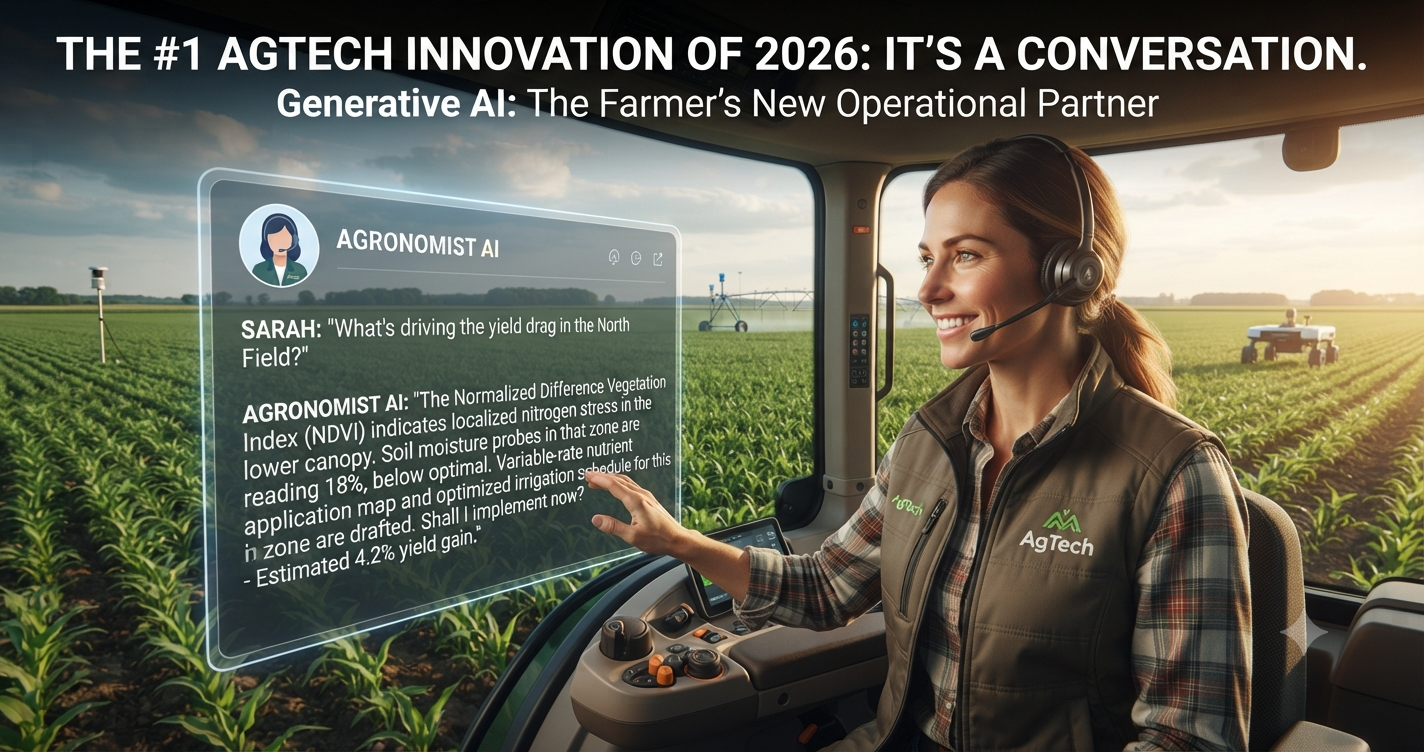

Ask ten agtech analysts what’s driving farming forward agriculture technology innovation in 2026 and you’ll get ten different lists: robotics, biologicals, carbon markets, IoT sensors. But pull back far enough, and one shift sits underneath almost all of them — AI is no longer just crunching numbers in the background. It’s talking back.
The single biggest agriculture technology innovation of 2026 is the rise of the generative AI agronomist: a conversational decision-support layer that fuses satellite imagery, soil sensors, weather data, and equipment feeds into plain-language answers a farmer can act on in the field, not just a dashboard they have to interpret.
Agriculture Technology Innovation Table of Contents
Why This Is the Agriculture Technology Innovation That Matters Most Right Now
AI has quietly powered yield prediction, disease detection, and imagery interpretation for years. What’s changed in 2026 is visibility and usability. Instead of a farmer studying a dashboard, they can now simply ask a system a question — “should I irrigate now?” or “what’s driving the yield drag in the north field?” — and get an instant, data-grounded answer.
Industry leaders describe this as the shift from “what happened” to “what should I do next, and when.” That reframing turns AI from a passive reporting tool into an active operational partner — one that drafts season plans, flags input timing, and explains its own recommendations rather than just surfacing a number.
This matters because the value of agricultural data has always been bottlenecked by interpretation. Farms have sensors, drones, and connected machinery generating enormous volumes of data, but converting that data into a same-day decision has been the hard part. Generative AI closes that gap by acting as the translation layer between raw data and field action.
The Numbers Behind the Shift
The scale of investment and adoption backs up the trend:
- The global AI-in-agriculture market is projected to reach roughly $3.1–3.4 billion in 2026, with forecasts pointing toward $8+ billion by 2030–2031.
- The generative AI segment specifically is projected to grow around 30% in 2026 alone — one of the fastest-growing sub-categories in the entire agtech space.
- Precision farming applications currently hold the largest share of AI spend, at over 40% of the market, with computer vision applications growing fastest.
- Adoption is uneven by farm size: large operations (5,000+ acres) are moving fastest, while small farms under 2,000 acres lag due to cost and complexity — a gap that subscription-based, pay-per-acre AI pricing models are starting to close.
- Government support is accelerating adoption at the lower end of the market too, with a significant share of recent U.S. climate-smart agriculture funding earmarked specifically for AI-enabled nutrient management on underserved farms.
What Generative AI Agronomists Actually Do
The most useful way to understand this innovation is by use case rather than buzzword. In 2026, the highest-impact generative AI applications in the field include:
Natural-language decision support — Farmers ask direct questions instead of interpreting dashboards, and receive irrigation, nutrient, or spray-timing recommendations grounded in real field data.
Automated season planning — Systems draft seeding, input, and variable-rate plans automatically, then let a human adjust rather than build from scratch.
Label and compliance intelligence — AI reads and cross-references chemical labels against field-specific conditions, reducing manual compliance research.
Simplified grower reporting — Farm managers can generate investor- or lender-ready summaries without manually compiling data from multiple systems.
Early-stage stress detection — AI-driven imagery and sensor fusion flags pest, disease, or nutrient stress earlier than manual scouting would catch it.
The Innovations Right Behind It
Generative AI is the connective layer, but it’s scaling because three adjacent innovations are maturing alongside it:
Purpose-built autonomous machinery. Robotics is moving away from one-size-fits-all tractors toward machines built specifically for orchards, vineyards, high-value vegetables, or broadacre row crops. The global autonomous farm equipment market is projected to grow from roughly $12 billion today toward $55 billion by the early 2030s, driven by labor scarcity and precision input demands.
Biologicals integrated into digital agronomy. Biological fertilizers, biostimulants, and biocontrols are being layered directly into the same digital platforms driving AI recommendations, rather than sold as standalone products. Distributor surveys show a large majority plan to expand their biological product lines in 2026, as growers look for residue-light, soil-friendly input programs.
Rural connectivity finally catching up. AI-driven recommendations are only as good as the data feeding them, and 2026 is being described as a turning point for rural connectivity — with new satellite and IoT infrastructure partnerships reducing the “dead zones” that have limited real-time data collection on remote farmland.
What This Means for the Broader Food Chain
For processors, distributors, and foodservice buyers further down the supply chain, this shift matters beyond the farm gate. Faster, AI-informed decisions at the field level translate into more predictable yields, earlier visibility into supply disruptions, and tighter input-cost forecasting — all of which ripple into pricing, contracting, and inventory decisions across the value chain. As AI-verified sustainability data becomes a standard output of these platforms, it’s also starting to feed directly into procurement and carbon-reporting requirements for buyers further downstream.
The Bottom Line
Robotics, biologicals, and connectivity are all advancing in 2026 — but the innovation tying them together, and the one reshaping how farmers actually make decisions, is generative AI acting as a conversational agronomist. It’s not replacing the farmer or the human agronomist relationship; every industry leader interviewed on the topic is clear that AI amplifies expertise rather than substituting for it. But as a single innovation with the broadest impact across farm sizes, crop types, and operations in 2026, this is the one to watch.
Related
Global Crops And Grains Market 2026
FAQ
What is the number one agriculture technology innovation in 2026?
Generative AI-powered agronomy assistants — conversational AI tools that combine satellite imagery, soil sensors, and weather data to give farmers real-time, natural-language recommendations — are widely considered the leading agtech innovation of 2026.
How fast is AI adoption growing in agriculture?
The generative AI segment of the agriculture market is projected to grow around 30% in 2026 alone, while the broader AI-in-agriculture market is expected to roughly double in value by 2030–2031.
Is AI replacing farm robots and automation as the top trend?
No — AI and robotics are complementary. Purpose-built autonomous machinery for orchards, vineyards, and row crops is growing rapidly, but generative AI is increasingly the “intelligence layer” connecting robotics, sensors, and agronomy data into a single decision system.
Are small farms adopting AI technology as fast as large operations?
Not yet. Large farms over 5,000 acres are adopting AI fastest, while farms under 2,000 acres lag due to cost and complexity. Subscription-based, pay-per-acre pricing models and government funding programs are starting to close that gap.
Will AI agronomists replace human agronomists?
Industry leaders consistently describe generative AI as a tool that amplifies human agronomists and grower relationships rather than replacing them, particularly for complex, whole-farm decisions that still require human judgment and trust.