
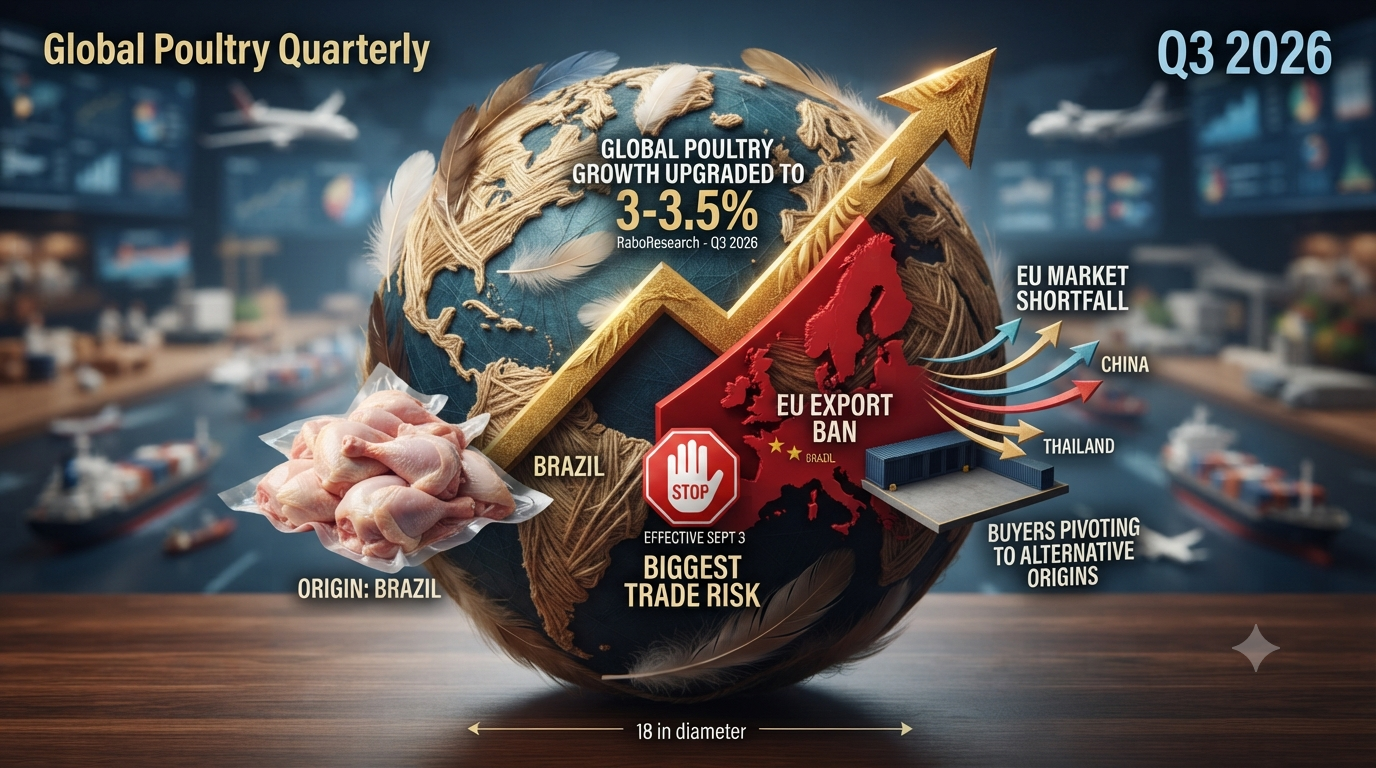

Global poultry market growth in 2026 has been upgraded to 3–3.5% by Rabobank, with Brazil’s confirmed EU export ban from September now the biggest trade risk.
The revision, published in RaboResearch’s Global Poultry Quarterly Q3 2026, lifts the bank’s earlier 2.5–3% forecast and confirms poultry as the standout performer in global animal protein. Production expanded by more than 5% year-on-year in several major markets during the first quarter, led by China, the European Union, Brazil, South Africa and the Philippines. But the report’s bullish headline sits alongside a sharpening set of risks — oversupply pressure, fragile low-income demand, and a trade shock now locked into the calendar: the EU’s removal of Brazil, its largest poultry supplier, from its list of approved exporters effective September 3.
Table of Contents
Why the Global Poultry Market Keeps Outperforming
The engine behind poultry’s momentum is price. With beef values elevated across most regions, chicken’s widening cost advantage continues to pull consumers down the protein ladder, cementing its position as the default affordable animal protein even in weak macroeconomic conditions. Rabobank notes this substitution effect is broad-based, spanning developed and emerging markets alike.
That demand strength has now delivered three consecutive years of roughly 3% global expansion, and 2026 is tracking ahead of plan. The bank’s Q1 2026 outlook had pencilled in around 2.5% growth; six months later the floor of the range is where the ceiling used to be.
Trade is holding up better than the structural trend would suggest. Global poultry trade grew 3.5% year-on-year in the first quarter — a striking result after several weak years and despite active geopolitical disruption. Flows into the Gulf proved especially resilient, supported by exporters and transit hubs including Brazil, Ukraine, Turkey, Iraq, Saudi Arabia and Oman, while the interim US–Iran agreement and the reopening of commercial traffic through the Strait of Hormuz eased near-term risks to energy, shipping and feed ingredient flows.
The Local-to-Local Shift Accelerates
Beneath the trade recovery, the structural direction is unmistakable: governments are prioritising food security, incentivising domestic production and reshaping supply chains around a local-to-local model. The trend is most visible across the Middle East, Africa and Southeast Asia — and nowhere more dramatically than in China, which has completed its transformation from the world’s largest poultry importer into a significant net exporter, upending long-established trade balances.
For exporters built on distance trade — Brazil, Thailand, the EU, the US — this is the defining strategic challenge of the decade. Import markets are becoming production markets, and the volume that remains contestable is increasingly fought over on price, compliance and logistics reliability.
Brazil’s EU Ban: From Risk Scenario to Reality
The Rabobank report flags potential EU restrictions on Brazilian poultry as the key uncertainty for coming months — and events have since overtaken the caveat. The European Commission’s Implementing Regulation 2026/1189 formally removes Brazil from the list of approved third-country exporters from September 3, 2026, covering poultry, beef, eggs, aquaculture and other animal products. The stated grounds are insufficient assurances on restrictions of critically important antimicrobials — substances including virginiamycin, tylosin and bacitracin — under the EU’s One Health antimicrobial resistance policy.
The timing is politically loaded: the ban lands just months after the EU–Mercosur agreement provisionally entered into force, and Brazilian industry bodies ABIEC and ABPA argue the issue is regulatory recognition rather than any sanitary violation. Brazil has begun tightening federal inspection procedures and has submitted compliance protocols to Brussels, but the next scheduled meeting of the relevant EU authorisation body falls in October — after the ban takes effect — meaning only an extraordinary session can prevent disruption.
Rabobank’s scenario analysis maps the consequences: EU prices pushed higher on reduced import availability, Brazilian domestic prices pressured lower by displaced supply, and EU buyers pivoting to alternative origins led by Thailand and China. European buyers have already been front-loading Brazilian volumes ahead of the deadline.
Buyer and Procurement Implications
For B2B buyers, the next two quarters demand active positioning. First, EU-exposed buyers of chicken breast, cuts and processed poultry should secure forward cover now or qualify alternative origins — Thai and Chinese suppliers will command pricing power if the September ban holds, and the 2025 HPAI-driven Brazil disruption showed how quickly EU prices re-rate. Second, buyers in the Middle East and Africa may benefit from displaced Brazilian volume seeking new homes at discounted levels — a genuine buying window if it materialises. Third, feed-linked cost exposure remains manageable with grain prices contained, but El Niño risk and breeding stock scarcity are the two supply-side variables most likely to tighten availability into 2027. Fourth, the local-to-local trend argues for supplier diversification strategies that include domestic and regional processors, not just distance-trade origins. Finally, watch low-income demand signals: any deterioration could see consumers trade down from chicken to eggs or plant proteins, softening the demand floor that underpins current pricing.
What This Means Across the Food and Beverage Value Chain
Feed, Grains and Oilseeds
A faster-growing global flock is a direct demand signal for corn, soymeal and feed additives. With Rabobank projecting 3–3.5% market growth and production running above 5% in several regions, feed compounders and grain traders should expect firmer offtake through H2 — particularly in China, Brazil and Southeast Asia. The contained feed price environment is currently a margin gift to integrators, but El Niño remains the swing factor: any Southern Hemisphere crop disruption would compress poultry margins quickly and could slow placement decisions into 2027. Feed buyers should treat current grain values as a hedging opportunity rather than a resting state.
Competing Proteins: Beef, Pork and Eggs
Poultry’s growth is coming at least partly out of beef’s plate share. Elevated cattle prices are doing the marketing for chicken, and every quarter this differential persists deepens the substitution habit — a structural concern for beef processors banking on demand snapping back when herds rebuild. Pork sits awkwardly in the middle, competitive in some markets but losing the value battle in others. At the bottom of the ladder, eggs and plant proteins become the trade-down beneficiaries if low-income consumers weaken further, meaning egg producers should watch macro data in southern Asia and Africa as closely as their own supply numbers.
Processed and Packaged F&B
Chicken’s cost advantage is reshaping NPD pipelines. Ready-meal manufacturers, snacking brands and private-label producers reformulating towards poultry as the hero protein will find raw material economics supportive — but the Brazil–EU rupture cuts both ways. European further-processors relying on Brazilian breast meat and cooked poultry inputs face a genuine cost shock from September, while manufacturers in the Middle East and Africa could inherit a discount window as displaced Brazilian volume seeks alternative homes. Procurement teams in processed foods should be stress-testing recipes and supplier matrices against a two-tier world: expensive EU poultry, cheap ex-Brazil poultry.
Foodservice and QSR
The QSR chicken arms race — visible in every major chain’s menu pipeline — now has a supply-side tailwind in most of the world and a headwind in Europe. Operators in the EU face rising input costs on breast meat and prepared poultry precisely when value messaging is central to winning strained consumers, squeezing the margin between menu price discipline and food cost inflation. Chains with global supply contracts should expect regional price divergence and may need to re-plumb European sourcing towards Thailand, domestic EU integrators or reformulated cuts. Elsewhere, abundant competitively priced chicken keeps the category’s unit economics attractive.
Retail and Private Label
Grocers benefit from chicken’s role as the value anchor of the meat aisle — it drives footfall and basket conversion when shoppers are stretched. But European retailers should prepare for shelf-price pressure on poultry lines from Q4, with private-label further-processed products (nuggets, kievs, cooked sliced) most exposed to the loss of Brazilian inputs. Retailers who lock supply early or pivot ranges towards domestic origin — and merchandise it as a provenance story — can turn a supply problem into a margin and marketing advantage. In import-dependent regions outside Europe, redirected Brazilian volume may actually improve retail poultry economics.
Logistics and Cold Chain
A 3.5% rise in global poultry trade is volume for reefer operators — but the September ban will redraw the routes. Expect Brazilian frozen poultry flows to swing harder towards the Gulf, Africa and Asia, intensifying demand for reefer capacity and cold storage on those lanes while EU-bound Latin American volumes fall away. Thai and Chinese exporters scaling into Europe will need additional certified cold chain capacity on Asia–Europe services. The reopened Strait of Hormuz has eased Gulf transit risk for now, but contingency routing remains a live requirement, and front-loading of Brazilian product into EU cold stores ahead of the deadline is already tightening European frozen warehousing.
Packaging and Processing Equipment
Production growth above 5% in multiple regions translates into capex: new slaughter lines, cut-up and deboning automation, and further-processing capacity, particularly in China, Brazil, South Africa and Southeast Asia. Equipment vendors should prioritise these expansion markets over saturated Western ones. On the materials side, rising further-processed poultry volumes drive demand for vacuum skin packs, modified-atmosphere trays and freezer-grade films — while any EU shift towards domestic sourcing will pull packaging demand towards European converters and away from export-oriented Brazilian plants.
Ingredients and Food Safety
The antimicrobial ruling behind the Brazil ban is the loudest signal yet that compliance is becoming a trade weapon. Suppliers of antibiotic alternatives — probiotics, phytogenics, organic acids, vaccines — gain a structural demand driver as exporters worldwide move to insulate themselves against similar rulings. Coating systems, marinades and seasoning houses tied to poultry further-processing ride the category’s volume growth. And with breeding stock scarcity flagged as a key 2026 risk, genetics companies hold unusual pricing power: hatching egg and parent stock availability may quietly become the binding constraint on everyone else’s growth plans.
Related
FAQ
What is Rabobank’s global poultry market forecast for 2026?
RaboResearch raised its 2026 global poultry market growth forecast from 2.5–3% to 3–3.5%, after first-quarter production grew more than 5% year-on-year in key markets including China, the EU, Brazil, South Africa and the Philippines.
Why is the EU banning Brazilian poultry imports?
From September 3, 2026, the EU is removing Brazil from its list of approved exporters of poultry and other animal products, citing insufficient assurances on the restriction of critically important antimicrobials in animal production under Implementing Regulation 2026/1189.
How will the Brazil ban affect poultry prices?
Rabobank expects EU poultry prices to rise on reduced import availability while Brazilian domestic prices come under pressure from displaced supply, with EU buyers shifting sourcing towards Thailand and China if the ban proceeds.
Sources
- Rabobank / RaboResearch — Global Poultry Quarterly Q3 2026 (July 2026)
- EuroMeat News — Rabobank: Global poultry sector accelerates in 2026 (July 15, 2026)
- Meat+Poultry — Global poultry growth rises as trade holds firm (July 2026)
- Euronews — EU to ban Brazilian meat imports from September (May 12, 2026)
- S&P Global Commodity Insights — EU restricts Brazilian meat imports; poultry impact seen limited (June 9, 2026)
- UkrAgroConsult — EU to ban imports of Brazilian beef and poultry from September (June 11, 2026)
- The Poultry Site — Brazil tightens meat inspections to avoid EU import ban (July 2026)
- Vesper — Brazil loses EU poultry access from September (May 2026)