

A toxic hydrofluoric acid leak at the Port of Antwerp-Bruges has shut key container terminals, deepening congestion across North European supply chains.
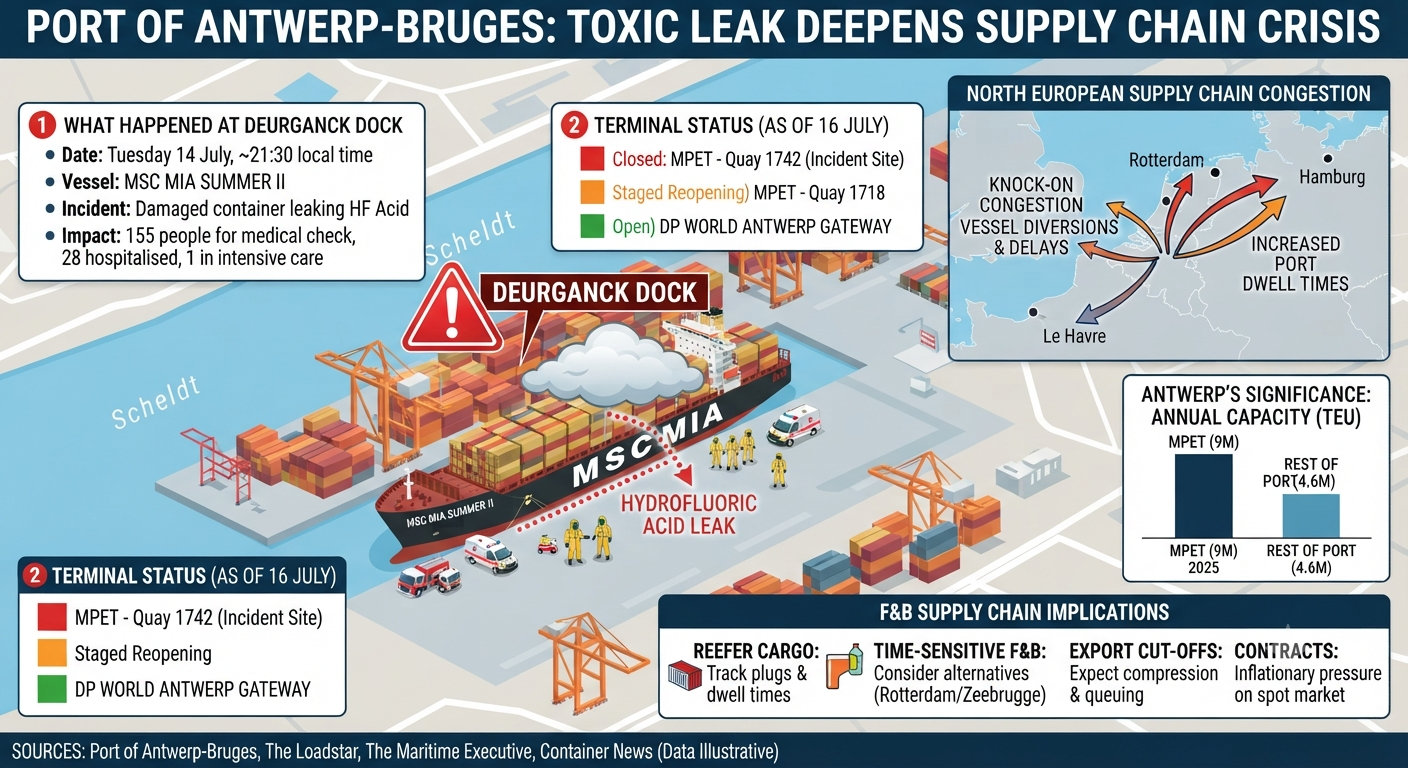
Europe’s second-busiest container port suffered a major operational shock this week after a hazardous chemical leak forced the evacuation and closure of its largest terminal complex. A damaged container carrying hydrofluoric acid began leaking aboard the MSC Mia Summer II at around 21:30 local time on Tuesday 14 July, while the vessel was alongside the MSC PSA European Terminal (MPET) at the Deurganck Dock. The incident sent more than 150 people for medical assessment and brought waterside, truck and rail operations at the dock to a complete standstill.
What Happened at the Deurganck Dock
Emergency services activated the municipal emergency plan, evacuated the terminal and established a wide safety perimeter around the vessel and quay. According to the Port of Antwerp-Bruges, 155 people underwent medical checks after possible exposure to the fumes, with 127 sustaining minor injuries and 28 kept in hospital for observation, including one person in intensive care. Hydrofluoric acid is a highly corrosive industrial chemical whose vapours can cause severe injuries, and health effects can manifest up to a day after exposure.
Both terminals on the dock were shut: MPET, the joint venture between PSA Antwerp and MSC’s Terminal Investment Limited, and DP World’s Antwerp Gateway. The Kieldrecht Lock was closed and vessel movements in the affected section suspended.
A Staged and Incomplete Reopening
Recovery has been slower than the carrier initially signalled. MSC had indicated operations would resume around 14:00 on Wednesday, but reopening has instead proceeded in stages as safety inspections progressed. DP World’s Antwerp Gateway and MPET’s Quay 1718 resumed operations Wednesday evening, and vessels moored near the dock entrance were allowed to leave. However, the northern side of the dock — Quay 1742, where the incident vessel was berthed — remained closed, with the port authority confirming in its 16 July update that the safety perimeter was still in place and MPET was not yet cleared to fully resume while contaminated containers were unloaded and cleaned.
The capacity at stake is significant. MPET has annual handling capacity of around 9 million TEU and accounts for more than half of Antwerp’s container throughput, in a port that handled 13.6 million TEU in 2025.
Congestion on Top of Congestion
The timing is difficult. North European ports have been battling congestion for months, with schedule reliability already slipping across the container network, and this is the second major incident at the Deurganck Dock this year — an oil spill in April temporarily blocked the port’s access route to the North Sea. Trade press warnings to European shippers and forwarders of significant operational disruption reflect the reality that vessels diverted or delayed at Antwerp cascade quickly into Rotterdam, Hamburg and Le Havre, stretching berth windows, haulage capacity and rail slots across the range. The disruption also lands mid-peak-season, with carriers already applying general rate increases and surcharges from 15 July.
What It Means for F&B Shippers and Cold Chain Operators
Antwerp is a critical European gateway for food and beverage trade — cocoa, coffee, fruit, juice concentrates and a heavy reefer flow all move through the port. For F&B logistics and procurement teams, several actions follow. First, expect vessel delays and rolled cargo on Antwerp calls into next week; reefer shipments should be tracked closely, since plug capacity and dwell times deteriorate quickly when terminals run backlogs. Second, importers with time-sensitive or temperature-controlled cargo should ask forwarders now about discharge alternatives at Rotterdam or Zeebrugge and pre-book onward haulage, which tightens fast in these scenarios. Third, exporters routing through Antwerp should build slack into cut-off times, as terminal reopening in stages typically means compressed gate windows and truck queuing. Finally, the incident strengthens the case shippers are already making against locking early annual ocean contracts at peak-distorted rates — disruption premiums are inflating the spot market, and committing at the top of a disrupted market rarely ages well.
What caused the Antwerp port disruption?
A container carrying hydrofluoric acid was damaged and began leaking aboard the MSC Mia Summer II at the MPET terminal on the evening of 14 July, triggering evacuations, terminal closures and suspension of shipping traffic at the Deurganck Dock.
Which terminals were affected?
Both terminals on the Deurganck Dock closed: MPET, operated by PSA Antwerp and MSC’s Terminal Investment Limited, and DP World’s Antwerp Gateway. Antwerp Gateway and part of MPET have since reopened, but the dock’s northern quay remains shut pending clean-up and authority approval.
How serious is the impact on European supply chains?
MPET alone handles more than half of Antwerp’s container volume, and the port was already congested. Shippers should expect vessel delays, cargo rollings and knock-on congestion at neighbouring North European ports over the coming week.
Sources
- The Loadstar
- The Maritime Executive
- World Cargo News
- Container News
- Marine Insight
- PortNews