
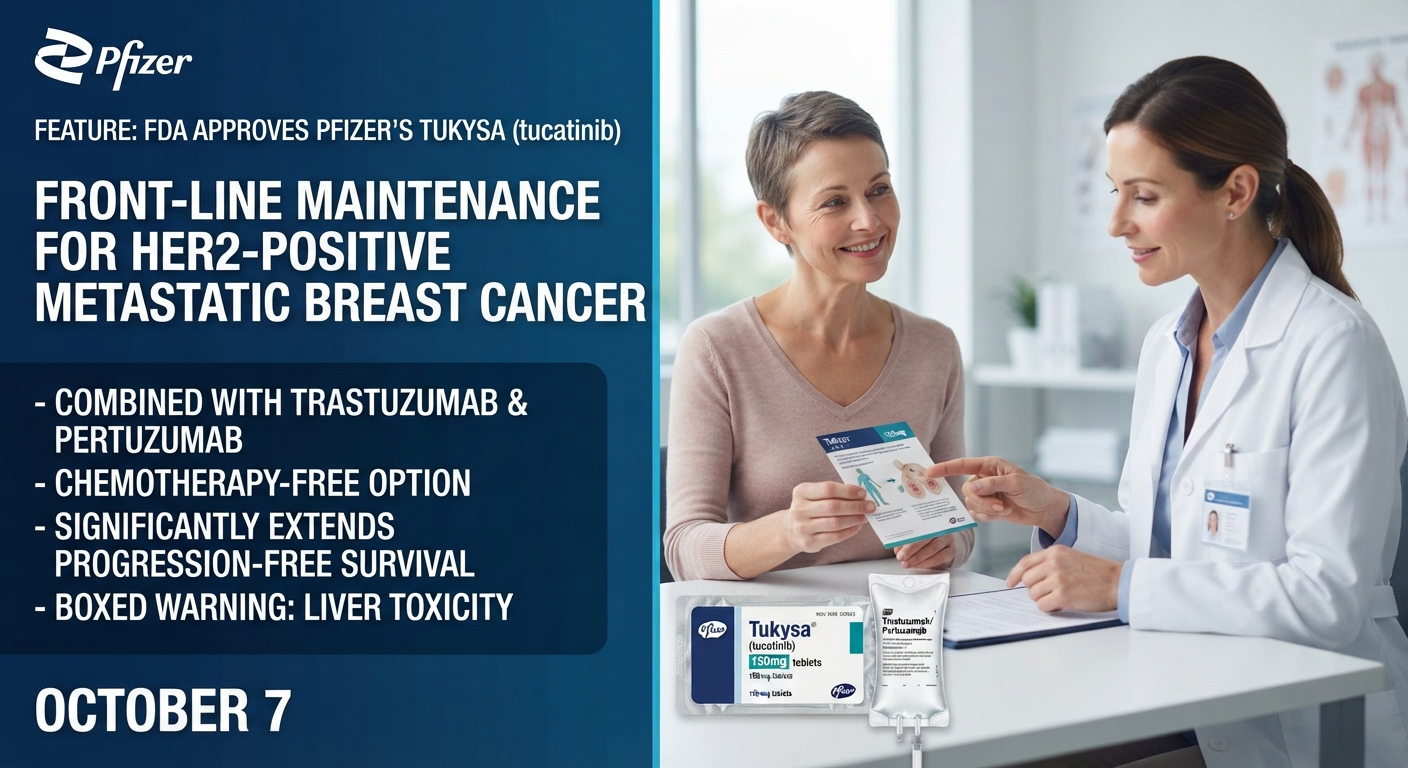

The FDA has approved Pfizer’s Tukysa with trastuzumab and pertuzumab as front-line maintenance for HER2-positive metastatic breast cancer.
The approval, granted on 7 October, moves tucatinib from later lines of treatment into the first-line setting. It gives patients a chemotherapy-free option to keep the disease in check after initial treatment.
The approval at a glance
- Drug: Tukysa (tucatinib), taken orally, with trastuzumab and pertuzumab
- Indication: Maintenance treatment for adults with unresectable locally advanced or metastatic HER2-positive breast cancer after induction treatment
- Trial: HER2CLIMB-05, 654 patients
- Previous approval: April 2020, for previously treated patients
What the trial showed
In HER2CLIMB-05, patients who had completed induction treatment without their disease progressing were randomised to tucatinib or placebo, both alongside trastuzumab and pertuzumab.
- Median progression-free survival: 24.9 months with tucatinib versus 16.3 months with placebo, a gain of 8.6 months
- Risk reduction: About 36% lower risk of progression or death (hazard ratio 0.64)
- Overall survival: Data are not yet mature
The safety trade-off
The label carries a boxed warning for severe liver toxicity, which was more pronounced in this trial than previously seen with the drug. Serious adverse reactions occurred in 17% of patients, and liver toxicity led 8% to stop treatment. One fatal drug-induced liver injury occurred. Diarrhoea affected 73% of patients, though most cases were not severe.
The label recommends liver function tests before starting, every two weeks for the first two months, and every three weeks after that.
Why it matters
- A bigger market. Moving into front-line maintenance means many more patients are eligible, and for longer.
- Chemo-free maintenance. Pfizer describes it as “a chemotherapy-free option that can help delay disease progression after initial treatment.”
- Monitoring burden. Regular liver testing adds work for oncology clinics and patients.
What it means for the supply chain
Tukysa is an oral tablet, so it is dispensed through specialty pharmacies rather than infused in clinics. Longer treatment durations in the maintenance setting mean higher, steadier demand. Oncology pharmacies and distributors should expect volume growth, alongside more frequent laboratory monitoring for patients.
The bottom line
Tukysa’s front-line approval adds more than eight months of progression-free survival for patients with HER2-positive metastatic breast cancer, at the cost of closer liver monitoring.
Frequently Asked Questions
What did the FDA approve? Tukysa (tucatinib) with trastuzumab and pertuzumab as maintenance treatment for HER2-positive metastatic breast cancer after induction therapy.
How much did it delay progression? Median progression-free survival was 24.9 months with Tukysa versus 16.3 months with placebo.
What are the main safety concerns? Severe liver toxicity, which carries a boxed warning, and diarrhoea.
Does it improve overall survival? That is not yet known. Overall survival data are immature.
Sources
| Source | Used for |
|---|---|
| AJMC | Approval date, indication, trial results, safety data and Pfizer statement |
| Healio | Approval coverage |
| CancerNetwork | HER2CLIMB-05 trial design |
| Pfizer announcement (via Business Wire) | Approval announcement |
Additional Resources
| Resource | What you’ll find |
|---|---|
| US Food and Drug Administration (FDA) | Oncology approvals and prescribing information |
| ClinicalTrials.gov | HER2CLIMB-05 trial record |
| National Cancer Institute | Information on HER2-positive breast cancer |
| Pfizer investor relations | Oncology portfolio updates |
Data note: Pricing for the new indication was not disclosed. Survival data are immature, so no overall survival benefit is claimed.