

JBS brings in a $2.5B Indonesian sovereign fund partner, China suspends Uruguay’s top beef exporter, and US export values hold despite China’s absence.
Introduction
Meat trade is being reshaped this week by money and by market access. JBS just brought Indonesia’s sovereign wealth fund in as a $2.5 billion partner for its Australia and New Zealand business — confirmed via the company’s own SEC filing — one of the largest protein-sector deals of the year. Meanwhile China, still largely absent from US beef trade, has now suspended Uruguay’s largest beef exporter outright over a veterinary drug residue violation. Here’s what matters across farm, processing and markets today.
Farm & Production
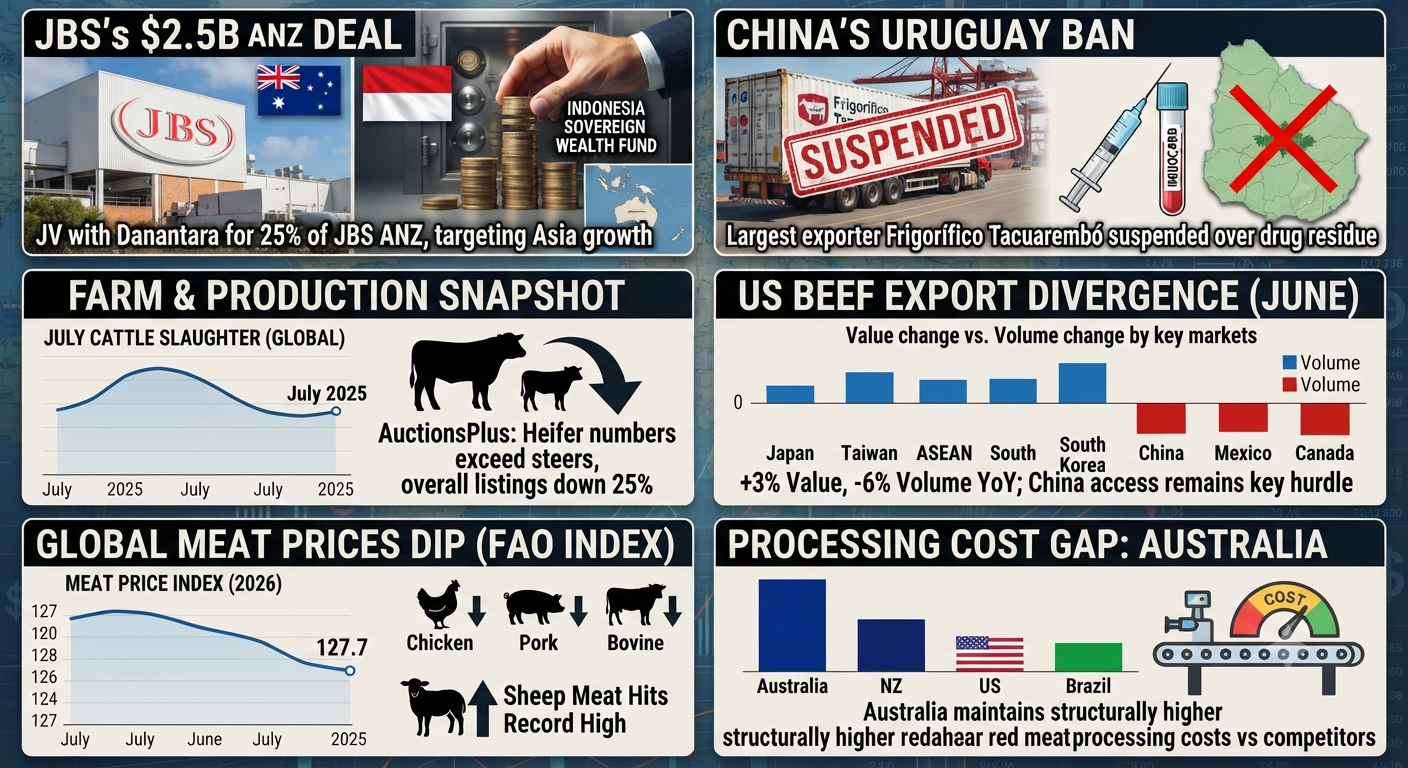
Cattle slaughter volumes are climbing month-on-month, though the specific July tally needs a caveat. Trade reporting puts July slaughter at 1.095 million head, up 1.7% from June’s previous high but still 12.2% below July 2025. Note: this figure comes from a single source I could not independently corroborate — worth confirming against official government data before publishing as a hard fact.
Online cattle trading is flashing an unusual signal. Friday’s AuctionsPlus catalogue showed heifer numbers exceeding steers — a rare occurrence — while listings fell 25% to 13,668 head and clearance dropped to 54%. Heifers and lighter steers also eased in c/kg price this week, even as heavier steers improved slightly. Buyers are watching the Bureau of Meteorology’s forecast on a possible “Super El Niño” as a key input to near-term supply decisions.
Feedgrain markets are splitting north from south. Contrasting seasons have widened the spread between northern and southern Australian grain markets, with troubled yield prospects up north against a bumper southern crop — the kind of regional divergence that directly affects feedlot cost structures depending on sourcing region.
Processing & Manufacturing
JBS brings Indonesia’s sovereign wealth fund in as a $2.5 billion partner for its Australia and New Zealand business. Per JBS’s SEC filing, Danantara Investment Management will subscribe for 25% of a new joint venture holding JBS’s entire ANZ operation, starting with an initial $800 million (9.64% stake) at completion and building to the full 25%/$2.5 billion over three years. The deal gives the venture up to A$7.1 billion in total firepower for acquisitions and greenfield investment across Indonesia, Southeast Asia, Australia and New Zealand. The ANZ business itself is a genuine crown jewel right now: fiscal 2025 net sales hit a record US$8.08 billion, up 21% year-on-year, with adjusted pre-tax earnings up 38% to $916 million — a sharp contrast to JBS’s US beef operations, which continue to face margin pressure from record cattle costs and herd contraction.
China has suspended Uruguay’s largest beef exporter over a veterinary drug residue violation. Uruguay’s Ministry of Livestock confirmed Chinese authorities detected imidocarb — an antiparasitic used for tick-borne disease — above the permitted limit in a boneless beef shipment from Frigorífico Tacuarembó, effective August 6. It’s the second such finding from the same plant in 2026 (the first was in May), and Uruguay’s own required withdrawal period for the drug is 213 days, meaning this points to a compliance failure well upstream of the shipment itself. The stakes are significant: Tacuarembó was Uruguay’s top beef exporter in 2025 at US$457 million in sales, and led the country’s export rankings again through the first five months of 2026 with $157 million. For buyers sourcing Uruguayan beef, this is a live supply disruption at the country’s single largest export plant, not a minor compliance footnote.
A separate study finds Australian meat processing costs remain structurally higher than key competitors. New research confirms Australian red meat processing costs continue to run above New Zealand, the United States and Brazil — a persistent competitiveness gap worth factoring into any sourcing comparison across those origins.
Markets & Trade
US beef export value rose in June even as volume fell, entirely on the back of markets outside China. USMEF-compiled USDA data confirm June beef exports totaled 88,586 metric tons, down 6% year-on-year, but export value still climbed 3% to $790.1 million, lifted by gains in Japan, Taiwan, the ASEAN region, Central America, South Korea, Hong Kong, the Caribbean and Africa. Value was roughly steady to the Middle East but fell to Mexico, Canada and China specifically. For the first half of 2026, beef export volume is down 9% at 545,649 mt and value down 4% to $4.74 billion — USMEF attributes much of that gap directly to China, where US beef access lapsed after facility registrations expired and were not renewed following a strong start to 2025.
Global meat prices fell for the first time in 2026. FAO’s Meat Price Index dropped 2.8% in July to 127.7 points, down from a record June level, though still 0.8% above a year ago. The decline was broad-based — poultry, pork and bovine meat quotations all eased — with sheep meat the lone exception, hitting a record high on tight Oceania export supplies.
Conclusion
The through-line this week is access and trust. JBS is buying growth capacity in a region where rising incomes and protein demand justify a multi-billion-dollar bet, while Uruguay is losing access to its most important market at its single largest plant over a compliance lapse. US exporters are proving resilient everywhere except China, where the door has simply stayed shut since facility registrations lapsed. For buyers, the Tacuarembó suspension is the most immediate actionable item — if you’re sourcing Uruguayan beef, confirm your supplier isn’t running through that plant before assuming continuity.