
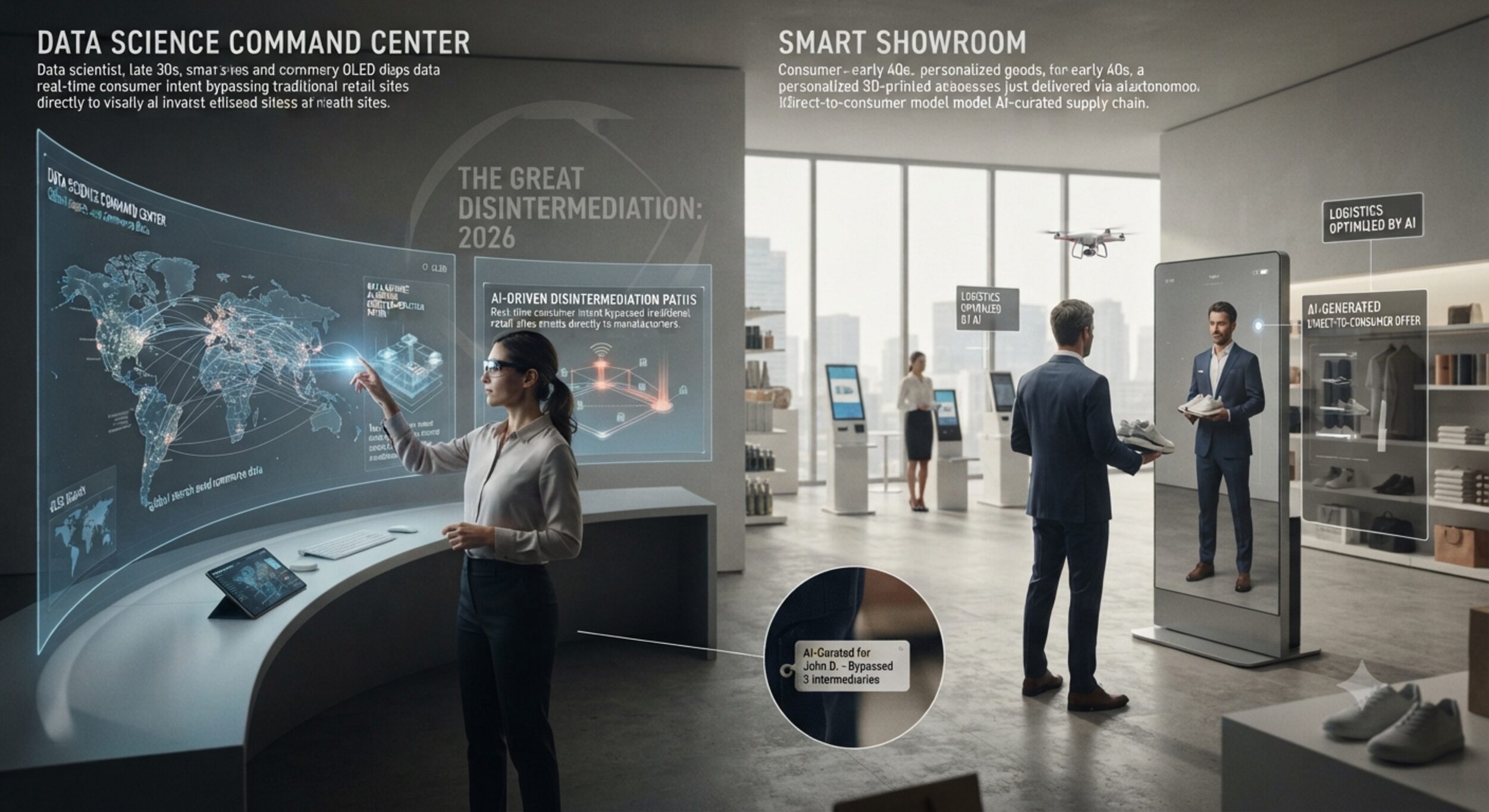
A Comprehensive Research Report on Zero-Click Searches, AI Traffic Explosion, and the End of Traditional SEO
Report Date: July 2026
Data Sources: SparkToro, Adobe Digital Insights, IBM Institute for Business Value, National Retail Federation, Similarweb
Research Methodology: Synthesis of multiple independent data sources from Jan–April 2026 measuring 68% zero-click searches, 393% AI traffic growth, and 42% AI conversion advantage
EXECUTIVE SUMMARY
The digital landscape is undergoing a fundamental restructuring that will reshape marketing budgets, procurement strategies, and brand positioning through 2027. Three converging data signals confirm that AI has moved from emerging technology to primary search and commerce interface:
- 68% of Google searches now end without a click to any external website (up from 60.45% in 2024), meaning only 276 of every 1,000 searches send visitors to the open web
- AI-driven traffic to U.S. retail sites grew 393% year-over-year in Q1 2026, with AI-referred shoppers converting 42% better than non-AI traffic—a complete reversal from March 2025 when AI traffic converted 38% worse
- 45% of global consumers now use AI during buying journeys, with 41% using AI to research products, 33% to interpret reviews, and 31% to hunt for deals
This convergence signals the end of Google’s 25-year dominance as the primary discovery layer between consumers and brands. Answer Engines (ChatGPT, Perplexity, Claude, Gemini) and AI-powered shopping assistants are now the intermediary—and unlike Google, they don’t just list options; they make recommendations, pre-qualify shoppers, and compress the entire decision funnel into a single exchange.
For food and beverage brands, retailers, and supply chain companies, this transformation demands immediate strategic reorientation: traditional SEO optimization, content marketing, and paid search are becoming increasingly ineffective as consumers bypass websites entirely. Success in 2026–2027 requires rethinking brand visibility, content strategy, and procurement positioning around AI citation authority and “Share of Model” (how often your brand appears in AI-generated recommendations).
Table of Contents
PART 1: THE ZERO-CLICK REVOLUTION — 68% OF SEARCHES DON’T DRIVE WEBSITE VISITS
The Data: A Decade of Decline
Google searches ended without a click 68.01% of the time in the U.S. during the first four months of 2026, according to SparkToro research based on Similarweb clickstream data. That’s up from 60.45% in 2024, a 7.56-point increase in two years—the fastest two-year acceleration on record.
The longer historical trajectory is even more dramatic:
- 2016: ~45% zero-click searches
- 2019: ~50% zero-click searches
- 2024: 60.45% zero-click searches
- 2026: 68.01% zero-click searches
This represents a 23-point rise across a decade—but the acceleration is exponential. The last two years account for nearly one-third of the entire decade’s movement.
What Is a Zero-Click Search?
A zero-click search occurs when a user queries Google and finds the answer directly on the search results page (SERP) without clicking through to any external website, Google property (Maps, YouTube), or follow-up search. The user gets their answer and stops.
Zero-click searches include:
- AI Overviews (Google’s generative AI summaries at the top of search results)
- Featured snippets (direct answers in boxes)
- Knowledge panels (information cards for entities, people, places)
- Local packs (business listings, reviews, maps)
- Answer boxes (quick facts, definitions, calculations)
Each of these SERP features provides immediate answers without requiring users to visit a website. AI Overviews now appear on more than 20% of Google searches, and when they do, click-through rates drop by nearly 60%.
The Real Story: Only 276 Clicks Per 1,000 Searches Reach the Open Web
The headline “68% of searches don’t click” obscures the more damning reality: only 276 of every 1,000 searches send a visitor to the open web. This means:
- If a website previously received traffic from 1,000 Google searches, it now receives traffic from 276 searches
- The other 724 searches resolve entirely within Google’s interface, never reaching the website
- For most businesses, this is a >70% decline in organic search traffic potential
This is not a minor trend. This is a fundamental destruction of the traffic model that powered digital marketing for 25 years.
The AI Overviews Multiplier Effect
AI Overviews are likely contributing to the increase in zero-click searches, though the study doesn’t isolate the extent to which the overall rise between 2024 and 2026 can be attributed specifically to AI Overviews</cite>. However, the directional signal is clear: Google’s push toward AI-powered summaries is explicitly reducing traffic to external websites.
The mechanism: When Google’s AI system generates a summary of your content and displays it directly on the search results page, the user gets the answer they needed without visiting your site. Google captures engagement, data, and ad inventory. Your website gets zero traffic.
For food and beverage brands, this is catastrophic. A brand selling sustainable beef that previously ranked #1 for “regenerative beef farming” and received hundreds of monthly searches now watches those searches resolve within Google’s AI overview, with no traffic to the brand’s website and no opportunity to showcase premium products, sustainability credentials, or customer testimonials.
Desktop vs. Mobile: The Device Split
The 68% aggregate masks important device-level differences. The study assumes roughly two-thirds of searches happened on mobile and one-third on desktop, which lines up with broader web traffic patterns. Mobile zero-click rates are likely higher than desktop, though the study doesn’t break this out explicitly.
This matters for procurement and supply chain companies: mobile-first shopping (particularly in emerging markets and among younger demographics) amplifies zero-click exposure and reduces website-driven traffic potential.
Implications for Food & Beverage Brands
For a meat brand, dairy company, or beverage manufacturer, zero-click search dominance means:
- SEO investment ROI has collapsed — Ranking #1 for a search term no longer guarantees traffic or conversions; it just means your content appears higher in Google’s AI summary (with no traffic attribution)
- Website traffic cannot be the primary KPI — Brands must shift to “Share of Model” metrics: how often does your brand appear in AI-generated recommendations? How frequently are you cited as the source for competitor comparisons?
- Traditional paid search is less efficient — As more users rely on AI assistants that don’t display ads in the traditional sense, paid search click-through rates decline and CPCs increase as competition concentrates on a shrinking pool of clickable searches
- Content strategy must change completely — Instead of optimizing for “clicks,” brands should optimize for “citation in AI responses.” This requires publishing original research, data, and thought leadership that AI systems cite as authoritative sources
PART 2: THE AI TRAFFIC EXPLOSION — 393% GROWTH AND 42% BETTER CONVERSION RATES
The Volume Story: 393% YoY Growth, Converting Better Than All Other Channels
By March 2026, Adobe reports AI traffic was converting 42% better—a new record, according to the company, which tracks over one trillion visits to U.S. retail sites. Revenue per visit from AI referrals was 37% above non-AI traffic as of last month.
This is a staggering reversal from one year prior. <cite index=”44-1″>According to Adobe, just one year ago, regular human traffic was worth 128% more. In March 2025, AI traffic converted 38% worse than standard non-AI sources like paid search and email.
The conversion flip:
- March 2025: AI traffic converts 38% worse than non-AI
- March 2026: AI traffic converts 42% better than non-AI
- Total swing: 80 percentage points in 12 months
For a retail site with typical conversion rates:
- Non-AI traffic: 2–2.5% conversion
- AI-referred traffic (March 2026): 2.84–3.55% conversion
This is not statistical noise. This represents real, measurable purchasing behavior where AI-referred shoppers are more likely to buy than any other traffic source.
Growth Trajectory and Holiday Peak
AI-driven traffic to U.S. retail sites grew 393% in Q1 2026 compared to the same period last year. Adobe reported that AI traffic from Q1 2026 grew 393% year over year, with March alone up 269% YoY. “This continues the momentum that was observed during the most recent holiday season (Nov. to Dec. 2025) where AI traffic was up 693% YoY”.
The holiday surge (693% YoY) suggests that AI shopping behavior intensified during peak shopping season, with AI assistants actively recommending products and facilitating purchases on behalf of holiday shoppers.
Engagement and Behavior Metrics
Once a shopper arrives at a retail site via an AI assistant, they spend 48% more time on the page, browse 13% more pages per visit, and show a 12% higher engagement rate than visitors from other channels.
This behavior pattern is critical: AI-referred shoppers arrive pre-qualified (they’ve already asked an AI for a recommendation), they’re committed to purchase research, and they spend significantly more time evaluating products. This is not accidental traffic; it’s high-intent, high-engagement traffic.
Adobe’s Survey Data: 85% of AI Shoppers Report Improved Experience
Adobe surveyed more than 5,000 U.S. consumers alongside its traffic data. Thirty-nine percent said they’ve used AI for online shopping, and 85% of that group said it improved their experience.
This is crucial: a massive majority of consumers using AI for shopping report positive experiences and improvement over traditional browsing. This suggests AI adoption will continue accelerating as more consumers discover the convenience and quality of AI-recommended shopping experiences.
Revenue Per Visit: 37% Higher Than Non-AI Traffic
Revenue per visit from AI referrals was 37% above non-AI traffic as of last month. This metric is often overlooked in favor of traffic volume, but it’s the most important for profitability.
For a retail site generating $100 in revenue per 100 non-AI visits ($1 per visit), the same 100 AI-referred visits generate $137 in revenue ($1.37 per visit). This 37% lift compounds across an entire e-commerce operation and likely reflects:
- Higher average order value from AI-recommended products
- Higher-margin products being recommended by AI (premium/specialty items)
- Lower return rates from AI-recommended purchases (more precise matching between customer and product)
- Cross-sell and upsell effectiveness from AI bundles and recommendations
Procurement and Supply Chain Implications
For food and beverage suppliers, this data has critical implications:
1. Retail Partner Strategy Will Shift to AI Visibility Retailers will increasingly prioritize suppliers whose products are visible to AI recommendation engines. Private-label SKUs, premium items, and high-margin products will be preferred because AI systems recommend them, driving higher AOV and conversion.
2. Product Data Becomes Critical AI systems require detailed, machine-readable product data to make recommendations (ingredients, sourcing, sustainability claims, certifications, allergen info, nutritional data). Suppliers with complete, accurate product data structured for AI consumption will be preferred.
3. Premium and Specialty Products Will Gain Share The higher revenue-per-visit from AI suggests AI systems recommend premium, specialty, and innovative products. Commodity suppliers will face margin pressure; premium suppliers will see preference.
4. Sustainability and Traceability Matter As shown in subsequent sections, consumers using AI for shopping prioritize sustainability and traceability. Suppliers documenting these attributes (regenerative agriculture, organic certification, local sourcing) will be recommended more frequently.
PART 3: CONSUMER AI ADOPTION — 45% USE AI IN SHOPPING, 41% FOR PRODUCT RESEARCH
IBM–National Retail Federation Global Study: 45% of Consumers Use AI
A new global study from the IBM Institute for Business Value, in collaboration with the National Retail Federation, found that while nearly three-quarters of surveyed consumers (72%) still shop in stores, almost half (45%) turn to AI for help during their buying journeys.
This finding demolishes the lingering narrative that AI shopping is a niche behavior. Nearly half of global consumers are now actively using AI to guide purchasing decisions. This is mainstream adoption, not early-adopter behavior.
Use Cases: Research (41%), Reviews (33%), Deals (31%)
Additionally, the study noted 41% of respondents use AI to research products, 33% to interpret reviews, and 31% to search for deals.
These use cases reveal how consumers are deploying AI across the shopping journey:
Research (41%): Consumers ask AI questions about product features, specifications, sourcing, sustainability, and recommendations. An example: “What’s the best grass-fed beef brand for grilling?” This is classic product research that would have required 10–15 minutes of website browsing and search engine queries. Now it’s a one-message AI exchange.
Reviews (33%): Consumers ask AI to synthesize and interpret customer reviews from multiple sources. Instead of reading 50 one-star and five-star reviews on Amazon, consumers ask an AI to summarize the consensus: “What do people say about this beef brand?” or “Are the negative reviews about quality or delivery?”
Deals (31%): Consumers use AI to find pricing, discounts, and promotional opportunities. “Which retailer has the best price for Grass-Fed Angus beef this week?” This is deal-hunting and price-comparison behavior that previously drove traffic to comparison shopping engines and discount retailers.
The Pre-Shopping Shift: Arriving with Defined Preferences
The IBM–NRF study notes that consumers are arriving in-store or online with more defined preferences, shaped in part by AI-driven recommendations and insights.
This is a critical behavioral shift. Consumers are no longer browsing; they’re arriving with decisions pre-made by AI. For retailers, this compresses the sales funnel dramatically. For brands, it means product visibility to AI systems determines purchase likelihood before consumers ever encounter your product in-store or online.
Physical Retail Persists (72% Still Shop in Stores)
Despite AI adoption, nearly three-quarters of surveyed consumers (72%) still shop in stores. This is important for food and beverage, where fresh, perishable products still drive significant in-store traffic.
However, the behavior has changed: consumers arrive in-store already informed by AI, with preferences and specific products in mind. They’re not browsing the beef case wondering what to buy; they’re there to buy the specific grass-fed brand an AI recommended. In-store retail isn’t dying; it’s becoming destination shopping for pre-selected products, not discovery retail.
PART 4: THE END OF SEO — GENERATIVE ENGINE OPTIMIZATION (GEO) IS THE NEW GAME
The SEO Problem: 68% of Searches Don’t Reach Your Website
Traditional SEO optimization—engineering content and websites to rank highly in Google search results—assumes that ranking leads to traffic. This assumption is collapsing.
If 68% of searches don’t click through to websites, then ranking #1 for a search term no longer guarantees traffic. Instead, it might mean your content is summarized in Google’s AI Overview, with full attribution to your competitor’s website (which appears second) because they paid for a prominent ad placement.
Enter Generative Engine Optimization (GEO)
GEO is a new content and brand strategy focused on being cited as an authoritative source within AI-generated responses. Instead of optimizing for Google’s ranking algorithm, brands optimize for inclusion and citation within AI systems.
The GEO Strategy:
- Publish original research, data, and thought leadership that AI systems will cite as authoritative sources
- Structure content in scannable, AI-readable formats that answer questions consumers ask AI assistants
- Build your “Share of Model” — track how often your brand appears in AI-generated recommendations for key queries
- Become the cited authority so when an AI assistant answers “Which beef brand is most sustainable?” your research appears as the source
Practical GEO Examples for Food & Beverage Brands
Example 1: Sustainable Beef Brand
- Instead of optimizing a website page for “regenerative beef farming,” publish original research: “2026 Regenerative Ranching Study: Soil Health Improvements Across 500,000 Acres”
- Structure the report with clear sections, data visualizations, and verifiable findings
- Submit to industry databases and make it downloadable with your brand attribution
- Goal: When AI systems summarize regenerative beef practices, your research is cited as the primary source
Example 2: Dairy Company
- Instead of product pages for individual cheese SKUs, publish thought leadership: “The Economics of Grass-Fed Dairy: Price Premium Justification Through Nutritional and Sustainability Metrics”
- Include original data, peer-reviewed references, and producer interviews
- Goal: When AI systems answer “Is grass-fed dairy worth the premium?” they cite your research as the authoritative economic analysis
Example 3: Protein Processor
- Instead of marketing collateral, publish original industry analysis: “Q2 2026 Protein Market Dynamics: AI-Driven Demand Shifts and Supply Chain Implications”
- Make this quarterly (establishing it as a canonical source that AI systems reference repeatedly)
- Goal: When retailers ask AI about protein supply trends, your quarterly report becomes the cited source of truth
Tracking Share of Model
“Share of Model” is the new metric that replaces organic search impressions and clicks. It measures how often your brand appears in AI-generated responses for key queries.
Brands should monitor:
- How often your brand is cited in ChatGPT, Perplexity, Claude, and Gemini responses to key questions
- Which competitors’ brands appear alongside yours
- Which data sources or research pieces are cited most frequently
- Trending AI-mentioned attributes (e.g., if sustainability becomes the top-cited factor for beef recommendations, ensure your brand’s sustainability research is cited)
Tools for GEO and Share of Model Tracking
Currently, dedicated GEO tools are limited, but brands can track Share of Model through:
- Manual queries to AI assistants (search your brand, competitors, and key category questions)
- Adobe’s LLM Optimizer and similar tools (designed to measure visibility to AI systems)
- Search console monitoring for branded searches (AI users often search your brand name directly after seeing AI recommendations)
- Custom surveys asking consumers which AI recommendations they received
PART 5: THE TRANSFORMATION OF BUYER BEHAVIOR — IMPLICATIONS FOR PROCUREMENT AND RETAIL
The Buyer Journey Compression
Traditional e-commerce buyer journey:
- Search (Google, Amazon search, browse)
- Browse results (10–30 results per page)
- Visit websites (3–5 competitive sites)
- Read reviews (multiple sources)
- Compare pricing (multiple retailers)
- Decide and purchase (4–6 hours total)
AI-mediated buyer journey:
- Ask AI (single query)
- Receive recommendation (AI summarizes options, recommends top choice)
- Purchase (1-click checkout for AI-recommended product)
- Total time: 2–5 minutes
This compression is catastrophic for product visibility. Brands that don’t appear in AI recommendations simply don’t exist in the compressed funnel. Brands that do appear have enormous advantage because they occupy a larger share of the consumer’s attention.
Pre-Shopping Information Gathering
Consumers are gathering information through AI before they ever visit a retail site or store. This means:
- Retail doesn’t control discovery anymore — AI controls discovery
- Your brand’s visibility to AI determines store-visit likelihood — If an AI doesn’t recommend your beef, the consumer won’t look for it in-store
- Procurement teams must engage with AI visibility — Not just traditional retail channels
The Sustainability Filter
Earlier sections noted that 33% of consumers use AI to interpret reviews and 31% to search for deals. Critically, consumers are using AI to filter for sustainability, traceability, and ethical sourcing.
For dairy and beef suppliers, this is a major shift: sustainability is no longer a premium positioning; it’s a baseline filtering criterion. Suppliers without documented sustainability practices simply won’t appear in high-preference recommendations.
Private Label and AI Visibility
Retailers are beginning to understand that AI visibility determines private-label penetration. If a retailer’s private-label beef brand doesn’t appear in AI recommendations, consumers will continue buying branded alternatives.
This means procurement teams must work with suppliers on:
- Complete product data accessibility to AI systems
- Transparency about sourcing and production practices
- Competitive positioning against national brands in AI queries
PART 6: CRITICAL QUESTIONS AND RISKS
Is This Data Permanent or Temporary?
The zero-click and AI adoption trends are unlikely to reverse. Consumers have discovered the convenience of AI shopping and are unlikely to return to manual search browsing. Google has invested billions in AI Overviews and continues expanding AI features. Retailers have validated that AI-referred traffic converts better and drives higher AOV.
However, regulatory pressure could moderate the trend. If regulators force Google to reduce AI Overview prevalence or require more external links in search results, zero-click rates might stabilize or decline. Similarly, if AI-mediated shopping produces poor recommendations or high return rates, consumer enthusiasm could cool.
Risk assessment: Low probability of reversal; high probability of continued acceleration.
Will Retail Channel Consolidate Further?
If AI-mediated shopping continues accelerating, smaller retailers without AI visibility will face margin pressure and traffic decline. Larger retailers (Amazon, Walmart, Target) that can optimize for AI visibility will gain share.
This suggests procurement consolidation: more buyers will source from a smaller number of suppliers that have invested in AI-readable data and visibility optimization.
Can Smaller Brands Compete?
Yes, but only through original research, data publication, and thought leadership. A smaller, premium beef producer can’t out-spend a large commodity producer on traditional marketing. But a smaller producer can publish original ranching research, soil health data, and sustainability metrics that become authoritative sources AI systems cite.
The shift to GEO favors authentic, differentiated brands with original insights over mass-market brands with large advertising budgets.
RECOMMENDATIONS FOR FOOD & BEVERAGE BRANDS, RETAILERS, AND SUPPLIERS
For Brands
- Conduct an AI visibility audit — Search key product and category terms in ChatGPT, Perplexity, Claude, and Gemini. How often does your brand appear? Which competitors dominate?
- Publish original research — Identify 2–3 areas where you have unique data or insights (sustainability, pricing, product quality, sourcing, etc.). Publish this research quarterly.
- Optimize product data — Ensure all product specifications, sourcing information, sustainability claims, and certifications are complete, accurate, and machine-readable. Feed this data to retailers and retail platforms that share with AI systems.
- Build “Share of Model” tracking — Begin monitoring how often your brand appears in AI responses. Set targets for Share of Model improvement.
- Shift marketing spend allocation — Reduce reliance on traditional SEO and paid search. Invest in thought leadership, research publication, and influencer partnerships with industry analysts and experts.
For Retailers
- Understand AI traffic quality — AI-referred traffic converts better and generates higher revenue per visit. Optimize retail site architecture for AI-referred shoppers (they arrive pre-informed; make checkout fast and effortless).
- Demand product data completeness — Require suppliers to provide complete product data (nutritional, sourcing, sustainability, allergen info). This data must be accurate and machine-readable for AI systems to recommend products effectively.
- Prioritize supplier AI visibility — In procurement negotiations, consider a supplier’s AI citation footprint and Share of Model. Suppliers visible to AI systems will drive more consumer demand.
- Test private-label positioning against AI — Run experiments where private-label and branded products are positioned identically to AI systems. Measure which converts better. Use insights to inform product development and positioning.
For Suppliers and Food Companies
- Audit your data quality — Work with retailers to understand if your product data is complete and AI-readable. Invest in data infrastructure.
- Build supplier transparency — Document sourcing, production practices, sustainability metrics, and quality measures. Make these verifiable and citable.
- Anticipate procurement questions about AI visibility — Retail buyers will increasingly ask: “How often does your brand appear in AI recommendations for key category searches?” Be prepared to answer and improve.
- Consider consolidation risk — Suppliers without AI visibility will face margin pressure. Smaller producers should consider partnerships or mergers with larger producers that have invested in AI infrastructure.
CONCLUSION: THE WINNER AND LOSERS OF THE AI TRANSITION
Winners
- Brands with original research and thought leadership — Brands that publish authentic, data-backed insights will become authoritative sources cited in AI recommendations
- Premium and specialty suppliers — Higher AOV and margin products recommended more frequently by AI systems optimizing for revenue
- Retailers with sophisticated AI visibility strategies — Retailers that optimize private-label positioning and supplier data for AI systems will capture higher margin and traffic
- Procurement teams that anticipate change — Early action on supplier consolidation, data quality, and AI visibility will yield competitive advantage
Losers
- Commodity producers without differentiation — Commodity beef, dairy, and produce with no distinctive attributes will face AI-driven margin pressure as consumers optimize for quality and sustainability
- Traditional SEO-dependent brands — Brands that continue investing primarily in website optimization and organic search will see declining ROI as zero-click searches expand
- Small suppliers without AI visibility — Fragmented supply chains with multiple small suppliers will consolidate toward larger suppliers with AI infrastructure
- Retail businesses optimizing for website traffic instead of revenue per visit — Metrics that measure traffic volume will obscure the real opportunity: AI-referred traffic’s superior conversion and revenue per visit
FINAL WORD
The transformation from traditional search to AI-mediated commerce is not incremental. It’s a fundamental restructuring of how consumers discover, research, and purchase food and beverage products. The 68% zero-click metric, 393% AI traffic growth, and 42% conversion advantage are not marketing headlines; they’re evidence of a tectonic shift in buyer behavior.
For procurement teams, brand marketers, and retailers, the moment for strategic reorientation is now. The companies leading this shift—establishing AI visibility, publishing original research, and optimizing for Share of Model—will capture disproportionate margin and market share. Companies attempting to preserve the traditional search-driven model will see declining returns on marketing investment and eventual procurement consolidation.
The AI-mediated shopping era is here. The question is not whether to adapt, but how quickly.
Related
Report prepared: July 2026
Data current through: April 2026
Next update: October 2026 (to capture mid-year procurement trends and Q3 AI adoption)

