
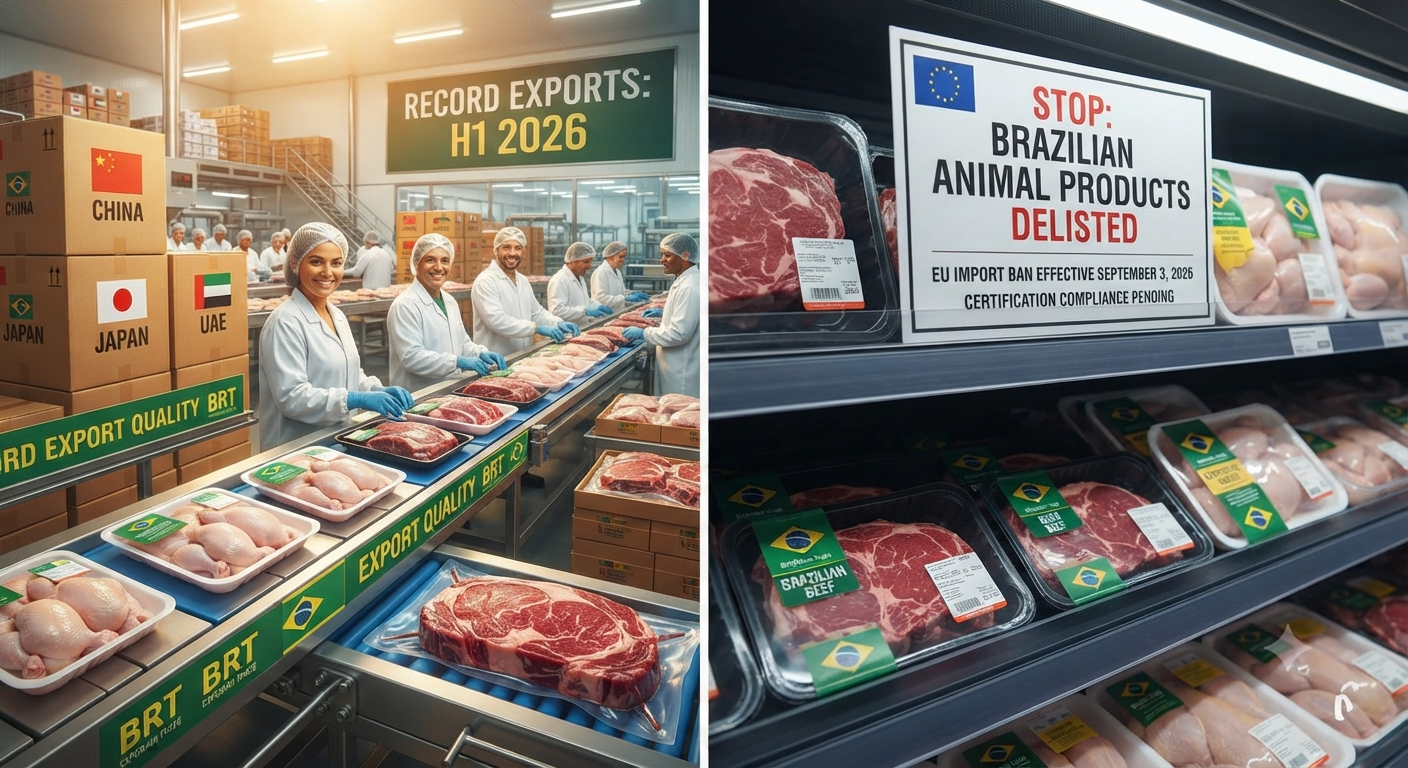

Brazil closed the first half of 2026 with the best chicken and beef export numbers in its history, on both volume and revenue. That’s the headline. The complication sitting underneath it: the European Union has already voted to strip Brazil off its list of approved animal-product suppliers, with the ban set to take effect September 3 — right as Brazilian exporters were posting triple-digit growth into that same market.
Table of Contents
June and First-Half Chicken Numbers
Brazilian chicken meat exports — fresh and processed combined — reached 482,800 tons in June 2026, according to the Brazilian Association of Animal Protein (ABPA). That’s up 40.6% from the 343,400 tons shipped in June 2025. Export revenue came in at US$985.5 million, 54.7% higher than the same month last year.
That June performance capped the strongest first half in Brazilian chicken export history. Between January and June, shipments totaled 2.936 million tons, up 12.9% year-over-year, generating US$5.7 billion in revenue — a 17% increase over the same period in 2025.
Some of June’s headline growth is inflated by a weak comparison base: June 2025 was still recovering from a single, since-resolved case of Highly Pathogenic Avian Influenza (HPAI) on a commercial Brazilian farm, which triggered temporary restrictions in several markets. That’s most visible in the destination-by-destination breakdown, where a handful of countries show implausibly large percentage gains that reflect how depressed last year’s numbers were, not a genuine 100x demand shift.
Where the Chicken Is Going
China remained Brazil’s top chicken destination in June at 50,100 tons — technically a 12,248.8% year-over-year increase, though that figure is almost entirely a base-effect artifact from last year’s restrictions. Japan followed with 46,600 tons (down 0.9%), the United Arab Emirates with 46,200 tons (down 5.1%), and Saudi Arabia with 33,100 tons (down 1.0%) — Brazil’s more mature markets held roughly flat.
The more meaningful growth shows up further down the list: the European Union imported 28,000 tons (up 250.7%), South Africa took 26,300 tons (up 946.3%), Mexico bought 25,400 tons (up 728.8%), and South Korea jumped to 18,500 tons (up 7,819.7%). The Philippines (12,500 tons, up 330.2%) and Singapore (12,000 tons, down 19.4%) rounded out the top ten. As with China, several of these gains are exaggerated by the low 2025 base, but the underlying direction — diversification away from a handful of legacy buyers and into a broader set of markets — is real and consistent with ABPA’s own framing of the first half.
Which States Are Shipping It
Paraná kept its position as Brazil’s top chicken-exporting state, shipping 199,300 tons in June, up 48.2%. Santa Catarina followed with 103,300 tons (up 35.2%), Rio Grande do Sul with 56,700 tons (up 40.1%), São Paulo with 29,900 tons (up 40.0%), and Goiás with 29,400 tons (up 55.4%). The concentration in Brazil’s south remains firmly intact even as export markets diversify.
ABPA president Ricardo Santin credited the first-half performance to Brazil’s ability to expand into value-added markets like Japan, the EU, South Korea, and China while holding its position in the Middle East, despite what he described as a backdrop of regional tension and Strait of Hormuz-related shipping disruptions.
Beef Posted Its Own Record First Half
Chicken wasn’t the only Brazilian protein setting records. Beef exports totaled 1.705 million tons in the first half of 2026, up 15.5% from 1.476 million tons a year earlier, according to Secex/MDIC data compiled by the Brazilian Association of Meat Exporting Industries (ABIEC). Revenue reached US$9.85 billion, up 36.2% — also a first-half record on both counts.
China led beef buyers by a wide margin, importing 794,700 tons worth US$4.87 billion in the first half — up 24% in volume and 49.4% in value. The United States followed with 205,000 tons (US$1.35 billion, up 13% in volume and 29.8% in value), then Chile, Russia, and the European Union, the last of which imported 51,200 tons worth US$452.3 million — up 18.2% in volume and 53.5% in value, making it the third-largest destination for Brazilian beef by revenue despite a comparatively modest volume.
June alone brought in 317,300 tons of beef exports (up 16.6%) and US$1.975 billion in revenue (up 38.1%) — the best single month in Brazilian beef export history, edging out the previous record set in May. Raw meat made up 88.1% of June’s volume and 92.6% of revenue, with processed meats, offal, fats, tripe, and salted meats splitting the remainder.
The Complication: Brazil Has Already Been Delisted by the EU
Here’s where the growth story runs into a wall. The European Commission voted in mid-May 2026 to remove Brazil from its list of countries authorized to export food-producing animals and animal-origin products to the bloc — covering beef, poultry, eggs, honey, aquaculture products, and casings. The measure takes legal effect September 3, 2026.
This isn’t a food-safety recall or a residue-contamination finding. It’s a certification and oversight problem. The EU has required, since 2023, that any country exporting animal products to the bloc formally guarantee that those animals never received antimicrobials reserved for human medicine or used as growth promoters — a rule the EU itself has applied domestically since 2006. Brazil simply hasn’t provided the documentation and monitoring infrastructure the European Commission wants to see. A recital in the relevant EU implementing regulation states plainly that the Commission has not received information guaranteeing Brazil will meet the requirement by the deadline.
In response, Brazil’s Ministry of Agriculture and Livestock (MAPA) approved a voluntary certification protocol built on the existing SISBOV cattle-traceability system, requiring individual animal identification, documented veterinary and feed histories, and third-party audits to prove exported animals never received the restricted substances. The catch, acknowledged even within Brazil’s own livestock sector: as of early July, no establishments had actually completed certification under the new protocol — leaving very little runway before the September deadline. One added complication is Brazil’s widespread use of ionophores like monensin, a feed-efficiency additive that Brazilian regulators consider safe but that falls within the category of substances the EU wants controlled.
ABPA and ABIEC maintain that Brazilian poultry and beef fully comply with EU antimicrobial standards already, and that the dispute is about proving government oversight rather than fixing actual practices. Brazil has continued adjusting its export-control systems through early July in an effort to reopen negotiations before the deadline, while EU officials have said the process for reinstatement — submission, Commission assessment, and formal relisting — simply takes time regardless of how compliant individual exporters are.
Why This Matters Beyond the Paperwork
The EU is not Brazil’s largest protein market by volume — it took roughly 6% of poultry shipments and a low single-digit share of beef in recent data — but it’s disproportionately valuable. EU buyers pay premium prices for higher-value cuts like boneless chicken breast and salted chicken breast, and the bloc’s standards function as a benchmark that other markets watch. Losing access wouldn’t just cost Brazil a mid-sized customer; it would remove one of the fastest-growing, highest-margin destinations right as June data shows EU chicken volumes up 250.7% and EU beef revenue up 53.5% year-to-date.
It’s also not unprecedented. The EU has suspended Brazilian poultry twice in recent years — over Newcastle disease in 2024 and over the HPAI case in 2025 — each time reopening the market within months once Brazil demonstrated compliance. Industry participants are watching for a similar resolution here, though the antimicrobial dispute is a regulatory and documentation issue rather than a disease event, which changes the playbook for how quickly it can be resolved.
For buyers, traders, and procurement teams with EU-Brazil exposure, the practical question is timing: shipments with export health certificates issued on or before September 2 are grandfathered in under current rules even if they arrive after the deadline, but anything certified from September 3 onward will require Brazil to be back on the approved list — something that, as of early July, had not happened.
What Happens Next
The European Commission’s decision still needs formal publication in the EU’s Official Journal to take definitive legal effect, though officials have indicated the timeline is not expected to change. Brazil’s path back onto the approved list runs through MAPA submitting compliance guarantees, the Commission assessing them, and a formal relisting vote — a multi-step process that European officials have been explicit takes real time, independent of how quickly individual exporters can prove compliance. Barring a fast resolution, Brazilian poultry, beef, and other animal-origin exports to the EU face a hard cutoff on September 3.
Related
FAQ
Is Brazil’s record chicken export growth real, or mostly a comparison-base effect?
Both are true, depending on the market. The overall first-half numbers — 2.936 million tons, up 12.9%, and US$5.7 billion in revenue, up 17% — are genuine records, not statistical artifacts. But some individual June destination figures, like China’s reported 12,248.8% increase, are exaggerated by how low June 2025 volumes were during HPAI-related restrictions.
Does the EU ban mean Brazilian chicken or beef is unsafe?
No. The European Commission has been explicit that this is a certification and oversight issue, not a finding of contamination or residues in Brazilian meat. The dispute is over whether Brazil can formally document, through audits and traceability systems, that exported animals never received antimicrobials the EU restricts — not whether the meat itself failed any safety test.
What products does the EU measure actually cover?
Based on the European Commission’s published list changes, the measure applies to bovine, equine, poultry, aquaculture products, honey, and casings — a broad slice of Brazil’s animal-origin export portfolio, not beef alone.
Will the September 3 deadline actually happen, or could it be pushed back?
As of early July 2026, EU officials had given no indication of a delay, and Brazil had not yet certified any establishments under its new compliance protocol. The Commission has said reinstatement requires Brazil to submit guarantees and undergo an assessment process that takes time regardless of last-minute compliance efforts.
How big a market is the EU for Brazilian chicken and beef, really?
Smaller by volume than China, Japan, or the Middle East, but disproportionately valuable. The EU takes a mid-single-digit share of Brazil’s total poultry exports but pays premium prices for higher-value cuts, and was among the fastest-growing destinations in the first half of 2026 for both chicken and beef.
Has the EU banned Brazilian poultry before?
Yes, twice recently — a 2024 suspension linked to Newcastle disease and a 2025 suspension tied to the avian influenza case referenced in this year’s export data. Both were resolved within months once Brazil demonstrated compliance, though this year’s antimicrobial-certification dispute is a different kind of issue and may not follow the same timeline.