
June 9, 2026
The global nuts market is valued at USD 56.2–87.3 billion in 2026, depending on scope, growing at a CAGR of 4.4–8.7% toward USD 87.2–134.7 billion by 2033–2036. When the full nuts ecosystem — encompassing edible nuts, peanuts, nut butters, nut milks, nut flours, nut-based ingredients for food manufacturing, and the processed nut snacks category — is considered, the total addressable market exceeds USD 200 billion in 2026. The global peanuts market alone is valued at USD 89.57 billion in 2026, the nut milk market at USD 14.03 billion growing at 11.40% CAGR, and the nut butters market at USD 4.24–4.95 billion growing at 4.73–7.6% CAGR.
Nuts are one of the world’s most ancient foods — consumed by humans for tens of thousands of years, traded across civilisations, and celebrated in virtually every food culture on earth. They are nutritional powerhouses: dense in healthy fats, complete proteins, fibre, vitamins, and minerals. They are the snack category that the modern health and wellness movement has most enthusiastically embraced. And in 2026, the humble nut is at the centre of one of the most commercially extraordinary viral food phenomena in modern food industry history — the Dubai Chocolate moment that transformed pistachio from a Middle Eastern culinary staple into the world’s most globally coveted flavour ingredient.
Created by food scientist Sarah Hamouda of Dubai’s FIX Dessert Chocolatier, the “Can’t Get Knafeh of It” bar — filled with crunchy kadayif pastry and vibrant pistachio cream — became the defining food trend of the mid-2020s. When TikTok creator Maria Vehera posted an ASMR-style video of the bar’s golden crunch and vivid green centre in December 2023, it ignited a global pistachio craze that is still intensifying in 2026. Searches for pistachios doubled in the past year, major brands including Starbucks, Häagen-Dazs, and Lindt launched pistachio product lines, and Wonderful Pistachios achieved a landmark milestone — becoming the first billion-dollar brand in The Wonderful Company’s portfolio in late 2025. The pistachio is 2026’s “Green Gold.”
But the nuts story in 2026 extends far beyond pistachios. The entire category is being transformed by converging forces: the protein megatrend elevating nuts as plant-based protein sources; the GLP-1 medication revolution creating demand for nutrient-dense, small-portion foods; the plant-based movement driving nut milk, nut butter, and nut-based ingredient innovation; and the climate crisis simultaneously threatening the water-intensive production of key tree nuts in California while creating commercial opportunities for more drought-tolerant alternatives.
This report provides the most comprehensive publicly available analysis of the global nuts industry in 2026 — covering market scale, individual nut categories, nut butter, nut milk, nut flours and ingredients, the pistachio phenomenon, sustainability and water challenges, regional dynamics, key challenges, strategic outlook, and leading companies.
Executive Summary: The 2026 Nuts Industry Landscape
The global nuts industry in 2026 is defined by the convergence of health, indulgence, and sustainability — three trends that rarely align in a single food category but do so uniquely and powerfully in nuts.
Key Takeaways for Stakeholders:
The global nuts market is valued at USD 56.2–87.3 billion in 2026, with the full ecosystem including peanuts, nut butters, and nut milks exceeding USD 200 billion. The edible nuts market is specifically valued at USD 72.6 billion in 2026, growing to USD 129.5 billion by 2036.
Wonderful Pistachios became the first billion-dollar brand in The Wonderful Company’s portfolio in late 2025, fuelled by the Dubai chocolate phenomenon, the “No Shells” product line, and flavoured variety expansion.
Pistachio searches doubled in one year, driven by the Dubai chocolate viral trend that has infiltrated coffee shops, bakeries, confectionery, and fine dining menus globally.
Almonds lead market share — almonds continue to dominate as the largest tree nut segment, with 50% production growth over the past decade, supported by California’s 80% share of global almond production.
Nut milk is growing at 11.40% CAGR — the fastest growth of any nut-derived product category, driven by dairy alternative demand, with the market projected to reach USD 41.30 billion by 2035.
Water scarcity is the industry’s critical structural challenge — California’s Central Valley, producing 80% of global almonds and significant pistachio volumes, faces acute water constraints under the Sustainable Groundwater Management Act (SGMA).
Peanuts remain the world’s most consumed nut by volume at USD 89.57 billion in 2026, but GLP-1 medications and the protein trend are reshaping consumption occasions from volume snacking toward nutrient-dense, portion-conscious formats.
In January 2026, Puratos acquired Vör Foods — accelerating nut-based baking innovation and signalling the food ingredient industry’s growing strategic interest in premium nut-derived ingredients.
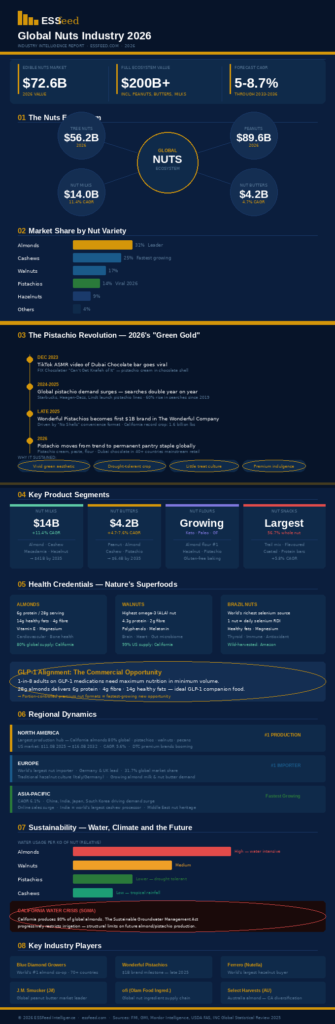
Table of Contents
1. Market Overview: The Full Nuts Ecosystem
Defining the Nuts Category
The global nuts industry encompasses an extraordinarily diverse range of products, from raw whole nuts consumed directly as snacks, to processed nut products, ingredient applications, and emerging nut-derived beverages and alternative proteins:
Tree nuts — almonds, cashews, walnuts, pistachios, hazelnuts, pecans, macadamia nuts, Brazil nuts, and pine nuts — produced from perennial trees and commanding the premium tier of the global nut market.
Peanuts (groundnuts) — technically a legume but culinarily and commercially treated as a nut, representing the world’s highest-volume nut category by production.
Nut butters and pastes — spreads produced by grinding roasted or raw tree nuts and peanuts, encompassing peanut butter, almond butter, cashew butter, hazelnut spreads (Nutella), pistachio cream, and walnut paste.
Nut milks and beverages — plant-based beverages produced from nuts including almond milk, cashew milk, macadamia milk, and hazelnut milk.
Nut flours and meals — ground nut products used in baking and cooking, including almond flour (the foundational ingredient of macarons and paleo baking), hazelnut flour, and pecan meal.
Nut-based snacks — roasted, salted, flavoured, and coated nut products; trail mixes; granola bars; and the growing category of nut-based protein snacks.
Nut ingredients — whole, chopped, sliced, diced, and paste-form nuts used as ingredients in confectionery, bakery, dairy, ice cream, and food processing.
Global Market Valuation
The global nuts market is valued at multiple levels of scope in 2026. The edible nuts market (tree nuts plus peanuts) is valued at USD 72.6 billion in 2026 by Future Market Insights, growing to USD 129.5 billion by 2036. Global Market Insights estimates the nuts market (excluding peanuts) at USD 56.2 billion in 2026, growing to USD 87.2 billion by 2035 at a CAGR of 5%. The broader nuts market including peanuts is estimated at USD 87.3 billion by Future Market Insights, with Mordor Intelligence placing the market at USD 40.28 billion in 2026 for the narrower processed nuts segment growing to USD 52.33 billion by 2031.
When peanuts (USD 89.57 billion), nut milks (USD 14.03 billion), nut butters (USD 4.24 billion), and nut-based snacks and ingredients are aggregated, the total global nuts ecosystem approaches or exceeds USD 200 billion in 2026 — making nuts one of the most commercially significant food categories globally.
Industry Structure
The nuts industry spans the full value chain from agricultural production through processing to branded consumer goods. Key players include Blue Diamond Growers (the world’s largest almond cooperative), Wonderful Pistachios & Almonds (part of The Wonderful Company), Olam International’s ofi (Olam Food Ingredients), ADM, Mariani Nut Company, Select Harvests, Borges Agricultural & Industrial Nuts, The J.M. Smucker Company (Jif peanut butter), and Ferrero (Nutella hazelnut spread). The industry is moderately fragmented — dominated at the top by scale agricultural cooperatives and branded consumer goods companies, while thousands of regional producers, specialty processors, and emerging DTC brands serve premium and niche segments.
2. Almonds: The Category’s Volume King
Market Scale
Almonds continue to dominate the tree nut market as the largest segment — supported by 50% production growth over the past decade, with California accounting for approximately 80% of global almond production. The global almond market drives the largest single category within the nuts sector by value, with Blue Diamond Growers — the world’s largest almond processing and marketing company — representing the cooperative of California almond growers.
Almonds’ commercial dominance is built on the extraordinary versatility of the ingredient: whole almonds as premium snacks, sliced almonds in baked goods and salads, almond flour as the foundation of paleo and gluten-free baking, almond butter as a premium nut spread, almond milk as the world’s most popular plant-based dairy alternative, and almond paste (marzipan) as a confectionery ingredient with thousand-year heritage.
Almond Milk: The Plant-Based Beverage Anchor
Almond milk is the world’s most widely consumed plant-based dairy alternative and the flagship product of the nut milk category. The global nut milk market is valued at USD 14.03 billion in 2025, growing at a CAGR of 11.40% through 2035 to reach USD 41.30 billion — one of the fastest growth rates of any food category globally. California produces approximately 80% of global almond supply, creating a geographic concentration that simultaneously drives the efficiency of the almond milk supply chain and creates vulnerability to California’s water crisis.
Almond Water Challenge
California’s Central Valley — the world’s most productive agricultural region for tree nuts — faces acute water constraints under the Sustainable Groundwater Management Act (SGMA). Almonds are water-intensive to grow, requiring significant irrigation in the arid California climate. Water access problems in California have reduced almond yields, and the long-term structural sustainability of California’s dominance in almond production is increasingly questioned by climate scientists, agricultural economists, and sustainability-oriented food brands.
The industry’s response includes: investment in more water-efficient drip irrigation systems; development of drought-tolerant almond rootstock varieties; geographic diversification of almond production into Australia, Spain, and parts of the Mediterranean; and the growth of pistachio cultivation as a drought-tolerant alternative to almonds in California’s Central Valley.
3. Pistachios: The Industry’s Most Extraordinary Story
The Dubai Chocolate Phenomenon
No single trend better illustrates the extraordinary commercial power of viral food culture than the global pistachio explosion driven by the Dubai Chocolate phenomenon. The story begins with food scientist Sarah Hamouda of Dubai’s FIX Dessert Chocolatier, who created “Can’t Get Knafeh of It” — a chocolate bar filled with crunchy kataifi pastry and vibrant pistachio-tahini cream that sold for approximately £15 and often sold out of its 500 daily units. In December 2023, TikTok creator Maria Vehera posted an ASMR-style video of the bar’s golden crunch and vivid green centre — and the pistachio craze ignited.
Searches for pistachios have doubled in the past year, with a 60% rise in searches recorded since 2019. Major food and drink brands including Starbucks, Häagen-Dazs, Lindt, and a proliferating ecosystem of bakeries, cafés, and food brands have launched pistachio product lines.
Wonderful Pistachios achieved a landmark milestone in late 2025 — becoming the first billion-dollar brand in The Wonderful Company’s portfolio, fuelled by explosive growth in its “No Shells” and flavoured product lines. The “No Shells” format — removing the friction of shell-cracking that limited pistachio consumption occasions — is commercially significant because it transformed pistachios from a sit-down, leisurely snack into an on-the-go, convenient format compatible with every snacking occasion.
Why Pistachio Mania Has Sustained
The pistachio trend’s extraordinary commercial durability — transitioning from a viral moment into an ongoing movement — reflects multiple reinforcing factors. First, genuinely superior taste: the combination of pistachio’s unique buttery, slightly sweet and savoury flavour with chocolate and pastry creates a complexity that is genuinely addictive. Second, stunning visual appeal: pistachio’s vivid green colour is one of the most photogenic food aesthetics on social media, making every pistachio product inherently shareable.
Third, a compelling sustainability narrative: pistachios require significantly less water than almonds, making them a more drought-resistant and planet-friendly option — a fact that resonates powerfully with eco-conscious consumers and has been amplified by food media. Fourth, premiumisation psychology: economists describe pistachio’s role in “little treat” culture — in a volatile economy, consumers may not buy luxury goods, but they will spend USD 10 on a Dubai-style latte or a premium pistachio croissant.
Fifth, structural supply dynamics: pistachio trees take approximately seven years to produce a first harvest, meaning the current commercial availability reflects investment decisions made a decade ago. California’s 2025 projected record pistachio crop of 1.6 billion pounds represents the maturation of massive investments made a decade ago — creating a supply abundance that has simultaneously enabled commercial scale and raised concerns about price sustainability.
Forest Feast and Commercial Adoption
Forest Feast’s Dubai chocolate-inspired Pistachio Crisp Milk Chocolate Dates — launched in July 2025, featuring sweet dates filled with creamy pistachio nut butter and crispy wafer enveloped in Belgian milk chocolate — launched in Morrisons and expanded to Waitrose, Boots, and Ocado, demonstrating the speed at which artisan versions of viral trends reach mainstream retail in the UK.
4. Cashews: The Fastest-Growing Tree Nut
Market Dynamics
Cashew nuts are witnessing the fastest growth of any tree nut category due to their versatility and health benefits. Cashews’ unique characteristics — creamy texture, mild sweetness, high magnesium content, and versatility in both sweet and savoury applications — make them the most application-flexible of all tree nuts.
In culinary applications, cashews serve as the foundation of virtually every premium dairy-free cream sauce, vegan cheese alternative, and plant-based dessert that requires creaminess without dairy. Soaked and blended cashews create an extraordinarily versatile dairy-free cream that has become indispensable in plant-based cooking. This culinary versatility — combined with cashews’ role as a premium snack, a confectionery ingredient, and a nut butter ingredient — is driving growth that outpaces almonds in relative terms.
Cashew Milk
Cashew milk — produced from soaked cashews blended with water — is growing rapidly as an alternative to almond milk, valued for its richer, creamier texture that makes it particularly well-suited for barista coffee applications. The barista-grade plant-based milk market is one of the most commercially dynamic in the entire plant-based food category, with cashew milk challenging oat milk for premium café positioning.
The Philippines, Thailand, and Vietnam are the world’s primary cashew production centres, with India serving as a major processing hub. The cashew supply chain — from raw cashew nut production in West Africa and Southeast Asia through industrial shelling and processing in India — is geographically complex and subject to significant supply disruption risks.
5. Walnuts: The Brain Health Nut
Nutritional Positioning
Walnuts occupy a unique nutritional positioning in the global nuts market — their exceptionally high omega-3 fatty acid content (ALA — alpha-linolenic acid), combined with emerging research on their role in cognitive health, gut microbiome support, and cardiovascular risk reduction, makes walnuts one of the most scientifically credible “functional foods” in the entire food category.
Research has associated regular walnut consumption with improved cognitive performance, reduced inflammation, better gut microbiome diversity, and cardiovascular benefits including reduced LDL cholesterol and blood pressure. The Cleveland Clinic and multiple nutritional guidelines specifically recommend walnut consumption for brain health — creating a scientific foundation for walnut marketing claims that most food categories cannot approach.
This brain health positioning is particularly commercially powerful in 2026 as cognitive health supplements and nootropic beverages represent one of the fastest-growing wellness categories — walnuts offer genuinely credible brain health benefits in natural food form that supplements cannot easily replicate.
California Walnut Production
California dominates global English walnut production, accounting for approximately 99% of US commercial production and a significant share of global supply. The walnut industry faces the same California water challenges as almonds and pistachios, though walnuts are somewhat less water-intensive than almonds and benefit from the state’s mild Central Valley climate.
6. Hazelnuts: The Chocolate Industry’s Foundation
The Nutella Effect
Hazelnuts occupy a unique position in the global nuts market — their single most important commercial application is as the defining flavour ingredient in Ferrero’s Nutella, the world’s best-selling hazelnut spread with annual revenues exceeding USD 2 billion. The hazelnut industry’s fortunes are deeply intertwined with Nutella’s continued growth — Ferrero is the world’s largest purchaser of hazelnuts, sourcing a significant proportion of the global hazelnut supply.
Turkey produces approximately 70% of the world’s hazelnuts, creating a geographic supply concentration that makes the global hazelnut market extraordinarily sensitive to Turkish agricultural conditions, political stability, and climate variability. Turkey’s political instability and climate volatility further destabilize hazelnut supply — a structural risk for every food manufacturer using hazelnuts as an ingredient.
Hazelnut Coffee Culture
Hazelnut is the world’s most popular coffee flavour — hazelnut coffee, hazelnut latte, and hazelnut macchiato are perennial bestsellers in coffee chains globally. The hazelnut flavour oil and extract market generates significant commercial volumes for flavour houses, and the combination of hazelnut with chocolate remains one of the most enduringly popular flavour combinations in confectionery and bakery.
7. Peanuts: The World’s Most Consumed Nut
Market Scale
Peanuts — technically a legume but universally classified as a nut in commercial and culinary contexts — are the world’s most consumed nut by volume and represent the largest single nuts market by commercial value at USD 89.57 billion in 2026. Their dominance reflects both their extraordinary agricultural productivity (peanuts fix atmospheric nitrogen, enriching soil rather than depleting it), their affordability relative to tree nuts, and their cultural embeddedness in North American, African, and Asian food traditions.
Peanuts are becoming more popular as a plant-based protein substitute as more people turn to plant-based diets, so increasing market demand. The adoption of plant-based diets in the US ranges from 14.4% to 17.2% of adults, indicating a measurable dietary transition that supports higher consumption of plant-derived protein sources including peanut butter and other nut products.
Peanut Butter: The Market’s Dominant Spread
Peanut butter is the world’s most consumed nut butter — and one of the most globally recognised food products in existence. The global nut butters market is valued at USD 4.24 billion in 2026, growing to USD 6.42 billion by 2035, with peanut butter commanding the largest single segment share while almond butter is growing fastest. The J.M. Smucker Company (Jif brand) is the dominant global peanut butter brand, maintaining market leadership through distribution depth, brand recognition, and consistent product quality.
The nut butters market is transitioning: peanut butter’s traditional dominance is being challenged by premium alternatives including almond butter, cashew butter, pistachio cream, and mixed nut butters that command higher price points among health-conscious, premium-oriented consumers. Consumer demand is increasingly shaped by nutritional transparency — buyers scrutinising ingredient lists for added sugars, hydrogenated oils, and artificial preservatives. Organic and non-GMO certifications have transitioned from niche differentiators to baseline expectations in premium segments.
In January 2026, Puratos acquired Vör Foods — accelerating nut-based innovation in the baking ingredients sector and demonstrating the strategic value that large food ingredient companies now place on premium nut-based product platforms.
8. Macadamia and Pecans: The Premium Tier
Macadamia: The World’s Most Expensive Nut
Macadamia nuts are the highest-value nut commercially traded globally — consistently commanding the highest per-kilogram price of any commercially produced nut, reflecting their limited geographic production range (Hawaii, Australia, South Africa, Kenya, and a few other subtropical regions), the long time-to-harvest from planting (7–10 years), and their genuinely exceptional flavour and texture profile.
Macadamia’s luxury positioning — rich, buttery, and uniquely satisfying — makes it the premium confectionery and gifting nut of choice. Macadamia milk is emerging as a premium plant-based dairy alternative, particularly popular in premium coffee applications where its creamy richness creates exceptional barista performance.
Pecans: The American Heritage Premium
Pecans — native to North America and deeply embedded in American culinary tradition through pecan pie, pralines, and pecan-crusted proteins — occupy a premium niche in the global nuts market. People who want high-quality food products and healthy options create a market for pecan and macadamia nuts, which exist as premium nut varieties. The growing global awareness of pecans’ health profile — high in oleic acid, antioxidants, and mineral content — is expanding their export market beyond North America into Europe and Asia.
9. Brazil Nuts and Pine Nuts: The Rainforest Economy
Brazil Nuts: Sustainable Wildcrafting
Brazil nuts are unique among commercially significant nuts — they grow exclusively in wild rainforest trees and cannot be cultivated commercially, making their supply entirely dependent on the health of Amazon rainforest ecosystems. Brazil nuts must be harvested from wild trees at heights reaching 50 metres, by communities who have harvested them for centuries.
This makes Brazil nuts simultaneously the world’s most naturally “organic” nut (wild-harvested, zero agricultural inputs) and one of the most sustainable food products in global trade, with Brazil nut collection providing direct economic incentive for rainforest conservation and indigenous community livelihoods. Brazil nuts are a genuinely exceptional functional food — the world’s richest source of selenium, with a single nut providing the recommended daily intake of this essential mineral.
Pine Nuts
Pine nuts — the seeds of certain pine tree species, harvested primarily in China, Russia, Afghanistan, Pakistan, and the Mediterranean — are among the most labour-intensive and expensive commercial nuts globally. Their primary culinary application — as the foundational ingredient of basil pesto — creates significant concentration of demand in the premium Italian and Mediterranean cuisine segment.
10. Nut Milks: The Plant-Based Beverage Revolution
Market Scale and Growth
The global nut milk market is valued at USD 14.03 billion in 2025, projected to grow at a remarkable CAGR of 11.40% from 2026 to 2035, reaching USD 41.30 billion. This makes nut milk the fastest-growing segment of the entire nuts ecosystem — driven by dairy alternative demand, lactose intolerance awareness, plant-based diet adoption, and continuous innovation in nut milk formulations and flavours.
Manufacturers are introducing new varieties including almond, cashew, coconut, macadamia, and hazelnut milk, as well as flavoured options, catering to diverse consumer preferences. The barista-grade plant-based milk market — specifically formulated to steam and foam like dairy milk for espresso-based coffee drinks — is particularly commercially dynamic, with Oatly dominating but nut milks competing for premium café positioning.
Almond vs. Oat: The Great Plant Milk Debate
Almond milk’s position as the world’s most consumed plant-based milk alternative is being challenged by oat milk’s rapid commercial ascent. While oat milk has outpaced almond milk in growth rate in the premium coffee channel — particularly in the US and Europe — almond milk’s established distribution, consumer familiarity, and lower sugar content maintain its overall volume leadership.
The sustainability debate adds complexity: almond milk requires significant water inputs per litre of final product (given California’s irrigation-intensive almond production), while oat milk has a lower water footprint but requires farmland and uses more energy in processing. The “which plant milk is most sustainable” debate is one of the most active consumer discussions in the food sustainability space and is directly shaping purchasing decisions among environmentally conscious consumers.
11. Nut Flours and Baking Innovation
Almond Flour: The Paleo and Keto Foundation
Almond flour — produced by grinding blanched almonds to a fine meal — has become one of the most commercially significant ingredient innovations in the health and wellness baking category. It is the foundational ingredient of paleo baking (which excludes grains), gluten-free baking (for consumers with coeliac disease or gluten sensitivity), keto baking (where its low carbohydrate content is essential), and macarons (the French confectionery that requires almond flour for its distinctive texture).
The growth of speciality dietary requirements — coeliac disease affecting approximately 1% of the global population, gluten sensitivity affecting a significantly larger share, and the voluntary adoption of gluten-free, paleo, and keto diets by health-conscious consumers — has created sustained structural demand for almond flour that is growing significantly faster than conventional wheat flour in the premium baking segment.
Nature’s Eats, a brand under Texas Star Nut & Food Co., introduced almond flour blended with natural ingredients to mimic traditional flour performance in baking and rising — addressing one of the primary technical challenges of pure almond flour (its inability to rise like wheat flour) and expanding almond flour’s applicability to a broader range of baking applications.
Hazelnut, Pecan, and Pistachio Flours
Beyond almond flour, hazelnut flour (used in French patisserie and premium chocolate products), pecan flour, and the emerging pistachio flour category are all growing as premium baking ingredients. The extraordinary success of pistachio as a flavour ingredient in 2025–2026 is driving rapid product development in pistachio paste, pistachio cream, and pistachio flour for commercial bakery, patisserie, and gelato applications.
12. Sustainability: Water, Climate and the Future of Nut Agriculture
California’s Water Crisis and Tree Nuts
The California water crisis is the defining sustainability challenge for the global tree nut industry. California’s Central Valley produces approximately 80% of global almonds, a significant share of global pistachios and walnuts, and is the world’s most commercially significant nut-growing region. The Sustainable Groundwater Management Act (SGMA) is progressively restricting the groundwater pumping that has historically sustained California’s water-intensive agriculture — creating structural limits on future production growth and requiring significant investment in water efficiency.
Pistachio growers have a natural resilience advantage: pistachios require less water than almonds and are more drought-tolerant, surviving on minimal water during droughts when almond trees struggle. This drought tolerance is one of the commercial sustainability arguments that pistachio advocates are making to increasingly sustainability-conscious institutional food buyers and retail own-brand teams.
Producers have begun investing in more water-efficient irrigation systems, drought-resistant nut tree varieties, and precision agriculture techniques — including IoT soil moisture sensors, AI-powered irrigation scheduling, and satellite-based crop health monitoring that enable precision water application that reduces waste without compromising yields.
Geographic Diversification of Production
The water constraint in California is accelerating geographic diversification of nut production into: Australia (almonds and macadamia), Spain and Portugal (almonds), Turkey (hazelnuts and pistachios), Iran (pistachios and walnuts), Southeast Asia (cashews), and South America (pecans). This geographic diversification reduces single-region supply concentration risk while creating new supply chain complexity for processors and branded nut companies accustomed to California’s efficient, high-quality production infrastructure.
Organic and Certification Trends
Consumers are increasingly opting for nuts with “organic,” “fair trade,” or low carbon footprint certifications. Online sales shares are growing, especially in China, the US, and South Korea, where younger generations are looking for a variety of branded products. The transition to organic certification — which requires three years of chemical-free production before certification is granted and typically reduces yields by 20–30% in the transition period — is a significant investment for nut growers, but commands premium retail pricing that makes the economics increasingly attractive in the premium segment.
13. GLP-1 and the Nuts Category
Natural Alignment with GLP-1 Nutrition Needs
The nuts category has a natural and powerful alignment with the nutritional requirements of GLP-1 medication users that positions it as one of the most commercially benefited food categories from the medication’s expanding adoption. GLP-1 users consuming significantly less food need: high-quality protein to preserve muscle mass; healthy fats that are satiating without being calorie-dense in volume; and nutrient-dense foods that deliver maximum nutritional value per gram consumed.
Nuts deliver all three simultaneously. A small handful of almonds (28 grams) provides 6 grams of protein, 14 grams of healthy monounsaturated and polyunsaturated fats, 4 grams of fibre, and significant magnesium, calcium, and vitamin E — making it one of the most nutrient-dense small-volume foods available. For GLP-1 users whose reduced appetite means they can only eat small amounts, the nutritional density of nuts makes every calorie count in a way that is commercially differentiated from most snack categories.
14. Regional Dynamics
North America: Production and Premium Consumption Leader
The US dominates global nut production — particularly almonds (California), pistachios (California), walnuts (California), pecans (Georgia, Texas, New Mexico), and peanuts (Georgia, Texas, Virginia). The US nuts market is projected to grow from USD 10,976.6 million in 2025 to USD 16,026.1 million by 2032 at a CAGR of 5.6%.
The US consumer is the world’s most sophisticated premium nut consumer — embracing organic certification, flavour innovation, DTC subscription nut brands, and the extraordinary ecosystem of artisan nut butter companies that have built premium businesses through clean-label positioning and single-origin storytelling.
Europe: The World’s Largest Import Market
Europe is the world’s largest importer of nuts — with Germany leading European nut consumption. Almonds are gaining popularity as a source of raw materials for non-dairy products, with Germany and the UK driving demand for almond-based beverages and ingredients. Traditional preferences for hazelnut-based spreads — particularly in Italy and Germany — coexist with the growing demand for peanut, almond, and cashew butters driven by plant-based protein trends.
The EU-funded school nutrition programs promoting protein-rich foods and the increasing prevalence of flexitarian diets are driving European nut consumption growth, while premiumisation toward organic and single-origin products is reshaping the retail landscape in Germany, France, and the UK.
Asia-Pacific: The Growth Engine
Asia-Pacific is the fastest-growing nuts market with a CAGR of 6.1% through 2030. China, India, and Japan have large consumer bases for almonds, peanuts, cashews, and walnuts. Online sales are growing rapidly — especially in China, South Korea, and Japan, where younger generations are looking for a variety of branded products through e-commerce and social commerce platforms.
India is emerging as a particularly dynamic growth market — both as a consumer of premium nuts (rising middle class, health consciousness) and as a processing hub for cashews (the world’s largest cashew processing industry is located in India’s Konkan coast region).
The Middle East — where nuts have been a central part of culinary culture for millennia — is the natural geographic home of the pistachio trend, and the region’s premium nut consumption reflects a deep cultural heritage of nut-centric food culture. Dubai’s role in the pistachio craze is no accident — it reflects the region’s existing sophistication in premium nut applications.
15. Critical Risks and Challenges
Nut Allergies
Nut allergies — particularly peanut allergy and tree nut allergies — represent the most significant regulatory and public health challenge facing the nuts industry. Tree nut allergies can cause anaphylactic reactions requiring emergency medical treatment, and peanut allergy affects approximately 1–2% of the population in Western countries, with prevalence increasing over recent decades.
The regulatory requirements for nut allergen labelling — mandatory in the US (FDA major allergen labelling), EU (EU food information to consumers regulation), and most other major markets — create significant labelling, manufacturing facility segregation, and supply chain traceability requirements for food manufacturers using nuts as ingredients. The growth of “free-from” and allergen-safe product lines is creating both challenges (exclusion from nut-containing product categories) and opportunities (dedicated nut-free snack alternatives).
Climate Vulnerability
Beyond California’s water crisis, global nut production faces multiple climate-related threats. Turkey’s political instability and climate volatility are destabilising hazelnut supply. Extreme weather events — late frosts destroying almond blossoms, droughts reducing pistachio yields, tropical storms disrupting cashew harvests — create year-to-year production volatility that translates directly into price spikes. The social media-driven demand volatility of the pistachio craze has created price and supply chain disruptions that illustrate how rapidly viral trends can overwhelm supply chains built on 7–10 year production cycles.
Demand Volatility and Social Media Trends
The Dubai chocolate pistachio phenomenon exemplifies how social media-driven trends can disrupt markets overnight. The pistachio shortage is a catalyst for rethinking supply chains — concentration creates systemic risks when demand unexpectedly spikes. For nut growers, the 7–10 year investment cycle for new pistachio orchards means they cannot respond to viral demand spikes with immediate supply increases.
16. Strategic Outlook for Stakeholders
Actionable Recommendations
Position Nuts as GLP-1 Companion Foods Proactively: The natural alignment of nuts with GLP-1 nutritional requirements — high protein, healthy fats, fibre, and micronutrient density in small volumes — is a commercial positioning opportunity that the nuts industry has not yet fully exploited. Creating GLP-1-specific portion-sized nut products with specific nutritional claim stacks (protein content, omega-3, magnesium) represents a high-value near-term opportunity.
Build Pistachio Capability Before the Trend Normalises: The pistachio moment is not over — searches doubled in the past year and Wonderful Pistachios’ billion-dollar brand milestone demonstrates the commercial scale achievable. Food manufacturers who have not yet developed pistachio product lines are still in the window to capture trend momentum before market saturation occurs.
Invest in Water-Efficient Production Technology: For nut growers and agricultural cooperatives in water-stressed regions, investment in precision irrigation technology, soil moisture sensing, and AI-powered water management is both a sustainability imperative and a commercial necessity — SGMA restrictions will progressively tighten, and growers without water efficiency infrastructure will face production constraints before competitors who invest now.
Diversify the Nut Portfolio for Premium Market Access: The premium nut market — encompassing macadamia, pecan, pistachio, and flavoured specialty nuts — is growing faster than the commodity segment. Branded nut companies that build diversified portfolios spanning standard and premium nut varieties capture both volume and margin growth.
Strategic Summary: The 2026 Nuts Business Model
| Strategic Priority | Traditional Approach | 2026 Competitive Standard |
|---|---|---|
| Product Portfolio | Commodity whole nuts | Diversified: butters, milks, flours, snacks, flavoured formats |
| Pistachio Strategy | Standard snack positioning | Dubai chocolate adjacent premium innovation |
| GLP-1 Positioning | General health claims | Specific nutrient density claims for GLP-1 companion positioning |
| Sustainability | General organic certification | Water footprint transparency, precision agriculture investment |
| Distribution | Retail mass market | DTC subscription + online + foodservice premium |
| Production Resilience | Single-region concentration | Multi-geography diversification for climate resilience |
17. Leading Industry Companies
| Company | Region | Strategic Focus |
|---|---|---|
| Blue Diamond Growers | USA/Global | World’s largest almond cooperative and processing company. Almond Breeze almond milk brand. Comprehensive almond ingredient portfolio. California-based with global distribution across 70+ countries. |
| The Wonderful Company (Wonderful Pistachios & Almonds) | USA/Global | Wonderful Pistachios — first billion-dollar brand in portfolio, achieved late 2025. “No Shells” product line. Flavoured pistachio innovation. California’s largest pistachio producer. |
| ofi (Olam Food Ingredients) | Singapore/Global | Global leader in nut ingredient supply across cashews, almonds, pistachios, and hazelnuts. Comprehensive supply chain from farm to food manufacturer. Sustainability certification programme. |
| Ferrero Group | Italy/Global | World’s largest hazelnut buyer. Nutella — world’s best-selling hazelnut spread. Kinder, Ferrero Rocher, Raffaello all nut-dependent products. Expanding nut ingredient sourcing across Africa and Europe. |
| The J.M. Smucker Company | USA/Global | Jif brand — dominant global peanut butter market leader. Expanding into premium nut butter varieties. Strong North American retail distribution. |
| ADM (Archer Daniels Midland) | USA/Global | Major nut ingredient supplier and processor. Comprehensive portfolio of nut-derived ingredients for food manufacturing. Precision agriculture partnerships supporting sustainable nut sourcing. |
| Borges Agricultural & Industrial Nuts | Spain/Global | Leading European nut company across almonds, hazelnuts, walnuts, and mixed nuts. Strong in Mediterranean origin storytelling and premium positioning. |
| Select Harvests | Australia/Global | Australia’s leading almond producer — providing geographic diversification from California supply concentration. Growing export volume to Asian and European markets. |
| Mariani Nut Company | USA | Premium California walnut and almond producer. Organic certification leader. Premium dried fruit and nut combination products. |
| American Pistachio Growers | USA | Industry association representing 800 US pistachio growers in California and Arizona. Collective marketing and sustainability advocacy. Managing the extraordinary pistachio demand surge of 2025–2026. |
Related Reports
As the industry shifts from the high-inventory dynamics of previous years toward a tighter global supply-demand balance, understanding the current agricultural landscape is critical. Our Global Crops and Grains Market 2026 Report provides a data-driven look at the production trajectories, fertilizer cost pressures, and logistical challenges defining the current marketing year.
Valued at USD 559.66 billion in 2026, the global animal feed industry is rapidly shifting toward precision nutrition and digital intelligence. For a deep dive into the current market dynamics, supply chain challenges, and growth drivers, read the full Global Animal Feed Industry Report 2026.
Frequently Asked Questions (FAQ)
What is the global nuts market size in 2026?
The global nuts market is valued at multiple levels depending on scope. The edible nuts market (all tree nuts plus peanuts, retail and ingredient) is valued at USD 72.6 billion in 2026 by Future Market Insights, growing to USD 129.5 billion by 2036. Global Market Insights estimates the tree nuts market (excluding peanuts) at USD 56.2 billion in 2026, growing to USD 87.2 billion by 2035. The peanuts market alone is valued at USD 89.57 billion in 2026. Including nut butters (USD 4.24 billion), nut milks (approximately USD 15 billion in 2026), and nut-based snacks and ingredients, the total global nuts ecosystem approaches or exceeds USD 200 billion in 2026. Almonds lead tree nuts by market share, supported by 50% production growth over the past decade. North America remains the largest consumption market. Asia-Pacific is the fastest-growing market at a CAGR of 6.1%.
What is the Dubai chocolate pistachio trend and why has it sustained?
The Dubai chocolate phenomenon traces to food scientist Sarah Hamouda of Dubai’s FIX Dessert Chocolatier, who created “Can’t Get Knafeh of It” — a chocolate bar filled with kataifi pastry and pistachio-tahini cream — that went viral when TikTok creator Maria Vehera posted an ASMR video in December 2023. The bar’s golden crunch revealing vivid green pistachio filling became one of the most replicated food images on social media globally. The trend has sustained because it is underpinned by multiple reinforcing factors: pistachio’s genuinely exceptional flavour profile; its vivid photogenic green colour; a compelling sustainability narrative (less water than almonds); the premium “little treat” psychology driving consumers toward accessible luxuries; and the structural investment maturation that has made 2025–2026 a record pistachio harvest year. Wonderful Pistachios became the first billion-dollar brand in The Wonderful Company’s portfolio in late 2025, validating the commercial scale of the trend.
What is the difference between tree nuts and peanuts?
The key distinction is botanical: tree nuts grow on trees and contain a hard, inedible shell surrounding a seed kernel, while peanuts are legumes — they grow underground on plants in the bean/legume family, similar to lentils or chickpeas. Tree nuts include almonds, cashews, walnuts, pistachios, hazelnuts, pecans, macadamia nuts, Brazil nuts, and pine nuts. Peanuts (groundnuts) are botanically a legume but are universally treated as nuts in culinary, commercial, and regulatory contexts. Nutritionally, peanuts and tree nuts share key characteristics — high in healthy fats, protein, fibre, and micronutrients — but tree nut allergies and peanut allergy are distinct immune responses that are not cross-reactive in most patients. Commercially, peanuts are significantly cheaper to produce than tree nuts (they are highly productive, nitrogen-fixing crops) and represent the world’s highest-volume “nut” market at USD 89.57 billion in 2026.
How are nuts benefiting from the GLP-1 medication trend?
Nuts are naturally aligned with the nutritional requirements of GLP-1 medication users — making the category one of the most commercially advantaged food segments from this trend. GLP-1 users dramatically reduce their total food intake, meaning the nutritional quality of what they do eat becomes more critical. Nuts deliver extraordinary nutritional density in small volumes: a 28-gram serving of almonds provides 6 grams of protein, 14 grams of healthy fats, 4 grams of fibre, and significant vitamins and minerals. This makes nuts ideal for GLP-1 users who need maximum nutrition in minimum volume. Additionally, nuts’ satiety effect — their combination of protein, fat, and fibre creating prolonged fullness — aligns with the reduced hunger state of GLP-1 users, who benefit from foods that satisfy without requiring large volumes. The GLP-1 companion positioning opportunity is strongest for nut products clearly communicating their protein content, nutrient density, and healthy fat profile — particularly in convenient, portion-controlled formats.
What is the water crisis affecting nut production in California?
California’s Central Valley — which produces approximately 80% of global almonds and a significant share of global pistachios and walnuts — faces acute water constraints driven by decades of over-extraction from underground aquifers, declining snowpack from climate change, and increasing drought frequency. The Sustainable Groundwater Management Act (SGMA), enacted in 2014 with implementation accelerating through 2026 and beyond, progressively restricts groundwater pumping in California’s most important agricultural areas, creating structural limits on the water available for irrigation-intensive tree nut production. Water access problems in California have already reduced almond and pistachio yields and raised production costs significantly. The industry’s response includes investment in precision drip irrigation, drought-tolerant rootstock development, and geographic diversification of production into Australia, Spain, and other water-adequate regions. Pistachios have a natural advantage — they require significantly less water than almonds and can survive drought conditions that would stress almond orchards.
What are the key product innovations in the nuts category in 2026?
Six innovations are defining the global nuts category in 2026. First, pistachio cream and paste — the commercial mass production of Dubai chocolate-inspired pistachio cream is driving a wave of product launches across bakery, confectionery, gelato, and coffee. Second, nut-based protein snacks — almonds, peanuts, and cashews being formulated into high-protein bars, bites, and clusters targeting the protein megatrend. Third, nut milk innovation — cashew milk, macadamia milk, and pistachio milk challenging almond and oat milk in the premium plant-based dairy alternative category. Fourth, flavoured nut butters — infused with chocolate, honey, adaptogens, and superfoods beyond basic roasted nut paste. Fifth, nut flour expansion — pistachio flour, hazelnut flour, and pecan flour joining almond flour as premium baking ingredients. Sixth, whole-supply-chain sustainability labelling — origin traceability, water footprint claims, and regenerative agriculture certification becoming commercial differentiators in premium retail.
What are the key product innovations in the nuts category in 2026?
Six innovations are defining the global nuts category in 2026. First, pistachio cream and paste — the commercial mass production of Dubai chocolate-inspired pistachio cream is driving a wave of product launches across bakery, confectionery, gelato, and coffee. Second, nut-based protein snacks — almonds, peanuts, and cashews being formulated into high-protein bars, bites, and clusters targeting the protein megatrend. Third, nut milk innovation — cashew milk, macadamia milk, and pistachio milk challenging almond and oat milk in the premium plant-based dairy alternative category. Fourth, flavoured nut butters — infused with chocolate, honey, adaptogens, and superfoods beyond basic roasted nut paste. Fifth, nut flour expansion — pistachio flour, hazelnut flour, and pecan flour joining almond flour as premium baking ingredients. Sixth, whole-supply-chain sustainability labelling — origin traceability, water footprint claims, and regenerative agriculture certification becoming commercial differentiators in premium retail.
Who are the largest nuts companies globally in 2026?
The global nuts industry is led by a combination of scale agricultural cooperatives, multinational food ingredient companies, and major branded consumer goods companies. Blue Diamond Growers is the world’s largest almond cooperative, marketing under the Blue Diamond snack nut and Almond Breeze plant-based milk brands across 70+ countries. The Wonderful Company operates Wonderful Pistachios — now a billion-dollar brand — as the world’s most commercially significant pistachio brand. ofi (Olam Food Ingredients) is the leading global nut ingredient supplier across cashews, almonds, and pistachios. Ferrero is the world’s largest hazelnut buyer through Nutella and its broader confectionery portfolio. The J.M. Smucker Company leads global peanut butter through the Jif brand. ADM is a major nut ingredient supplier and processor. Select Harvests leads Australian almond production. Borges leads European nut marketing. American Pistachio Growers is the collective marketing body for US pistachio growers managing the extraordinary demand surge of 2025–2026.
Sources and Additional References
- Future Market Insights: Nuts Market Global Analysis Report 2026–2036 — https://www.futuremarketinsights.com/reports/nuts-market
- Future Market Insights: Edible Nuts Market Size, Share & Forecast to 2036 — https://www.futuremarketinsights.com/reports/edible-nuts-market
- Future Market Insights: Nut Butters Market Size, Demand & Trends 2025 to 2035 — https://www.futuremarketinsights.com/reports/nut-butters-market
- Global Market Insights: Nuts Market Size & Share | Growth Trends 2035 — https://www.gminsights.com/industry-analysis/nuts-market
- Mordor Intelligence: Nut Market Size, Trends, Report Analysis, Share & Growth Drivers 2031 — https://www.mordorintelligence.com/industry-reports/nut-market
- SkyQuest: Tree Nuts Market Size, Share, Analysis, Industry Trends by 2033 — https://www.skyquestt.com/report/tree-nuts-market
- SkyQuest: Nut Butters Market Size & Share | Growth Trends 2033 — https://www.skyquestt.com/report/nut-butters-market
- Market Research Future: Tree Nuts Market Size, Share, Analysis, Industry Trends by 2035 — https://www.marketresearchfuture.com/reports/tree-nuts-market-2482
- Market Research Future: Nut Butters Market Demand, Size, Share, Industry Growth — https://www.marketresearchfuture.com/reports/nut-butters-market-1299
- Fortune Business Insights: Peanuts Market Size, Share, Growth, Industry Report 2026–2034 — https://www.fortunebusinessinsights.com/peanuts-market-112151
- Fortune Business Insights: Nut Ingredients Market Size, Share | Industry Report 2026–2034 — https://www.fortunebusinessinsights.com/nut-ingredients-market-115330
- Verified Market Research: Edible Nuts Market Size, Share & Forecast — https://www.verifiedmarketresearch.com/product/edible-nuts-market/
- Expert Market Research: Nut Milk Market Size and Share | Industry Forecast 2035 — https://www.expertmarketresearch.com/reports/nut-milk-market
- Research Nester: Nut Butters Market Size & Share | Growth Analysis 2035 — https://www.researchnester.com/reports/nut-butters-market/8424
- Grand View Research: Nuts Market Size, Share & Trends Analysis Report 2030 — https://www.grandviewresearch.com/industry-analysis/nuts-market-report
- The Business Research Company: Nuts Market Size, Share, Trends, Drivers Report 2026 — https://www.thebusinessresearchcompany.com/report/nuts-global-market-report
- Foodcom S.A.: The Nut Market in 2026 — Market Dynamics and Analysis | Global Report — https://foodcom.pl/en/global-report-nuts-market-overview/
- FoodBev Media: Peak Pistachio — The F&B Industry Is Still Going Nuts for Dubai Chocolate — https://www.foodbev.com/news/peak-pistachio-the-f-b-industry-is-still-going-nuts-for-dubai-chocolate
- KQED: Pistachios and Climate Change — Inside Dubai Chocolate Is a Very California Story — https://www.kqed.org/news/12060700/dubai-chocolate-recipe-pistachios-climate-change-california
- The Nutri Deep: Why Are Pistachios So Popular All of a Sudden? The Rise of the “Green Gold” — https://thenutrideep.com/why-pistachios-are-popular-2026-trend-analysis/
- Postdigitalist: Pistachio Craze Trend Analysis — From Dubai Chocolate to Global Markets — https://www.postdigitalist.xyz/blog/pistachio-trend
- Accio Business Intelligence: Trend of Pistachio Nuts 2025 — Growth, Demand & Supply Insights — https://www.accio.com/business/trend-of-pistachio-nuts
- AInvest: Pistachio Shortages Highlight Supply Chain Fragility — https://www.ainvest.com/news/pistachio-shortages-highlight-supply-chain-fragility-opportunities-niche-nut-producers-2506/
- Vocal Media / Persistence Market Research: US Nuts Market Sustainability Trends — https://vocal.media/journal/u-s-nuts-market-sustainability-trends
- Ken Research: North America Nuts Market Insights, Size, Trends & Forecast Report 2030 — https://www.kenresearch.com/industry-reports/north-america-nuts-market
