
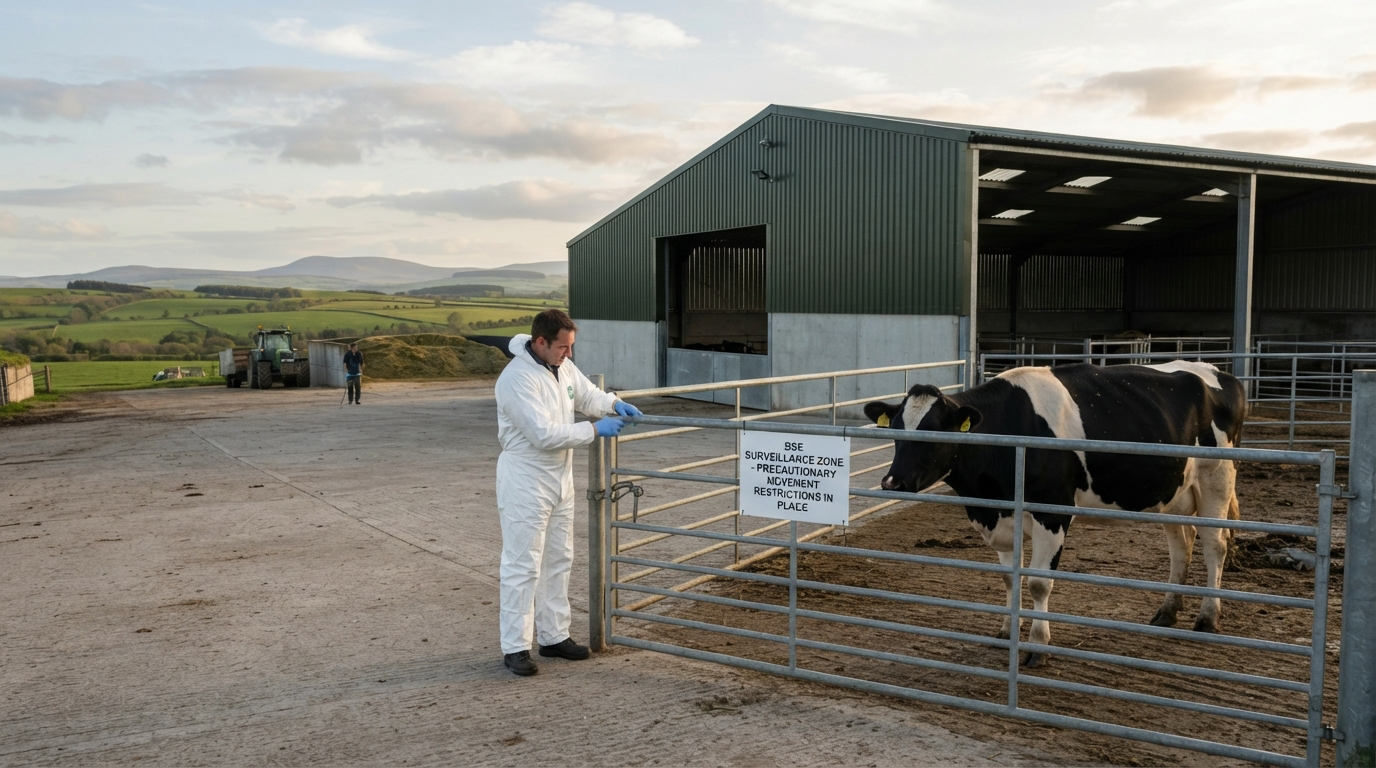

The UK confirmed a case of classical bovine spongiform encephalopathy (BSE), commonly known as mad cow disease, on a farm in Dumfries and Galloway, Scotland on August 19, 2026. This is the first confirmed UK BSE case in over two years, emerging just three months after the UK received “negligible risk” status from the World Organisation for Animal Health (WOAH) in May 2025. While food safety authorities confirm zero risk to human health and the affected animal did not enter the food chain, the timing raises serious questions about the sustainability of the UK’s newly-acquired negligible risk status and poses immediate compliance risks for premium export markets including Japan and South Korea.
Table of Contents
Case Details: 7.5-Year-Old Cow, Routine Surveillance Detection
On August 19, 2026, UK food safety authorities confirmed a case of classical bovine spongiform encephalopathy (BSE) in a cow on a farm in Dumfries and Galloway in southwest Scotland. The confirmation came after routine surveillance testing identified the disease in an animal that had died on the farm.
Confirmed Case Specifications:
- Animal Age: 7.5 years old at time of positive test
- Detection Method: Routine BSE surveillance program (all animals over 4 years that die on farm routinely tested)
- Location: Dumfries and Galloway, Scotland (southwest region)
- Food Chain Impact: Animal did NOT enter human food chain (identified before processing/slaughter)
- Disease Type: Classical BSE (not variant CJD-linked atypical form)
Agriculture Minister Jim Fairlie praised Scotland’s surveillance system, stating: “Following confirmation of a case of classical BSE in Dumfries and Galloway, the Scottish Government and other agencies acted swiftly and decisively to protect the agriculture sector. The rapid identification of the case demonstrates that Scotland’s surveillance system is working effectively.”
Surveillance Program Context: Scotland’s BSE surveillance program involves intensive testing of cattle to detect the disease. The program targets animals over 4 years of age that die on farm—animals that would not normally enter commercial processing. This intensive surveillance approach is designed to catch classical BSE at the earliest possible stage and prevent any risk of infected material reaching the food chain.
The fact that this 7.5-year-old animal was identified through routine on-farm death surveillance (rather than at slaughter) confirms that UK controls are functioning as designed. However, the case itself raises the uncomfortable question: how did this animal become infected despite decades of strict safeguards?
Food Safety Assessment: Zero Risk to Human Health
Food Standards Scotland (FSS) and the UK’s regulatory authorities have confirmed unequivocally that this case poses zero risk to human health. This assessment is based on several critical factors:
- No Food Chain Entry: The affected animal was identified through on-farm death surveillance before it reached slaughter or processing facilities. It did not enter the human food supply at any point.
- Age Restrictions in Export Markets: Even if this animal had entered the supply chain, it would have exceeded the age restrictions for export to premium markets like Japan (under 30 months) and been unsuitable for export-grade processing.
- Variant CJD Link Limited: Classical BSE has never been definitively linked to variant Creutzfeldt-Jakob disease (vCJD) in humans—the disease that caused the 1990s public health panic in the UK. The human risk from classical BSE is considered remote compared to the historical atypical BSE strains.
- Regulatory Oversight: UK processing facilities that export beef to premium markets operate under stringent EU and WOAH protocols requiring specific handling of at-risk materials (SRM—specified risk materials). An animal of this age would trigger automatic removal of high-risk tissues regardless of test results.
The Northern Ireland Department of Agriculture, Environment and Rural Affairs (DAERA) reinforced this assessment, with Minister Andrew Muir stating: “The case was identified as a result of routine BSE surveillance and stringent control measures that are in place. The animal did not enter the human food chain and Food Standards Scotland have confirmed there is no risk to human health as a result of this isolated case.”
This absolute safety confirmation is important for consumer reassurance—but it does little to address the reputational and trade implications of the case confirmation itself.
Response Measures: Movement Restrictions & Investigation
UK authorities have implemented standard precautionary response measures:
Immediate Actions Taken:
- Movement Restrictions: Precautionary movement restrictions have been placed on the affected cow’s offspring and cohort animals at the impacted farm. These animals (those that may have shared similar exposure risks at the farm) will be isolated and traced.
- Offspring & Cohort Tracing: Offspring of the affected animal and cohort cattle have been traced and isolated. These animals will be destroyed in line with legal requirements for BSE-affected cohorts.
- Epidemiological Investigation: The Animal and Plant Health Agency (APHA) is conducting a full epidemiological investigation to identify the source of disease. This is standard procedure for any confirmed classical BSE case and is considered essential to prevent recurrence.
- Affected Farm Cooperation: The owners of the affected animals are working with authorities on next steps. The farm has cooperated with authorities in implementing movement restrictions and tracing.
Investigation Focus — Feed Source Critical: Classical BSE is caused primarily by contaminated animal feed (cattle fed rendered material containing infected animal protein). UK safeguards have prohibited ruminant-to-ruminant feed practices since the 1990s. The APHA investigation will focus on determining how this animal was exposed to BSE prions, given that feed contamination should have been prevented by existing regulations.
Possible investigation pathways:
- Contaminated imported animal feed (unlikely given UK/EU feed import controls)
- Failure in a specific feed mill’s compliance with rendering regulations
- Cross-contamination during feed production or handling
- Historical exposure years ago (given the 7.5-year age and potential 8+ year incubation period)
The origin identification is critical—if the infection source is found to be recent (post-2000s controls), it would suggest regulatory failure. If it reflects historical exposure from decades past (pre-1990s contamination), it would simply confirm that occasional old cases continue to surface as long-incubation animals age.
OIE Negligible Risk Status: Awarded May 2025, Now Under Scrutiny
The timing of this case is remarkably inopportune for the UK beef industry. In May 2025, the World Organisation for Animal Health (WOAH, formerly OIE) officially recognized the UK as having negligible risk status for classical BSE—an upgrade from the previous “controlled risk” designation that had persisted since the 1990s epidemic.
What Negligible Risk Status Means: Negligible risk is WOAH’s most favorable classification for BSE. It signals to trading partners that the country has:
- Demonstrated comprehensive disease surveillance systems capable of detecting BSE cases promptly
- Implemented strict controls on animal feed (ruminant-to-ruminant protein bans)
- Removed specified risk materials (SRM) from the food and feed chains
- Maintained traceability systems for animal movements
- Achieved sustained low incidence of disease (historically low case numbers)
Negligible Risk Achievement Was Hard-Won: Achieving negligible risk status was a major milestone for the UK after decades of restrictions following the 1980s-1990s BSE epidemic. The upgrade was based on rigorous WOAH assessment of the UK’s surveillance data, regulatory frameworks, and historical case patterns. The UK documented decades of intense surveillance with minimal case detection—a record that demonstrated the effectiveness of post-1990s controls.
The August 2026 Case Challenge: A confirmed BSE case just three months after receiving negligible risk status creates an awkward question for trading partners: If the UK truly has negligible risk status, why is BSE still appearing? The official answer is that negligible risk does not mean zero risk—it means controlled and minimized risk. Occasional cases can still occur in countries with negligible risk status, particularly given the long incubation period of classical BSE (up to 8+ years).
However, trading partners may not accept this nuance. Premium markets that had closure to UK beef under “controlled risk” status may question whether they should re-impose restrictions until it’s clear this case does not signal a resurgence.
Official Position on Status Maintenance: Northern Ireland’s DAERA Minister stated flatly: “This finding will not impact on Northern Ireland’s or Scotland’s BSE negligible risk status.” The official position is that a single case, caught through surveillance, does not invalidate the negligible risk classification. However, multiple cases within a short timeframe could trigger status review.
Export Compliance Risk: Japan & South Korea Market Access Threatened
The most immediate risk from the BSE case confirmation is not food safety but trade. Japan and South Korea are premium markets for UK beef, and both maintain strict BSE-related requirements.
Japan — Restricted Market Access: Japan had maintained a complete ban on UK beef imports during the BSE crisis era. In 2019, Japan partially lifted the ban, but only for beef carcass meat and offal from animals under 30 months of age. Products such as minced beef and prepared/cooked beef remain prohibited.
UK beef exports to Japan in 2025: £9.80 million—a substantial but still restricted market given Japan’s importance as a global beef importer. The narrow age restriction (under 30 months only) means much of the UK beef supply (cows over 30 months old, breeding bulls, older animals) cannot access this market.
Japan’s import framework relies on the Japan Export Verification Programme (EVP) and requires site-specific approvals, official certification, and ongoing audits. The process is deliberately strict and risk-averse—any question about UK BSE status could trigger additional verification requirements or temporary suspension of shipments pending investigation.
South Korea — Closed Market Under Formal Ban: South Korea maintains a formal ban on all UK beef imports that has been in place since 2001 due to BSE concerns. This is one of the last major trade restrictions linked to BSE, and the ban has persisted despite UK requests for market access negotiations.
The ban on UK beef in South Korea is particularly significant because South Korea is a high-value market with substantial demand for premium grass-fed beef (which the UK produces). Industry analysts identified South Korea as a major upside opportunity once the UK achieved negligible risk status and could request formal market access negotiations. The August 2026 BSE case significantly complicates those negotiations before they even formally began.
Other Premium Markets Monitoring: Beyond Japan and South Korea, other premium export destinations (Malaysia, UAE, China’s high-end foodservice sector) monitor UK BSE status closely. These markets require detailed export certificates, specified traceability documentation, and compliance with age/processing protocols. Any question about UK BSE status could trigger requests for additional certification or delays in export approval.
⚠️ EXPORT COMPLIANCE RISK: UK beef exporters should prepare for potential questioning from trading partners about the BSE case. Additional documentation, certification requirements, and compliance audits may be requested, even though official position is that negligible risk status is maintained.
Historical Context: Classical BSE Outbreak Peak 1992, Tight Controls Since
To contextualize the August 2026 case, understanding the BSE epidemic history is essential:
BSE Epidemic Timeline:
- 1985-1989: BSE first recognized in UK cattle. Initially rare, detected in small numbers.
- 1989-1992: Exponential increase in case numbers. Peak epidemic: 1992 = ~37,000 cases confirmed in UK cattle (peak year)
- 1996: Public health crisis: First cases of variant Creutzfeldt-Jakob disease (vCJD) in humans—a degenerative brain disease linked to BSE consumption. Public panic ensues. UK government imposes ban on beef exports.
- 1996 Onwards: UK implements strict regulations: ruminant-to-ruminant feed ban, specified risk material (SRM) removal, animal traceability, intensive surveillance.
- 1990s-2000s: Case numbers decline dramatically as contaminated feed ages out of system and controls take effect.
- 2006+: UK achieves OIE “controlled risk” status, marking recognition that epidemic is over and controls are effective.
- May 2025: WOAH officially recognizes UK as “negligible risk”—highest classification achievable.
- August 2026: Single classical BSE case confirmed on Scottish farm.
Why Occasional Cases Still Occur: The long incubation period of classical BSE (2-8 years, sometimes longer) means that animals infected before rigorous controls were implemented can still manifest disease decades later. The August 2026 case in a 7.5-year-old animal likely reflects exposure many years ago (potentially 1999-2001 era or earlier), not current system failure.
However, this explanation does not prevent trading partners from asking: If the animal was exposed years ago, weren’t there supposed to be safeguards preventing that? And if safeguards failed then, could they fail again?
Classical BSE vs. Variant CJD: Disease Origins & Incubation Period
A critical distinction for food safety is between classical BSE (the original epidemic strain) and atypical/variant BSE forms:
Classical BSE:
- Caused by consumption of contaminated animal feed (rendered infected tissue)
- Original strain responsible for 1980s-1990s UK epidemic
- Associated with variant Creutzfeldt-Jakob disease (vCJD) in humans who consumed infected beef
- Incubation period: 2-8 years typically; can extend to 8+ years in rare cases
- Detection: Confirmed through brain tissue analysis (post-mortem) or rapid neurological deterioration
Atypical/L-Type BSE:
- Occurs spontaneously in older cattle (not feed-related)
- Identified in animals over 10 years old typically
- Human health risk unknown (no cases of vCJD linked to atypical BSE)
- Extremely rare even in countries with negligible risk status
The August 2026 case is confirmed as classical BSE—the feed-related form. This makes the epidemiological investigation more urgent: if it was indeed feed-related, investigators must determine whether the feed contamination source was recent or historical. If recent, it suggests regulatory failure. If historical, it simply reflects the tail end of the epidemic.
vCJD Human Risk Magnitude: It’s important to emphasize that the human risk from classical BSE in modern times is extremely remote. The UK’s vCJD crisis occurred in the 1990s-2000s when infected beef was entering the food chain and being consumed before the case was identified and safeguards were implemented. Modern safeguards—SRM removal, traceability, age-restricted export, processing controls—have virtually eliminated the risk that infected material reaches consumers. The August 2026 case poses zero immediate human health risk given these controls.
Previous UK Cases: Pattern of Occasional Positive Testing Despite Controls
The August 2026 case is notable as the first UK BSE confirmation in over two years—but it’s not unprecedented even in the negligible risk era:
Recent Case Pattern: The UK continues to identify occasional BSE cases despite decades of strict controls. Surveillance data shows:
- Post-2010: Rare but occasional cases detected through surveillance (typically 1-3 cases per year in UK-wide surveillance)
- Cases primarily detected in older animals (over 5 years old) that died on farm
- None in recent years entered food chain (all detected through on-farm surveillance)
- Epidemiological investigations typically inconclusive about source (no clear link to recent feed contamination)
What This Pattern Shows: UK surveillance is functioning as designed—catching occasional cases before they enter processing. However, the continuing appearance of cases (even at very low frequency) keeps the question alive: are these residual animals from old exposures, or signs of new contamination risks?
The two-year gap before the August 2026 case may have created a false sense of security in some quarters—industry and trading partners may have believed the UK had truly reached zero-case status. The case now confirms that occasional positives should be expected even in negligible risk countries, given the disease’s long incubation period and the pool of animals that were exposed decades ago.
Implications for UK Beef Exporters: Documentation & Compliance Urgency
For UK beef exporters, the August 2026 case creates immediate and medium-term compliance challenges:
EXPORTER ACTION ITEMS:
- Export Certificate Preparation: UK exporters should ensure detailed export health certificates are prepared for all shipments, emphasizing:
- Animal age and post-mortem testing status
- Specified risk material (SRM) removal documentation
- Processing facility BSE protocols and certifications
- Traceability records for individual animals
- Customer Notification: Proactive communication with trading partners (Japan, South Korea, premium Asian markets) explaining the case, response measures, and continued safety protocols. Transparency builds confidence.
- Compliance Audit Readiness: Be prepared for additional audits or inspections by importing countries’ veterinary authorities. Maintain complete documentation of all processing, handling, and dispatch protocols.
- Market Access Negotiation Risk: If planning to request market access in South Korea or expand access in Japan, expect slower negotiations and additional requirements in the near term. This should not deter efforts, but timeline expectations should be adjusted.
- Premium Product Focus: Emphasize export of younger animals (under 30 months for Japan market) and premium cuts with full SRM removal verification. Commodity beef to markets with less stringent BSE requirements may face fewer compliance questions.
- Surveillance Data Advocacy: Support UK government communication of ongoing surveillance data to trading partners, demonstrating continued effectiveness of detection systems. Transparent surveillance data builds confidence in negligible risk status.
Timeline for Resolution: APHA’s epidemiological investigation will take weeks to months. Results may clarify whether the case reflects historical exposure or recent contamination. Exporters should monitor investigation progress and be ready to communicate findings to trading partners as they emerge.
Long-Term Positioning: This case should not fundamentally undermine the UK’s negligible risk status or export credentials. Negligible risk means occasional cases can still occur—the UK’s response (rapid detection, investigation, prevention of food chain entry) demonstrates the controls are working. Exporters who position this message clearly to trading partners will maintain confidence.
Sources & References
| Source | URL | Publication Date |
|---|---|---|
| Farmers Weekly – Classical BSE case confirmed in Dumfries and Galloway | https://www.fwi.co.uk/news/classical-bse-case-confirmed-in-dumfries-and-galloway | August 19, 2026 |
| Shetland Times – Agricultural minister confirms case of BSE in Scotland | https://www.shetlandtimes.co.uk/news/agricultural-minister-confirms-case-of-bse-in-scotland-442889 | August 19, 2026 |
| gov.scot – BSE case in Scotland | https://www.gov.scot/news/bse-3/ | August 19, 2026 |
| DAERA – DAERA Minister responds to Classical BSE case confirmed in Scotland | https://www.daera-ni.gov.uk/news/daera-minister-responds-classical-bse-case-confirmed-scotland | August 21, 2026 |
| British Veterinary Association – Case of classical BSE confirmed in Scotland | https://www.bva.co.uk/news-and-blog/news-article/case-of-classical-bovine-spongiform-encephalopathy-bse-confirmed-in-scotland/ | August 20, 2026 |
| FarmingUK News – Movement restrictions imposed after BSE case | https://www.farminguk.com/news/movement-restrictions-imposed-after-bse-case-in-dumfries-and-galloway_69008.html | August 20, 2026 |
| Vet Times – Classical BSE case confirmed on Dumfries and Galloway farm | https://www.vettimes.com/news/vets/livestock/classical-bse-case-confirmed-on-scottish-farm | August 19, 2026 |
| Fox News – Scotland’s hate crime law sparks backlash for free speech concerns | https://www.foxnews.com/world/first-case-mad-cow-disease-2-years-reported-uk | August 19, 2026 |
| NFU Online – UK’s BSE ‘negligible risk’ status a significant step | https://www.nfuonline.com/updates-and-information/bse-negligible-status/ | June 3, 2025 |
| WOAH – Bovine spongiform encephalopathy | https://www.woah.org/en/disease/bovine-spongiform-encephalopathy/ | June 4, 2026 |
| Vet Times – UK BSE risk status downgraded to ‘negligible’ | https://www.vettimes.com/news/vets/livestock/uk-bse-risk-status-downgraded-to-negligible | June 2025 |
| APHA Science – BSE: From crisis to confidence | https://aphascience.blog.gov.uk/2025/10/22/bse-achieving-negligible-risk-status/ | October 22, 2025 |
| AHDB – Protecting and growing UK red meat exports to Japan | https://ahdb.org.uk/news/protecting-and-growing-uk-red-meat-exports-to-japan-why-compliance-matters | 2026 |
| AHDB – Asia: Market access and barriers to trade | https://ahdb.org.uk/trade-and-policy/export-opps/regions/asia/market-access | 2025-2026 |
| FarmingUK News – UK beef gets global all-clear as BSE risk downgraded | https://www.farminguk.com/news/uk-beef-gets-global-all-clear-as-bse-risk-downgraded_66668.html | June 2, 2025 |
| GOV.UK – Cattle: TSE surveillance statistics | https://www.gov.uk/government/publications/cattle-tse-surveillance-statistics | June 18, 2026 |
Frequently Asked Questions (FAQ)
❓ What exactly is classical BSE?
Classical BSE is a prion disease in cattle caused by consumption of contaminated animal feed—specifically, feed containing rendered material from BSE-infected animals. It’s a progressive, fatal neurological disease. Incubation period is typically 2-8 years, but can extend longer. It’s the original strain responsible for the UK epidemic of the 1980s-1990s.
❓ Is this case a risk to consumers?
No. Food Standards Scotland confirms zero risk to human health. The animal did not enter the food chain (detected through on-farm surveillance before slaughter). Modern processing safeguards—SRM removal, age restrictions for export, traceability—virtually eliminate risk that infected material reaches consumers.
❓ How did this 7.5-year-old cow become infected given “tight controls”?
The source is under investigation by APHA. Most likely: the animal was exposed to contaminated feed years ago (potentially pre-2000), before strict controls fully eliminated all feed contamination risk. The long incubation period (2-8+ years) means animals exposed decades ago can manifest disease now. This doesn’t necessarily indicate current control failure.
❓ What’s the connection to variant CJD?
Variant CJD (a human disease) was linked to classical BSE consumption in the 1990s UK epidemic. This case poses no such risk because the animal didn’t enter the food chain. Modern processing controls remove specified risk materials (SRM) that would theoretically carry prion contamination, further reducing any residual risk.
❓ Does this case invalidate the UK’s negligible risk status?
No—according to DAERA and UK officials, negligible risk status is maintained. Negligible risk does not mean zero risk; it means controlled and minimized risk. Occasional cases can still occur in negligible risk countries, particularly with long-incubation diseases. The key is that the case was caught through surveillance (system working), not that it indicates status change.
❓ When did the UK get negligible risk status?
May 2025—just three months before this August 2026 case confirmation. This timing is awkward but not unprecedented. The negligible risk assessment was based on long-term surveillance data showing minimal cases over decades. A single case doesn’t overturn that assessment, but it does make trading partners ask questions about whether nothing has changed.
❓ What markets are at risk for export access restrictions?
Japan (which has restricted access: only under-30-month animals) and South Korea (formal ban since 2001) are the primary concerns. Both maintain strict BSE requirements. Other premium markets (Malaysia, UAE, China) may also request additional certification. US, EU, Australia unlikely to restrict UK beef due to their own experience with BSE and strict protocols.
❓ What are the economic implications for UK beef exporters?
Likely short-term: increased compliance documentation requirements, potential delays in export approval from premium markets. Medium-term: South Korea market access negotiations may stall or slow. Long-term: minimal impact if APHA investigation shows historical exposure (not recent feed failure). UK should maintain proactive communication with trading partners.
❓ How many BSE cases did the UK have historically?
Peak epidemic year was 1992 with approximately 37,000 cases. Cases declined dramatically after strict controls were implemented (feed bans, SRM removal, surveillance). By the 2000s, UK was reaching single-digit annual cases. Current era: occasional cases still surface (1-3 per year in surveillance). The August 2026 case follows a two-year gap, which may have created false sense of zero-case status.
❓ What happens to the affected farm and animals?
The affected cow has already been identified and isolated. Offspring and cohort animals are being traced and will be destroyed in line with legal BSE response protocols. Movement restrictions prevent export of potentially exposed animals. Farm continues operating but remains under investigation and oversight pending APHA completion of epidemiological investigation.