
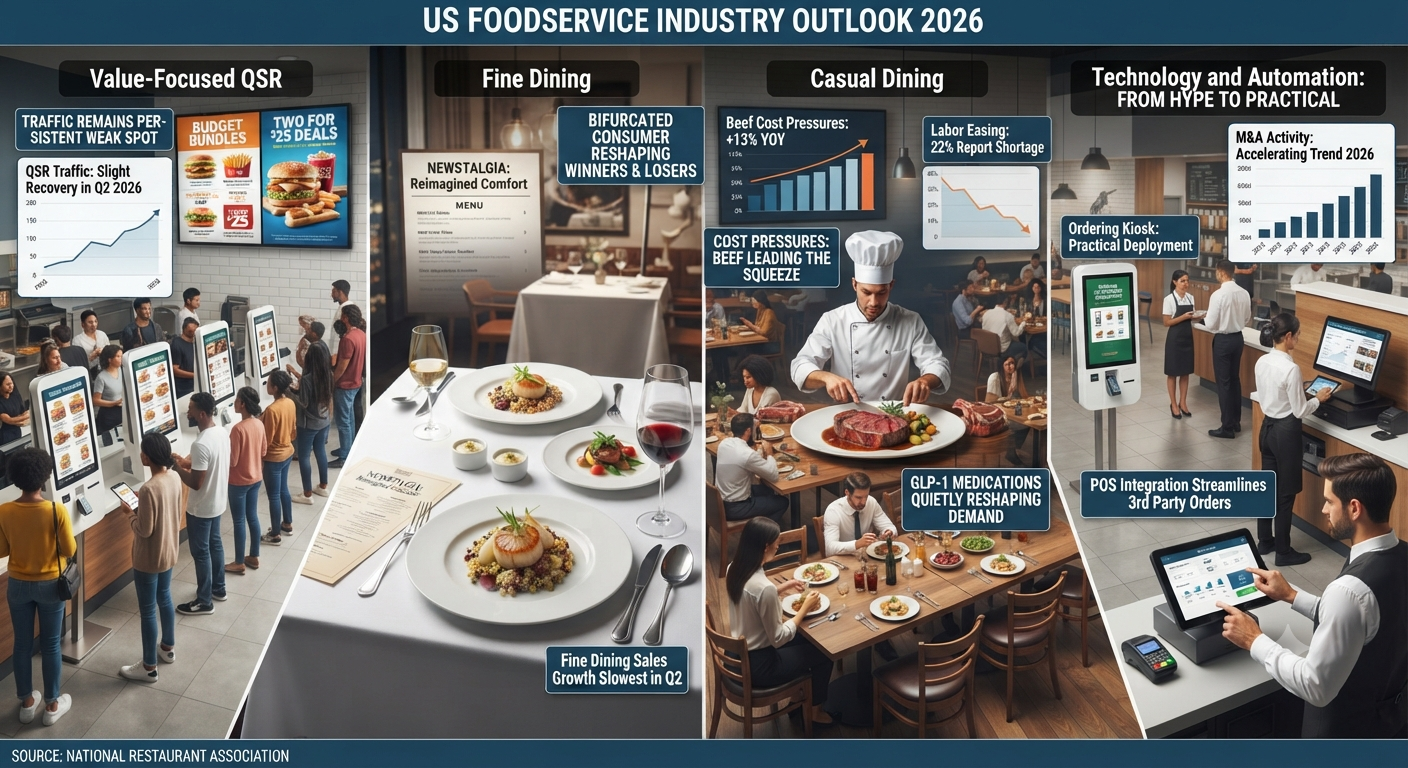

Foodservice sales are projected to hit a record $1.55 trillion in 2026, but underneath that headline number sits a divided industry — value-focused winners pulling ahead while traffic keeps declining industry-wide.
Table of Contents
The Headline Number Masks a More Complicated Reality
US restaurant and foodservice sales are projected to reach $1.55 trillion in 2026, according to the National Restaurant Association’s 2026 State of the Industry report — up from a record $1.4 trillion in 2025. On paper, that looks like solid growth. Adjusted for inflation, however, real consumer spending gains are projected at a modest 1.3%, and the report’s own economists describe the industry’s posture as “cautiously optimistic” rather than confident.
The gap between nominal and real growth is the story to watch. Eating and drinking place sales — which represent roughly 72% of total industry sales — were up 2.7% year-on-year in nominal terms as of May 2026, but down 0.9% once adjusted for inflation. That marked the fourth real sales decline in five months on a 12-month basis, underscoring that much of the industry’s apparent growth is being driven by menu price increases rather than actual increased consumption.
Traffic Remains the Industry’s Persistent Weak Spot
Customer traffic has been in a prolonged slump. In April 2026, only 27% of restaurant operators reported rising customer traffic year-on-year, down from 31% in March, while 49% reported declines — making April the 14th time in the last 15 months that operators reported a net traffic decline. Same-store sales told a somewhat better story, with 48% of operators reporting increases in April, up slightly from March, but the traffic figures make clear that much of that sales growth is coming from higher checks rather than more visits.
There was a genuine bright spot in June: same-store sales rose 2% — the largest monthly increase since January and the fourth-highest month since August 2023 — while customer traffic, though still negative, improved to just a 0.9% decline, its best reading since January. Every restaurant segment except fast casual posted a stronger sales increase in June than the month before, with casual dining holding the top spot it’s occupied since March, while fine dining posted its weakest same-store sales growth for the third time since March. Analysts caution the improvement may partly reflect an easy comparison against weak July 2024 results, and warn that tariffs and a softening labor market could pressure conditions again later in the year, particularly in Q4.
A Bifurcated Consumer Is Reshaping Winners and Losers
Perhaps the clearest theme across current industry analysis is bifurcation — both in consumer spending and in brand performance. Higher-income consumers are expected to drive most of 2026’s spending growth, while lower- and middle-income consumers continue pulling back. More than 6 in 10 operators reported declining traffic in 2025, with only 15% reporting an increase, and just 2 in 10 consumers said they were dining out more often through any channel.
This divide shows up starkly in same-store sales data across major chains. In the most recent quarter tracked by Restaurant Dive, results ranged from a 9.5% sales drop at one major brand to 21.4% growth at another — a spread of nearly 31 percentage points between the best and worst performers. Industry analysts attribute much of this to value positioning: sit-down locations in both fine dining and casual dining are holding up well, while QSR and fast-casual brands reliant on lower-income consumers saw traffic drop off more sharply. Brands leaning into visible value — like two-entrees-for-a-fixed-price deals or the return of budget meal bundles — have seen measurably better results than those that haven’t.
Cost Pressures: Beef Leading the Squeeze
Rising input costs, and beef in particular, are cited as a defining margin pressure for 2026. With beef prices climbing to records on historically tight US cattle supply, restaurant chains reliant on beef-forward menus face a genuine cost management challenge separate from broader consumer spending trends — a dynamic that helps explain why some menu innovation in 2026 is trending toward smaller portions, protein diversification, and value-focused bundling rather than simply raising prices further.
GLP-1 Medications Are Quietly Reshaping Demand
One of the more structurally significant shifts identified across multiple 2026 trend reports is the growing impact of GLP-1 weight-loss medications on dining behavior. Research consistently shows GLP-1 users reduce intake of high-calorie, high-sugar and high-fat foods while placing more emphasis on protein, fiber and overall nutritional value per bite — a shift industry analysts describe as changing not just what people order, but how much. Operators are responding with smaller portions, snackable and shareable formats, and menu items built around protein density and functional nutrition, rather than assuming this is a temporary trend to wait out.
Technology and Automation: From Hype to Practical Deployment
After several years of aggressive robotics and AI hype, 2026 marks what industry analysts describe as a more practical, grounded phase of foodservice technology adoption. Rather than headline-grabbing robotic novelties, the focus has shifted to technologies that measurably improve customer service, streamline operations and support faster day-to-day decision-making.
Concrete examples already in deployment include self-ordering kiosks and computer vision-based checkout systems becoming standard in self-serve dining formats, and integration platforms that route third-party delivery marketplace orders directly into a restaurant’s point-of-sale system — eliminating manual re-entry across multiple tablets and menus, a persistent operational headache for multi-location operators. The stated goal across most of these deployments isn’t headcount reduction so much as productivity per worker: automating repetitive tasks so staff can focus on service rather than fixing fragmented technical systems.
Labor: Easing, But Not Solved
Labor conditions have genuinely improved compared to the acute shortages of recent years — unfilled job openings and separations have leveled out year-on-year, and only 22% of operators reported insufficient staff to meet demand in the most recent data, down sharply from 32% in 2024 and well below the post-pandemic peak of 78% in 2021. Despite this, roughly half of operators still report job openings that are difficult to fill, and QSR labor costs continue climbing, partly driven by a wave of state minimum wage increases. The National Restaurant Association projects the industry will add roughly 100,000-150,000 jobs annually over the next decade, bringing total employment above 17 million, even as more than half of operators say they’d cut headcount if business conditions soften further.
M&A Activity Poised to Accelerate
After three consecutive years of declining restaurant industry M&A activity, deal volume is expected to build through 2026 as perceptions of a more favorable merger climate overcome prior hesitation on both sides of the table. Private equity investors who had been waiting on the sidelines are increasingly active again, with expectations for easing capital costs and a more merger-friendly regulatory environment cited as key catalysts. Separately, brand migration is picking up — several franchisees who spent years building out legacy QSR brands are shifting toward newer, faster-growing concepts, partly to diversify revenue and capture growth potential legacy brands can no longer offer.
Menu Trends Worth Watching
Beyond pricing and portioning, several specific menu shifts are showing up consistently across current trend data:
- Meat is outgrowing plant-based alternatives in foodservice, with the plant-based shift moving away from meat mimicry and toward whole-food ingredients like legumes and vegetables rather than processed substitutes.
- Structured customization is scaling faster than open-ended choice — build-your-own formats with clear boundaries (a protein, a base, an optional topper) are converting better than menus offering unlimited options, because they protect back-of-house efficiency while still feeling personalized.
- “Newstalgia” is defining flavor innovation — familiar comfort dishes reimagined through modern techniques, rather than entirely novel concepts.
- Cannabis normalization is becoming a genuine competitive and menu consideration, with consumption lounges increasingly competing with restaurants and bars for social occasions, and potential federal rescheduling raising the prospect of THC-infused menu items down the line.
What This Means for Foodservice-Adjacent Businesses
- Value positioning matters more than price increases right now. Brands winning share are the ones making value visible and structured, not simply raising or holding prices.
- Protein and portion strategy needs to account for GLP-1-driven demand shifts, not treat them as a niche trend — this is showing up broadly enough to influence core menu economics.
- Beef cost exposure deserves explicit menu engineering attention given the structural, multi-year nature of current cattle supply constraints.
- Technology investment should prioritize integration and operational simplicity over novelty — the clearest ROI signals right now are in order-routing, POS integration and reducing manual workflow friction, not standalone robotic gimmicks.
- M&A-minded operators and suppliers should expect increased deal activity through 2026, creating both consolidation risk and partnership opportunity depending on where a business sits in the value chain.
The Bottom Line
Foodservice heading into the second half of 2026 is neither in crisis nor in a clean recovery — it’s genuinely bifurcated, with real winners and real losers determined largely by how well operators translate value positioning, protein-forward menu design, and practical technology adoption into measurable traffic and margin gains. The headline $1.55 trillion sales figure is real, but it’s being carried disproportionately by pricing and higher-income consumer spending rather than broad-based traffic recovery — a distinction that matters enormously for anyone selling into, supplying, or investing in this sector.
Sources
FAQ
How big is the US foodservice industry expected to be in 2026?
Projected at $1.55 trillion in total sales, up from a record $1.4 trillion in 2025, though real inflation-adjusted growth is a more modest 1.3%.
Is restaurant traffic actually growing in 2026?
No, not consistently. April 2026 marked the 14th time in 15 months that operators reported a net decline in customer traffic, though June showed the best traffic reading since January.
Why is beef such a significant cost pressure for restaurants right now?
US beef prices are at record highs due to the smallest national cattle herd in 75 years, creating a structural, multi-year cost challenge for beef-forward menu items rather than a temporary price spike.
How are GLP-1 medications affecting restaurants?
GLP-1 users tend to eat less overall and prioritize protein, fiber and nutritional density over high-calorie, high-sugar foods, prompting operators to shift toward smaller portions and more nutrition-forward menu items.
Is restaurant industry M&A activity increasing?
Yes, after three years of decline, deal volume is expected to build through 2026 as capital costs ease and regulatory conditions become more merger-friendly, with private equity investors increasingly active again.
What foodservice segment is performing best right now?
Casual dining has led same-store sales growth since March 2026, while fine dining has posted the weakest growth multiple times over the same period — reflecting a broader bifurcation between value-focused and premium segments.