

GRAS reform remains stalled at the FDA while states move ahead independently, ingredient buyers are rethinking single-origin sourcing, and processing equipment investment keeps climbing on automation demand. Here’s the full ingredients and machinery picture for 2026.
Table of Contents
Ingredients: Regulation Is the Dominant Storyline
GRAS Reform Remains the Industry’s Biggest Open Question
The single most-watched regulatory development in food ingredients this year continues to be the FDA’s anticipated overhaul of the “generally recognized as safe” (GRAS) pathway, which currently allows companies to bring new ingredients to market without formal agency review. HHS Secretary Robert F. Kennedy Jr. has indicated the FDA intends to eliminate the option for companies to self-affirm ingredient safety without notifying the agency, and the proposed rule is under review at the White House Office of Information and Regulatory Affairs.
Industry concern centers on retroactivity. At a recent GlobalChem conference, chemical and food industry representatives warned that a stricter GRAS framework could require companies to retroactively prove the safety of ingredients used for decades — a process one specialty chemical regulatory leader described as potentially requiring companies to search back through old hard-copy files spanning multiple decades. FDA’s own food chemical safety director has acknowledged the challenge but expects most companies will be able to support their existing GRAS determinations when asked. Legal experts are advising companies to begin auditing their ingredient records now, well ahead of any final rule.
States Are Moving Faster Than Washington
With federal GRAS reform still pending, state and local governments are outpacing federal action on food chemical regulation. Legal and economic experts tracking the space say states are passing more food-related legislation than ever, and — notably — this is one of the few areas where states as politically different as California and Texas are finding common ground. A push for federal preemption legislation, which would establish one national standard and override the growing state patchwork, failed to advance in 2025, leaving companies to navigate divergent requirements state by state in the meantime.
Ingredient Supply Chains Are Diversifying Away From Single Origins
Tariff exposure and quality considerations are reshaping ingredient sourcing strategies. In the vanilla category, a November 2025 executive order exempted more than 200 agricultural and food inputs — including vanilla beans, cinnamon and various nuts — from tariffs that had been imposed earlier in the year. But importers report the relief has done little to eliminate uncertainty, and interest in diversified sourcing is rising regardless: Indonesian vanilla suppliers report growing interest from US buyers seeking premium Grade A beans as an alternative to reliance on a single origin, a lesson the industry says it learned the hard way during COVID-era disruptions.
Pea protein tells a similar story. Following anti-dumping and countervailing duty orders on Chinese pea protein imports, suppliers are advising food manufacturers to prioritize domestic sourcing and demand full supply chain transparency from grower to finished ingredient, specifically to avoid tariff exposure and mitigate risks like poor harvests or shipping delays.
Ingredient Innovation Continues Regardless of Regulatory Uncertainty
Despite the regulatory overhang, new ingredient launches continue at pace. Recent examples include a plant-based, FDA GRAS-recognized sweetener with a sugar-like taste profile, a new grain-based emulsifier built from upcycled ingredients aimed at clean-label formulation, and new sorbitan ester product lines targeting bread, confectionery, oils and dairy applications. Separately, tagatose — a low-calorie natural sweetener with EU-approved health claims — has been granted exemption from added sugar labeling in the US, a regulatory shift that could significantly accelerate its adoption across the industry.
The global food ingredients market itself remains firmly in growth mode, projected to expand from $302.56 billion in 2026 to $487.51 billion by 2034, with Asia Pacific currently the largest regional market.
Processing Machinery and Equipment: Automation Investment Accelerating
US Market Data Now Available for the First Time in This Format
PMMI (The Association for Packaging and Processing Technologies) and the Food Production Solutions Association released their first joint 2026 Processing State of the Industry Report this year, providing a new benchmark for the sector. The US food and beverage processing machinery market reached $6.2 billion in shipment value in 2025, up a modest 3.2% over 2024, with projections pointing to $6.7 billion by 2027. Meat and poultry processing equipment represents the largest single segment at 29.2% of the market, followed by prepared foods (14%) and dairy (12.4%), while pet food and inspection equipment are flagged as among the fastest-growing categories through 2030.
Global Machinery Market Continues Steady Expansion
Multiple independent market analyses converge on a consistent picture: global food processing machinery is a $80-90 billion-plus market in 2026, growing at a 5-6% compound annual rate toward the $115-135 billion range by the early 2030s. Processing equipment — mixing, thermal processing, extrusion and separation systems — continues to command the largest share of revenue, reflecting manufacturer priority on primary transformation equipment to drive throughput and consistency. Asia-Pacific remains the fastest-growing regional market, driven by rising exports, urban consumption growth and government incentives supporting food processing infrastructure, while Western Europe and North America remain the largest existing markets by installed base.
Automation and AI Are the Defining Trend
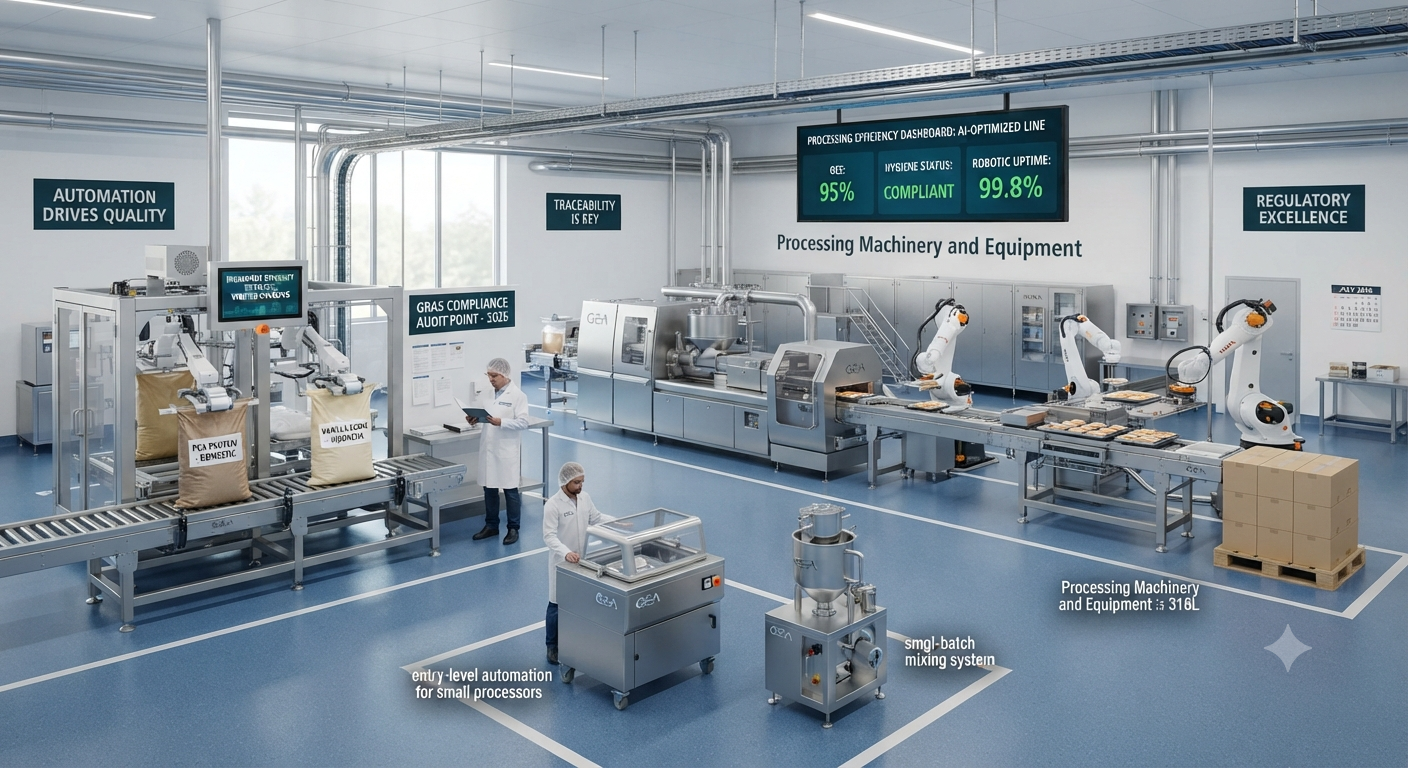
Across virtually every market report reviewed, automation is the single most consistently cited growth driver. Smart and AI-enabled processing systems are the fastest-growing equipment category, expanding at more than 7% annually, as manufacturers pursue predictive maintenance, resource efficiency and real-time quality monitoring. Practical examples already in the field include manufacturing intelligence platforms that shift plants from reactive to predictive maintenance models, reducing unplanned downtime, and AI-driven robotic systems now handling food portioning and packing tasks with improved consistency and reduced waste.
Robotics adoption specifically is being driven by labor shortages and tightening hygiene standards — global industrial robot installations hit 4.28 million units in 2023, up 10% year-on-year, a trend food manufacturers are increasingly tapping into for tasks like cutting, portioning and palletizing that reduce direct human contact with ready-to-eat foods.
M&A and New Product Launches Reshaping the Supplier Landscape
Consolidation continues among major equipment suppliers. The Middleby Corporation, a US-based foodservice and processing equipment leader, acquired German extrusion, molding and depositing systems manufacturer Oka-Spezialmaschinenfabrik in August 2025, expanding its bakery, confectionery and pet food equipment portfolio. Separately, GEA introduced its Automated Line Concept, a fully integrated system combining conveying, portioning and packaging with digital process monitoring — designed to reduce downtime and improve hygiene by limiting direct product contact across bakery, dairy and prepared food lines.
Equipment suppliers are also responding directly to smaller processors priced out of high-end automation. Advanced hygienic machinery — typically built with 316L stainless steel and specialized surface finishes to meet FDA and EU standards — carries significant capital costs that can deter smaller manufacturers. In response, suppliers including GEA have introduced entry-level thermoforming and processing systems specifically targeting small and medium-sized companies, alongside more flexible financing and leasing models.
Regulatory Pressure Is Also Driving Equipment Investment Directly
Beyond ingredients, several specific FDA and USDA regulatory actions now in motion carry direct implications for processing equipment and hygiene systems. FDA is reviewing a food additive petition that would allow ionizing radiation treatment of raw enriched wheat flour up to 30 kGy as a pathogen control measure — a change highly relevant to flour mills, bakery manufacturers and dry-mix producers if approved. Separately, FDA has extended the comment period on cumulative risk assessment of phthalates in food-contact materials, a proceeding directly relevant to packaging, PVC/vinyl tubing, gaskets, conveyor belts and other food-contact equipment systems across the industry.
What This Means for F&B Operators
- Start GRAS documentation reviews now, regardless of final rule timing. Whatever the final scope of FDA’s reform, the direction of travel — more scrutiny of existing ingredient safety files — is clear enough to justify proactive record audits.
- Build sourcing redundancy into ingredient contracts, not just pricing terms. Vanilla and pea protein both illustrate that tariff exposure and single-origin risk are now standing considerations for ingredient procurement, not one-off disruptions.
- Evaluate automation investment against labor and hygiene pressure, not just throughput gains. The equipment market data suggests smart/AI-enabled systems are growing fastest specifically because they address labor shortages and food-contact hygiene requirements simultaneously — a combined ROI case that’s increasingly hard to ignore.
- Watch for entry-level automation options if capital is the barrier. Major suppliers are actively building lower-cost, flexible-financing product lines specifically for processors who’ve been priced out of advanced hygienic machinery until now.
- Track state-level ingredient legislation directly, independent of federal GRAS timing. With federal preemption stalled, state rules are likely to keep moving first and fastest, similar to the pattern already seen with food dyes and additives more broadly.
The Bottom Line
Ingredients and machinery are being pulled in the same direction by the same underlying forces: tighter regulatory scrutiny, persistent trade and tariff uncertainty, and a structural push toward automation to manage rising hygiene and labor cost pressure. Neither GRAS reform nor the state legislative patchwork shows signs of resolving quickly, which means ingredient sourcing and equipment investment decisions increasingly need to be made under continued uncertainty rather than waiting for regulatory clarity that may not arrive this year.
Related
Sources
FAQ
What is GRAS reform and why does it matter for ingredient suppliers?
GRAS (“generally recognized as safe”) currently lets companies introduce food ingredients without formal FDA review. Proposed reform would require companies to notify the FDA of new GRAS determinations, and potentially retroactively document the safety basis for ingredients already in use, creating a significant compliance burden for companies with decades of formulation history.
Is federal or state regulation moving faster on food ingredients?
State regulation is currently outpacing federal action. A push for national preemption legislation failed in 2025, leaving states — including politically divergent ones like California and Texas — to independently advance food chemical and additive legislation.
How big is the global food processing machinery market in 2026?
Estimates vary by research firm but converge in the $80-90 billion range for 2026, with most projections showing growth to $115-135 billion by the early 2030s at a 5-6% compound annual growth rate.
What’s driving processing equipment investment right now?
Automation and AI-enabled systems are the fastest-growing equipment category, driven primarily by labor shortages, stricter hygiene requirements, and demand for predictive maintenance and real-time quality monitoring.
Are smaller food processors being priced out of automation?
Advanced hygienic machinery carries high capital costs, but major suppliers including GEA have introduced entry-level automated systems and flexible financing specifically to make automation accessible to small and medium-sized processors.
How are ingredient supply chains responding to tariff risk?
Buyers in categories like vanilla and pea protein are actively diversifying sourcing away from single-origin dependence and prioritizing domestic or multi-country supply chains to reduce tariff and disruption exposure.