
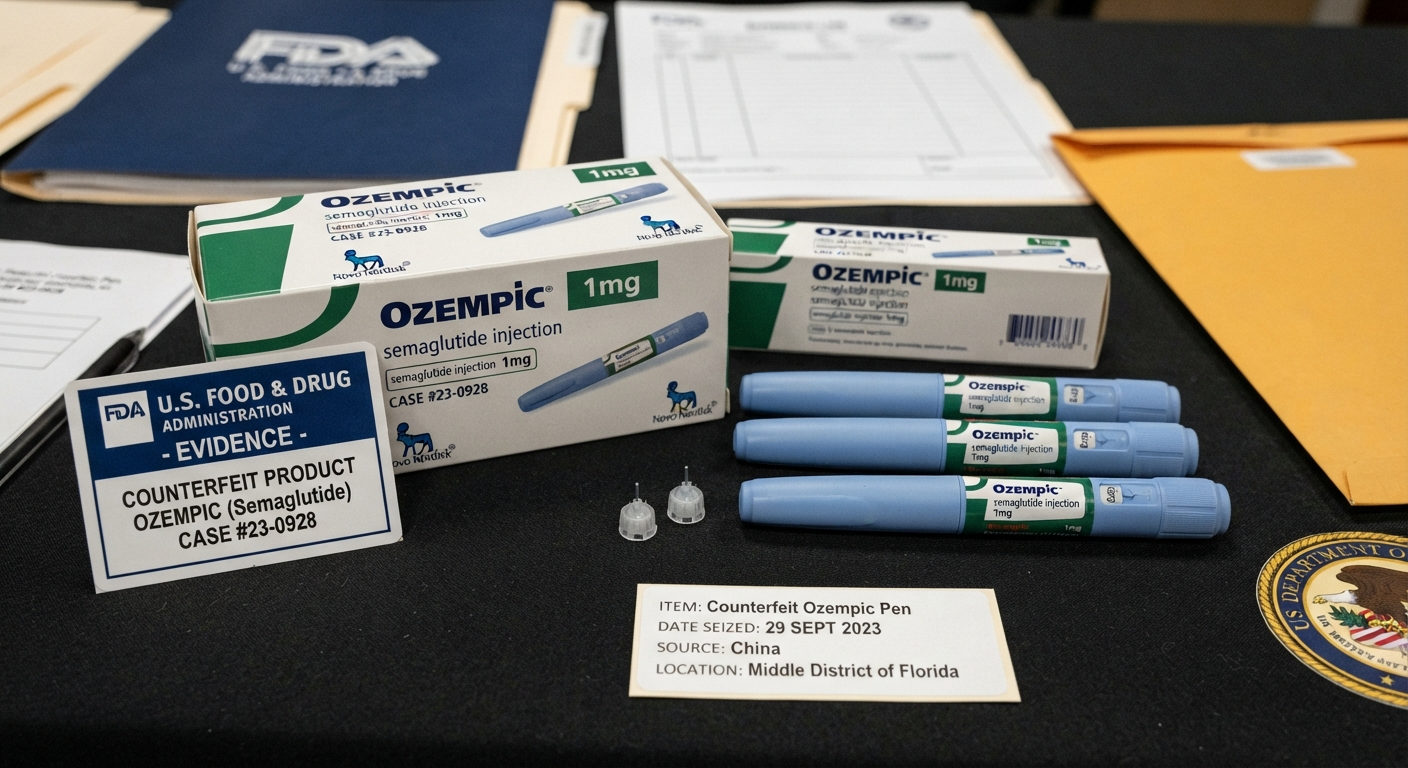

Two Indian nationals have been charged in the US over an alleged scheme to smuggle counterfeit Ozempic from China and sell it to US distributors.
The US Attorney’s Office for the Middle District of Florida announced the charges on 29 September, following an investigation supported by the FDA’s Office of Criminal Investigations.
The case at a glance
- Charged: Swapnadip Roy, 33, and Vicky Ramancha, 37
- Charges: Conspiracy and smuggling
- Product: Counterfeit Ozempic (semaglutide)
- Alleged period: July 2023 to April 2024
- Source: Unauthorised suppliers in China
How the alleged scheme worked
According to court documents, the defendants obtained counterfeit Ozempic and sold it at deep discounts to co-conspirators and US distributors. The fakes came with counterfeit packaging, package inserts, pen labels and needles, designed to make them look authentic. The products were intended to reach pharmacies and patients.
Prosecutors allege the distribution continued even after the FDA seized counterfeit Ozempic and issued a public warning in December 2023.
As in all criminal cases, an indictment is an allegation only. The defendants are presumed innocent unless proven guilty.
Why it matters
“Counterfeit drugs are a direct threat to public health and patient safety,” said Acting FDA Commissioner Kyle Diamantas. The FDA says it will trace illicit networks across borders and supply chains.
- High demand attracts fakes. GLP-1 drugs such as Ozempic have faced high demand and supply constraints, making them a target for counterfeiters.
- Discounts are a red flag. The alleged scheme relied on deep discounts to attract buyers.
- Fakes can look convincing. Copies of packaging, inserts and pen labels make visual checks unreliable.
What it means for pharmacies and distributors
The case is a reminder to buy only from authorised, licensed trading partners and to use the product tracing and verification required under US law. Pharmacies should treat unusually cheap offers of high-demand drugs as a warning sign, check suspicious products, and report concerns to the FDA.
The bottom line
The charges show that counterfeit GLP-1 drugs are a real supply chain threat, not just an online scam. Sourcing discipline is the best defence for pharmacies and distributors.
Frequently Asked Questions
Who has been charged? Swapnadip Roy, 33, and Vicky Ramancha, 37, both Indian nationals.
What are they accused of? Conspiracy and smuggling related to the distribution of counterfeit Ozempic.
Where did the fake products come from? Prosecutors allege they came from unauthorised sources in China.
How can pharmacies protect themselves? Buy only from authorised trading partners, use required product verification, be wary of deep discounts, and report suspect products to the FDA.
Sources
| Source | Used for |
|---|---|
| US Food and Drug Administration (FDA) press announcement | Charges, defendants, scheme details and FDA statement |
| US Attorney’s Office for the Middle District of Florida (as reported by FDA) | Announcement of charges |
Additional Resources
| Resource | What you’ll find |
|---|---|
| FDA – Counterfeit medicine information | How to identify and report counterfeit drugs |
| FDA – Drug Supply Chain Security Act (DSCSA) | Product tracing and verification requirements |
| National Association of Boards of Pharmacy (NABP) | Guidance on safe sourcing |
| Novo Nordisk | Guidance on identifying genuine Ozempic |
Data note: The volume of counterfeit product involved and potential penalties were not disclosed.