
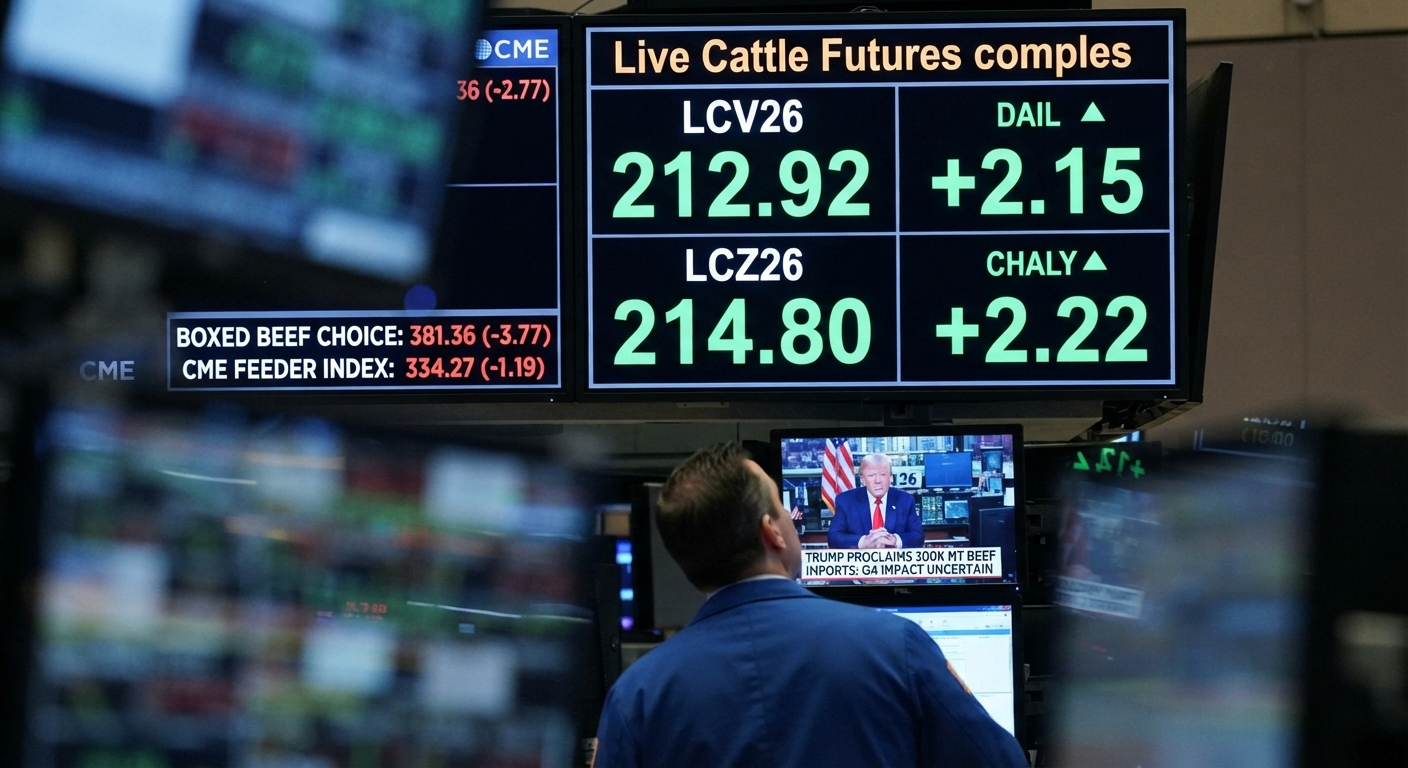

Live cattle futures posted their strongest single day in over a week, with October contracts closing at 212.92¢/lb (+2.15¢) and December at 214.80¢/lb (+2.22¢). The rebound occurred despite multiple bearish headline shocks: Trump’s proclamation to import 300,000 metric tons of ground beef trimmings over 90 days beginning Sept 1, the reopening of the Douglas, Arizona border crossing to Mexican cattle imports, declining boxed beef values, and a weak fed cattle cash market.
The bearish stack:
- Boxed beef prices down $3.77 (Choice) to $381.36/cwt and Select down $3.49 to $359.19
- Mexican cattle imports resumed after border closure to prevent New World Screwworm (closure was 15 months; reopened Aug 24)
- Trump’s 300,000 MT ground beef import allowance announced Aug 26, with no country of origin disclosed and stated intent to undercut retail beef prices by 25%
- Cash trade light at 1,164 head sold; live steers sold $216–220 (stable but thin volume)
- Feeder cattle under pressure at 322.45¢/lb
Why futures rallied despite bearish news:
Analysts and traders offered a simple explanation: most of the negative information was already priced in. October live cattle futures had been trading in the 210-213 range for over a week as the Mexico border reopening was anticipated and the broad outlines of Trump’s import plan were known. By Tuesday morning (Aug 27), traders saw the pullback as oversold. Technical traders covered short positions, and momentum chasers followed.
The risk behind the rebound:
This is a technical bounce, not a fundamental recovery. The August 27 rally occurred with no supporting cash trade improvement and no clarity on Trump’s import sourcing. Boxed beef—the true price driver for feeder cattle and finished cattle—is still moving lower. The CME Feeder Cattle Index fell $1.19 to $334.27, and September feeder cattle contracts are at 322.45¢/lb—the lowest since late May.
Trump’s 300,000 MT ground beef import plan—the real headwind:
On August 26, the White House announced that up to 300,000 metric tons of lean beef trimmings will enter the US over 90 days (Sept 1 – Nov 30) without triggering higher out-of-quota tariffs. The stated goal: reduce ground beef retail prices by 25% and give US producers time to rebuild cattle herds. The reality:
- Sourcing undisclosed: The White House did not name which country is supplying the beef. Historical precedent points to Australia, New Zealand, or Brazil, but the ambiguity creates uncertainty for domestic producers.
- Timing directly conflicts with holiday demand season: September-October typically see moderate beef buying; November-December peak demand. Flooding the market with 300,000 MT during the lead-up to Thanksgiving and Christmas could collapse spot prices for ground beef before the peak selling window.
- Producer timing mismatch: Feeder cattle and yearlings going into feedlots now will finish 90-120 days from now (mid-Nov to late Dec). If ground beef prices crater in Oct due to imports, these cattle will finish into a depressed market.
- Impact on finished cattle prices unknown: Whether imported trimmings collapse ground beef prices without impacting live cattle depends on packer pass-through decisions. Early signals (weak boxed beef) suggest pass-through is happening.
What buyers need to know:
Finished cattle prices may hold technically through mid-September on the technical rebound, but expect downside pressure re-emerge as November holidays approach and imported beef hits retail. Lock Q4 orders at current prices if possible. For feedlots, consider accelerating placement timing into Sept to avoid the October import surge.