
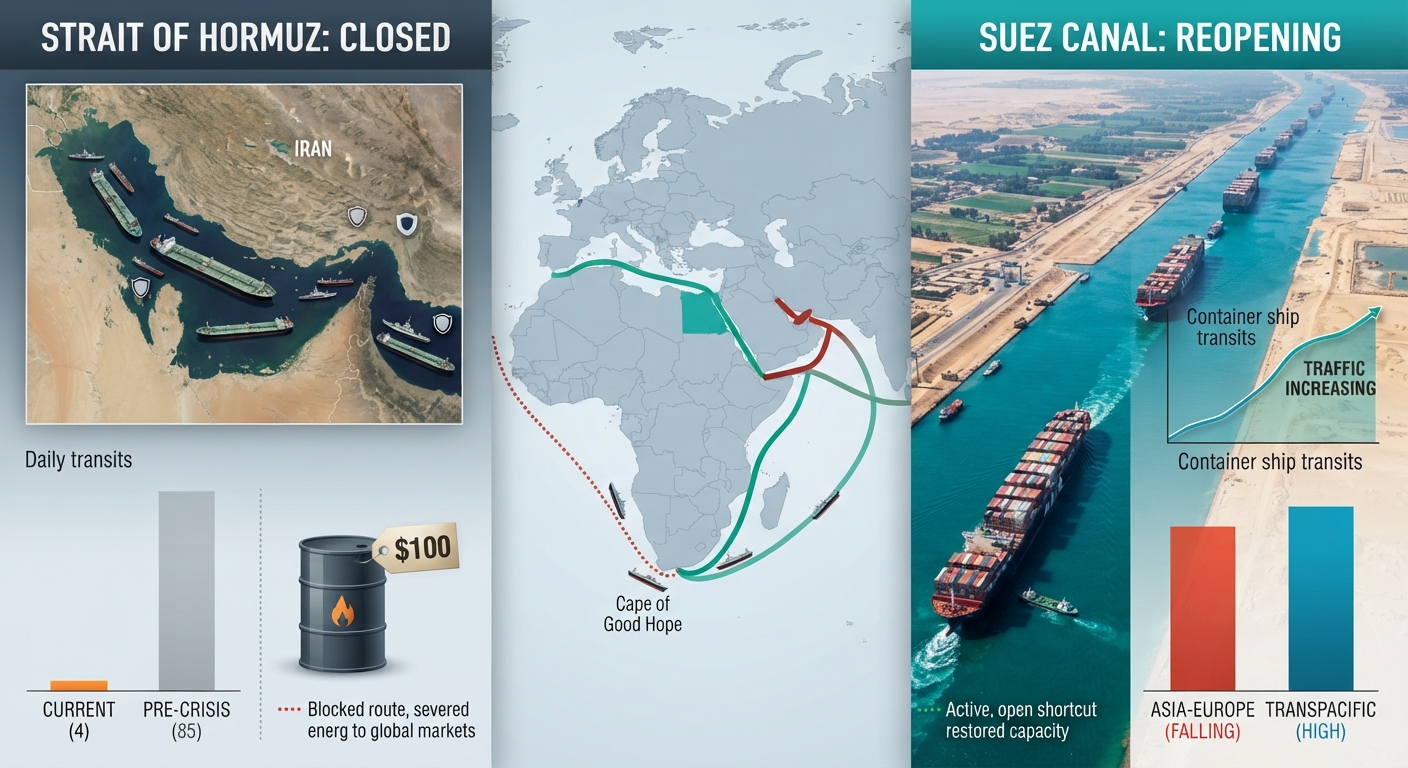

The Strait of Hormuz crisis has entered its 221st day with transits near zero, even as container lines begin returning to the Suez Canal.
Global shipping now faces two very different chokepoints. One of the world’s key energy routes remains largely closed, while the main shortcut between Asia and Europe is reopening.
Hormuz: no sign of reopening
- Transits: IMF PortWatch recorded just 4 transits on 4 October, against a pre-crisis average of 85 a day.
- Attacks rising: Reuters and gCaptain report that attacks on tankers last week reached their highest weekly level since the Iran war began. A separate strike injured 12 crew.
- Hard line from Tehran: Iran’s parliament speaker, Mohammad Bagher Ghalibaf, said on 4 October that the strait “will not reopen until Iran’s seven conditions are met.” An Iranian official also warned that alternative routes along Oman’s coast could be blocked.
- Oil: Brent crude is trading around $100 a barrel.
No active negotiations to reopen the strait have been reported.
Suez: carriers return
At the same time, container lines are coming back to the Red Sea and Suez Canal:
- Busiest week since 2024: 30 container ships over 4,000 TEU transited Suez in the last week of September.
- Capacity shifting back: Linerlytica estimates about 140 container ships, just over 2 million TEU of capacity, have switched from the Cape of Good Hope to Suez since May.
- Major carriers: Cosco made its first westbound Suez transit in more than two years on 4 October. The Premier Alliance has scheduled Suez routings from November.
- Security still uncertain: A reported Houthi pledge not to attack European ships has not been confirmed by the EU.
What it means for freight rates
The two chokepoints are pulling rates in opposite directions (Drewry WCI, week to 1 October, per 40ft):
- Asia–Europe falling: Shanghai–Rotterdam down 2% to $3,399. Asia–Europe rates have now fallen for 12 weeks in a row as Suez capacity returns.
- Transpacific still high: Shanghai–Los Angeles flat at $7,835, and Shanghai–New York up 1% to $10,428.
Xeneta’s Peter Sand says container rates have passed their post-Hormuz crisis peak for 2026, but no collapse is in sight.
Why it matters
- Energy and fuel costs. With Hormuz shut, oil around $100 keeps bunker fuel, trucking and air freight costs high.
- Gulf trade disrupted. Cargo for Gulf markets continues to be rerouted through alternative ports and overland routes.
- Europe gets relief. Shorter Suez routings cut transit times and add capacity on Asia–Europe lanes.
What it means for shippers
- European importers: Expect softer rates and shorter transit times as more services return to Suez, but keep contingency plans in case security worsens.
- US importers: Budget for elevated transpacific rates through year-end.
- Gulf and Middle East trade: Plan for longer lead times and higher costs while Hormuz remains closed.
- Everyone: Review fuel surcharges, since oil prices are the main transmission channel from Hormuz to freight costs.
The bottom line
Shipping is being reshaped by two chokepoints at once. Suez is reopening and easing Asia–Europe costs, while Hormuz keeps energy and Gulf trade under severe pressure with no end in sight.
Frequently Asked Questions
Is the Strait of Hormuz open? Not normally. Only 4 transits were recorded on 4 October, against a pre-crisis average of 85 a day.
When could Hormuz reopen? No negotiations have been reported. Iran says it will not reopen until its conditions are met.
Are ships returning to the Suez Canal? Yes. About 140 container ships have switched back from the Cape of Good Hope since May, and the last week of September was the busiest for Suez since 2024.
What is happening to container rates? Asia–Europe rates have fallen for 12 straight weeks, while transpacific rates remain high.
Sources
| Source | Used for |
|---|---|
| Straits.live daily brief (citing IMF PortWatch, Reuters and gCaptain) | Hormuz transits, attacks, Iranian statements and oil price |
| ContainerSignal (citing The Loadstar, gCaptain, Linerlytica, Drewry and Xeneta) | Suez return, carrier schedules, transit figures and freight rates |
Additional Resources
| Resource | What you’ll find |
|---|---|
| IMF PortWatch | Daily chokepoint transit data |
| Drewry World Container Index | Weekly container spot rates |
| Xeneta | Ocean freight rate benchmarks |
| Suez Canal Authority | Canal transit information |
| UKMTO (United Kingdom Maritime Trade Operations) | Maritime security advisories for the region |
Data note: Brent prices varied between reports during the day, so the post uses “around $100”. Transit counts are daily figures and can change quickly.