
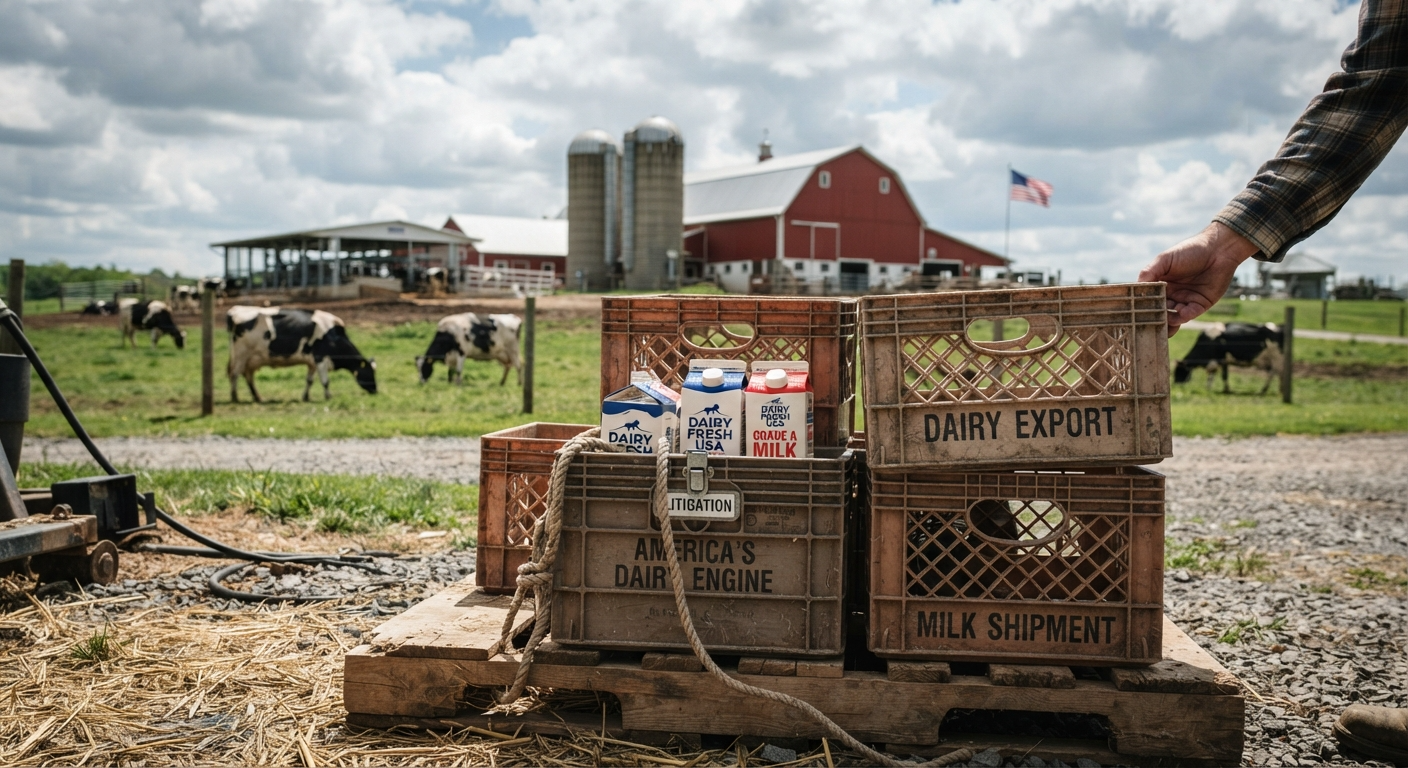

A new class action targets 14 US dairy co-ops and NMPF’s NEXT export program, putting a key tool behind US dairy exports and farm milk prices under legal fire.
The farmer-funded export program has quietly helped move American cheese, butter and milk powder into overseas markets for more than two decades. It is now the centre of a federal antitrust case. On 5 October 2026, a proposed class of US consumers sued 14 dairy marketing cooperatives in the US District Court for the Eastern District of Virginia, in Norfolk. They allege that the export assistance program run by the National Milk Producers Federation (NMPF) works as a price-raising cartel.
The case is in its earliest stage and the claims are allegations, not findings. Even so, the target is a program that many US co-ops rely on to compete abroad, so the case matters to farmers, processors, exporters and buyers alike.
What the Lawsuit Alleges
The complaint, which appears to be captioned Oriakhi v. National Milk Producers Federation, targets Cooperatives Working Together (CWT). CWT is the farmer-funded program created by NMPF and now operating under the NEXT name. The 14 named defendants are members of the program.
The core argument is about supply. Under NEXT’s export assistance program, members use voluntary contributions to subsidise each other’s export sales. Eligible products include anhydrous milkfat, butter and butter blends, natural and process cheeses, whole and skim milk powder, ESL/aseptic fluid milk, cream and milk protein concentrate.
The plaintiffs claim the program works like this:
- Milk is diverted abroad. Subsidised exports turn raw milk into products that are shipped overseas.
- Domestic supply tightens. Less milk and fewer finished products remain for the US market.
- Prices rise. Wholesale butter and cheese prices, which react quickly to supply changes, are pushed above competitive levels, and those increases are passed on to shoppers.
The consumers are suing under the Sherman Act, state antitrust and consumer-protection laws in states that allow indirect purchasers to recover damages, and unjust enrichment. They want damages and an injunction. The complaint also points to concentration in the sector, claiming Dairy Farmers of America handles close to a third of US fluid milk. It cites a 2012 CWT update to members saying the program added 43 cents per hundredweight to milk received by farmers.
When the case was first reported, neither the cooperatives nor the plaintiffs had responded to requests for comment.
Why NEXT Matters to US Dairy
This is not a minor program. NMPF has said NEXT helped export the equivalent of 74 million pounds of butter and 127 million pounds of cheese in a recent year. NMPF president Gregg Doud has described the program as a way to build overseas demand and keep participating co-ops competitive when US prices diverge from world prices.
It is also very active right now. In September 2026, NEXT member cooperatives signed 91 contracts covering 14.9 million pounds of product. Those sales are destined for buyers in Asia, North America, the Middle East and North Africa, Oceania, the Caribbean, and South and Central America, with shipments running through July 2027.
Supporters say export programs help balance a US milk supply that keeps growing faster than domestic demand. The lawsuit takes the opposite view of the same mechanism: exporting milk raises prices at home.
History Repeating Itself
CWT has faced this kind of challenge before. Its herd retirement program (2003–2010) paid farmers to send whole herds to slaughter, which cut the national milk supply. That program produced several class actions:
- Indirect purchasers (retail shoppers of milk and dairy products) settled for about $52 million in 2016.
- Direct purchasers of cheese and butter settled with NMPF for $220 million in late 2019, approved in 2020. Defendants admitted no wrongdoing.
- A separate suit from retailer Winn-Dixie was also settled.
The new complaint says CWT has paid more than $270 million in antitrust settlements over the past decade. One difference from those earlier cases is important. The herd retirement program removed cows. The export program moves product. The plaintiffs now have to persuade a court that subsidising exports reduces domestic supply in the same legally meaningful way. That will be harder to prove.
Defendants in earlier cases also relied on the limited antitrust protection that US farmer cooperatives have under the Capper-Volstead Act. If that defence is raised again, it will likely be one of the central legal battles.
What It Means for the Industry
For cooperatives and farmers: The immediate risk is legal cost and uncertainty, not a change to operations. If the case survives early motions, NEXT members could face discovery, reputational pressure and the question of whether to keep contributing. Any change to the program would affect how surplus milk is cleared, and that affects farmgate prices.
For exporters and overseas buyers: There is no sign of disruption yet. Contracts already signed run into mid-2027. A long fight that eventually led to an injunction could change how competitively US product is priced against New Zealand and EU suppliers. That remains a conditional, longer-term risk.
For domestic buyers and processors: The lawsuit adds a new argument to ongoing debates over dairy pricing. Retailers, foodservice operators and manufacturers that buy cheese and butter will be watching. Direct purchasers brought the largest previous settlement.
For the market: The timing is notable. Global buyers are paying up for protein. Skim milk powder has been pricing above whole milk powder at recent Global Dairy Trade events, and US nonfat dry milk revisited the $2.10s in late September. The lawsuit claims that exports tighten US supply, and it arrives when protein supplies already look tight. If plaintiffs use current market conditions to support their argument, that context could matter.
What to Watch Next
- Defendants’ response: A motion to dismiss is typical in antitrust class actions. Whether the case gets past that stage is the first real signal.
- Copycat filings: Earlier CWT litigation drew several parallel suits from direct purchasers and retailers. Similar filings would increase the potential exposure.
- Industry messaging: NMPF, the National Dairy Promotion and Research Board and the United Dairy Industry Association meet in Kissimmee, Florida, on 19–21 October. Expect the export program’s value to be discussed there.
- Policy crossover: Farm bill negotiations and trade disputes, including the US–Canada dairy friction and new US tariffs on Canadian goods, keep export strategy in the political spotlight.
Data accuracy note: Lawsuit details come from press coverage of the complaint; the complaint itself was not independently reviewed. Figures attributed to the plaintiffs, such as DFA’s market share, the 43 cents per hundredweight and the $270 million in settlements, are their claims, not verified facts. Possible outcomes are described as conditional. No court has ruled on the merits.
FAQ
What is the NEXT program?
NEXT is the current name of Cooperatives Working Together (CWT), a farmer-funded program run by the National Milk Producers Federation. Member cooperatives contribute money to support each other’s dairy export sales to foreign markets.
Who filed the lawsuit, and where?
A proposed class of US consumers filed it on 5 October 2026 in the US District Court for the Eastern District of Virginia, against 14 dairy marketing cooperatives that belong to the program.
What do the plaintiffs claim?
They claim that subsidised exports reduce the domestic supply of milk and dairy products, which pushes US prices for milk, cheese and butter above competitive levels, and that consumers pay the difference.
Has CWT been sued before?
Yes. Its herd retirement program (2003–2010) led to class actions that settled for about $52 million (indirect purchasers, 2016) and $220 million (direct purchasers, 2019–2020), with no admission of wrongdoing.
Will this disrupt US dairy exports now?
Not immediately. The case is at the pleading stage, and September 2026 NEXT contracts run through July 2027. Any operational impact would depend on future court rulings.
What defence might the cooperatives raise?
In earlier cases, defendants relied on the limited antitrust protection that the Capper-Volstead Act gives farmer cooperatives. A similar argument is likely, but it has not yet been filed in this case.
Why does this matter outside the US?
US exporters compete directly with New Zealand and the EU in powder, cheese and butter markets. A long-term change to US export support could shift price competition in Asia, the Middle East and Latin America.
Additional Resources
| Resource | What you’ll find |
|---|---|
| National Milk Producers Federation (NMPF): NEXT program updates | Monthly NEXT-assisted export sales and program descriptions |
| US District Court, Eastern District of Virginia: case docket | Filings and rulings as the case progresses |
| USDA Agricultural Marketing Service: Dairy Market News | Weekly US and international dairy commodity prices, including nonfat dry milk and GDT recaps |
| Global Dairy Trade: event results | Product-by-product auction prices and index movements |
| US Dairy Export Council | US dairy export volumes and market data |
| Capper-Volstead Act (1922) | The law defining cooperatives’ limited antitrust protection |
Sources
| Source | Publisher | Date |
|---|---|---|
| Consumers accuse milk ‘cartel’ of antitrust violations | Courthouse News Service | 6 Oct 2026 |
| September NEXT-Assisted Export Sales Total 14.9 Million Pounds | National Milk Producers Federation | Oct 2026 |
| Margins Tighten for Producers Amid Feed and Fuel Cost Increases | National Milk Producers Federation | Oct 2026 |
| Settlement reached in herd retirement case | Farm Progress | Dec 2019 |
| Advised Client on National Antitrust Litigation Affecting the Dairy Industry | Shipman & Goodwin | 2020 |
| Dairy industry antitrust case study (CWT herd retirement program) | AgEcon Search, University of Minnesota | 2022 |
| Global Dairy Trade rises 1.2%: what’s next for milk? | eDairy News | 6 Oct 2026 |
| Skim Milk Powder Lifted the Global Dairy Trade Index | DairyNews.today | Sept 2026 |