
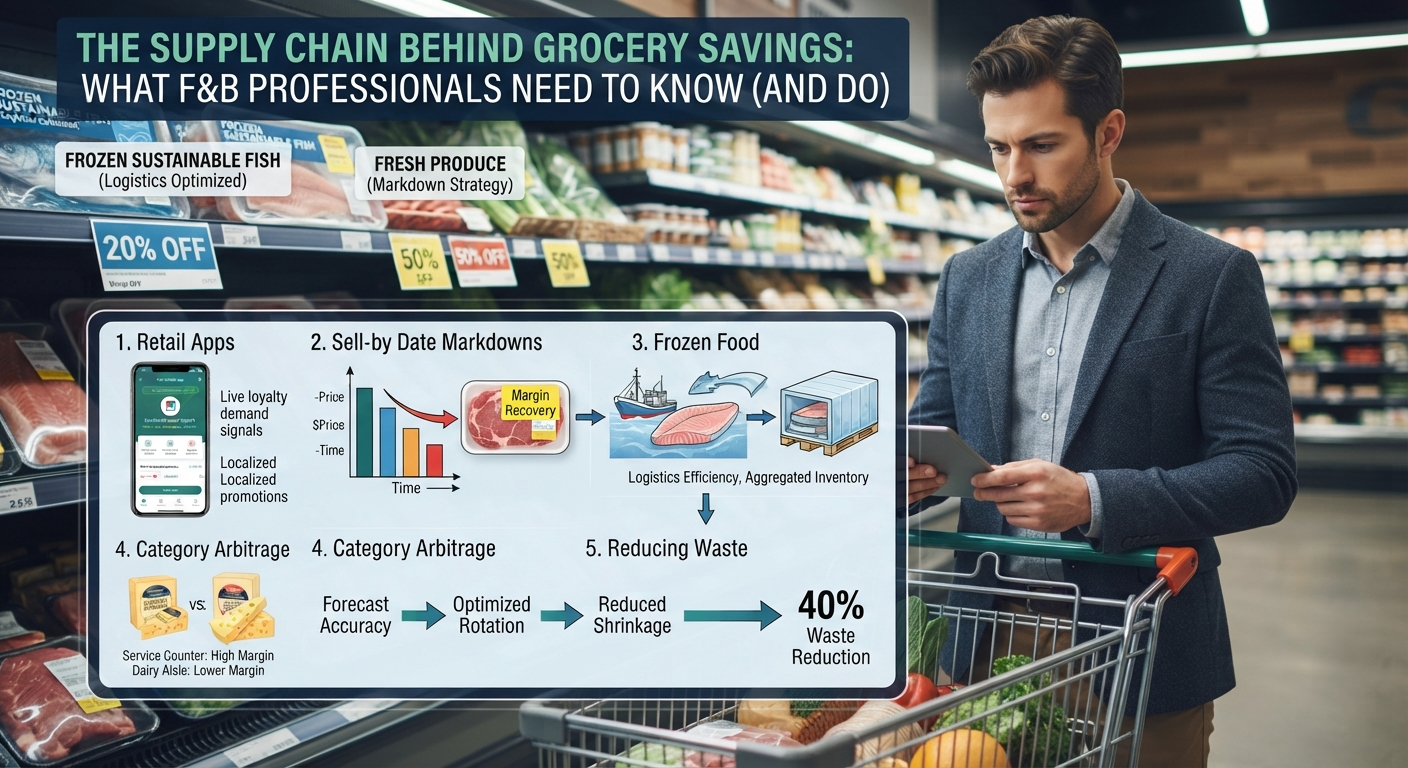
F&B professionals apply supply chain discipline to personal shopping by understanding retail markdown timing, frozen economics, category arbitrage, and waste reduction as cost signals from the supply chain itself.
Grocery professionals know what consumers don’t: every price signal, every markdown, every frozen alternative tells a story about logistics cost, shelf velocity, and supply chain friction. Here’s how to read the retail code—and save real money in the process.
1. Retail Apps: The Real-Time Demand Signal
When procurement directors download grocery store apps, they’re not just checking for coupons. They’re watching demand management in real time.
Retailers use digital promotions and manufacturer coupons (distributed via apps) to manage category velocity and shift inventory. Loyalty programs track purchase patterns by customer segment, time of week, and seasonal shifts. For the F&B supply chain professional, this teaches a critical lesson about visibility: the companies that win at retail are the ones investing in demand transparency upstream.
The same principle applies to your own shopping. Store apps release deal cycles predictably, usually on fixed days. Smart shoppers shop those releases. Smarter supply chain professionals design their promotions around proven sell-through windows—the same way their retail partners do.
2. Sell-by Date Markdowns: Understanding Shelf Life Economics
Here’s the uncomfortable truth retail won’t advertise: a 20–50% markdown on perishables approaching sell-by dates is not a gift. It’s margin recovery.
When a retailer marks down meat or produce one day before the sell-by date, they’re optimizing for revenue, not goodwill. They’ve accepted that the product won’t sell at full price; the alternative—waste and zero revenue—is worse. For procurement and supply chain professionals, this is a reminder: shelf life and shrink are economics. The retailer’s markdown behavior reflects the cost of carrying inventory past peak desirability.
For consumers (and F&B pros shopping on personal time), the play is obvious: build a relationship with department staff. Ask when manager’s specials hit. Check back the day after first markdowns—deeper discounts often follow. This is basic retail mathematics.
3. Frozen Food: The Unspoken Supply Chain Win
Frozen is cheaper for a reason. And it’s not the one consumers usually think.
Frozen products solve two supply chain problems simultaneously: they extend shelf life (reducing shrink risk) and allow producers to aggregate inventory across geographic regions, creating logistics efficiency. A frozen fish fileted and frozen at catch point, then consolidated with thousands of other units into a full pallet, moves through the supply chain differently than fresh counter fish. Consolidation drives down per-unit transport cost.
Phil Lempert’s observation about frozen produce picked at peak freshness is technically accurate, but here’s the professional insight: frozen preserve quality at lower total cost to the system. The price difference (20–30% lower) reflects real supply chain efficiency, not inferior product.
For professionals: this teaches a principle about cost reduction. When you’re sourcing or negotiating with suppliers, understand the modal shift opportunity. Specifications that shift volume toward frozen or shelf-stable alternatives often unlock meaningful savings without sacrificing end-product quality—because the supply chain costs less to deliver.
4. Price Comparison and Category Arbitrage
The cheese example Lempert cited is instructive: identical product, different price, different location. This is category arbitrage, and it’s rampant in retail.
For procurement professionals negotiating with supermarkets or foodservice chains, this is the inverse problem: you’re competing against the retailer’s own ability to source or position the same product at different margins in different parts of the store. The specialty cheese counter might run a 60% margin; the dairy case might run 30%. Your price must compete with both.
For consumers: this is a search cost problem. Use price comparison tools like Flipp to map pricing across stores and aisles before you buy. For supply chain professionals: this is your message to retail partners—help them optimize for velocity across all touchpoints, not just one shelf set.
5. Reducing Waste: The Economics of Overstock
The fact that 40% of food is wasted in the U.S. is a supply chain indictment, not a consumer problem.
Waste happens at retail because of forecast error, overstock mentality, and poor rotation discipline—the same root causes that plague professional supply chains. A shopper who overbuy and wastes is mirroring a distribution center that overstock SKUs and writes off margin.
The discipline of meal planning and shopping lists applies directly to supply chain demand planning. Buy what you use. Consume what you buy. Track rotation. These are operational hygiene principles that work at retail and in corporate supply.
FAQ
Q: Why are frozen products consistently cheaper than fresh? A: Frozen products consolidate volume at scale, reducing per-unit transport and handling costs. The price difference reflects real supply chain efficiency. Fresh alternatives incur higher shrink and spoilage costs, which are built into the retail price.
Q: How do retailers decide when to mark down perishables? A: Retailers use demand forecasting and inventory-turn models to predict sell-through. Markdowns begin one to two days before sell-by dates based on category velocity. If a product isn’t moving at full price, the retailer marks it down to recover margin before loss (spoilage) occurs. It’s a revenue optimization play.
Q: Can I negotiate better prices at retail by understanding their cost structure? A: Understanding retail cost structure helps you negotiate smarter, but you can’t change the fundamentals. Instead, focus on how your product can improve their category velocity, reduce shrink, or fit into their supply chain more efficiently. Suppliers who help retailers solve problems (demand transparency, better inventory rotation, reduced spoilage) get better pricing.
Q: Should I prioritize frozen over fresh for cost savings? A: For cost-conscious consumers and procurement professionals: prioritize frozen for staples where quality difference is minimal (fruit, ground beef, some vegetables). Reserve fresh for items where freshness is a material quality attribute. This mirrors professional procurement logic: optimize for total cost of ownership, not ingredient cost alone.
Q: How do loyalty programs actually work from a supply chain perspective? A: Loyalty programs generate customer-level purchase data, allowing retailers to forecast demand by segment. This data flows upstream to suppliers, improving forecast accuracy. Suppliers who leverage this data (via access agreements with retailers) can reduce inventory buffers and improve supply chain efficiency. The loyalty discount is how retailers pay for that data value.
Sources & References
| Source | Type | Focus |
|---|---|---|
| USA TODAY (Sept. 2026) — Maddie Rhodes, “These 5 hacks make groceries cheaper, according to finance experts” | Journalism | Consumer-facing grocery cost reduction tactics; expert commentary from The Krazy Coupon Lady, NerdWallet, and Supermarket Guru |
| The Krazy Coupon Lady | Industry Resource | Retail promotional mechanics; store app functionality; timing of digital deals |
| NerdWallet (Finance Expert Commentary) | Industry Resource | Loyalty program discount mechanics; price comparison tools (Flipp) |
| Supermarket Guru (Phil Lempert) | Industry Expert | Frozen vs. fresh pricing differentials; category arbitrage; food waste economics |
| USDA Food Waste Data | Government Research | U.S. food waste volume and percentage (40% of food supply) |

