
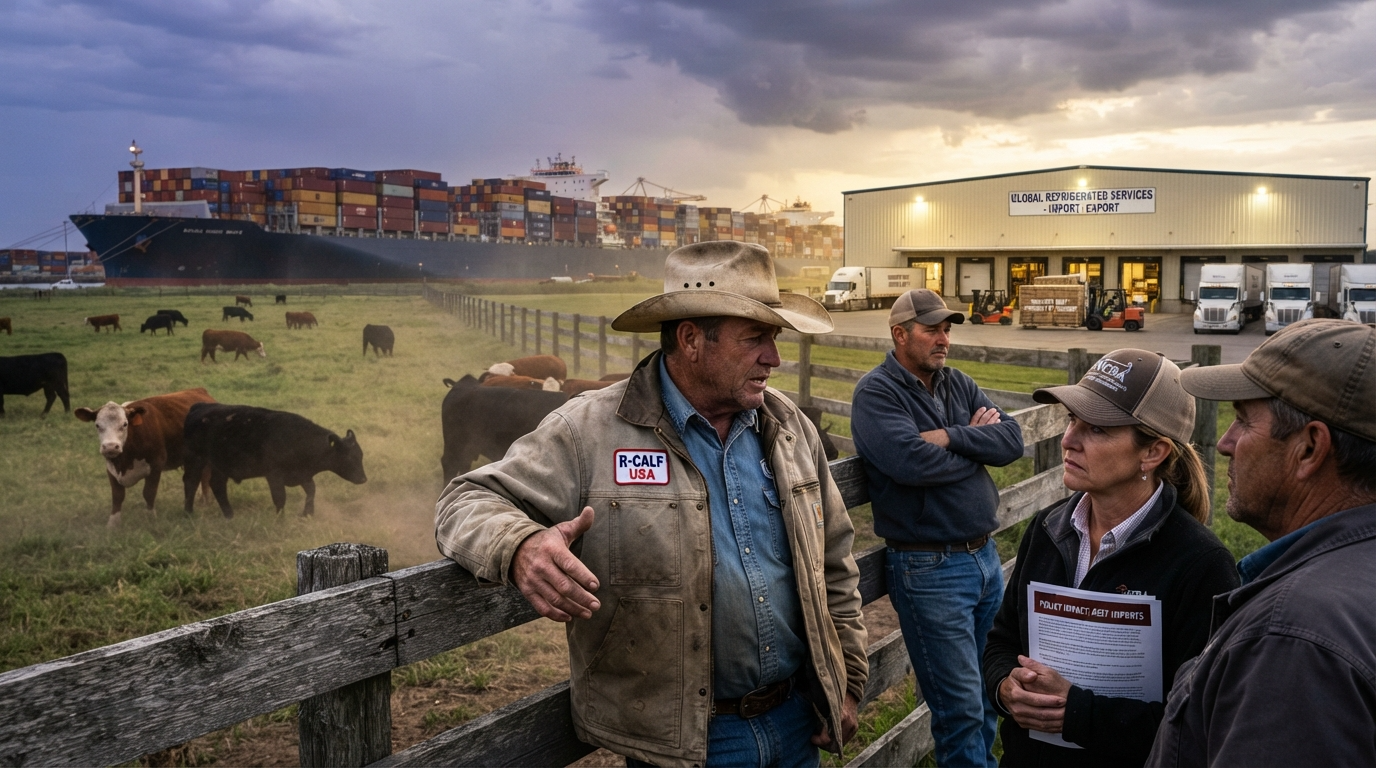

Four major U.S. agricultural organizations have jointly urged President Trump to reverse his controversial 90-day tariff-free beef import plan, warning that dumping 300,000 metric tons (661 million pounds) of foreign ground beef into American markets threatens food security and derails critical herd-rebuilding efforts for ranchers already struggling with historic cattle shortages.
What Just Happened: The Trump Beef Import Plan Explained
On August 21, 2026, President Trump announced via Truth Social that the United States would temporarily suspend tariffs on up to 300,000 metric tons of imported ground beef for 90 days starting September 1. The proclamation was formally signed days later, creating one of the most controversial agricultural policy moves of his administration.
Trump’s stated goal is straightforward: lower grocery store beef prices for American consumers by flooding the market with cheaper foreign beef. The administration claims importers have committed to selling the imported beef at 25% below current market prices—a pledge that has sparked intense debate about feasibility and enforcement.
The Industry’s Unified Response
The backlash came swiftly and decisively. Four major agricultural groups signed a joint letter opposing the plan:
- Livestock Marketing Association (LMA)
- American Farm Bureau Federation (AFBF)
- National Cattlemen’s Beef Association (NCBA)
- United States Cattlemen’s Association (USCA)
The leadership of these organizations warned that the policy will “devastate domestic cattle markets, discourage vital herd-rebuilding efforts, and ultimately compromise America’s long-term food security.”
NCBA’s Stance
The National Cattlemen’s Beef Association expressed being “disappointed” with the plan, arguing that introducing below-market beef will negatively impact American cattle producers who are already facing mounting pressures.
AFBF’s Position
Rob Duvall, speaking for the American Farm Bureau Federation, was particularly pointed in his criticism: “Farmers and ranchers are extremely disappointed to learn that President Trump plans to flood the American market with hundreds of millions of pounds of foreign-raised beef.”
Duvall highlighted a critical reality: “The U.S. is already importing beef at record levels. This decision would be an unprecedented move and would translate to nearly an additional 60% increase in imports over the next 90 days.”
He added context that challenges the administration’s framing: “Despite high beef prices in grocery stores, prices paid to farmers and ranchers for their cattle have fallen sharply over the past two months, and beef packing plants are shutting down across the U.S.”
Why Ranchers Are Panicking: The Real Problem
Understanding the cattle industry’s alarm requires context about what American ranchers are currently facing:
Historic Herd Lows
The U.S. cattle herd sits at its lowest level since the 1950s. Years of devastating drought, skyrocketing feed costs, and forced herd liquidation have created a production crisis. Ranchers have been rebuilding slowly, making painful decisions about which animals to keep and which to sell.
Price Squeeze for Producers
Here’s the cruel irony that industry groups are highlighting: while consumers see sky-high beef prices at grocery stores (up 24% since Trump took office in January 2026), ranchers themselves are seeing prices paid for their cattle fall sharply. This squeeze creates an impossible situation—the retail markup is going to intermediaries, not producers.
Packing Plant Closures
Multiple beef processing plants have announced closures across the country during 2026. Tyson Foods, for example, announced shutdowns affecting slaughter and fabrication capacity. When processing infrastructure shrinks while the industry is trying to rebuild, it creates a supply chain bottleneck that further pressures producers.
The Screwworm Crisis
On top of everything else, ranchers are dealing with New World screwworm infestations spreading across the Southwest. This parasitic threat forces additional herd management costs and preventative measures.
The Math Problem: Will It Actually Work?
Agricultural economists are raising serious questions about whether Trump’s plan will achieve its stated goals:
Import Volume vs. Feasibility
For context: Brazil, the world’s largest beef exporter to the U.S., shipped approximately 387,000 metric tons to America during the entire year of 2025. The Trump plan calls for importing 300,000 metric tons in just 90 days—a massive logistical undertaking that some experts question is physically achievable in the proposed timeframe.
Kansas State University agricultural economist Glynn Tonsor calculated that 300,000 metric tons represents only about 3% of annual U.S. beef consumption. That relatively small percentage makes it unlikely the additional imports alone will dramatically alter grocery-store prices.
Consumer Savings: Underwhelming
Texas A&M agricultural economist David Anderson provided a sobering reality check for consumers: for the typical American eating nearly 60 pounds of ground beef per year, a 25-cent price decrease would mean annual savings of just $15.
Meanwhile, the domestic cattle industry could see far more significant damage.
The Missing Commitment
Trump’s proclamation references commitments from unspecified parties to sell beef at 25% below market prices, but the administration hasn’t detailed who made these commitments, how the discount will be enforced, or which countries will supply the beef. This lack of transparency has raised concerns about the plan’s enforceability.
Why Flooding With Foreign Beef Doesn’t Fix the Problem
Industry groups argue the Trump administration is treating a supply-side problem like a demand-side problem:
The Real Issue: Not Enough American Cattle
The root cause of high beef prices isn’t greed or speculation—it’s a genuine shortage of American beef production capacity. You can’t solve a production shortage by importing more meat temporarily. Once the 90 days end, the domestic herd will still be undersized, and prices will likely rebound if they’ve dropped at all.
Undermining Herd Rebuilding
When ranchers make the difficult, capital-intensive decision to hold onto breeding stock rather than selling it to recover cash, they’re betting on future herd growth. A sudden influx of cheap foreign beef undermines that investment by collapsing prices just when ranchers are trying to recover from a financial crisis.
Long-Term Food Security
The agricultural groups argue that the plan sacrifices long-term domestic food security for short-term political optics around consumer prices. In an era of global supply chain disruptions, pandemic risks, and geopolitical instability, maintaining robust domestic agricultural capacity has strategic importance beyond just economics.
Current Import Trends: Context for the Plan
The U.S. is already importing beef at historically high levels:
- USDA forecasted 1.36 billion pounds of imported beef for Q4 2026 alone
- Full-year 2026 projections show record-level imports—an increase of more than 80% from 2021 (when the U.S. imported about 3.4 billion pounds)
- Brazil is the top supplier, followed by Mexico, Australia, and Argentina
Top beef import sources include:
- Brazil
- Mexico
- Australia
- Argentina
This context makes industry leaders’ claim that the plan represents an “unprecedented” increase even more alarming to domestic producers.
The Tariff Background: How This All Works
Understanding the tariff system helps explain why the 90-day waiver is controversial:
Normally, imports entering under quota face a tariff of just 4.4 cents per kilogram. However, imports exceeding the quota face a 26.4% tariff. For beef valued around $7 per kilogram, that tariff difference can exceed $1.80 per kilogram in costs—a substantial barrier that protects domestic producers from extreme import competition.
By waiving these tariffs, Trump is essentially removing the price protection that keeps foreign beef from undercutting American production during vulnerable periods like the current herd-rebuilding phase.
Republican Senators Weigh In
The backlash wasn’t limited to industry groups. Several Republican senators who represent cattle-producing states expressed concern about the plan, warning that increasing imports hurts ranchers—putting them at odds with their party’s president on this particular issue.
So What Happens Next?
The 90-Day Timeline
The tariff waiver runs from September 1 through November 30, 2026. During this window, importers can bring in up to 300,000 metric tons of lean beef trimmings without triggering the standard out-of-quota tariff.
The Pressure Campaign
Industry groups are actively lobbying the Trump administration to reverse the policy before the September 1 start date. The joint letter from NCBA, AFBF, LMA, and USCA represents a rare moment of unified agricultural opposition.
Political Considerations
For Trump, the plan represents an attempt to address inflation concerns ahead of political considerations. For ranchers, it feels like a betrayal during the most vulnerable period for American beef production in decades.
The Bottom Line
What started as an effort to ease consumer concerns about beef prices has become a flashpoint for larger debates about trade policy, agricultural protectionism, domestic production capacity, and food security.
The cattle industry isn’t opposing cheap beef for consumers out of pure self-interest—they’re arguing that the method chosen to achieve lower prices will destroy the domestic production base that America ultimately depends on for food security. Whether that argument carries weight in the administration’s cost-benefit analysis remains to be seen.
SOURCES
- Drovers: “U.S. Cattle Industry Unites to Urge President Trump to Reverse 90-Day Beef Import Plan”
- Fox Business: “Trump allows 300,000 metric tons of tariff-free beef imports in bid to cut prices, drawing rancher backlash”
- CNN: “Trump is letting in 300,000 tons of beef duty-free”
- NPR: “Will Trump’s latest beef plan make your hamburger cheaper? Not much, experts say”
- CNBC: “Trump to allow import of 300,000 metric tons of ground beef without tariff”
- NewsNation: “Trump’s beef plan: How much the US already imports and where it comes from”
- Newsweek: “Map reveals America’s top beef suppliers as Trump signs controversial import plan”
- Feedstuffs: “Trump’s beef import plan rankles U.S. industry”
- YourNews: “Trump’s 300,000-Ton Beef Import Plan Draws Fire From U.S. Cattle Producers”
FREQUENTLY ASKED QUESTIONS
Q: How much is 300,000 metric tons of beef in pounds?
A: 300,000 metric tons equals approximately 661 million pounds of ground beef or lean beef trimmings.
Q: When does Trump’s 90-day tariff waiver start and end?
A: The tariff waiver is effective from September 1, 2026, through November 30, 2026—a full 90-day period.
Q: What’s the commitment about 25% below market prices?
A: Trump announced that importers committed to selling the imported beef at 25% below current market prices, though the administration hasn’t specified which companies made this commitment or how it will be enforced.
Q: Why do ranchers oppose this plan if it lowers beef prices?
A: Ranchers argue that while lower retail prices benefit consumers, the plan undermines their ability to rebuild cattle herds after years of drought and liquidation. Additionally, prices paid to ranchers for their cattle have already fallen sharply, so the benefit to producers is unclear.
Q: What percentage of U.S. beef consumption is 300,000 metric tons?
A: Agricultural economists estimate it represents roughly 3% of annual U.S. beef consumption, suggesting the impact on overall prices may be minimal.
Q: How much will the average consumer save?
A: For consumers eating the average 60 pounds of ground beef annually, a 25-cent price decrease would mean about $15 in annual savings—assuming the discount is actually passed through to consumers.
Q: Is the U.S. already importing record amounts of beef?
A: Yes. USDA forecasts show 2026 will see record-level beef imports, representing more than an 80% increase from 2021 levels. The current plan would add an additional 60% increase over 90 days.
Q: Which countries supply the most beef to the U.S.?
A: Brazil is the top supplier, followed by Mexico, Australia, and Argentina. Brazil alone exported about 387,000 metric tons to the U.S. during all of 2025.
Q: What’s the current state of the U.S. cattle herd?
A: The U.S. cattle herd is at its lowest level since the 1950s due to years of drought, high feed costs, and forced liquidation by ranchers.
Q: How have beef prices changed under Trump’s 2026 administration?
A: According to Labor Department figures, the price of ground beef has climbed 24% since Trump returned to office in January 2026.
Q: Why are beef processing plants closing?
A: Multiple factors including reduced cattle availability, higher operating costs, and tighter margins have led companies like Tyson Foods to announce plant closures in 2026.
Q: What is the screwworm problem affecting cattle?
A: New World screwworm is a parasitic threat spreading across the Southwest, forcing ranchers to implement additional herd management costs and preventative measures during an already expensive rebuilding period.
Q: Can the U.S. really import 300,000 metric tons in 90 days?
A: This is debated. Given that Brazil exports about 387,000 metric tons annually to the U.S., redirecting 300,000 tons in 90 days would require extraordinary logistical coordination and may not be physically achievable.
Q: What organizations are opposing the plan?
A: The Livestock Marketing Association (LMA), American Farm Bureau Federation (AFBF), National Cattlemen’s Beef Association (NCBA), and United States Cattlemen’s Association (USCA) have jointly opposed the plan.
Q: What are out-of-quota tariffs on beef imports?
A: When beef imports exceed a specified quota, they face a standard tariff of 26.4%. Trump’s plan waives this tariff for 90 days, creating a temporary incentive for importers to bring in beef without the normal tariff penalty.