
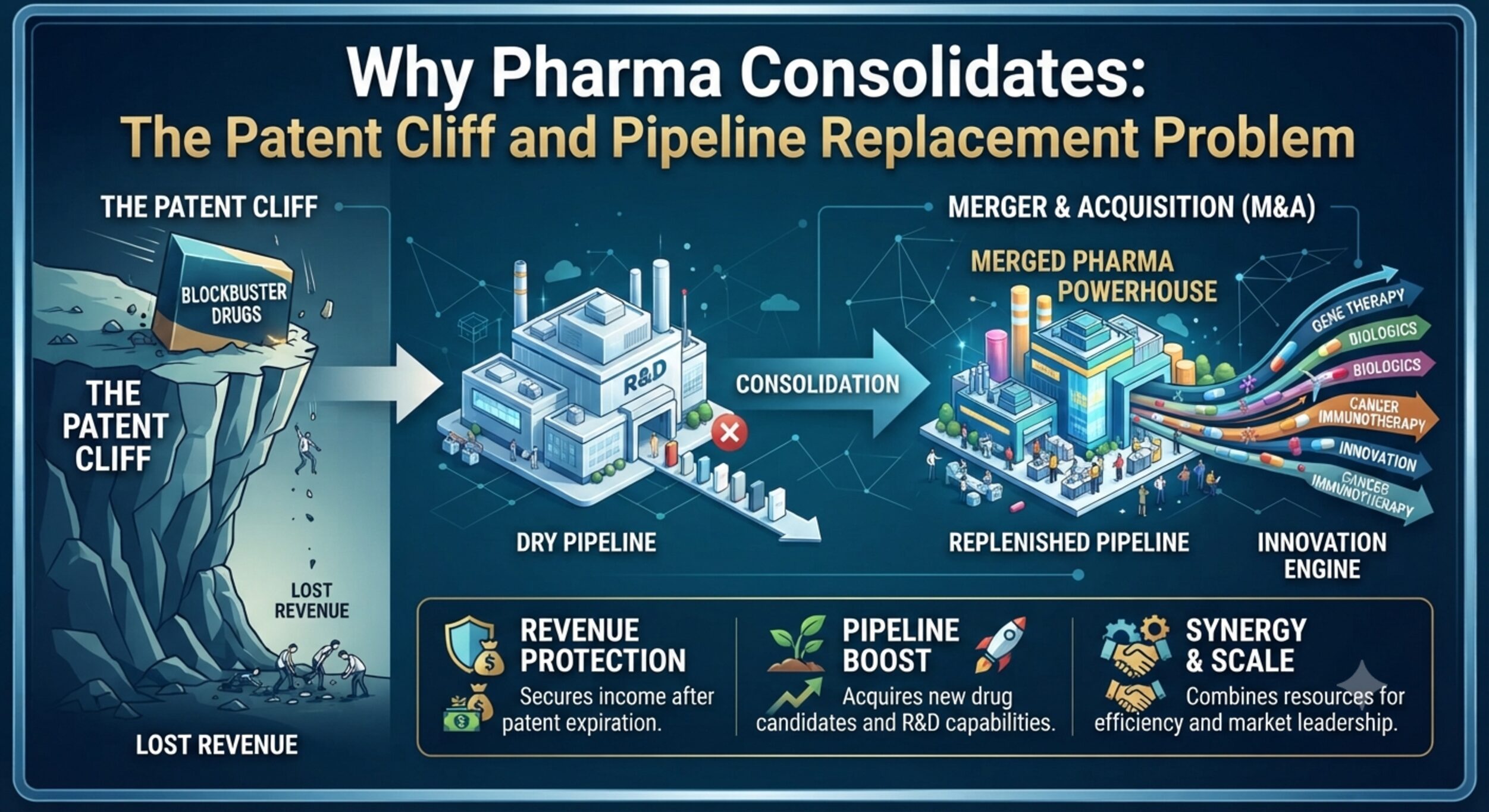
Pharmaceutical consolidation is not a choice. It is a structural necessity imposed by the industry’s fundamental economics: massively expensive R&D that takes over a decade to reach the market, blockbuster drugs that generate half a company’s revenue, and patent cliffs that create sudden, predictable, enormous revenue gaps. When a billion-dollar drug loses exclusivity, a company must replace that revenue or shrink. The mechanism for replacement is acquisition — buying access to development-stage or recently-approved drugs that can fill the earnings gap before it opens.
This report explains the consolidation drivers, the scale of the patent cliff, and what it means for the competitive landscape.
Table of Contents
The patent cliff: Scale and timing
Biopharmas face an estimated $230 billion in annual sales as blockbuster drugs see their patents expire in the coming years. The top 20 drugs heading for the patent cliff account for a combined $176.442 billion in sales — 75% of the $236 billion in annual sales set to disappear with loss of exclusivity.
2026 marks the start of a particularly pronounced cliff, with key patents on billion-dollar drugs set to expire. The US market alone is projected to lose more than $230 billion in revenue between 2025 and 2030.
The specific schedule matters:
- 2026: Merck’s Januvia (diabetes, $2.255B) and Janumet ($1.433B), Pfizer’s Xeljanz (immunology, $1.618B)
- 2027: Pfizer’s Ibrance (oncology, $6.393B)
- 2028: Amgen and Pfizer’s Enbrel (immunology, $5.386B)
- 2028: Merck’s Keytruda (oncology, ~$29.5B in 2023 revenue)
- 2029: Amgen’s Repatha (cardiovascular, $3.574B)
Among the most exposed are Merck and Pfizer, whose portfolios include several blockbuster small-molecule drugs reaching loss of exclusivity. For Bristol Myers Squibb, the stakes are particularly high. Eliquis, together with the company’s immuno-oncology flagship drugs Opdivo, accounts for roughly half of BMS’s total earnings. As both drugs approach the end of their exclusivity, the company faces what analysts describe as the largest growth gap among its large-cap pharmaceutical peers, estimated at approximately $38 billion in future at-risk revenue.
The revenue erosion following generic or biosimilar entry is not gradual. For a small-molecule blockbuster with thin secondary patent protection, the initial year of multi-source generic competition typically produces an 80-90% price and volume decline.For biologics like Keytruda or Enbrel, the decline is slower due to switching friction and PBM dynamics, but the trajectory is identical: the drug becomes a commodity at low margin.
Why outsourcing and acquisition are cheaper than internal R&D
The core problem is that developing a new drug is phenomenally expensive and uncertain. With an average cost of $2.6 billion and a development timeline spanning 10 to 15 years, pharmaceutical companies must navigate a complex landscape of research, clinical trials, regulatory approvals, and financial risks. Only 12% of drugs that enter human trials make it to approval.
This creates a mathematical trap: if you spend $2.6 billion to develop a drug and only 1 in 12 drug candidates that enter Phase I trials succeeds, the true cost per successful drug is vastly higher when you account for failures. The expected value is negative unless the approved drug becomes a blockbuster generating billions in revenue.
The implication: building a drug internally is a bet-the-company exercise for most companies. Acquiring an asset that has already cleared clinical development (Phase III or approved) is dramatically cheaper and de-risks the portfolio. Notable transactions include Johnson & Johnson’s $14.6 B acquisition of Intra-Cellular Therapies, Novartis’ $12 B purchase of Avidity Biosciences, Merck’s ~$10 B deal for Verona Pharma, Sanofi’s ~$9.5 B acquisition of Blueprint Medicines.
This dynamic is accelerating M&A. Jefferies tracked 14 deals of at least $500 million in Q1 2026, compared to 32 across all of 2025. At the current pace, Jefferies projects total deal value reaching $172 billion in 2026, compared to $111 billion in 2025. That is not a marginal increase. It represents a fundamental acceleration of the sector’s consolidation timeline.
M&A capacity and urgency
Large pharma companies have enormous cash and borrowing capacity, and they are deploying it. BMO has identified several companies with significant remaining acquisition capacity: AbbVie with approximately $33.6 billion, Novartis with approximately $53 billion, Bristol Myers Squibb with approximately $21.9 billion, and Amgen with approximately $18.6 billion.
We forecast that consolidation will continue in 2026, with companies such as Merck, Johnson & Johnson, Novartis, Sanofi and Bristol Myers Squibb likely candidates to actively pursue deals. We believe this will amount to 15% growth in both total deal value and the total number of deals, which would amount to nearly 520 deals and a little over $230 billion in deal value. This expectation is based on three factors: first, companies need to replenish their pipelines as branded medicines that bring in $200-250bn in sales will come off patent by 2032.
The urgency is existential. A company facing a $38 billion revenue cliff (like BMS) cannot wait for internal R&D to generate replacement revenue. Acquisitions are survival.
The focus: Late-stage assets and approved drugs
Acquirers are targeting late-stage or approved assets, not early-discovery biotech. Merck paid $6.7 billion for Terns Pharmaceuticals and its oral leukemia candidate, TERN-701. Eli Lilly — flush with cash from its obesity portfolio — offered $6.3 billion upfront, plus $1.5 billion in contingent value rights, for Centessa Pharmaceuticals and its portfolio of sleep disorder treatments. Biogen committed $5.6 billion for Apellis Pharmaceuticals and its pair of approved drugs, Syfovre and Empaveli.
The pattern is consistent: companies are buying assets in Phase II/III or approved. These have meaningful clinical validation and a clear regulatory path, reducing the development cost and time-to-market. The target price reflects the risk reduction: a Phase III asset trades at a premium to a Phase I program because the probability of regulatory approval is higher.
Therapeutic area focus: Oncology, obesity, rare disease
Acquirers are concentrating on high-priority, high-value therapeutic areas where competition drives M&A. Oncology remains the most consolidated: Insitro (AI drug discovery) has inked deals with Eli Lilly and Bristol-Myers Squibb to develop novel therapeutics. Formation Bio (AI for clinical-trials optimization) has translated its approach into outsized deals, selling promising cancer drug candidates to Sanofi (€545 million) and Eli Lilly (~$2 billion).
Obesity is the newest and hottest. Biopharma announced more than $250 billion across 516 licensing deals in 2025, with milestone-heavy structures dominating. The biggest deals reflect two mega-trends: the obesity gold rush and Chinese innovation going global.</cite> Eli Lilly alone has deployed over $25 billion in the first half of 2026, much of it focused on obesity and metabolic disease.
Rare disease remains attractive because of the Orphan Drug Act’s incentives (extended market exclusivity, fast-track FDA review, tax credits), lower competition, and the ability to charge premium prices to a defined patient population.
AI-driven drug discovery: The new consolidation driver
Consolidation is increasingly driven not just by patent cliffs but by the race to acquire AI drug discovery capabilities. AI-powered biotech firms continue to attract big pharma partnerships and acquisitions. In 2025 Eli Lilly and NVIDIA jointly committed up to $1 billion over five years to build a supercomputing AI infrastructure for drug R&D.
Large pharma is essentially outsourcing its drug discovery to AI startups and biotech companies with proprietary platforms. The acquirer buys access to the technology, the talent, and the candidate pipeline, hoping to compress the development timeline from 12+ years to less.
Bristol Myers Squibb: The cautionary tale
Bristol Myers Squibb illustrates the patent cliff problem in real time. Bristol Myers Squibb is in a tough spot as 2026 begins. Patents will soon expire for two of its top sellers, heightening pressure on the New Jersey pharmaceutical giant to find replacements. A handful of the company’s drugs failed late-stage trials last year, though, erasing multiple chances at future sales growth.
Bristol Myers deepened its cost-cutting plans last year to help fight through the turbulent period ahead and, at a presentation kicking off the conference Monday, CEO Chris Boerner said the company is “well on [its] way to delivering” the expected savings. But Boerner was also adamant that an arsenal of marketed and emerging medicines could help fill the coming revenue gap.
BMS is simultaneously cost-cutting and acquiring: it acquired Orbital Therapeutics for cell therapy capability expansion and is actively hunting for approved or late-stage assets. The strategy is defensive — cut costs to weather the revenue cliff while acquiring enough new assets to rebuild growth. This pattern repeats across large pharma.
What this means for procurement and investors
For procurement teams: Consolidation means your supplier landscape will concentrate further. Smaller, specialized suppliers and CDMOs may be acquired, changing contract terms and governance. Ensure your supply agreements include change-of-control provisions and have contingency partners identified for critical products.
For investors: The patent cliff creates a predictable squeeze on pharma valuations in 2026-2028, followed by potential recovery if companies successfully acquire and commercialize replacement products. Companies with strong pipelines or obesity assets command premiums. Those facing patent cliffs without acquisition firepower trade at discounts.
For biotech: This is a buyer’s market for large pharma. If you have a late-stage asset or approved drug, you will attract acquirers. Valuations are high because replacement cost is astronomical.
Frequently asked questions
What happens to a drug’s price when it loses patent protection?
Generic entry produces an 80-90% price decline in the first year for small molecules. For biologics, biosimilar entry is slower (18-36 months to meaningful market penetration), but the outcome is the same: the drug becomes a commodity at low margin. The branded manufacturer typically exits the market or holds a small share at generic-level pricing.
Why can’t pharma just develop new drugs internally?
They can, but it’s expensive and slow. Developing one drug costs $2.3-2.6 billion and takes 10-15 years. Only 12% of drugs entering human trials get approved. A company facing a $38 billion revenue cliff cannot wait 10-15 years; acquiring an asset in Phase III or approved shortens the timeline to 1-3 years. The math is simple: acquisition is faster and lower-risk.
Are all acquisitions successful?
No. Integration failures, missed commercial ramp, manufacturing problems, and unexpected safety signals all occur post-acquisition. Large pharma companies accept a failure rate and structure deals (milestone payments tied to regulatory or sales milestones) to share risk with the seller.
Does the patent cliff get worse over time?
Yes. As biologic patents expire, the pattern repeats. Humira lost exclusivity in 2023 and is being dismantled by biosimilars. Over the next decade, dozens of other biologics will follow. The industry will see increasingly frequent, predictable revenue cliffs. This structural pressure will continue to drive consolidation.
Sources
- Gene Engineering & Biotechnology News — Top 20 Drugs Heading for the Patent Cliff, 2026-2029: https://www.genengnews.com/topics/drug-discovery/top-20-drugs-heading-for-the-patent-cliff-2026-2029/
- Drug Discovery News — Blockbuster Drugs Face a Massive Patent Cliff in 2026: https://www.drugdiscoverynews.com/blockbuster-drugs-face-a-massive-patent-cliff-in-2026-17019
- IntuitionLabs — Drug Patents Expiring in 2026: A Comprehensive Guide: https://intuitionlabs.ai/articles/drug-patent-expirations-2026
- IntuitionLabs — Oncology AI Deals & Pharma M&A Trends: 2026 Analysis: https://intuitionlabs.ai/articles/oncology-ai-deals-pharma-ma-2026
- Nature Foleon — Pharma Power Plays: Mergers, Acquisitions & Deals Reshaping 2026: https://nature.foleon.com/pharma-insight-reports/pharma-power-plays-mergers-acquisitions-deals-reshaping-2026/
- M&A Advisor — Seven Deals, $29 Billion, Twelve Days: https://maadvisor.com/maalerts/seven-deals-29-billion-twelve-days/
- BioPharma Dive — JPM26: US Biotech’s ‘Sputnik Moment’ and Bristol Myers’ Big Year: https://www.biopharmadive.com/news/jpm26-china-biotech-pfizer-obesity-bristol-sarepta-elevidys-sales/809320/
- ING THINK — Come Together: Pharma M&A Set to Accelerate in 2026: https://think.ing.com/articles/come-together-pharma-ma-will-accelerate-in-2026/
- Vision Life Sciences — Pharma Licensing Deals & M&A Tracker 2026: https://visionlifesciences.com/insights/pharma-deal-tracker-2026
- Yahoo Finance — Pharma and Biotech M&A Boom Accelerates: https://finance.yahoo.com/sectors/healthcare/articles/pharma-biotech-m-boom-accelerates-172400276.html
- BioSpace — Biopharma Strikes 50+ M&A Deals in H1: https://www.biospace.com/business/biopharma-strikes-50-m-as-deals-in-h1-led-by-lillys-25b-spend
- PatentPC — The Cost of Drug Development: How Much Does It Take to Bring a Drug to Market?: https://patentpc.com/blog/the-cost-of-drug-development-how-much-does-it-take-to-bring-a-drug-to-market-latest-data
- Gene Engineering & Biotechnology News — The Unbearable Cost of Drug Development: https://www.genengnews.com/gen-edge/the-unbearable-cost-of-drug-development-deloitte-report-shows-15-jump-in-rd-to-2-3-billion/
- Scientific American — Cost to Develop New Pharmaceutical Drug Now Exceeds $2.5B: https://www.scientificamerican.com/article/cost-to-develop-new-pharmaceutical-drug-now-exceeds-2-5b/
- DrugPatentWatch — The Impact of Drug Patent Expiration: https://www.drugpatentwatch.com/blog/the-impact-of-drug-patent-expiration-financial-implications-lifecycle-strategies-and-market-transformations/
- PharmaExec — The Pharma Patent Cliff Explained: https://www.pharmexec.com/view/patent-cliff-explained-what-how-companies-navigate

