
How a nearly $2 trillion market is reshaping itself around obesity drugs, where the growth is coming from, and why the industry’s earnings power is diverging by therapeutic area.
The global pharmaceutical market is at an inflection point. For decades, it was defined by blockbuster oncology drugs, established cardiovascular franchises, and incremental innovation in mental health. In 2026, the story is different. A single class of metabolic drugs — GLP-1 receptor agonists for diabetes and obesity — has become the fastest-growing driver of industry revenue. Cancer is still the largest therapy area by spending, but for the first time, obesity drugs are attracting venture capital, manufacturing investment, and corporate strategy attention at a scale that rivals oncology. Meanwhile, patent cliffs for legacy biologics are compressing margins, and pricing pressure from governments is real.
This report provides the numbers that define the global pharma landscape: market size, regional distribution, therapy area breakdown, and what the shift toward metabolic diseases means for supply chains and procurement.
Table of Contents
Global market size and growth
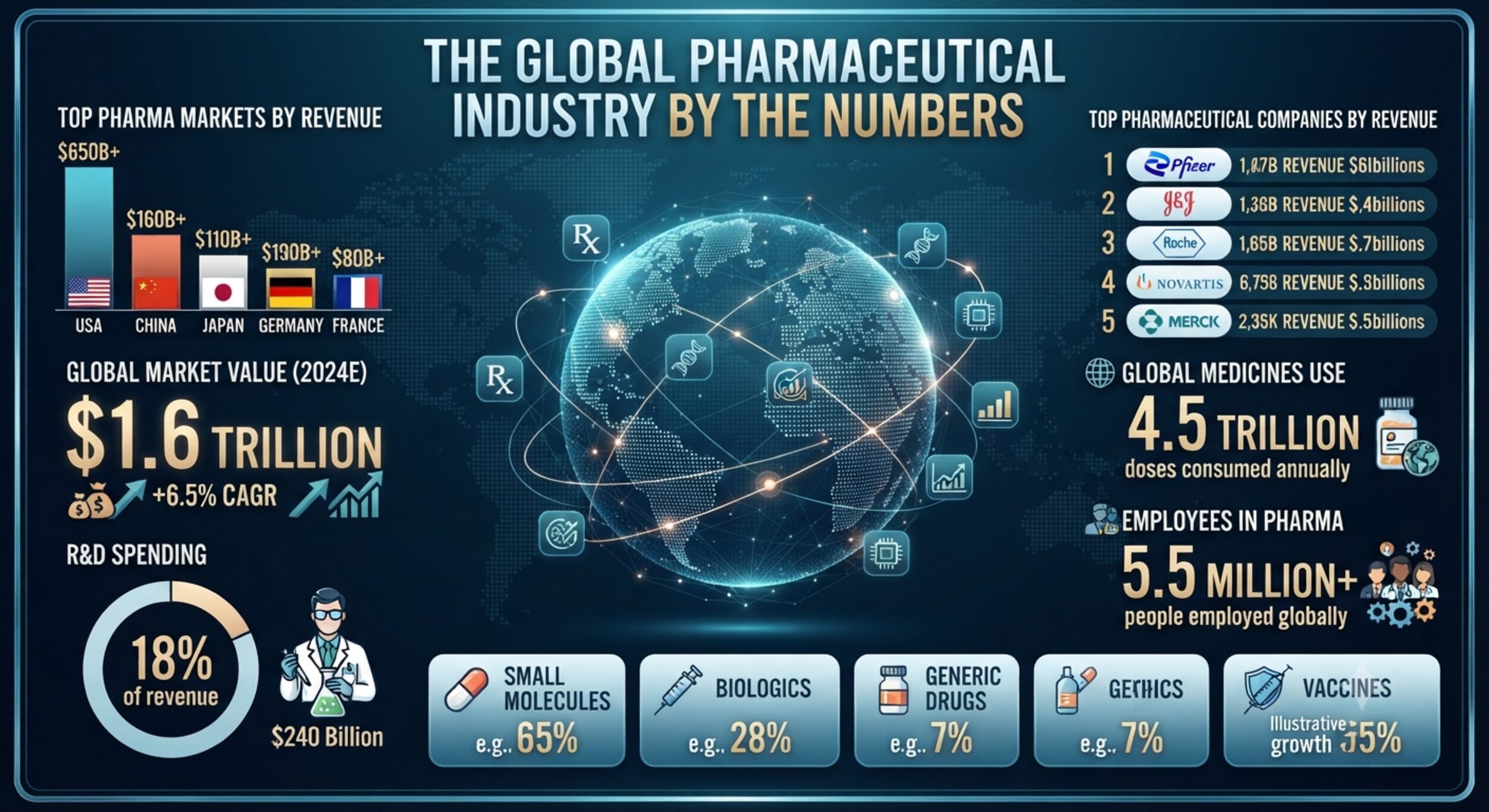
<cite index=”27-1″>The global pharmaceutical market was valued at USD 1,738.0 billion in 2025 and is projected to grow from USD 1,837.0 billion in 2026 to USD 2,776.7 billion by 2033, at a CAGR of 6.1%.</cite> Different analysts publish slightly different figures — some show 5% CAGR, others 8% — depending on how they segment the market and what they include. The consensus range is 5-8% growth, placing the market near $2 trillion in 2026 and heading toward $2.5-3 trillion by the early 2030s.
For context, <cite index=”36-1″>the global medicine market is projected to grow at 5-8% CAGR through 2030, reaching approximately $2.6 trillion, with the U.S. market growing at 4-7% net CAGR, a robust environment by historical comparison.</cite> This is faster than GDP growth in most developed markets, driven by an aging population, rising chronic disease prevalence, and the expansion of treatment areas that were previously untreated (obesity being the clearest example).
Regional distribution
<cite index=”27-1″>North America dominated with 41.8% of global pharmaceutical revenue in 2025.</cite> Within North America, the United States represents roughly 45-50% of global pharmaceutical spending — by far the largest single market. <cite index=”32-1″>The North American pharmaceutical market is projected to grow from $635.31 billion in 2025 at a 6.37% CAGR.</cite>
Europe represents roughly 20-25% of global spending, with Germany, France, and the UK as the largest markets. European pricing is tightly controlled by government health systems; pricing power is lower than in the US.
<cite index=”27-1″>Asia Pacific is the fastest-growing regional market by CAGR from 2026-2033.</cite> <cite index=”32-1″>China’s pharmaceutical market is projected to grow from USD 93.11 billion in 2026 to USD 183.66 billion by 2035, at a CAGR of 7.84%.</cite> China is particularly relevant for procurement because it is both the largest market for API imports (as discussed in earlier reports) and an increasingly competitive market for finished drugs as Chinese manufacturers scale.
The implication for supply chain: manufacturing and distribution investment is flowing toward Asia Pacific, but North America remains the profit center and the driver of innovation.
Therapy area breakdown: Where the money goes
Oncology: Still the largest, still the most lucrative
<cite index=”45-1″>In 2026, global pharmaceutical sales in the oncology sector surpassed 232 billion U.S. dollars.</cite> Oncology represents roughly 13-15% of total pharmaceutical spending but commands far higher prices per dose than most other categories. <cite index=”42-1″>IQVIA projects global spending on oncology drugs will reach roughly $273 billion in 2025, with growth around 9-12% annually.</cite>
The oncology market is driven by immunotherapies (checkpoint inhibitors like Keytruda and Opdivo), targeted therapies (drugs targeting specific mutations), and emerging modalities like antibody-drug conjugates (ADCs) and cell therapies (CAR-T). Innovation is relentless; the pipeline contains hundreds of oncology candidates in clinical development. Profit margins in oncology are the highest in pharma, justifying the R&D investment.
Immunology: The second-largest spend category
<cite index=”39-1″>Immunology has an 18.3% market share, with spending on immunology drugs close to $175 billion for conditions like rheumatoid arthritis, psoriasis, and other immune-mediated diseases.</cite> The market is mature and competitive — TNF inhibitors (Humira, Enbrel, Remicade) have been blockbusters for two decades and are now facing biosimilar entry, compressing prices. But newer mechanisms (IL-6 inhibitors, IL-17 inhibitors, JAK inhibitors) are growing, and the immunology franchise is stable and cash-generative.
Diabetes and obesity: The fastest-growing segment
This is where the real story is. Diabetes and anti-obesity drugs combined represent <cite index=”39-1″>an anti-obesity market now representing ~$42 billion and 4.6% share, climbing to the fourth-largest category, with ~190 pipeline assets and projections of $100B incremental growth by 2029.</cite> <cite index=”45-1″>Anti-diabetes drug sales are approximately 92 billion U.S. dollars in 2026.</cite>
The driver is GLP-1 receptor agonists: semaglutide (Novo Nordisk’s Ozempic for diabetes, Wegovy for obesity), tirzepatide (Eli Lilly’s Mounjaro for diabetes, Zepbound for obesity), and a wave of competitors. <cite index=”39-1″>Tirzepatide leads both diabetes (Mounjaro $39.1B, +67.1%) and obesity (Zepbound $22.9B, +188.7%), while semaglutide’s Wegovy reached $18.6B (+29.2%).</cite>
The obesity indication is transformative. Obesity affects roughly 2 billion people globally, and most were previously untreated. GLP-1s offer meaningful weight loss (15-20%+ of body weight), and demand has overwhelmed supply. <cite index=”41-1″>In July 2026, AstraZeneca announced a USD 50 billion investment in the U.S. by 2030, with a new multi-billion-dollar drug substance facility in Virginia focused on weight management and metabolic therapies, aiming to support its goal of reaching USD 80 billion in revenue by 2030.</cite>
The supply chain challenge for GLP-1s is acute: these are injectables requiring cold chain, specialty pharmacy distribution is constrained, and manufacturing is capacity-limited. For procurement teams, GLP-1 sourcing is now a strategic priority.
Cardiovascular: Large market, compressed by generics
Cardiovascular drugs remain a massive category by volume — statins, ACE inhibitors, beta-blockers, and anticoagulants are among the most prescribed drugs globally. But <cite index=”44-1″>cardiovascular APIs held a 28.26% share of the total API market in 2025, the single largest therapeutic segment by revenue, though this reflects high volume at low unit prices as many are generic.</cite> Spending growth in cardiovascular is flat to low single-digits; the category is dominated by generics with thin margins.
Emerging areas: Mental health, rare diseases, infectious disease
Psychiatric medications (antidepressants, antipsychotics) generate roughly $30-40 billion annually. Rare diseases (oncology subset, genetic disorders, autoimmune conditions affecting <200,000 people each) are individually small but collectively meaningful; the number of orphan drugs in development has grown exponentially.
Infectious disease (antibiotics, antivirals) remains a substantial but non-glamorous category. Pricing pressure is intense because of antibiotic resistance concerns and the public health imperative to keep antibiotics affordable.
Specialty drugs: The margin driver
<cite index=”42-1″>By 2025, specialty drugs are projected to account for roughly 50% of global pharmaceutical spending, and as much as 60% in developed markets.</cite> Specialty drugs are complex, high-cost therapies (usually injectables or therapies requiring monitoring): biologics, oncology drugs, GLP-1s, rare disease treatments. They generate disproportionate profit because pricing power is high for novel mechanisms, and they command premium reimbursement from payers.
The supply chain implication is severe: specialty drug distribution is concentrated in a handful of specialty pharmacies, cold-chain infrastructure is critical, and logistics costs are 5-15% of product cost vs. <1% for oral medications.
Branded vs. generic, and the biosimilar boom
<cite index=”27-1″>The branded segment held the largest market share of 66.5% in 2025.</cite> Branded drugs earn premium pricing because of patent protection or regulatory exclusivity. Generics represent the remainder: drugs where patents have expired and multiple manufacturers compete on price.
Biosimilars occupy the middle ground. They enter when biologic patents expire, priced 25-35% below the reference product. In 2026, major biosimilars for Humira (adalimumab), Enbrel (etanercept), and Remicade (infliximab) are capturing market share. For procurement teams, biosimilar entry into a portfolio can reduce costs materially — though not to generic levels because manufacturing complexity limits the discount depth.
Small molecules vs. biologics
<cite index=”27-1″>Conventional drugs (small molecules) segment held the largest market share of 54.2% in 2025.</cite> Small molecules remain the revenue plurality because of the sheer volume of chronic disease treatments (cardiovascular, CNS, GI, respiratory). But growth is slowing; small molecules mature and enter generic competition.
Biologics are smaller by revenue share but growing faster. <cite index=”44-1″>While synthetic APIs captured 65.78% of revenue in 2025, biological APIs are the fastest-growing segment of the pharmaceutical API market, expected to expand at a 9.22% CAGR through 2031, driven by immuno-oncology, bispecific antibodies, CAR-T cell therapies, and GLP-1 biologics.</cite>
Route of administration: Oral is dominant, injectables growing
<cite index=”27-1″>The oral segment held the largest market share of 57.4% in 2025.</cite> Oral drugs are convenient, scalable, and affordable to distribute — most generic drugs are oral tablets. But <cite index=”28-1″>the parenteral segment is expected to expand at a significant CAGR between 2026 to 2035,</cite> driven by biologics, GLP-1s, and specialty therapies that cannot be taken orally.
The infrastructure implication: cold chain, specialty pharmacy, and injectable handling become more critical as injectables grow from ~30% of spending to 40%+ by the 2030s.
Clinical pipeline and innovation velocity
The pharmaceutical industry has roughly 13,500 drug compounds under active clinical evaluation. Oncology alone has over 4,200 candidates, reflecting the industry’s massive R&D investment in cancer. GLP-1 and obesity therapeutics now have 190+ candidates in development — a measure of how crowded the space has become and how much capital is flowing toward metabolic diseases.
AI-driven drug discovery, real-world evidence generation, and digital quality assurance are accelerating innovation and reducing development timelines. But regulatory approval remains a bottleneck; the FDA’s standard path requires Phase 1, 2, and 3 clinical trials that take years.
Patent cliffs and pricing pressure
Patent expirations for major biologics (Humira 2023, Enbrel 2025, Stelara 2026, Keytruda 2028) are creating margin pressure for incumbent manufacturers. Biosimilar entry compresses pricing. Simultaneously, governments are implementing pricing reforms (US Inflation Reduction Act drug price negotiation, EU Health Technology Assessment frameworks, Japan price controls). The result: pricing power is declining, and companies are doubling down on innovation to offset lost revenue from patent expiration.
What this means for procurement and supply chain
Specialty pharmacy is becoming core infrastructure. As the market shifts toward biologics and injectables, most hospitals and health plans now need dedicated specialty pharmacy capability. Budget accordingly — it is no longer optional.
GLP-1 sourcing is a strategic bottleneck. GLP-1 demand exceeds supply. Manufacturing capacity is expanding but will remain tight through 2027-2028. If your health plan or hospital system covers obesity treatment, secure supply agreements now; spot market prices are volatile.
Biosimilar entry creates near-term opportunity. Immunology and oncology franchises are entering biosimilar competition in 2026-2028. Negotiate aggressively with reference product manufacturers; credible biosimilar threats provide leverage.
Asia Pacific manufacturing growth will reshape supply chain. India, China, and Southeast Asia are expanding pharmaceutical manufacturing capacity. This creates opportunities for lower-cost sourcing but also supply concentration risk if you rely on newly scaled facilities.
Patent cliff timing matters. Know when key products lose exclusivity in your portfolio. Plan biosimilar transitions 12-18 months in advance.
Frequently asked questions
Why do GLP-1 drugs cost so much?
Manufacturing biologics is expensive (as detailed in earlier reports). GLP-1s require cold chain, specialty pharmacy distribution, and patient support programs. Pricing also reflects the newness — patents protect these drugs from competition for years. As more GLP-1 competitors enter (Novo, Eli Lilly, Roche, Viking, Viking, Viking) and as manufacturing scales, prices should decline. But initial pricing reflects the market’s willingness to pay for significant weight loss.
Are biosimilars really as good as the original biologic?
Yes, for most clinical purposes. Biosimilars are “highly similar” but not identical to the reference product due to manufacturing differences. The FDA requires clinical trials showing no clinically meaningful difference. Switching from a reference product to a biosimilar is safe; most patients will not notice.
Why is obesity treatment such a big deal for pharma?
Obesity is untreated. Unlike diabetes (which was already treated with metformin and insulin), obesity had no effective pharmaceutical treatment until GLP-1s. The addressable population is massive (2+ billion people globally), and payers are now reimbursing. This is a new market, not a shift from existing drugs — the total opportunity is genuinely incremental to the industry.
What happens when GLP-1 patents expire?
Biosimilar entry, price compression. Novo Nordisk and Eli Lilly will lose pricing power. But the market will still grow because access expands when prices fall. Similar to what happened with monoclonal antibodies after Remicade’s patent expired in 2018 — biosimilars entered, prices fell, and volumes grew.
Sources
- Grand View Research — Pharmaceutical Market Report 2026-2033: https://www.grandviewresearch.com/industry-analysis/pharmaceutical-market-report
- Precedence Research — Pharmaceutical Market 2026 to 2035: https://www.precedenceresearch.com/pharmaceutical-market
- Coherent Market Insights — Pharmaceutical Market 2026-2033: https://www.coherentmarketinsights.com/industry-reports/pharmaceutical-market
- Fortune Business Insights — Pharmaceuticals Market 2026-2034: https://www.fortunebusinessinsights.com/impact-of-covid-19-on-pharmaceuticals-market-102685
- IQVIA Institute — Global Medicine Use Trends 2026: https://www.iqvia.com/blogs/2026/03/iqvia-institutes-2026-forecast-global-medicine-use-stays-strong-despite-headwinds
- Managed Healthcare Executive — GLP-1 Drugs to Drive Growth in Obesity and Diabetes Treatment: https://www.managedhealthcareexecutive.com/view/glp-1-drugs-to-drive-growth-in-obesity-and-diabetes-treatment-amcp-annual-2026
- IntuitionLabs — Global Pharmaceutical Market Analysis & Trends: https://intuitionlabs.ai/articles/pharmaceutical-market-analysis-trends
- ChemOx Pharma — Pharmaceutical API Market 2026: https://chemoxpharma.com/pharmaceutical-api-market-2026/
- Statista — Leading Therapeutic Areas 2026: https://www.statista.com/statistics/279916/top-10-therapeutic-classes-by-global-pharmaceutical-sales/
- Healthcare Ranking — Top 20 Global Pharmaceutical Companies 2026: https://hcranking.com/news/2026/05/202605288873
- Toward Healthcare — North America Pharmaceutical Market Sizing: https://www.towardshealthcare.com/insights/north-america-pharmaceutical-market-sizing
- Toward Healthcare — Global Pharmaceutical Market Sizing: https://www.towardshealthcare.com/insights/pharmaceutical-market-sizing
- DataMint Intelligence — Pharmaceuticals Market 2026-2035: https://www.datamintelligence.com/research-report/pharmaceuticals-market
- FiercePharma — Obesity Drugs Set to Top Rankings by 2030: https://www.fiercepharma.com/pharma/move-over-oncology-obesity-diabetes-meds-will-take-over-2030s-top-drug-rankings-evaluate

