
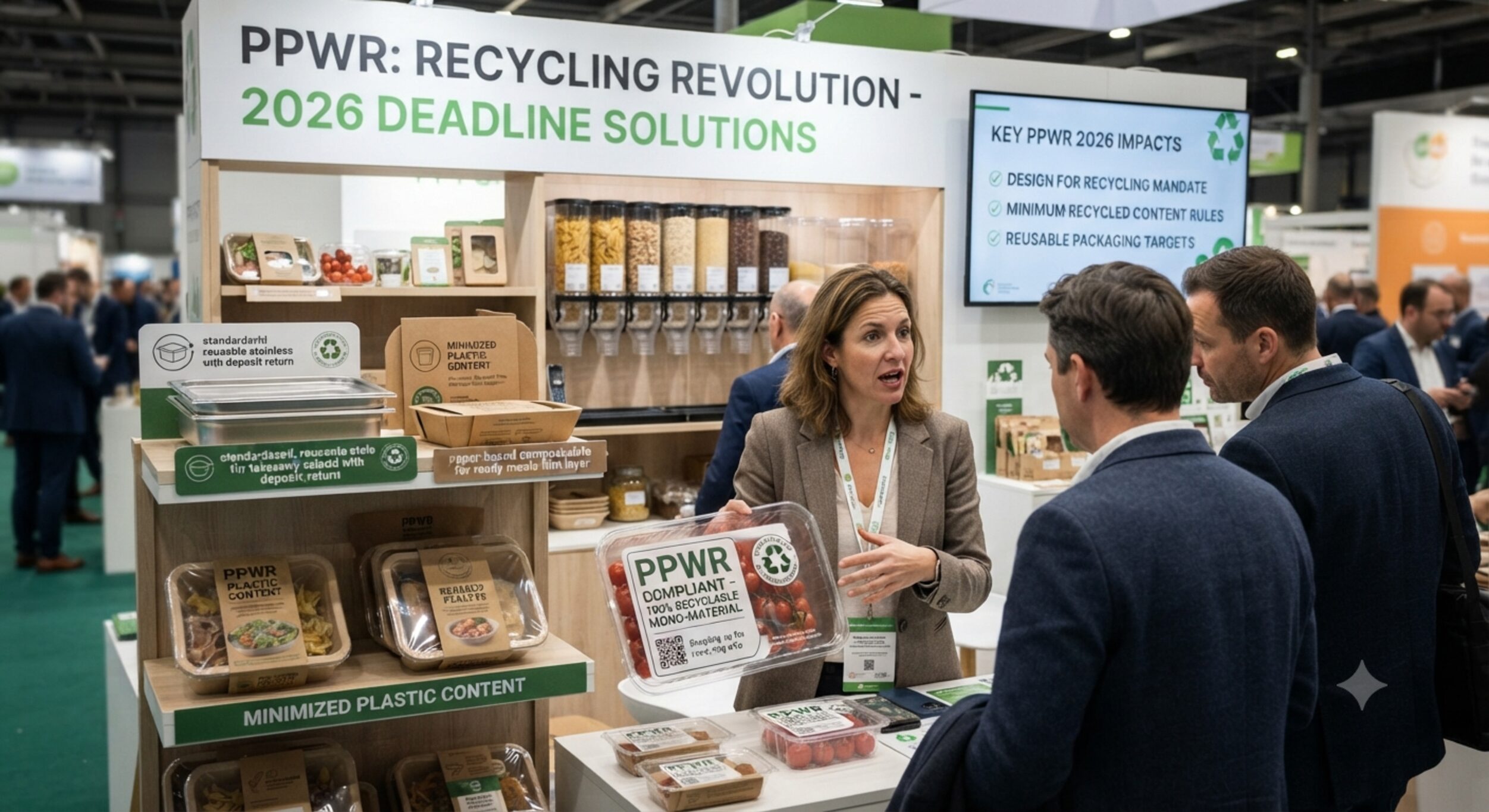
The PPWR deadline lands on 12 August 2026, turning food packaging trends from marketing positioning into a hard compliance requirement for buyers.
Sixteen days from now, the EU’s Packaging and Packaging Waste Regulation becomes directly applicable across all 27 member states. There is no national transposition, no grace period, and no exemption for stock already in production. Packaging placed on the EU market after 12 August must comply.
That single date reframes almost every packaging trend the industry has been discussing this year. Recyclable monomaterials, paperisation, QR-enabled labelling, portion formats — these have been positioned as consumer-led innovation. From next month, a growing share of them are legal minimums with audit trails attached.
For food and beverage buyers, the practical question is no longer which packaging trends to follow. It is which obligations bite when, and who carries the liability.
Substantiated sustainability becomes a legal test
Market researcher Innova Market Insights named “substantiated sustainability” its leading packaging trend for 2026 — the shift from environmental claims to verified environmental claims. The framing was consumer-driven: shoppers will pay a premium for sustainable formats but increasingly demand proof.
Regulation has since overtaken sentiment. PPWR, formally Regulation (EU) 2025/40, entered into force in February 2025 and applies from August 2026. It imposes binding requirements on design, composition, recyclability, recycled content, minimisation and labelling across the full value chain — manufacturers, importers and distributors alike.
The liability point matters and is widely misunderstood. If you import packaged goods into the EU, you are generally treated as the importer and must verify compliance before the product reaches the market. A supplier’s assurance is not a defence.
What changes in August, and what follows
From 12 August 2026: essential design and composition requirements apply, certain single-use packaging formats are banned outright, and conformity documentation must be in place. The 1994 Packaging Directive is repealed the same day.
The heavier obligations are staged:
- 12 August 2028 — harmonised material composition labelling
- 12 February 2029 — mandatory QR-coded labels on reusable packaging
- 1 January 2030 — only packaging graded A, B or C may be marketed, alongside minimum recycled content thresholds for plastics
- 31 December 2030 — member states must recycle 70% of packaging waste by weight
- 1 January 2035 — recyclability must be demonstrated at scale
- 1 January 2038 — only grades A and B permitted
The 2030 recyclability grading is the commercially significant one, and packaging redesign typically runs on 12 to 24 month lead times. Work that has not started is already behind.
Where the material innovation is landing
The supplier response, on display at Interpack in Düsseldorf in May, has concentrated on structural simplification rather than novel materials.
Mondi’s Re/cycle RetortPouch replaces multilayer plastic with a recyclable monomaterial format, while its Re/cycle FunctionalBarrier Paper pouch reflects the wider paperisation push. Coveris has developed MonoFlexBE, a recyclable high-barrier monomaterial that retains a metallic finish — an explicit attempt to hold shelf impact while dropping the multilayer structure.
The logic is consistent across both. Coveris flexibles business development director Katja Killian has described the acceleration toward fully recyclable monomaterial and paper-based formats as consumer-driven. In practice it is also the shortest path to a passing recyclability grade in 2030.
Food waste reduction sits alongside it as the second axis. Coveris’ Freshlife perforation technology manages internal atmosphere to extend produce shelf life; Mondi’s PickUp and Coral trays target portion formats with reduced material use. Mondi corrugated innovation head Jan Blankiewicz has framed food waste prevention as delivering environmental and economic returns together — which is the honest commercial case, since packaging typically represents a small fraction of the embedded footprint of the food inside it.
Digital moves from marketing to mandate
QR codes, augmented reality and digital product passports have been discussed as engagement tools. From February 2029 they become obligatory on reusable packaging, and harmonised labelling from 2028 will require standardised material composition data on-pack.
That converts a marketing budget line into an IT and data-governance line. The upstream requirement is a clean, auditable material composition record per SKU — which most food businesses do not currently hold in structured form.
What it means for buyers and procurement teams
Audit your importer status first. If you place packaged goods on the EU market, you likely carry the compliance obligation regardless of who designed the packaging. Establish this before August, not after an enforcement query.
Get conformity documentation into supplier contracts now. Warranties covering recyclability grade, recycled content and composition data are cheaper to negotiate at renewal than to retrofit under enforcement pressure.
Price the 2030 grading, not the 2026 date. August is the compliance floor. The commercial reset is grade A–C eligibility in 2030, which will strand some current formats entirely. Ask suppliers for indicative grades on every SKU you buy today.
Expect landed-cost inflation on the transition. Monomaterial high-barrier films and paper-based barrier formats generally carry a premium over incumbent multilayer structures, and recycled-content feedstock pricing will tighten as 2030 thresholds approach.
Non-EU exporters are in scope. UK, US, African and Asian suppliers shipping packaged product into the bloc face the same requirements. If you export to the EU, your packaging is regulated by it.
Related
FAQ
When does the PPWR deadline take effect?
The regulation applies from 12 August 2026 across all EU member states. It is directly binding with no national transposition and no general grace period, so packaging entering the market after that date must comply.
What are the key food packaging trends for 2026?
Innova Market Insights identified substantiated sustainability, digital-enhanced designs, health-forward convenience, personalised packaging and sensory unboxing. In practice, verified recyclability and material simplification dominate, because regulation now underwrites them.
Who is liable for PPWR compliance in the supply chain?
Responsibility follows role. Importers placing packaged goods on the EU market are generally required to verify compliance themselves, which means brand owners and buyers cannot rely solely on supplier declarations.

