
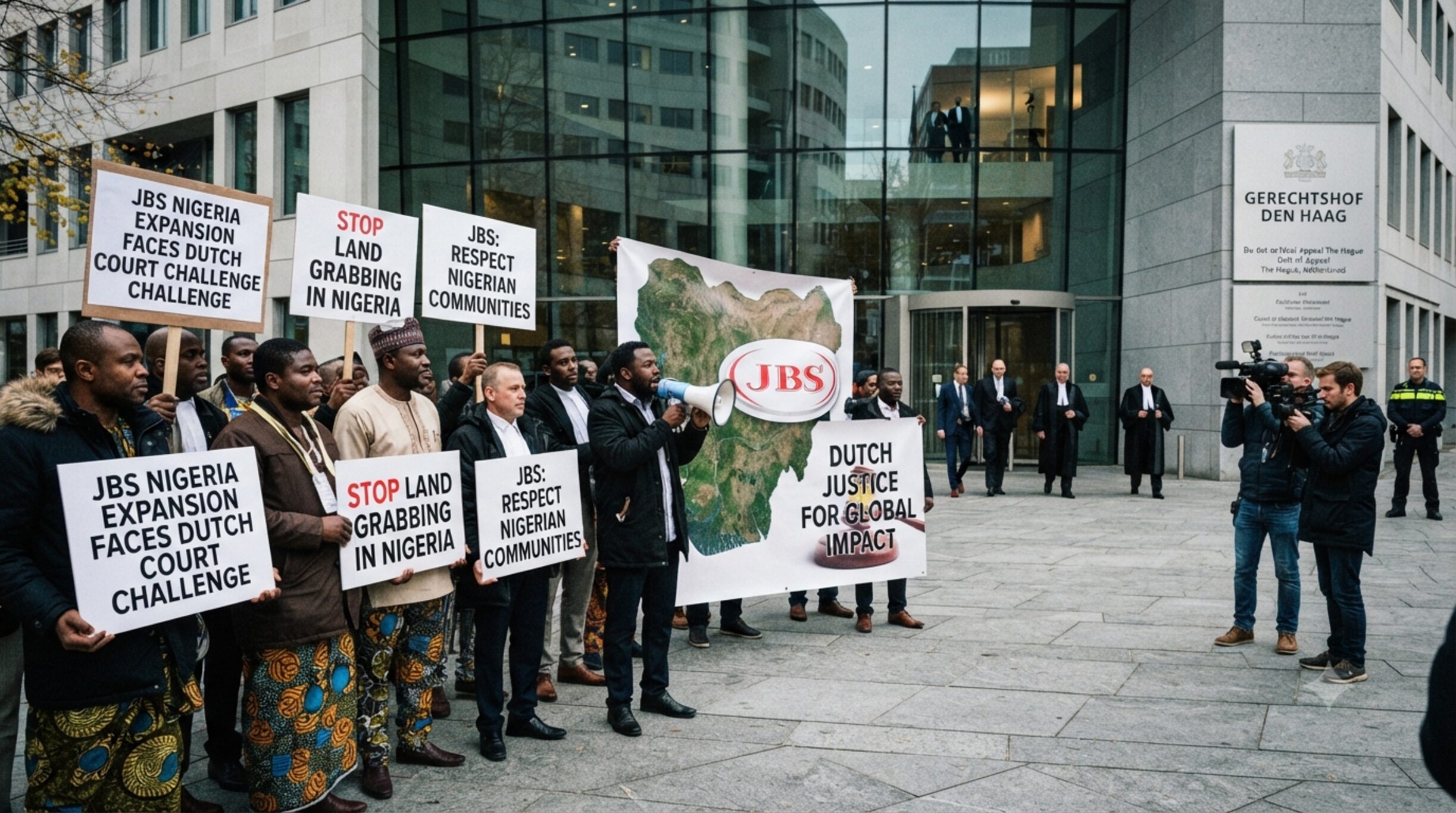
Greenpeace has petitioned a Dutch court over the JBS Nigeria expansion, seeking disclosure on a $6bn plan that could reshape African protein supply.
The world’s largest meat company is being taken to court in its new home jurisdiction — not yet over what it does, but over what it will not say. Greenpeace Netherlands filed a petition on 22 July asking a Dutch court to compel JBS to hand over internal information on its $6 billion global growth programme, roughly half of which is earmarked for Nigeria.
This is a disclosure action, not a damages claim. Greenpeace has been explicit that it is a preliminary step, intended to build the evidentiary base for substantive litigation later. The mechanism is new Dutch legislation giving parties with a legitimate interest the right to demand specific corporate data needed to bring a case against a Dutch company. The escalation follows JBS declining to comply with a formal disclosure demand served in April.
For protein buyers, the case is worth watching less for its climate politics than for what it signals about where legal risk is migrating in the supply chain.
What the petition is actually seeking
Greenpeace’s argument rests on the Dutch duty of care — the same broad standard that underpinned the Milieudefensie action against Shell, where a final ruling is expected in early 2027. The NGO contends that JBS’s historic practices and forward expansion plans are inconsistent with the company’s own stated climate and biodiversity obligations.
Legal counsel for Greenpeace International has framed the objective plainly: the target is the business model and the growth model, not a single facility. The organisation’s stated suspicion is that JBS has not assembled the impact data it would need to understand the consequences of what it is building.
Until now, this species of case has been reserved almost exclusively for oil and gas. A Paris court recently ordered TotalEnergies to disclose climate risks tied to emissions from its products, though it stopped short of mandating operational limits. Applying the template to agriculture is the genuinely novel element here, and it is why lawyers are treating the filing as a potential precedent for the wider food sector.
Why Nigeria is the pressure point
JBS signed a memorandum of understanding with the Nigerian government in November 2024 covering a $2.5 billion, five-year build-out: six processing plants, three poultry, two beef and one pork. The commercial logic is not obscure. Nigeria has more than 220 million people, protein production accounts for roughly a tenth of GDP, and domestic supply meets only about 40% of demand. JBS has positioned the investment as support for Nigeria’s national food security plan, with commitments to work with smallholder producers.
Civil society groups in Nigeria dispute that the groundwork has been done. Campaigners say there is no publicly available evidence of impact assessments or community consultation, and that freedom-of-information requests have gone unanswered. One Nigerian campaign network has pointed to a reported allocation of 1.2 million hectares in Niger state as the kind of commitment that ought to be scrutinised before it is locked in.
Their concerns cluster around four things: displacement of smallholders, competition for land and water, disease and antimicrobial-resistance risk in concentrated production, and long-lived methane emissions. Livestock is estimated to account for around 31% of global methane output.
The transparency record behind the case
The timing is not accidental. JBS missed its end-2025 deadline to clean up its Amazon beef supply chain, has since dropped its net-zero-by-2040 commitment, and excluded indirect emissions — the methane from cattle that dominates its footprint — from its most recent sustainability reporting. Greenpeace has used that sequence to argue that the company is retreating from disclosure precisely as it accelerates growth.
JBS relocated its headquarters to the Netherlands last year to enable a New York listing and give the founding Batista family a larger ownership stake. That move opened access to deeper capital markets. It also brought the group inside a European transparency and duty-of-care regime that is materially more demanding than the Brazilian one it left. The company told the Guardian it does not comment on proceedings it has not been formally notified of.
What it means for buyers and procurement teams
Sourcing risk is shifting from farm to boardroom. The exposure being tested is disclosure quality at group level, not conditions at a single abattoir. Buyers running supplier ESG questionnaires should expect to need more than corporate sustainability report extracts within two to three years.
Scope 3 exclusion is now a live commercial question. If a supplier’s reporting omits enteric methane, any downstream emissions figure built on it is incomplete. Customers with their own science-based targets will find that gap surfacing in their own audits.
Watch the precedent, not the verdict. Even a partial disclosure order creates a template that NGOs can apply to other Dutch- or EU-domiciled agrifood groups. Dairy, feed and palm-linked businesses are the obvious next candidates.
Nigerian and West African supply timelines carry political risk. If consultation gaps become a live domestic issue, project schedules can slip regardless of the Dutch case. Buyers modelling African poultry or beef availability from 2029 onward should treat the build-out as unconfirmed.
Contract language is the practical hedge. Deforestation, land-tenure and disclosure warranties in supply agreements are cheaper to negotiate now than to litigate later, particularly for EUDR-exposed buyers.
FAQ
What is Greenpeace asking the Dutch court to do?
Compel JBS to disclose internal information on its climate, nature and human rights impacts, particularly regarding its $6 billion expansion plan. It is a disclosure petition under new Dutch legislation, filed as groundwork for possible substantive litigation rather than as a claim for damages or operational restrictions.
How large is the JBS Nigeria expansion?
Around $2.5 billion over five years, covering six processing plants — three poultry, two beef, one pork — under a memorandum of understanding signed with the Nigerian government in November 2024.
Why is the case being heard in the Netherlands?
JBS moved its corporate headquarters from Brazil to the Netherlands last year ahead of its New York listing. That places it within Dutch jurisdiction and subject to the Dutch duty-of-care standard, the same framework used in climate litigation against Shell.

