
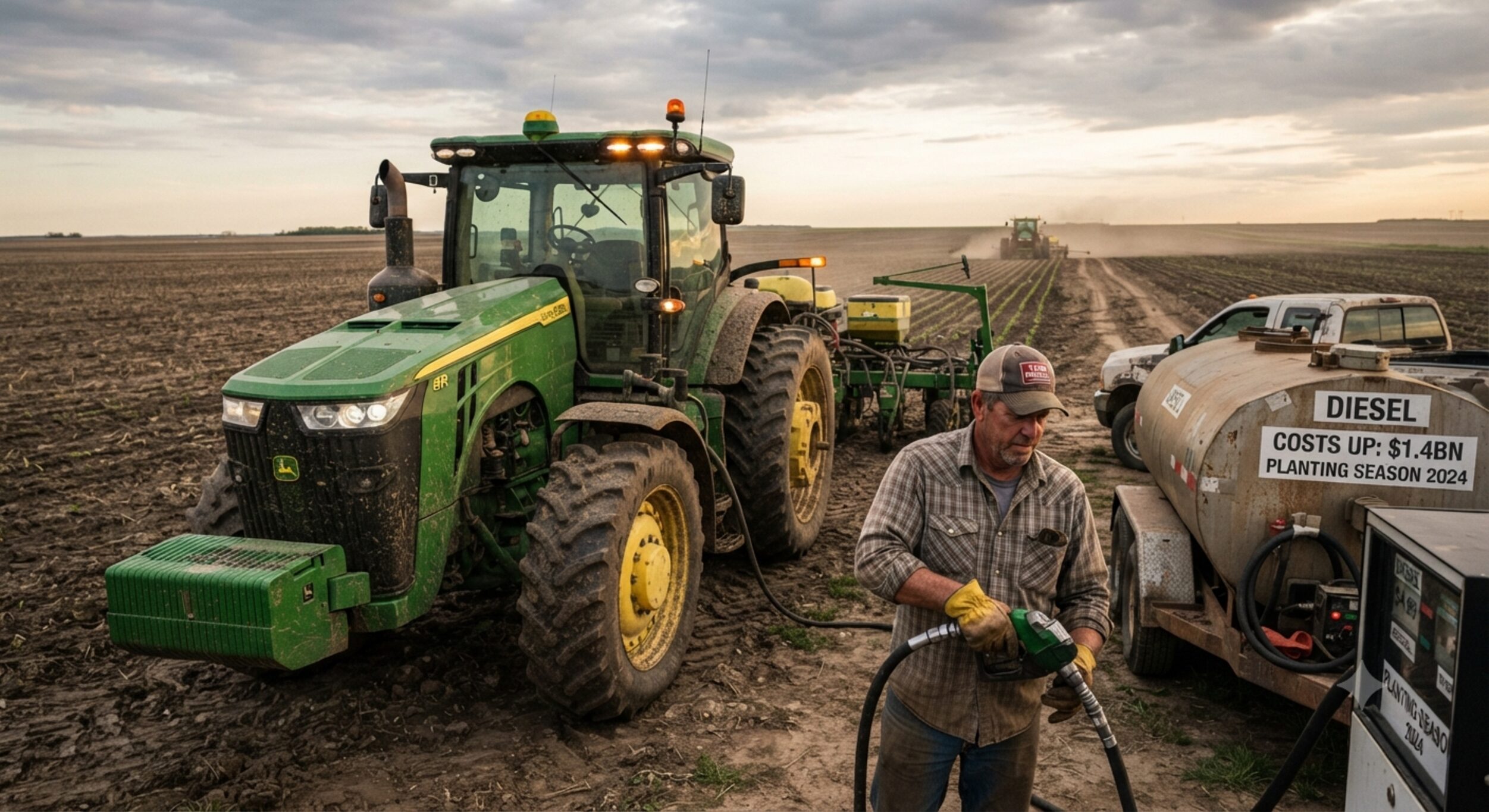
Farm diesel costs rose $1.4 billion across the 2026 US planting season, a 63% jump that reshapes crop budgets, freight rates and buyer pricing.
A new congressional analysis has put a hard number on something US growers already felt in their fuel tanks this spring. Farm diesel costs across corn, soybean, wheat, cotton and rice plantings ran roughly $1.41 billion higher in 2026 than in 2025 — a 63.2% year-on-year increase concentrated into the narrow weeks when tractors cannot afford to sit idle.
The figure comes from the minority (Democratic) staff of the US Congress Joint Economic Committee, which built the estimate from AAA and Energy Information Administration price data, USDA and Iowa State University Ag Decision Maker fuel-use coefficients, and USDA acreage and planting-window data. The report frames the spike as a consequence of the conflict with Iran and layers it on top of existing tariff pressure. That framing is partisan and should be read as such — but the underlying price series and fuel-burn assumptions are public, checkable and broadly conventional.
For anyone buying, moving or processing food, the number matters less as politics than as a cost signal working its way through the 2026 crop.
What the analysis actually measures
The $1.4 billion covers one thing only: diesel burned in field operations to plant five crops. It excludes fuel for irrigation pumping, harvest, on-farm drying, generators running greenhouse climate control, and the trucks that haul grain to elevator or port. It also excludes the fertiliser and chemical cost inflation running in parallel.
In other words, this is a floor, not a ceiling. The full energy input burden on the 2026 crop is materially larger than the headline figure suggests.
Timing amplified the damage. Diesel prices peaked mid-planting, when substitution is impossible — a grower cannot defer tillage or seeding by six weeks waiting for gasoil to soften. The EIA’s May Short-Term Energy Outlook projected on-highway diesel averaging $5.36 per gallon in Q2 2026 before easing to $4.94 in Q3 and $4.73 in Q4, against a full-year average of $4.76. Prices have since retreated: the national on-highway average sat around $4.57 in early July, roughly 84 cents above the same week in 2025.
Where the fuel cost increase concentrated
By absolute dollars, the Corn Belt absorbed the most. Illinois led at +$163.2 million, followed by Iowa (+$151.1m), Minnesota (+$101.7m), Nebraska (+$99.9m) and North Dakota (+$88.6m). That ranking tracks planted area more than anything else.
The percentage table tells a different story. Florida topped it at +90.6%, ahead of Alabama (+86.2%), Oklahoma (+85.9%), West Virginia (+85.8%), Kansas (+83.8%) and Indiana (+79.5%). Southern and southern-plains states saw steeper relative increases, reflecting local price movement and crop mix rather than scale.
Both tables are useful for different purposes. Absolute dollars indicate where regional working-capital stress is largest. Percentage change indicates where the shock was most disruptive to a grower’s own budget.
The number that matters on-farm
Aggregate billions are abstract on a 2,000-acre operation. The per-tank figures are not.
At peak 2026 planting-season prices, refilling a typical 750-gallon on-farm bulk tank cost an average of $1,538 more than at the equivalent 2025 peak. Filling a 100-gallon grain truck cost about $205 more; a 122-gallon tractor tank about $250 more. Michigan (+$1,850), Ohio (+$1,815) and Indiana (+$1,804) saw the largest bulk-tank increases; California topped the list at +$2,037.
Those are per-fill numbers. A mid-sized row-crop operation refilling bulk storage several times through planting is looking at four to five figures of unbudgeted diesel spend before a single bushel is priced.
What it means for buyers and procurement teams
Margin compression is real but not catastrophic at sector level. USDA’s Economic Research Service forecasts 2026 net farm income at $153.4 billion, down 0.7% nominally and 2.6% in real terms, with total production expenses up 1.0% to $477.7 billion. Fertiliser spend is forecast slightly lower. Diesel is a genuine shock, but it lands on a sector the USDA still expects to run above its 20-year average in real terms.
Expect the pressure at the margin, not the mean. Highly leveraged row-crop operations with thin working capital are where a $1,500-per-fill increase turns into deferred maintenance, delayed input payments or forced marketing. Buyers with grower-direct supply should be watching counterparty liquidity, not just headline farm income.
Freight is the second-order transmission channel. The same fuel curve moves reefer and dry-van surcharges. Contracts with fuel escalators indexed to EIA weeklies have already repriced; contracts without them will reprice at renewal.
Diesel has eased — the cost is already in the crop. Planting fuel is a sunk 2026 production cost regardless of where Q4 prices land. It does not automatically pass into grain prices, which are set globally, so the burden sits with the producer unless government support absorbs it.
Watch the policy response. USDA has been in direct talks with input suppliers since March on fuel and fertiliser costs, and supplemental assistance requests are live. Any support package changes grower cash-flow assumptions for Q4 and into 2027 planting decisions.
FAQ
How much more did US farmers spend on diesel in 2026?
Approximately $1.41 billion more than in 2025 for planting corn, soybeans, spring wheat, cotton and rice — a 63.2% year-on-year increase. The figure excludes harvest, irrigation, drying and haulage fuel, so total on-farm energy cost inflation is higher.
Which states saw the biggest increase in farm diesel costs?
Illinois, Iowa, Minnesota, Nebraska and North Dakota absorbed the largest dollar increases. By percentage, Florida (+90.6%), Alabama (+86.2%), Oklahoma (+85.9%), West Virginia (+85.8%) and Kansas (+83.8%) led.
Will higher farm fuel costs push up food prices?
Not directly or proportionally. Diesel is a small share of the retail food dollar and commodity prices are set on global markets, so growers cannot simply pass the cost forward. The more likely route to shelf prices is freight and cold-chain surcharges, which move with the same fuel curve and do get passed through contractually.

