
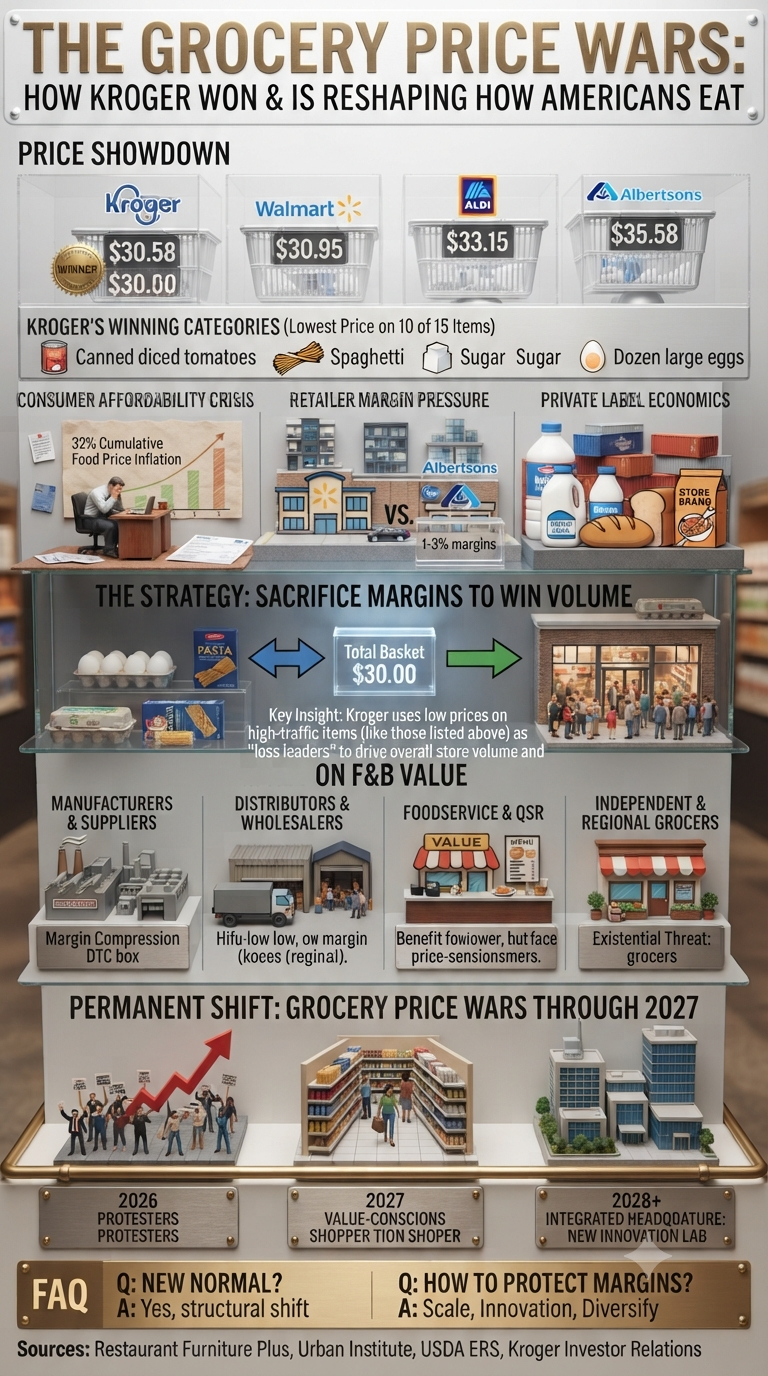
Kroger beat Walmart, Aldi, and Albertsons in a head-to-head price showdown. The grocery price wars aren’t slowing down—and they’re forcing retailers to sacrifice margins to win shelf space in your kitchen.
Kroger just fired a shot across the retail grocery landscape that signals the grocery price wars have officially escalated. In a head-to-head comparison of 15 store-brand essentials—milk, bread, eggs, chicken breast, spaghetti, canned beans, and baking items—Kroger emerged as the price leader with a total basket cost of $30.00. Walmart followed at $30.95, Aldi at $33.15, and Albertsons at $35.58. Kroger had the lowest prices on 10 of the 15 items analyzed, cementing its position as the value leader in an increasingly vicious grocery price wars environment.
But here’s what matters beyond the headlines: these grocery price wars are reshaping profitability across the entire food and beverage value chain. Manufacturers face margin compression as retailers leverage commodity pricing to gain market share. Distributors navigate tightening margins. Foodservice operators source differently. And consumers—squeezed by 32% food price inflation over five years—are finally getting relief, albeit at someone else’s expense. For F&B professionals, understanding the dynamics of the current grocery price wars is critical to procurement strategy and margin management through 2027.
Why the Grocery Price Wars Erupted Now
The grocery price wars didn’t emerge in a vacuum. Three structural forces collided:
1. Consumer Affordability Crisis: Food prices have climbed 32% over the past five years, pushing more than one in four working-age Americans into credit card debt to cover regular grocery bills, according to a new Urban Institute study. Shoppers are no longer browsing—they’re hunting for “checkout relief.” This demand for value created an opening for aggressive retailers willing to compress margins to gain volume.
2. Retailer Margin Pressure: Big-box grocers (Kroger, Walmart, Aldi) operate on notoriously thin margins (1–3%). The only way to win in this environment is scale and efficiency. Kroger operates roughly 1,229 grocery stores across 16 states; Walmart operates thousands globally. These scale players can absorb margin compression that smaller regional chains (Albertsons at $35.58) cannot. The grocery price wars are thus a consolidation mechanism—winners gain market share, losers lose customers permanently.
3. Private Label Economics: The shift to store-brand essentials (the basket in this study was entirely private label) has accelerated dramatically. Manufacturers selling to retailers under private label contracts face downward price pressure as retailers use these commodities as loss leaders. The grocery price wars pit retailer against retailer, and manufacturers absorb the cost.
The Grocery Price Wars Strategy: Sacrifice Margins to Win Volume
Kroger’s $30 basket price represents a deliberate strategy to win the grocery price wars through aggressive positioning on high-traffic categories. Look at Kroger’s specific wins in the comparison:
- Canned diced tomatoes: Lowest price
- Spaghetti: Lowest price
- Sugar: Lowest price
- Dozen large eggs: Lowest price
These aren’t random victories. Eggs, canned tomatoes, pasta, and sugar are category drivers—high-traffic items that consumers price-check and use as reference points. When shoppers see Kroger’s eggs are cheapest, they perceive Kroger as winning the grocery price wars, even if Aldi’s dairy is competitive. Perception drives traffic, and traffic drives basket economics.
The grocery price wars are thus fought on a handful of high-visibility items while margins on other products (organic, premium, specialty) offset the losses. For every $30 basket Kroger sells at razor-thin margins, it relies on adjacent basket sales—premium items, prepared foods, fuel loyalty programs—to maintain overall profitability.
What the Grocery Price Wars Mean for F&B Value Chain
Manufacturers & Private Label Suppliers: You’re on the losing end of the grocery price wars. Retailers are aggressively negotiating lower pricing on store-brand essentials to win market share. Your margin per unit is compressing. Strategies to consider: (1) Volume displacement—if your private label orders increase 15% to offset 5% price cuts, maintain profitability through scale. (2) Innovation—develop differentiated products (organic, specialty, premium private label) that command higher prices and escape the grocery price wars dynamic. (3) Direct-to-consumer—bypass retail altogether and capture full margin.
Distributors & Wholesalers: The grocery price wars are creating bifurcated demand. High-volume, low-margin orders to Kroger surge (you move more cases at lower per-unit margins). Meanwhile, independent retailers and regional chains facing margin pressure may reduce orders or consolidate suppliers. Your margin profile becomes “high volume, low unit profit”—which requires ruthless cost management and supply chain efficiency to remain viable.
Foodservice & QSR: The grocery price wars are your competitive threat and opportunity. As consumer grocery budgets tighten, foodservice faces margin pressure from value-conscious consumers. However, if you source through distributors competing for Kroger-scale volumes, you benefit from supplier price concessions flowing through the channel. Lock in long-term contracts with distributors now to capture savings as grocery price wars drive wholesale commodity prices downward.
Independent & Regional Grocers: The grocery price wars are an existential threat. Albertsons at $35.58 for a comparable basket is 18.6% higher than Kroger. Independent grocers cannot match this pricing without destructive margin compression. The grocery price wars thus accelerate consolidation—smaller players sell to larger chains or exit the market. Strategic response: (1) Differentiation (local sourcing, prepared foods, community positioning), (2) Niche focus (organic, specialty, ethnic), (3) Digital/e-commerce to reach price-conscious shoppers without physical footprint costs.
Retailers & Store Operators: If you’re not Kroger, Walmart, or Aldi, the grocery price wars are challenging your viability. Albertsons’ $35.58 is $5.58 (18.6%) higher than Kroger’s $30—an unbridgeable gap for price-conscious shoppers. Your only path is differentiation: better prepared foods, local products, community integration, loyalty programs that reward frequency. Price-matching the grocery price wars leaders is a losing strategy.
The Aldi Anomaly: Winning a Different Battle in the Grocery Price Wars
Aldi’s positioning in the grocery price wars is instructive. At $33.15 for the basket, Aldi sits between Walmart and Albertsons—not the lowest, but competitive. However, the study notes that “Aldi’s store-brand dairy products stood out as a particularly strong value.” This suggests Aldi isn’t trying to win the grocery price wars on all fronts. Instead, Aldi is positioning as a value play on specific categories (dairy) while accepting higher prices on others.
This is strategic positioning. Aldi’s store format is optimized for a younger, more affluent demographic prioritizing quality and sustainability alongside price. Aldi is thus winning the grocery price wars in a different segment—not the absolute price warrior (that’s Kroger), but the quality-value hybrid that appeals to demographics less price-sensitive than Walmart shoppers but more value-conscious than Whole Foods shoppers.
For manufacturers and suppliers, this signals an opportunity: not all grocery price wars are equal. If your product fits Aldi’s quality-value positioning (organic, European heritage, sustainability focus), you have pricing power that you won’t have in Kroger’s race-to-the-bottom basket.
The Macro Story: Grocery Price Wars Signal Permanent Shift in Consumer Behavior
The grocery price wars aren’t temporary. They reflect a structural shift in how American consumers approach grocery shopping. With 32% cumulative price inflation over five years, shoppers have moved from “shopping for preference” to “shopping for price relief.” This mindset shift is permanent. Even when inflation moderates and incomes rise, these consumers will retain their price-consciousness.
Retailers understand this. The grocery price wars aren’t cycles—they’re the new baseline. Expect:
- Intensifying competition on private label: Retailers will expand store-brand assortments and aggressively price them.
- Margin compression across the channel: Manufacturers will face downward pricing pressure; distributors will operate on tighter margins.
- Format consolidation: Smaller regional chains and independent grocers will face margin pressure; winners (Kroger, Walmart, Aldi) will gain share.
- Innovation in value positioning: Retailers will look beyond price to loyalty programs, digital/e-commerce, and community differentiation.
FAQ
Q: Will the grocery price wars eventually end, or is this the new normal?
A: This is the new normal. Consumer price consciousness triggered by 32% inflation over five years is structural, not cyclical. Even when food inflation moderates, shopper behavior will remain price-focused. Retailers are committing to the grocery price wars for the medium term (2027–2029). Plan accordingly.
Q: As a manufacturer, how do I protect margins in the grocery price wars?
A: Three strategies: (1) Increase volume to offset unit price declines. (2) Innovate—move upmarket with premium, differentiated products that escape the grocery price wars dynamic. (3) Diversify channels—direct-to-consumer, foodservice, non-traditional retail (dollar stores, club) to reduce retailer dependency.
Q: Should I switch to alternative retailers to escape the grocery price wars?
A: If you’re a retailer competing on price: No. The grocery price wars are system-wide—Kroger’s $30 basket will force Walmart and Aldi to defend. Your only escape is differentiation (quality, format, community) or niche focus (organic, specialty, ethnic). If you’re a consumer: Yes. The grocery price wars mean Kroger (and increasingly Walmart and Aldi) offer genuine value. Shopping behavior should shift accordingly.
Q: How long will the grocery price wars last?
A: Through 2027 at minimum, likely beyond. Retailers have committed capital to low-price positioning. They won’t abandon the grocery price wars until consumer demand for value moderates—unlikely before 2028.
Q: What’s the impact on foodservice vs. retail?
A: Foodservice benefits indirectly from the grocery price wars. As retailers negotiate lower wholesale prices with suppliers, some of those savings flow to foodservice distributors, reducing your input costs. Lock in long-term supplier contracts now to capture savings from the grocery price wars dynamic.
Q: Will Kroger’s win in the grocery price wars lead to market consolidation?
A: Yes, likely. Albertsons at $35.58 cannot sustain pricing 18.6% above Kroger. Albertsons will either merge with a stronger competitor (Kroger, Walmart), invest heavily in differentiation, or cede market share. The grocery price wars are consolidation accelerators.
Q: Are there opportunities in the grocery price wars?
A: Yes—for retailers and manufacturers innovating in value formats. Dollar stores, warehouse clubs, and e-commerce are growing faster than traditional grocery. If you can differentiate on format (convenience, sustainability, quality-value hybrid), you can win even while competitors fight the grocery price wars on absolute price.
Sources
- Restaurant Furniture Plus – Grocery Price Comparison Study (2026): https://www.restaurantfurnitureplus.com
- Urban Institute – Credit Card Debt for Groceries Study (2026): https://www.urban.org
- Fox Business – “Major Grocery Chain Beats Walmart, Aldi in Price War” (2026): https://www.foxbusiness.com
- Southern Living – Grocery Chain Price Analysis (2026): https://www.southernliving.com
- USDA Economic Research Service – Food Price Inflation Analysis: https://www.ers.usda.gov
- Kroger Investor Relations – Store Count and Market Presence: https://www.kroger.com/investor-relations

