
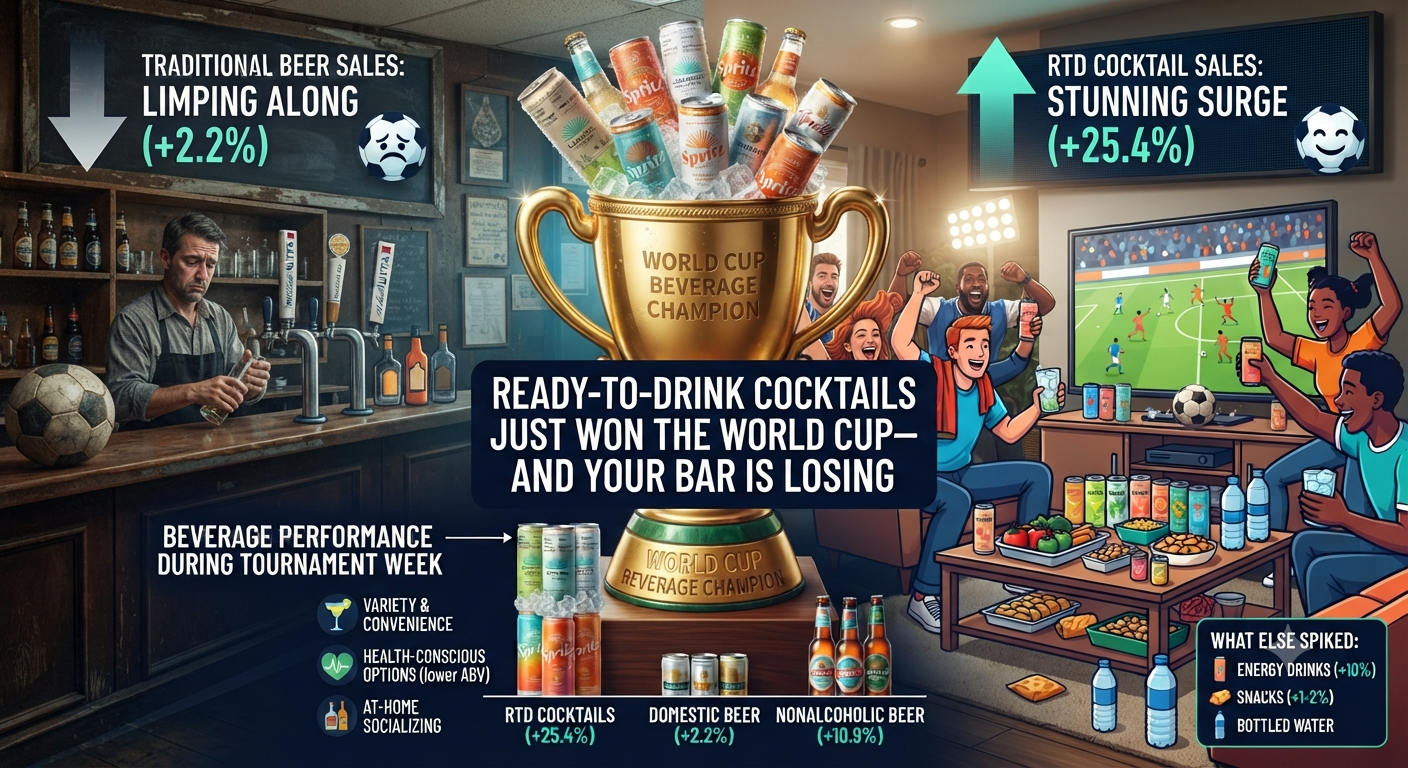
Premixed cocktails crushed beer during the tournament. Here’s why ready-to-drink beverages are reshaping retail, foodservice, and your bottom line.
The World Cup was supposed to be beer’s moment. Molson Coors deployed its largest media investment in years. AB InBev flooded bars with promotional energy. Michelob Ultra locked in as the official tournament sponsor. And yet ready-to-drink cocktails absolutely dominated the beverage space.
The data tells a story that should alarm traditional beer companies and excite innovation-focused brands: premixed cocktails posted a stunning 25.4% sales jump during the week ended June 28—the first full week of the tournament. Meanwhile, domestic beer case sales limped along with just a 2.2% increase. Even nonalcoholic beer outperformed traditional beer, with a 10.9% surge. For F&B leaders across retail, foodservice, and hospitality, ready-to-drink cocktails represent a fundamental shift in consumer behavior—and a massive opportunity if you act now.
Why Ready-to-Drink Cocktails Won When Beer Lost
The narrative that ready-to-drink cocktails are “convenience plays” misses the bigger story. These premixed beverages aren’t winning because they’re easy—they’re winning because they represent three critical consumer priorities simultaneously: variety, health consciousness, and home-based socializing.
Variety in a Single Purchase: Ready-to-drink cocktails offer flavor diversity that traditional beer cannot match. A single off-premise shopping trip can stock margaritas, mojitos, daiquiris, and negronis—all at different ABV levels. Consumers are no longer settling for a six-pack of one beer. They want choice, and premixed cocktails deliver it at scale.
Health-Conscious Options: Nonalcoholic and lower-ABV ready-to-drink cocktails allow consumers to balance indulgence with wellness goals. The data reinforces this: energy drinks spiked 10% during the tournament week, and bottled water also saw increased consumption. Consumers are seeking balance—they want to enjoy a cocktail without sacrificing their health trajectory. A 5% ABV ready-to-drink margarita checks both boxes.
The At-Home Consumption Shift: Here’s the kicker—despite heavy investment in bar and restaurant sponsorships, Circana’s pre-tournament survey showed that 93% of consumers planned to watch matches at home or at a friend’s place. Only 7% planned to watch at restaurants or bars. This off-premise preference fundamentally changes what beverages win. On-premise bars can push draft beer and full-service cocktails; at-home viewers need grab-and-go solutions. Ready-to-drink cocktails own this channel.
What This Means for Your Business Model
For Retail & C-Store Operators: Ready-to-drink cocktails are becoming a destination category. Consumers are making repeat shopping trips over the five-week tournament window to stock variety. This isn’t a one-time purchase—it’s a behavioral shift toward premixed cocktails for social occasions. Your margin opportunity is in shelf space optimization, end-cap placement, and bundle promotions. The ready-to-drink cocktail category is where growth lives.
For Foodservice & Bar Operators: If your strategy is to capture at-home drinkers by promoting bars, you’re fighting the data. Instead, pivot. Partner with RTD cocktail brands for home-delivery programs. Create pairings with food items for home entertaining kits. Offer pre-made cocktail-and-snack bundles for game-viewing groups. The consumer voted with their wallet—they want to consume at home. Help them do it better.
For Beverage Brands & Manufacturers: This is your moment to invest in ready-to-drink cocktail innovation. The premixed cocktail category is still nascent compared to beer and wine. First-mover advantage goes to brands that solve the remaining pain points: better shelf stability, premium flavor profiles, sustainability in packaging, and ABV variety. Diageo’s Casamigos recognized this; so should you. The old playbook of sponsoring bars and hoping for traction no longer works. The consumer has moved on.
For Wholesale & Distribution: Your sales teams need to understand that ready-to-drink cocktails are now a high-velocity category. Stock aggressively. Educate retail partners on placement and promotion. Monitor inventory turnover weekly—this category moves fast. Ready-to-drink cocktail shortages are money left on the table.
The Broader Beverage Trend: It’s Not About the Tournament
Circana’s Sally Lyons Wyatt made a critical observation: “It did amplify existing behaviors rather than actually creating new ones.” The World Cup didn’t create demand for ready-to-drink cocktails—it simply accelerated an existing trend toward nonalcoholic options, convenience beverages, and health-conscious drinking.
This is crucial context. The data reflects longer-term declines in traditional alcohol consumption as consumers prioritize wellness. Ready-to-drink cocktails aren’t winning because of the World Cup. They’re winning because consumers have permanently shifted their preferences.
What else spiked during tournament week:
- Energy drinks: +10% (consumers want sustained energy for multi-hour viewing)
- Bottled water: Increased (balance and hydration amid alcohol consumption)
- Nonalcoholic beverages: +10.9% in nonalcoholic beer alone
- Snack variety: Fresh produce trays, deli items, pretzels, popcorn, candy all grew 1–2%
The pattern is unmistakable: consumers want variety, balance, and health-aligned choices alongside their indulgences.
FAQ
Q: Will ready-to-drink cocktail sales stay elevated after the World Cup ends?
A: Circana expects the upward trend to continue, though at moderated levels. The tournament accelerated adoption among new consumers—some will stick with the category. Key is immediate post-tournament retention through promotions, new flavors, and availability. Brands that stay top-of-mind will capture the incremental share.
Q: Why did beer companies’ heavy World Cup investment fail to move the needle?
A: Beer is a mature category tied to traditional viewing occasions (bars, sports bars, stadiums). But 93% of consumers watched from home. Beer companies optimized for the wrong channel. Ready-to-drink cocktails, by contrast, own the at-home/off-premise space. It’s a channel mismatch, not a brand problem.
Q: Should bars and restaurants abandon traditional beer programs?
A: No. But they should pivot strategy. On-premise consumers still buy beer. The opportunity is to capture at-home viewers through delivery, kits, and home entertaining partnerships. Diversify revenue streams—don’t abandon on-premise, expand off-premise.
Q: Is this trend sustainable, or is it a World Cup blip?
A: It’s sustainable. The underlying drivers—health consciousness, convenience demands, and preference for variety—are structural, not event-based. The World Cup simply amplified what’s already happening. Brands investing in ready-to-drink cocktails now will see continued growth through 2027 and beyond.
Q: What should beverage brands prioritize to win in ready-to-drink cocktails?
A: (1) Flavor innovation—consumers want variety. (2) ABV options—low, moderate, and standard strength. (3) Sustainability—packaging matters to health-conscious consumers. (4) Quality—taste must match expectations set by craft cocktail culture. (5) Availability—retail distribution is critical; don’t limit to premium channels.
Sources
- Circana – World Cup Beverage Performance Data (June 28, 2026): https://www.circana.com
- Food Dive – “The beverages that scored in the World Cup” (July 16, 2026): https://www.fooddive.com
- Circana Consumer Insights – Off-Premise vs. On-Premise Viewing Preferences: https://www.circana.com/insights
- FIFA World Cup 2026 – Official Tournament Schedule: https://www.fifa.com/fifaworldcup
- Beverage Industry Association – Health-Conscious Drinking Trends 2026: https://www.beverageindustry.org

