
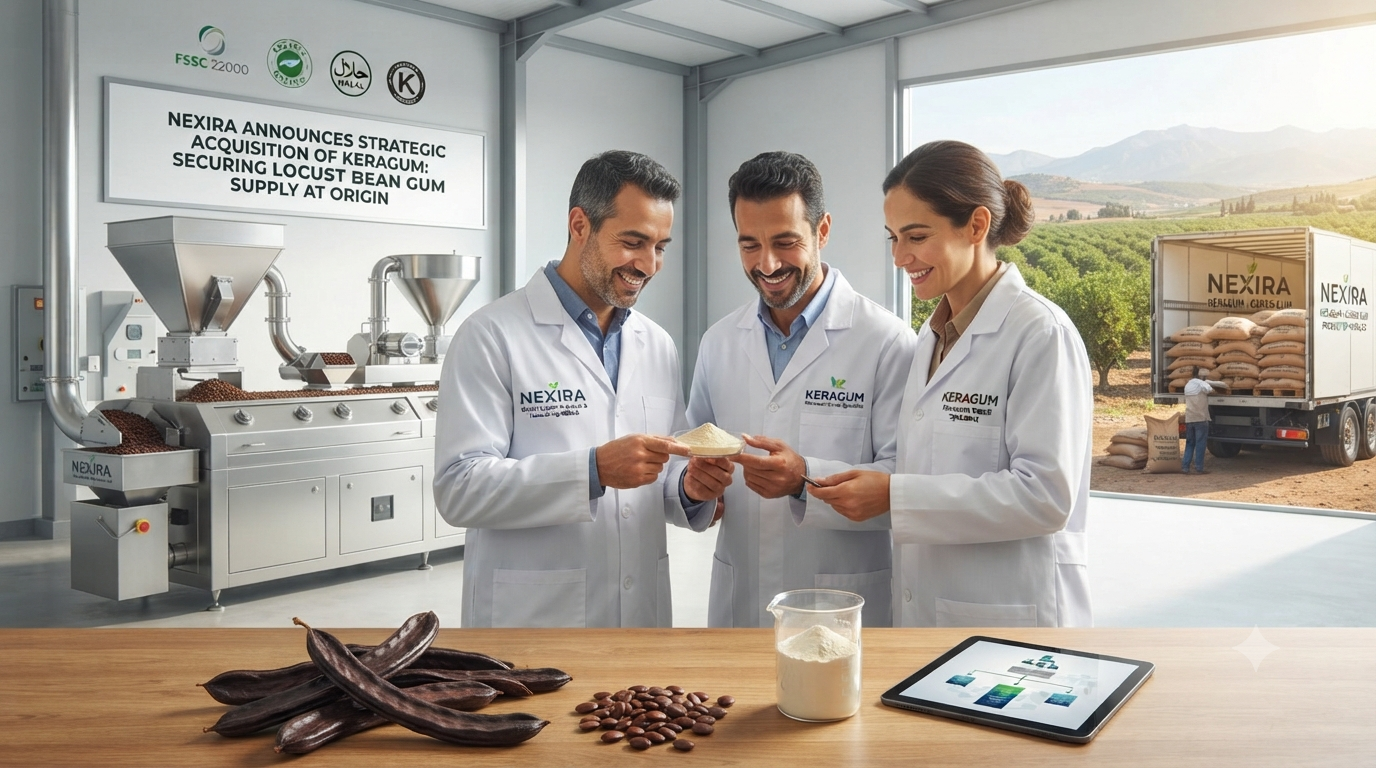
Nexira has acquired Moroccan carob specialist Keragum, anchoring locust bean gum supply at origin as hydrocolloid buyers navigate tight global markets.
French natural ingredients group Nexira has moved to lock down its position in one of the food industry’s most supply-constrained texturant markets, acquiring Casablanca-based carob processor Keragum for an undisclosed sum. The deal gives the Rouen-headquartered group direct control over locust bean gum (LBG) production in Morocco, one of the world’s leading carob-growing regions, and marks the company’s most significant upstream investment since it entered the LBG market through its 2021 purchase of Swiss hydrocolloids specialist UNIPEKTIN.
Why Nexira Is Buying at Origin
Keragum operates a recently commissioned production facility in the Casablanca region and sources carob pods and seeds through long-standing partnerships with local farming cooperatives. The site carries FSSC 22000, halal, kosher and organic certifications, giving Nexira an immediately export-ready asset rather than a greenfield project.
Nexira CEO Mathieu Dondain framed the transaction as a repeat of the company’s acacia gum playbook: investing as close as possible to the raw material to secure quality and generate value at origin. Chief operating officer Olivier Houalla said the acquisition strengthens the group’s position across the carob value chain, a market where Nexira has built a leading presence since 2021.
The logic is straightforward. LBG is extracted from carob seeds through mechanical processing, and the raw material base is geographically concentrated around the Mediterranean. Controlling seed sourcing and first-stage processing in Morocco insulates Nexira from the intermediary layers that have historically amplified price swings in the category.
A Texturant Market Under Pressure
Locust bean gum has been one of the more volatile corners of the hydrocolloids complex over recent years. Demand has expanded rapidly on the back of clean-label reformulation, plant-based dairy alternatives and ice cream stabilisation, while carob harvests have struggled to keep pace. Prices spiked sharply in the early 2020s as supply lagged demand, pushing some formulators toward substitutes such as guar, tara gum and acacia-based blends.
Beyond its established thickening and stabilising functions, Nexira has flagged R&D work extending carob into appetite management, plant proteins and cocoa replacement — the last of these particularly relevant while cocoa prices remain historically elevated. That positions carob as a multi-functional platform rather than a single-purpose texturant, raising the strategic value of secured seed supply.
Consolidation Ripples Through Ingredients
The deal lands in a period of intense consolidation across the ingredients sector. June saw Tate & Lyle’s board recommend Ingredion’s £2.7 billion cash offer, while IFF agreed the sale of its Food Ingredients business to CVC for US$4.3 billion. Against those headline transactions, Nexira’s bolt-on is modest in scale but consistent with the same underlying driver: buyers of functional ingredients are rewarding suppliers who can demonstrate supply security and traceability, and suppliers are paying to acquire it.
With revenue of €221 million, more than 300 employees, six production sites and a presence in over 80 countries, Nexira remains family-owned and mid-sized by global standards — which makes disciplined upstream acquisitions its most realistic route to defending share against larger hydrocolloid players.
What It Means for Buyers and Procurement Teams
For procurement teams sourcing LBG and adjacent texturants, the acquisition carries several practical implications. First, origin-integrated supply should improve continuity and lot-to-lot traceability for Nexira customers, a growing requirement under EU deforestation and due-diligence frameworks. Second, further vertical integration by a leading player may tighten the merchant market for uncommitted Moroccan carob seed, with knock-on effects for independent LBG processors and spot buyers. Third, dual-sourcing strategies remain prudent: LBG pricing is harvest-dependent, and buyers in ice cream, cream cheese, plant-based beverages and pet food should keep qualified alternatives such as tara or guar blends on file. Finally, formulators watching cocoa costs should note carob’s expanding role as a partial cocoa replacer — a conversation worth opening with suppliers ahead of 2027 planning.
What does Keragum bring to Nexira?
Keragum contributes a modern, certified LBG production facility near Casablanca, established sourcing relationships with Moroccan carob cooperatives, and full traceability from pod to finished gum — assets that anchor Nexira’s supply chain directly at origin.
Why does locust bean gum matter to food manufacturers?
LBG is a clean-label thickener, stabiliser and texturiser used widely in ice cream, dairy and dairy alternatives, sauces, cream cheese and nutraceuticals. Its natural positioning makes it a preferred replacement for more artificial texturising systems.
Will the acquisition affect LBG prices?
Terms were not disclosed and no immediate price impact has been signalled. However, deeper vertical integration by leading processors typically tightens spot availability of raw material over time, reinforcing the case for contracted supply and dual sourcing.
Sources
- Food Business News
- FoodBev Media
- NutraIngredients
- Dairy Foods
- Nexira corporate announcement

