

Every year brings a fresh crop of foodservice trend lists — flavor mashups, loyalty gamification, sustainable packaging. Most of them are real, but none of them are structural. They shift how a menu looks or how a rewards program feels. None of them solve the problem that’s actually threatening operators’ ability to run a shift.
The single biggest innovation in foodservice in 2026 does solve that problem. It’s AI voice ordering — systems that answer phones and take drive-thru orders without a human on the other end — and it’s succeeding right now for a very specific reason: it’s the first widely deployed technology directly targeting the industry’s most brutal, unsolved constraint, labor.
Table of Contents
Why This Beats Every Other Trend on the List
Restaurant staff turnover sits near 80% annually, and a large share of operators report they simply don’t have enough people to run their operations reliably. That’s not a minor inconvenience — it’s an existential problem. When you can’t reliably staff the phone or the drive-thru window, you’re not managing a labor shortage anymore; you’re losing revenue on orders that never get taken.
Voice AI is the first technology at scale that answers that problem directly, rather than working around it. It doesn’t reinvent the menu or the loyalty program — it makes sure the order actually gets captured in the first place. That’s a fundamentally different kind of innovation than a flavor trend, and it’s why this is the one worth paying attention to.
The Numbers Behind the Shift
The scale of adoption and the return on investment are both real, not speculative:
- Roughly 30% of restaurant calls go unanswered during peak hours under traditional staffing — every one of those is a lost order. Voice AI can answer every single call, 24/7, without exception.
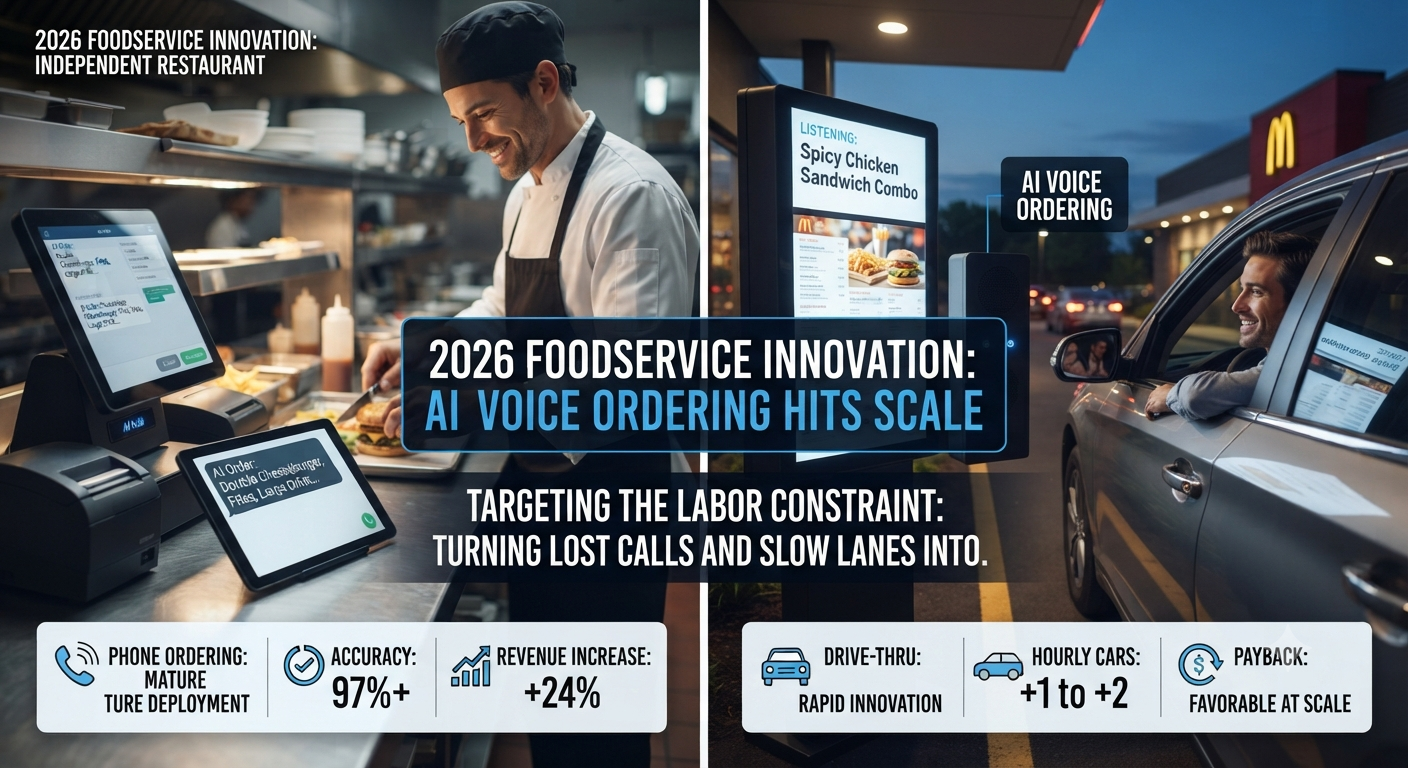
- Leading voice AI platforms report order accuracy above 95% on phone orders, with several publishing figures in the 97%+ range for well-scoped deployments.
- Restaurants deploying phone-based voice AI report revenue increases in the 22–26% range on phone orders specifically, largely by recapturing calls that previously went unanswered.
- On the drive-thru side, a well-managed lane running voice AI can process roughly 17–18 cars per hour compared to about 16 without it — a single extra car per hour can translate into over $185,000 in additional annual revenue for a 50-location chain.
- Independent restaurants and small chains (roughly 1–10 locations) are adopting phone-based voice AI faster than large enterprise chains, largely because the labor crisis hits them hardest and the return on investment is easier to isolate than more complex drive-thru hardware.
- Major point-of-sale providers have built native AI phone-ordering directly into systems restaurants already run day to day, lowering the barrier to adoption significantly compared to standalone platforms.
Why 2026 Is the Year It Actually Works
This isn’t the first time voice AI has been tried in foodservice — and that history matters, because it’s exactly why 2026 deployments are different rather than more hype.
Earlier drive-thru voice AI attempts ran into real trouble. High-profile pilots struggled with background noise, regional accents, and complex order modifications, leading to well-publicized accuracy issues and, in some cases, full partnership shutdowns. The public failures of 2023–2024 created a wave of skepticism that AI simply couldn’t handle live, noisy, high-pressure order-taking.
What changed by 2026 is a genuine technical leap: newer, restaurant-tuned voice models trained on far messier real-world audio, combined with faster real-time processing, have pushed accuracy from a shaky 80–90% range into a genuinely viable 93–97%+ range for well-configured deployments. That gap — from “customers constantly correcting the bot” to “the AI handles nearly every order cleanly” — is the difference between a gimmick and infrastructure.
Three practices now separate successful 2026 deployments from the failures that came before:
Human override is always available. The AI handles the default case, but a person can take over instantly for anything unusual, rather than forcing the system to fight through edge cases alone.
Every order is logged and sampled for accuracy review. Continuous monitoring means problems get caught and corrected quickly rather than silently degrading service.
Menu and pricing data stays current in real time. The AI reflects today’s specials, today’s stockouts, and today’s pricing rather than working from a static, outdated menu file.
Phone Ordering vs. Drive-Thru: Two Different Maturity Curves
It’s worth separating these two use cases, because they’re at genuinely different stages of readiness.
Phone ordering is the more mature and lower-risk deployment. It avoids road noise, overlapping cars, and expensive lane hardware entirely. Multiple major point-of-sale providers now offer native AI phone-ordering as a built-in feature, meaning restaurants don’t need to rip out existing systems to adopt it. For independent restaurants specifically, this is often the more sensible starting point, since the return on investment is cleaner and the deployment timeline is measured in hours rather than weeks.
Drive-thru voice AI is real and improving fast, but it’s a more demanding environment. It requires specialized microphone hardware designed to filter road and engine noise, weatherproofing, and tighter integration with existing speaker-post infrastructure. Upfront equipment costs can run into the tens of thousands of dollars per lane, which means the payback calculation only clearly favors adoption at a certain volume and scale. Large chains with the resources to absorb early-stage costs are currently leading here, while smaller independents are more likely to start with phone ordering first.
What This Means for the Rest of the Food Chain
For distributors, equipment suppliers, and technology vendors serving the foodservice sector, this shift has ripple effects worth watching. As voice AI adoption accelerates, particularly among independents and small chains, demand is likely to grow for point-of-sale integrations, kitchen display system compatibility, and hardware built specifically to support these deployments. Suppliers who can demonstrate seamless integration with existing restaurant technology stacks — rather than requiring operators to replace systems they already rely on — are positioned to capture the bulk of this growth.
The Bottom Line
Flavor trends and loyalty programs will keep evolving every year, as they always have. But the innovation actually reshaping how foodservice operates in 2026 is voice AI finally crossing the threshold from unreliable novelty to genuinely functional infrastructure. It directly targets the industry’s most persistent operational problem — labor — and the accuracy and revenue data now back up the case for adoption. The technology isn’t perfect yet, particularly in the noisier, more complex drive-thru environment, but the trajectory is clear: what started as a shaky experiment a few years ago is quickly becoming standard operating infrastructure across the industry.
Related
FAQ
What is the biggest innovation in foodservice in 2026?
AI voice ordering — systems that answer restaurant phone calls and handle drive-thru orders without a human — is widely regarded as the most significant foodservice innovation of 2026, given how directly it addresses the industry’s persistent labor shortage.
How accurate is AI voice ordering now compared to earlier attempts?
Leading 2026 voice AI platforms report order accuracy above 95%, with some reaching 97% or higher in well-scoped deployments, compared to the 80–90% range that caused high-profile failures in 2023–2024.
Is phone ordering or drive-thru voice AI more mature right now?
Phone ordering is the more mature and lower-risk use case, since it avoids road noise, overlapping vehicles, and expensive lane hardware. Drive-thru voice AI is improving quickly but still requires specialized equipment and larger upfront investment.
How much revenue can voice AI actually generate for a restaurant?
Restaurants using phone-based voice AI report revenue increases in the 22–26% range on phone orders by recapturing previously unanswered calls, while drive-thru deployments can add over $185,000 in annual revenue for a 50-location chain through modest throughput gains.
Why did earlier restaurant AI ordering attempts fail?
Earlier deployments struggled with background noise, accents, and complex order modifications, leading to accuracy issues and, in some cases, full program shutdowns. Newer 2026 systems use more advanced, restaurant-tuned voice models that have significantly closed that accuracy gap.
Are independent restaurants adopting this technology, or just large chains?
Independent restaurants and small chains are actually adopting phone-based voice AI faster than large enterprise chains in some cases, since the labor crisis affects them most acutely and the return on investment is easier to isolate than more complex drive-thru deployments.