
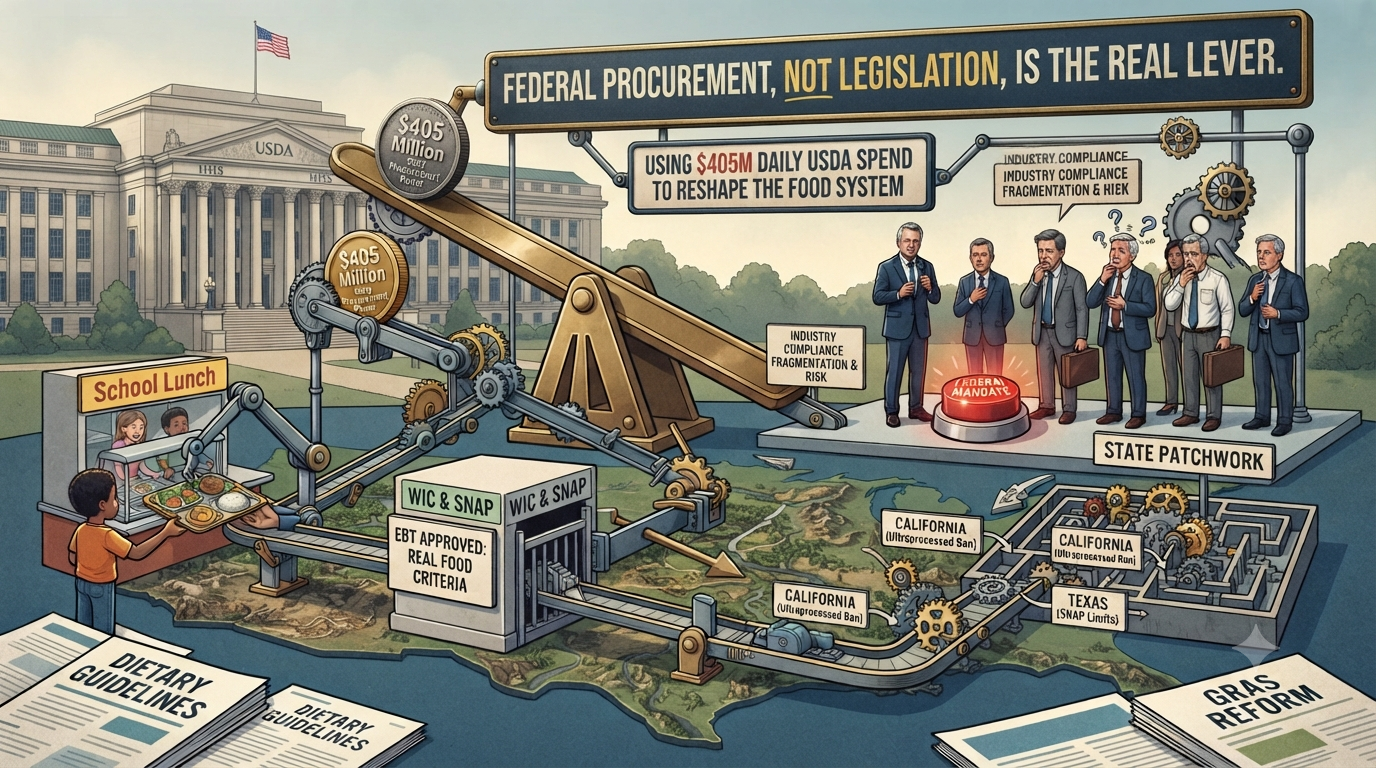
Federal Procurement, Not Legislation, Is the Real Lever
HHS Secretary Robert F. Kennedy Jr. has framed federal food procurement as the primary mechanism for reshaping the US food system, rather than pursuing legislation directly. At the MAHA Rally for Real Food in Austin, Kennedy pointed to the roughly $405 million a day USDA spends across school lunches, Head Start, WIC, SNAP and Indian Health Services food programs as the tool that will determine what gets fed to millions of Americans. Kennedy has also criticized decades of prior federal dietary guidance, arguing the government misled the public on food pyramid recommendations, particularly around saturated fat.
This procurement-first strategy matters for industry because it sidesteps the slower legislative process entirely. The 2025-2030 Dietary Guidelines for Americans, released by HHS and USDA, promote higher protein intake and introduce a new inverted food pyramid — a shift Kennedy called a decisive change in federal nutrition policy. While the guidelines carry no direct enforcement power, they function as a roadmap for future regulation and give food companies an early signal of which administration priorities will drive changes to federal food programs. One of the first proposed rules likely to draw on the new guidelines is an FDA effort to require front-of-pack nutrition labeling summarizing saturated fat, sodium and added sugar levels.
Table of Contents
Dyes and Additives: Voluntary Pressure Meets Regulatory Delay
Eliminating petroleum-based synthetic dyes has been a central theme of Kennedy’s public messaging. Kennedy has stated the administration secured industry agreement to remove certain dyes without passing legislation to ban them outright, framing it as voluntary cooperation rather than mandate.
The bigger structural fight is over GRAS — the “generally recognized as safe” designation that lets companies bring new ingredients to market without formal FDA review. HHS and the MAHA movement have identified GRAS reform as a top priority, arguing that exposure to inadequately reviewed additives is contributing to chronic disease. The FDA has announced plans to require companies to submit GRAS notices, but critics say the plan stops short of a rigorous, transparent safety review, and there’s no guarantee any proposed rule will actually be finalized given strong industry opposition.
Momentum here has been slower than promised. Lobbying groups have poured significant resources into fighting Kennedy’s GRAS reform push, and the FDA quietly revised its own website timeline to say the reforms would be complete by the end of 2027 — a full year later than Kennedy originally promised. CSPI’s principal food additives scientist has said the concern now is not a major regulatory swing but a series of smaller, incremental changes falling short of what MAHA activists are demanding. Kennedy himself, when pressed on the GRAS loophole timeline, offered only a brief “stand by” in response.
SNAP Restrictions Are Spreading State by State
Kennedy appeared alongside Texas officials when the state enacted food-related laws barring SNAP recipients from using benefits to purchase candy or sugary drinks. The USDA approved similar waivers for six additional states in December, bringing the total to eighteen states set to block those SNAP purchases in 2026 — with more expected to follow. The incentive structure reinforcing this trend runs through the $50 billion Rural Health Transformation Program, created under the GOP’s One Big Beautiful Bill Act, which awards points toward funding based on states adopting SNAP eligibility and definition changes aligned with MAHA priorities.
With more than 41 million people using SNAP benefits monthly, any shift toward using the program as a compliance lever — requiring manufacturers to meet specific nutritional requirements to remain SNAP-eligible — could reshape product formulation industry-wide, not just for products sold directly through the program.
The State Patchwork Problem
MAHA policy has made its deepest and fastest inroads at the state level rather than in Congress, drawing strong support from Republican legislators and, in some states, from Democrats as well. In 2025 alone, roughly 75 bills targeting food dyes were introduced across 37 states. More broadly, 38 states had active food additive legislation in 2025, according to MultiState.us tracking.
California Governor Gavin Newsom signed a bill establishing a legal definition for ultraprocessed foods and phasing them out of school meals — a move other states are expected to copy in 2026, while also inviting legal challenges. San Francisco’s City Attorney has already sued major food companies over what the suit describes as harmful and addictive products, naming specific cereal, pizza, soda and potato chip brands and linking them to serious health outcomes.
This fragmentation is now the industry’s central complaint. The Food Industry Association’s president has publicly warned against a state-by-state patchwork approach, arguing it drives up food costs, and has called instead for nationally uniform standards that help consumers meet health goals within their budgets. The National Association of Manufacturers has gone further, publishing a video warning that the food industry is under increasing strain from the combination of federal and state rules, and demanding a seat at the table in MAHA policy discussions.
Where MAHA’s Own Coalition Disagrees
The movement is not ideologically unified, which creates additional unpredictability for companies trying to plan ahead. MAHA supporters on the right have generally not prioritized sugar and sodium reduction the way left-leaning policymakers have, and the coalition has split over issues like raw milk consumption — which carries documented contamination risk — and increased saturated fat intake, which mainstream nutrition science still links to heart disease.
The new dietary guidelines reflect this tension directly: beef and livestock groups welcomed guidance nearly doubling recommended animal protein intake, while health and nutrition professionals pushed back on the same document’s parallel recommendation to reduce saturated fat. Kennedy has also faced backlash from his own base — MAHA activists reacted with anger after President Trump issued an executive order promoting expanded glyphosate use, a chemical Kennedy has spent years arguing is linked to chronic disease and has actively litigated against.
Ramifications for Food Companies
Taken together, the current environment creates several distinct categories of business risk:
Reformulation exposure. Dyes, GRAS-listed additives, sodium and added sugar are all under active federal and state scrutiny simultaneously, even without a single unifying law forcing the change.
Compliance fragmentation. With three dozen-plus states running independent legislative tracks, companies selling nationally may need formulation or labeling variants by state well before any federal standard consolidates the rules.
SNAP-channel risk. Any product category touching candy, soda or sugary drinks faces shrinking addressable market as more states restrict SNAP eligibility, with financial incentives actively encouraging more states to follow.
Litigation exposure. The San Francisco lawsuit against major food manufacturers signals that city and state legal action against ultraprocessed food marketing and formulation is now a live enforcement channel, not a hypothetical one.
Category-specific tailwinds. Not all of this is downside — the shift toward higher recommended animal protein intake in the new dietary guidelines represents a genuine opportunity for meat and dairy categories positioned around that guidance.
How Companies Should Prepare
- Map exposure by ingredient, not just by product. Dyes and GRAS-listed additives are the two fastest-moving fronts — audit formulations against both now rather than waiting for a federal mandate.
- Track state legislation actively, not federal. The real regulatory movement is happening in statehouses; a purely federal watch list will miss most of what’s coming.
- Reassess SNAP-eligible SKUs. Any product in the candy or sugary drink category should be stress-tested against a scenario where more states adopt restrictions.
- Build formulation flexibility into supply chains. A 50-state patchwork increasingly means planning for regional formulation variants rather than one national spec.
- Engage through trade bodies now. The Food Industry Association and National Association of Manufacturers are actively lobbying for national uniformity — a seat at that table is more useful than reacting after rules are set.
- Watch for uneven, sector-specific movement rather than one clean overhaul. Given internal disagreement within the MAHA coalition itself and industry lobbying already slowing GRAS reform, expect incremental, inconsistent progress rather than a single sweeping regulatory event.
The Bottom Line
MAHA is not a single policy — it’s a loose coalition operating across federal procurement, state legislation, litigation and voluntary industry pressure simultaneously, with meaningful internal disagreement about priorities. For food companies, the practical risk isn’t one big rule change to prepare for; it’s an accumulating, uneven set of state and category-specific shifts that reward companies tracking this closely over those waiting for federal clarity that may not arrive on the timeline Kennedy originally promised.
Related
Sources
| Source | Publication | Date | URL |
|---|---|---|---|
| KFF Health News | RFK Jr.’s MAHA Movement Has Picked Up Steam in Statehouses | January 13, 2026 | https://kffhealthnews.org/news/article/maha-rfk-kennedy-state-legislatures-dyes-ultraprocessed-foods/ |
| CBS News | RFK Jr.’s MAHA movement has picked up steam in statehouses | January 12, 2026 | https://www.cbsnews.com/news/rfk-jr-maha-health-states/ |
| Stateline | RFK Jr.’s MAHA movement has picked up steam in statehouses | January 19, 2026 | https://stateline.org/2026/01/19/rfk-jr-s-maha-movement-has-picked-up-steam-in-statehouses-heres-what-to-expect-in-2026/ |
| NewsNation | RFK Jr.’s MAHA movement at odds with food industry ahead of midterms | March 9, 2026 | https://www.newsnationnow.com/politics/maha-food-industry-rfk-jr-midterms/ |
| Food Navigator USA | RFK Jr targets food dyes, SNAP and UPFs in MAHA rally keynote | March 3, 2026 | https://www.foodnavigator-usa.com/Article/2026/03/03/rfk-jr-maha-rally-food-dyes-snap-and-upf-labeling/ |
| Center for Science in the Public Interest | Is RFK Jr. walking the walk? MAHA Report promises updates while New York acts on GRAS | October 2, 2025 | https://www.cspi.org/cspi-news/rfk-jr-walking-walk-maha-report-promises-updates-while-new-york-acts-gras |
| Bloomberg Law | RFK Jr.’s Food Pyramid Guides MAHA Path for US Policy, Industry | January 8, 2026 | https://news.bgov.com/health-law-and-business/rfk-jr-dietary-guidelines-to-shape-food-policy-industry-change |
| The Daily Beast | Robert F. Kennedy Jr.’s MAHA Agenda Starts to Unravel at FDA Over GRAS | June 17, 2026 | https://www.thedailybeast.com/robert-f-kennedy-jrs-maha-agenda-starts-to-unravel-at-fda-over-gras/ |
FAQ
What is the MAHA movement?
“Make America Healthy Again” is a health and nutrition policy agenda promoted by HHS Secretary Robert F. Kennedy Jr., focused on reducing chronic disease through changes to food dyes, additives, dietary guidance and federal food program eligibility.
Is MAHA driven by federal law or state action?
“Make America Healthy Again” is a health and nutrition policy agenda promoted by HHS Secretary Robert F. Kennedy Jr., focused on reducing chronic disease through changes to food dyes, additives, dietary guidance and federal food program eligibility.
What is GRAS reform and why does it matter to food companies?
GRAS (“generally recognized as safe”) allows companies to bring food ingredients to market without formal FDA review. MAHA has prioritized closing this loophole, but industry lobbying has already pushed the FDA’s own reform timeline back a year, to end of 2027.
How are SNAP rules changing?
Eighteen states will block SNAP purchases of candy and sugary drinks in 2026, with federal incentive programs rewarding additional states for adopting similar restrictions.
Is the food industry supportive of MAHA?
It’s mixed. Some reformulation efforts (like dye removal) have had voluntary industry cooperation, but major trade groups including the Food Industry Association and National Association of Manufacturers are actively lobbying against the state-by-state regulatory patchwork, pushing instead for one national standard.

