
June 9, 2026
The global juices market stands at USD 146.94 billion in 2026, forecast to reach USD 173.75 billion by 2031 at a CAGR of 3.41%. The global smoothies market is valued at USD 16.39–27.35 billion in 2026, growing at a CAGR of 7.20–9.06% toward USD 25.21–47.71 billion by 2031–2034. The global fruit juice market reaches USD 182 billion in 2026, growing at a CAGR of 6.61% toward USD 324 billion by 2035. The combined global juice and smoothies industry — encompassing all formats from conventional pasteurised orange juice through cold-pressed premium juices, vegetable and blended juices, RTD smoothies, smoothie bars and chains, and functional fortified juice beverages — represents one of the most commercially complex and strategically contested segments in the global beverage landscape.
The juice and smoothies industry in 2026 sits at the intersection of the health and wellness megatrend and the sugar backlash — simultaneously positioned as one of the most natural, nutritious, and health-associated beverage categories, and as a category under sustained regulatory and consumer pressure for its sugar content. Over 45 jurisdictions globally have now implemented sugar taxes or levies, raising juice prices by 8–12% and triggering reformulations toward stevia and monk fruit sweeteners that are reshaping product portfolios across the category. The December 2024 FDA ruling allowing 100% juice to carry a “healthy” claim has simultaneously created a regulatory tailwind for premium pure juice in North America, resetting shelf layouts and positioning strategies.
Against this complex backdrop, the industry’s most commercially exciting growth trajectory is in the premium, functional, and cold-pressed segments — where consumers are not stepping back from juice but trading up dramatically. The global cold-pressed juice market is growing at approximately 8.5% CAGR. Chobani’s acquisition of Daily Harvest in May 2025 is one of the most commercially significant M&A events in the smoothie category, bringing Greek yoghurt culture into DTC meal and smoothie delivery. Wonder Juice launched two new functional cold-pressed juices in its Wonder Green line in February 2026. Odwalla relaunched with a fresh line of juices and smoothies at Natural Products Expo West 2025. And Innocent Drinks launched Green Goodness and Red Goodness smoothies featuring plant-based superfoods in September 2025.
This report provides the most comprehensive publicly available analysis of the global juice and smoothies industry in 2026 — covering market scale, juice categories, smoothie segments, cold-pressed and HPP technology, functional fortification, GLP-1 impact, sugar regulation, sustainability, smoothie bars and chains, DTC and e-commerce, regional dynamics, key challenges, strategic outlook, and leading companies.
Executive Summary: The 2026 Juice and Smoothies Landscape
The global juice and smoothies industry in 2026 is defined by a bifurcation as stark as any in the beverage sector: the conventional pasteurised juice market faces sustained volume headwinds from sugar taxes, health-conscious reformulation pressure, and competition from functional alternatives, while the premium cold-pressed, functional, and superfood smoothie segments are growing at among the fastest rates in the entire beverage landscape.
Key Takeaways for Stakeholders:
The global juices market stands at USD 146.94 billion in 2026, growing at 3.41% CAGR to USD 173.75 billion by 2031. The 100% juice segment leads growth at a 3.94% CAGR as consumers favour purity and no-added-sugar profiles.
The global smoothies market is valued at USD 16.39–27.35 billion in 2026, growing at 7.20–9.06% CAGR — more than double the growth rate of conventional juice — toward USD 25–48 billion by 2031–2034.
Cold-pressed juice is the fastest-growing format in the entire juice category, with HPP technology enabling premium clean-label juices with extended shelf life that are reshaping the premium end of the market.
Sugar taxes in over 45 jurisdictions have raised juice prices 8–12% and forced widespread reformulation — the most significant regulatory disruption to the juice category in decades.
The FDA’s December 2024 “healthy” claim ruling for 100% juice has reset shelf layouts and positioning strategies in North America, creating a regulatory tailwind for pure juice that is driving Tropicana and Simply to lead clean-label reformulation efforts.
Chobani acquired Daily Harvest in May 2025 — the most significant smoothie industry M&A event of the year, combining premium DTC meal and smoothie delivery with Greek yoghurt scale and cold-chain infrastructure.
Consumers are shifting away from basic fruit smoothies toward options with added ingredients — plant proteins, probiotics, collagen, adaptogens, vitamins, and superfoods including spirulina, chia seeds, and acai — signalling the functional smoothie’s convergence with the supplement industry.
North America leads the smoothies market with 35.58–39.20% of global revenue; Asia-Pacific is growing fastest at 9.45% CAGR.
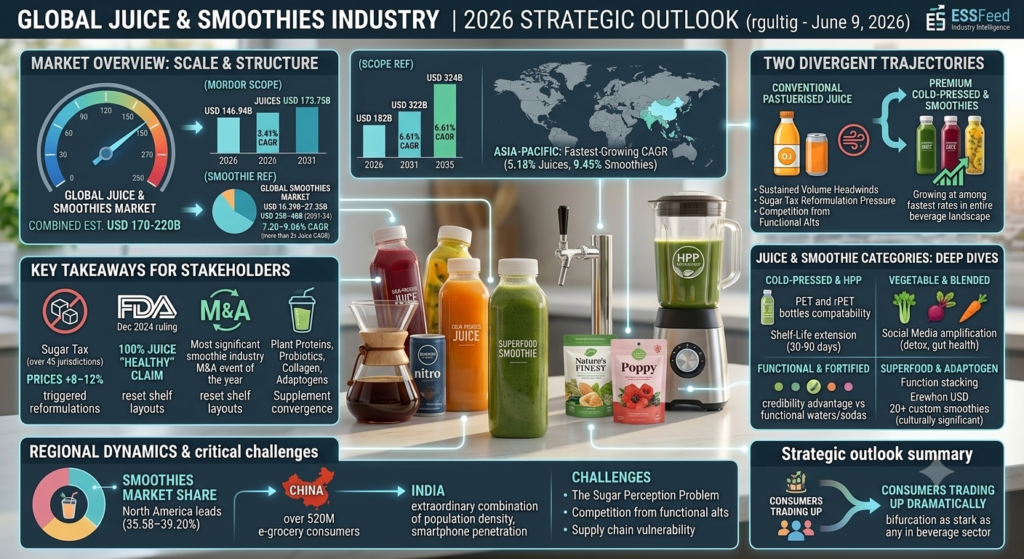
Table of Contents
1. Market Overview: Scale, Structure and Scope
Defining the Category
The global juice and smoothies industry encompasses a broad spectrum of products unified by their fruit and vegetable ingredient base and their positioning as natural, health-associated beverages:
Conventional pasteurised juices — orange juice, apple juice, grape juice, and other single-fruit and multi-fruit juices produced through high-temperature pasteurisation for mass-market retail and foodservice distribution.
100% pure juices and NFC (not from concentrate) — juices produced without reconstitution from concentrate, commanding premium positioning based on freshness, flavour, and clean-label credentials.
Cold-pressed and HPP juices — juices produced through cold mechanical pressing without heat, preserved through High-Pressure Processing rather than pasteurisation, delivering superior nutritional retention and fresh taste at premium price points.
Vegetable and blended juices — tomato juice, carrot juice, beetroot juice, celery juice, and vegetable-forward blends with functional and detox positioning.
Functional and fortified juices — juices enhanced with added vitamins, minerals, probiotics, collagen, omega-3, or other functional ingredients for targeted health benefit claims.
Fruit-based smoothies — blended beverages combining fruits, liquid bases (juice, water, milk, plant milk), and often additional functional ingredients, available in RTD retail formats and made-to-order foodservice formats.
Dairy and plant-based smoothies — blended beverages incorporating yoghurt, kefir, plant-based milk, or protein powders, often serving as meal replacement or post-workout nutrition vehicles.
Smoothie bars and foodservice — in-venue made-to-order smoothies from dedicated chains (Jamba, Smoothie King, Tropical Smoothie Café) and the expanding smoothie sections of broader food-to-go operators.
Global Market Valuation
The category’s commercial scale is significant across both its juice and smoothie dimensions. The global juices market stands at USD 146.94 billion in 2026 per Mordor Intelligence — encompassing the full range from commodity orange juice to premium cold-pressed — growing to USD 173.75 billion by 2031 at 3.41% CAGR. The fruit juice market specifically is recorded at USD 182 billion in 2026 per Econ Market Research, growing at 6.61% CAGR. The smoothies market is valued at USD 16.39–27.35 billion in 2026, with the wide range reflecting differences in scope between RTD retail smoothie products only versus the full smoothie universe including foodservice and bars.
Asia-Pacific is forecast to post the fastest regional CAGR of 5.18% in juices and 9.45% in smoothies, driven by rapid urbanisation, expanding cold-chain infrastructure, and the growing influence of Western health beverage culture on Asian urban consumers.
2. Juice Categories: Deep Dives
Conventional and 100% Pure Juice
The conventional juice market — dominated by orange juice, apple juice, and multi-fruit blends — is the category foundation by volume, though it faces sustained structural challenges in developed markets. Health-conscious consumers in Germany (historically Europe’s largest juice market) are increasingly wary of the sugar content in juice, prompting volume declines in conventional product. Sugar levies in over 45 countries have raised prices 8–12%, triggering reformulations toward stevia and monk fruit sweeteners and dampening volumes in sweetened juice drinks.
The December 2024 FDA ruling allowing 100% juice to carry a “healthy” claim represents the most significant positive regulatory development for the US juice category in years. Brands are now repositioning NFC (not-from-concentrate) lines to capitalise on this claim, with Tropicana and Simply leading reformulation efforts. The trend extends beyond sugar reduction: preservative-free cold-pressed juices processed through HPP are winning high-margin shelf space at Whole Foods and Sprouts. The January 2025 front-of-package added sugar proposal is forcing legacy SKUs to streamline recipes and strengthening the commercial case for 100% pure juice over juice drinks.
Cold-Pressed Juice: The Premium Category
Cold-pressed juice — produced by applying intense hydraulic pressure to extract juice from whole fruits and vegetables without heat, preserving enzymes, vitamins, and phytonutrients that conventional pasteurisation degrades — is the fastest-growing premium segment in the entire juice category. PET and rPET bottles represent approximately 47.6% of cold-pressed juice packaging in 2026, driven by the technical compatibility of plastic with HPP — which requires flexible packaging to withstand extreme hydraulic pressure without fracturing.
Wonder Juice launched two new functional cold-pressed juices in its Wonder Green line in February 2026 — Clean Green and Veg8 & Cayenne — targeting health-conscious consumers seeking detox, hydration, and bold flavours in daily wellness routines. In May 2025, HPP Europe installed advanced high-pressure processing lines across its partner cold-pressed juice facilities to enhance shelf life while maintaining nutritional integrity, expanding the commercial viability of cold-pressed across a wider geographic distribution network.
The cold-pressed juice market is growing at approximately 8.5% CAGR — materially above the conventional juice market — reflecting the consumer willingness to pay 3–5× the price of conventional juice for the combination of superior nutrition, fresh taste, clean-label ingredients, and the functional health positioning that cold-pressed commands.
Vegetable and Green Juices
The vegetable and blended juice category — encompassing celery juice, beetroot juice, carrot and ginger blends, green detox blends, and tomato-based juices — is experiencing significant growth driven by the wellness and detox culture that social media has amplified. Celery juice — promoted extensively on social media as a digestive health and anti-inflammatory remedy — drove a surge in green juice consumption that expanded the category’s consumer base beyond traditional health food enthusiasts into mainstream wellness culture.
Consumers are increasingly shifting toward vegetable-forward juices, cold-pressed juices, and functional blends fortified with vitamin C, probiotics, antioxidants, and immune-support ingredients. Reduced-sugar formulations and no-added-sugar 100% juices are gaining traction amid regulatory pressure on sugary beverages.
Functional and Fortified Juices
Functional juice — conventional or cold-pressed juice enhanced with vitamins, minerals, probiotics, collagen, adaptogens, or other health-active ingredients — sits at the convergence of the juice category and the functional beverages industry. PepsiCo has introduced probiotic-infused juices and expanded its portfolio to include plant-based and low-sugar options. Innocent Drinks launched Green Goodness and Red Goodness smoothies featuring plant-based superfoods like chia seeds and oat milk in September 2025.
The functional juice category benefits from a credibility advantage over functional waters and sodas: the nutritional foundation of real fruit and vegetable ingredients provides a believable platform for additional health ingredient claims, whereas functional water and soda must work harder to justify their functional positioning without a natural ingredient base.
3. Smoothie Segments: Deep Dives
Fruit-Based RTD Smoothies
Fruit-based RTD (ready-to-drink) smoothies — bottled or carton smoothies sold at retail for immediate consumption — represent the largest smoothie segment by value, anchored by brands including Innocent Drinks (Coca-Cola), Naked Juice (PepsiCo), Bolthouse Farms, and Odwalla.
Odwalla launched a fresh new line of juices and smoothies in March 2025 — including Mango, Strawberry-Banana, and Berries signature smoothies emphasising natural ingredients, free from added sugars, artificial flavours, and preservatives. The launch was presented at Natural Products Expo West 2025 and focused on health-conscious consumers, signalling the return of a historically significant brand to premium natural positioning.
The fruit-based smoothie segment is in the midst of a clean-label reformulation wave — brands removing artificial colours, flavours, and sweeteners, reducing added sugar, and emphasising the provenance and authenticity of fruit ingredients. Preferences for clean-label, organic, low-sugar, and functional ingredients are shaping the entire market, with online platforms and delivery apps expanding smoothie accessibility and boosting growth.
Protein and Performance Smoothies
The protein smoothie segment — products combining fruit and vegetable ingredients with whey, casein, or plant-based protein sources to deliver meaningful protein content alongside natural nutrition — is growing significantly faster than the conventional fruit smoothie segment, driven by the mainstreaming of protein as the most desired functional beverage attribute.
Bolthouse Farms has developed a line of plant-based protein drinks and introduced functional beverages aimed at specific health benefits, capitalising on the convergence of plant-based nutrition and performance beverage trends. The intersection of protein smoothies with the GLP-1 medication companion drink opportunity is one of the most commercially significant near-term innovation themes in the category — GLP-1 users consuming significantly less food need high-quality protein in convenient, nutrient-dense liquid formats.
Superfood and Adaptogen Smoothies
The superfood smoothie segment — incorporating acai, spirulina, maca, ashwagandha, lion’s mane, chlorella, moringa, and a growing roster of nutrient-dense botanical ingredients into blended beverage formats — is one of the most dynamically innovative sub-categories in the entire juice and smoothies market. Consumers are shifting away from basic fruit smoothies toward options with added ingredients including plant proteins, probiotics, collagen, adaptogens, vitamins, and superfoods such as spirulina, chia seeds, and acai.
The superfood smoothie format delivers the function stacking benefit that is driving growth across the entire functional beverage category — a single drink that simultaneously provides antioxidants, adaptogens, protein, fibre, and micronutrients in a format that feels like natural food rather than a supplement. This positioning is particularly effective with health-conscious millennial and Gen Z consumers who resist the medicinal framing of supplement products but enthusiastically embrace the same ingredients in food and beverage formats.
The Travis Scott and Erewhon collaboration launched in July 2025 — a probiotic smoothie named “Storm Storm” — illustrates the extraordinary commercial potential at the intersection of celebrity culture, premium wellness retail, and superfood smoothie positioning. Erewhon’s USD 20+ custom smoothies have become one of the most culturally significant food and beverage products in US health culture.
Daily Harvest and DTC Smoothie Subscription
Chobani’s acquisition of Daily Harvest in May 2025 is the most commercially significant M&A event in the DTC smoothie space — combining the clean, plant-forward meal and smoothie delivery model of Daily Harvest with Chobani’s scale, cold-chain infrastructure, and dairy-plus-plant-based positioning. Daily Harvest pioneered the DTC frozen smoothie subscription model, delivering pre-portioned smoothie ingredient cups that consumers blend at home — eliminating the labour and ingredient sourcing of from-scratch smoothie preparation while delivering premium, whole-food ingredient quality.
The DTC smoothie subscription model has demonstrated that there is a commercially significant consumer segment willing to pay meaningful premiums (USD 9–12 per smoothie) for the combination of premium ingredients, convenience, variety, and the perceived health credentials of plant-forward, unprocessed nutrition. Nutrisco’s majority stake in LiveMore Superfoods brings in plant-forward intellectual property and enhanced retailer access, further validating the DTC superfood smoothie commercial model.
Plant-Based and Dairy-Free Smoothies
Plant-based and dairy-free smoothies — using oat milk, almond milk, coconut milk, or other plant-based liquid bases — are growing faster than dairy-based equivalents, driven by the 10%+ of global consumers who identify as vegan or vegetarian and the much larger flexitarian population that is progressively reducing dairy consumption. Innocent Drinks launched smoothies featuring plant-based superfoods like chia seeds and oat milk, capitalising on the rising vegan trend particularly in Europe.
The rise of plant-based diets and vegan lifestyles in Europe is boosting demand for dairy-free smoothies across the UK, Germany, France, and Scandinavia. European smoothie consumers are choosing natural, organic, and less processed drinks, creating a market environment where plant-based clean-label smoothies are growing fastest in the world’s second-largest smoothie market.
4. High-Pressure Processing (HPP): The Technology Transforming Premium Juice
HPP Technology and Its Commercial Impact
High-Pressure Processing — applying extreme hydraulic pressure (typically 400–600 MPa) to packaged juices and smoothies to eliminate pathogens without heat — has become the defining technology of the premium cold-pressed juice and smoothie market. HPP preserves the enzymes, vitamins, and phytonutrients that heat pasteurisation degrades, delivering a genuine nutritional and sensory superiority over conventionally processed juices that justifies premium pricing and supports credible health benefit claims.
The commercial case for HPP investment has strengthened significantly as the cold-pressed juice category has grown from a niche health food store category into a mainstream premium retail format. In May 2025, HPP Europe installed advanced high-pressure processing lines across its partner cold-pressed juice facilities to enhance shelf life while maintaining nutritional integrity. Regulatory clarity around HPP and GRAS ingredients lowers innovation risk and widens formulation possibilities, allowing producers to increase their production and distribution reach.
HPP and Shelf Life Extension
The most commercially critical advantage of HPP for juice and smoothie brands is shelf life extension — enabling cold-pressed products to survive the refrigerated supply chain from production through distribution to retail and ultimately to consumers, maintaining the sensory and nutritional qualities that make premium pricing defensible. Traditional cold-pressed juices without HPP have shelf lives of 3–5 days, limiting distribution to local markets. HPP extends this to 30–90 days, enabling national and international distribution while maintaining the fresh, unprocessed quality that consumers pay a premium for.
5. Functional Ingredients: The Science Behind the Smoothie
Probiotics and Gut Health
The gut health megatrend — which has driven extraordinary growth in prebiotic sodas (Olipop, Poppi) and functional yoghurts — is creating significant demand for probiotic-enriched juices and smoothies. Probiotic-fortified vegetable blends and probiotic juice products are gaining traction as the microbiome health narrative extends to fruit and vegetable beverages. PepsiCo has introduced probiotic-infused juices; Karma unveiled its Pineapple Coconut Probiotic Water; and the broader functional juice and smoothie category is incorporating probiotic strains alongside prebiotic fibre to create credible gut health positioning.
Collagen and Beauty-From-Within
Collagen peptide supplementation in juice and smoothie formats — delivering the connective tissue and skin elasticity benefits of collagen in a familiar, enjoyable beverage format — is one of the fastest-growing functional ingredient trends in the premium smoothie category. Liquid Youth is a collagen-based drink that includes biotin and fibre, positioned within the “beauty-from-within” trend. The combination of fruit juice’s aesthetic appeal (vibrant colour, refreshing taste) with collagen’s beauty positioning creates a particularly compelling on-shelf story.
Adaptogens and Superfoods
Adaptogens — ashwagandha, lion’s mane, reishi, maca, rhodiola — and superfoods — spirulina, chlorella, acai, moringa, baobab — are increasingly featured in premium smoothie formulations targeting the mental wellness, energy, and holistic health consumer segments. Functional Nutrition Trends Accelerating Innovation and Premiumization in the Market as consumers shift toward added ingredients beyond protein to adaptogens and superfoods.
Vitamins, Minerals and Immune Support
The pandemic-driven immune support supplement trend continues to influence juice and smoothie formulations in 2026. Functional beverages infused with green tea extracts represented 27% of immunity-support beverage launches in the American beverage sector. Juices and smoothies enhanced with vitamin C, zinc, vitamin D, elderberry, and echinacea are among the most commercially successful functional fortification strategies in the category, building on juice’s pre-existing association with vitamin C and natural immunity support.
6. The GLP-1 Impact on Juice and Smoothies
New Opportunities and Challenges
GLP-1 medications — which dramatically reduce appetite and total food intake — create a nuanced impact on the juice and smoothies category. The category’s challenge: calorie-containing beverages including even the healthiest cold-pressed juices may be reduced in consumption as GLP-1 users reduce their overall caloric intake. The opportunity: the liquid format of juices and smoothies is particularly well-suited to GLP-1 users who find solid food difficult to consume but need concentrated nutrition in small volumes.
The most commercially promising GLP-1 opportunity in the juice and smoothies category is the high-protein, nutrient-dense smoothie — combining plant or dairy protein, collagen, gut health ingredients, and micronutrient-rich fruit and vegetable bases in a small-serving, calorie-efficient format that delivers maximum nutritional density per calorie. The premium smoothie’s natural positioning at the intersection of convenience, nutrition, and genuine food quality makes it one of the most appropriate beverage formats for the GLP-1 user who needs quality nutrition without quantity.
7. Smoothie Bars and Foodservice Chains
The Smoothie Bar Evolution
The smoothie bar and juice bar sector — encompassing dedicated chains, franchise systems, and independent operators — is evolving from simple beverage kiosks into immersive wellness destinations that emphasise transparency, customisation, and lifestyle branding. The smoothie bars have evolved from simple juice kiosks into immersive wellness destinations that emphasise transparency, customisation, and lifestyle branding.
Smoothie King operates the largest global smoothie bar chain, with a focus on purpose-driven wellness smoothies targeting specific health goals (weight management, energy, endurance, wellness). Jamba (formerly Jamba Juice) serves 12 classic smoothies, eight plant-based smoothies, eight super blend smoothies, and two kids’ smoothies from 784 locations. Tropical Smoothie Café has expanded its network significantly, positioning itself at the intersection of smoothies and food-to-go. Boost Juice Bars leads the Australian market and has expanded across Asia.
The customisation dimension of smoothie bars is one of their most commercially distinctive features — the ability to specify protein source, liquid base, superfood add-ins, and flavour profiles creates a personalised nutrition experience that RTD products cannot replicate. This customisation premium justifies the USD 8–15 price point of premium smoothie bar products relative to USD 3–5 RTD equivalents.
Premium Grocery Smoothie Bars
The Erewhon smoothie bar phenomenon — where a Southern California premium grocery chain has built one of the most culturally influential food and beverage presences in the US through its custom smoothie collaborations with celebrities and influencers — represents the highest expression of the experiential wellness dimension of the smoothie category. Erewhon smoothies at USD 18–24 each, featuring collaboration formulas with Travis Scott, Hailey Bieber, and other cultural figures, have made the smoothie a fashion accessory and cultural statement as much as a nutrition vehicle.
8. Sugar Taxes and Regulation
The Global Sugar Levy Wave
Levies in more than 45 countries have raised juice prices 8–12%, triggering reformulations toward stevia and monk fruit sweeteners and dampening volumes in sweetened juice drinks. The sugar tax wave — which began with the UK’s Soft Drinks Industry Levy in 2018 and has progressively expanded across Europe, Africa, Asia, and Latin America — has created the most significant regulatory disruption to the conventional juice category in decades.
For the juice industry, sugar taxes are particularly complex because fruit juice contains naturally occurring sugars that regulatory frameworks may treat equivalently to added sugars in soft drinks — penalising products with genuine nutritional credentials alongside those with purely caloric-sweetened formulations. The industry’s response has been multi-dimensional: reformulation of sweetened juice drinks to reduce total sugar; investment in 100% pure juice positioning that differentiates from added-sugar products; and advocacy for regulatory frameworks that distinguish naturally occurring fruit sugars from added sugars.
The FDA “Healthy” Claim Ruling
The December 2024 FDA ruling allowing 100% juice to carry a “healthy” claim on packaging and marketing is the most commercially positive regulatory development for the US juice category in years, explicitly distinguishing 100% pure juice from juice drinks with added sugars and positioning natural juice as a genuinely healthy food choice. Retailers are resetting shelf layouts as this ruling lets 100% juice carry a “healthy” claim, with Tropicana and Simply leading reformulation efforts.
9. Sustainability in Juice and Smoothies
Packaging Sustainability
The juice and smoothies category faces significant packaging sustainability challenges — the combination of PET bottles, Tetra Pak cartons, glass bottles, and single-serve packaging formats creates a diverse and complex packaging waste stream. The shift toward circularity is evident, with major players like Suja Life adopting rPET across their packaging. Aseptic cartons — the dominant format for conventional shelf-stable juice — reduce lifecycle carbon emissions by 30% compared to alternative packaging formats, providing a genuine sustainability credential that Tetra Pak and its licensees are leveraging commercially.
Bolthouse Farms unveiled a sustainability initiative in July 2025 aimed at reducing its carbon footprint by 30% over the next five years, including packaging optimisation, water conservation in agricultural operations, and supply chain carbon reduction. Odwalla’s March 2025 relaunch emphasised glass bottles and Tetra Prisma cartons as premium sustainable packaging alternatives to conventional PET.
Agricultural Sustainability
The juice industry’s agricultural sustainability challenges are significant — citrus, apple, and tropical fruit production is concentrated in climate-vulnerable regions and dependent on water-intensive agricultural practices. Climate change and extreme weather are affecting citrus and apple harvests, creating supply chain volatility and cost pressures. The industry is responding through: diversification of fruit sourcing across geographies, investment in drought-resistant crop varieties, and the development of vegetable-forward juice formats that have lower water intensity than tree fruit-dependent products.
10. Regional Dynamics
North America: Premium Leadership and Regulatory Transition
North America dominates the smoothies market with 35.58–39.20% of global revenue and is the home of the world’s most commercially dynamic premium juice and smoothie innovation. The North America fruits and vegetables juice market is projected to grow from USD 38.59 billion in 2026 to USD 45.62 billion by 2031 at 3.4% CAGR.
The FDA “healthy” claim ruling is resetting commercial dynamics in favour of 100% pure juice, creating a regulatory tailwind that major brands are exploiting through prominent clean-label positioning. The front-of-package added sugar proposal is simultaneously forcing legacy juice drink SKUs to reformulate or reposition.
The premium segment is driven by: cold-pressed juice at speciality grocery (Whole Foods, Sprouts, Erewhon), functional smoothie bars (Smoothie King, Jamba, Tropical Smoothie Café), DTC subscription smoothie services (Daily Harvest/Chobani), and the Erewhon celebrity collaboration smoothie phenomenon that has made premium wellness smoothies a cultural statement.
Europe: Clean Label and Sustainability Leadership
Europe is the world’s second-largest juice market, with Germany leading as historically the continent’s highest per-capita juice consuming country. However, European juice consumption is under the greatest regulatory pressure globally — UK sugar levies, EU added sugar transparency requirements, and the continent’s most health-literate consumer base are all creating structural pressure on conventional sweetened juice drinks.
Innocent Drinks — Europe’s leading smoothie brand, owned by Coca-Cola — represents the gold standard for sustainable, natural, clean-label juice and smoothie positioning in European markets, with its commitment to leading the recycling revolution and its consistent investment in genuinely natural, no-added-sugar formulations. The European plant-based smoothie segment is growing fastest on the continent, driven by the UK, Germany, and France’s rapidly expanding vegan and flexitarian populations.
Asia-Pacific: The Growth Engine
Asia-Pacific is the fastest-growing region for both juices (5.18% CAGR) and smoothies (9.45% CAGR), driven by: rapid urbanisation creating the convenient on-the-go consumption occasions where premium juice and smoothie products thrive; expanding cold-chain infrastructure enabling premium cold-pressed and chilled products to reach consumers across increasingly large geographic footprints; and a young, health-conscious urban population actively adopting Western wellness beverage culture.
China’s smoothie market was valued at USD 1.43 billion in 2025, representing roughly 5.59% of global market share, and growing rapidly as more people join the middle class, live in cities, and seek healthier drinks. India is a rapidly growing market in the Asia-Pacific region, supported by a booming health-conscious urban population and expanding cold chain infrastructure. Japan’s juice and smoothie production is sophisticated — Japan’s Soft Drink Association recorded 1.7 million kiloliters of juice production volume in 2024.
11. Critical Risks and Challenges
The Sugar Perception Problem
Despite the genuine nutritional credentials of 100% pure juice — which delivers vitamins, minerals, and phytonutrients alongside its naturally occurring sugars — the category’s sugar content has made it collateral damage in the broader war on sugary beverages. Consumer health literacy has become more sophisticated and more sceptical: the message that “juice is as sugary as soda” has been amplified by health media, nutritionists, and social media in ways that have created lasting category perception damage that the FDA’s “healthy” claim ruling is only beginning to reverse.
Competition From Functional Beverage Alternatives
The juice and smoothies category faces intensifying competition from every adjacent health beverage format — prebiotic sodas, functional waters, protein RTDs, kombucha, and the growing universe of functional beverages that offer lower sugar, higher functional ingredient density, and more sophisticated health positioning than conventional juice. The market faces intense competition from other healthful beverage alternatives including cold-pressed juices, protein shakes, and functional liquids that present unique benefits including higher protein content, detox properties, or focused functional substances.
Supply Chain and Agricultural Vulnerability
The juice industry’s dependence on agricultural commodity inputs — oranges, apples, berries, tropical fruits — creates significant exposure to weather events, pest outbreaks, and the long-term structural threat of climate change on primary growing regions. Climate-related challenges affecting citrus and apple harvests are already contributing to price volatility in the conventional juice market. The orange juice category in particular has faced extraordinary supply constraints from citrus greening disease and climate disruptions in Florida and Brazil over the past several years.
Shelf Life and Cold Chain Requirements
Premium cold-pressed and fresh juice products require continuous cold chain from production through distribution to consumption, creating higher logistics costs and complexity than ambient shelf-stable alternatives. High prices, shelf-life limitations, and sugar content concerns are the key challenges for the smoothie market. The cold chain requirement limits the geographic distribution radius achievable without HPP technology, constraining the reach of small and medium cold-pressed producers.
12. Strategic Outlook for Stakeholders
Actionable Recommendations
Lead on 100% Pure Juice Positioning in Light of the FDA Ruling: The December 2024 FDA “healthy” claim ruling represents the most significant commercial opportunity in the US juice category in years. Brands that move quickly to claim the “healthy” designation prominently — through packaging redesign, marketing investment, and retailer shelf placement negotiations — will capture the regulatory tailwind before competitors establish equivalent positioning.
Invest in HPP Capability as a Long-Term Competitive Moat: The cold-pressed HPP segment is growing at approximately 8.5% CAGR — materially above any other juice format. HPP capability enables the premium pricing, clean-label positioning, and extended shelf life that the cold-pressed segment requires. For juice producers not yet HPP-enabled, the investment decision is increasingly commercially urgent as the premium segment consolidates around HPP-processed products.
Build Functional Ingredient Stacking Into Core Product Development: The smoothie consumer is increasingly sophisticated — expecting more than fruit and liquid from their blended beverage. Building functional stacking capability — protein + prebiotic fibre + adaptogens + collagen + superfoods in palatable, genuinely delicious formulations — is the innovation capability that separates the premium smoothie brands of 2026 from the commodity blended fruit products of the past.
Position for GLP-1 Companion Opportunity: The high-protein, nutrient-dense smoothie is one of the most appropriate functional food formats for the growing GLP-1 medication user population. Brands that develop specific GLP-1 companion smoothie products — clearly positioned for the nutritional needs of medication users, clinically credible, and available in convenient formats — will access a growing market segment before competition intensifies.
Strategic Summary: The 2026 Juice and Smoothies Business Model
| Strategic Priority | Traditional Approach | 2026 Competitive Standard |
|---|---|---|
| Product Positioning | Fruit taste and refreshment | Functional nutrition + clean label + superfood stacking |
| Processing Technology | Conventional pasteurisation | HPP cold-pressed for premium; aseptic for sustainable ambient |
| Sugar Strategy | Volume-driven conventional formulations | No-added-sugar, reformulated, 100% pure positioning |
| Packaging | Conventional PET and carton | rPET, glass, Tetra Prisma sustainable formats |
| Distribution | Supermarket mass retail | Premium specialty + DTC subscription + smoothie bar |
| Innovation Engine | Flavour line extensions | Functional ingredient + superfood + GLP-1 companion innovation |
13. Leading Industry Companies
| Company | Region | Strategic Focus |
|---|---|---|
| PepsiCo (Tropicana, Naked Juice) | USA/Global | Leading US juice brand through Tropicana — repositioning NFC lines to carry FDA “healthy” claim. Naked Juice for health-conscious consumers with cold-pressed and functional juice blends. Probiotic-infused juice innovation. Plant-based and low-sugar portfolio expansion. |
| The Coca-Cola Company (Innocent, Simply) | USA/UK/Global | Innocent Drinks — Europe’s leading smoothie brand, committed to recycling revolution and clean-label ingredients. Simply Pop and Simply Orange in North America. Launched Green Goodness and Red Goodness plant-based superfoods smoothies September 2025. |
| Chobani (Daily Harvest) | USA | Acquired Daily Harvest in May 2025 — combining DTC frozen smoothie subscription with Chobani’s scale, cold-chain infrastructure, and plant-forward positioning. Most significant smoothie M&A event of 2025. |
| Suja Juice | USA | Premium cold-pressed HPP juice leader. Announced partnership with leading grocery chain September 2025 to expand Midwest distribution. Shifting toward rPET circular packaging. |
| Bolthouse Farms | USA | Plant-based protein drink and functional beverage innovation. Sustainability initiative targeting 30% carbon footprint reduction over five years (announced July 2025). |
| Odwalla (Coca-Cola) | USA | Relaunched with fresh juice and smoothie line at Natural Products Expo West 2025 — Mango, Strawberry-Banana, Berries; no added sugars, artificial flavours, or preservatives; glass bottles and Tetra Prisma cartons. |
| Smoothie King | USA/Global | World’s largest dedicated smoothie chain. Purpose-driven wellness positioning with smoothies targeting specific health goals. Strong franchise expansion across US and international markets. |
| Jamba | USA | 784 locations globally. Extensive smoothie menu from classic to plant-based to super blends. Focus on plant-based and functional drinks. |
| Innocent Drinks (Coca-Cola) | UK/Europe | Europe’s most recognised smoothie brand. Sustainability leadership — pledged to lead the recycling revolution. Plant-based superfood smoothies. Certified B Corp. |
| Wonder Juice | USA | Functional cold-pressed juice innovation. Launched Clean Green and Veg8 & Cayenne in Wonder Green line February 2026 targeting detox and hydration wellness routines. |
Related: As the global beverage market grapples with supply chain volatility and evolving regulatory requirements, companies must balance operational efficiency with the demand for premium, diverse product portfolios. We analyze the competitive landscape and industry projections in our Global Beverage Industry Report 2026.
Frequently Asked Questions (FAQ)
What is the global juice and smoothies market size in 2026?
The global juices market stands at USD 146.94 billion in 2026, projected to reach USD 173.75 billion by 2031 at a CAGR of 3.41%. The global fruit juice market is recorded at USD 182 billion in 2026, growing at a CAGR of 6.61% toward USD 324 billion by 2035. The global smoothies market is valued at USD 16.39–27.35 billion in 2026, with the wide range reflecting scope differences between RTD retail smoothies only and the full smoothie universe including foodservice chains and bars, growing at a CAGR of 7.20–9.06% toward USD 25–48 billion by 2031–2034. The combined global juice and smoothies industry represents approximately USD 160–210 billion in 2026, making it one of the largest categories within the broader non-alcoholic beverages market. North America leads the smoothies market with approximately 35–39% of global revenue; Asia-Pacific commands the fastest growth at 9.45% CAGR in smoothies and 5.18% in juices.
What is cold-pressed juice and why is it growing so fast?
Cold-pressed juice is produced by applying intense hydraulic pressure to whole fruits and vegetables, extracting their juice without heat. Unlike conventional pasteurised juice — which uses heat to eliminate pathogens and extend shelf life — cold pressing preserves the enzymes, vitamins, and phytonutrients that heat treatment degrades, delivering a genuinely superior nutritional and sensory product. Cold-pressed juices are typically preserved post-pressing through High-Pressure Processing (HPP), which uses hydraulic pressure at ambient temperature to eliminate pathogens without heat, extending shelf life to 30–90 days while maintaining fresh taste and nutritional integrity. Cold-pressed juice is growing at approximately 8.5% CAGR — more than double the growth rate of conventional juice — because it sits at the intersection of three powerful consumer trends: premium quality (superior taste and nutrition justify 3–5× price premiums), clean label (no heat, no additives, minimal processing), and wellness culture (enzymatic nutrition and phytonutrient preservation provide credible functional benefit claims).
How are sugar taxes affecting the juice industry?
Sugar taxes implemented in over 45 jurisdictions globally have raised juice prices by 8–12%, triggering significant reformulation activity and dampening volumes in sweetened juice drinks. The regulatory impact is complex because fruit juice contains naturally occurring sugars that some frameworks treat equivalently to added sugars — penalising products with genuine nutritional credentials alongside caloric soft drinks. The industry’s response has been multi-dimensional: reformulating sweetened juice drinks to reduce total sugar content, accelerating the positioning shift toward 100% pure juice (which in the US can now carry an FDA “healthy” claim following the December 2024 ruling), and investing in no-added-sugar alternatives sweetened with stevia and monk fruit. The front-of-package added sugar proposal from January 2025 is further forcing legacy juice drink SKUs to streamline recipes or face prominent warning labels at retail. Brands that have invested in 100% pure juice and cold-pressed positioning are commercially advantaged in the sugar tax regulatory environment because their products carry naturally occurring fruit sugars in a nutritional context that differs materially from added-sugar soft drinks.
How are sugar taxes affecting the juice industry?
Sugar taxes implemented in over 45 jurisdictions globally have raised juice prices by 8–12%, triggering significant reformulation activity and dampening volumes in sweetened juice drinks. The regulatory impact is complex because fruit juice contains naturally occurring sugars that some frameworks treat equivalently to added sugars — penalising products with genuine nutritional credentials alongside caloric soft drinks. The industry’s response has been multi-dimensional: reformulating sweetened juice drinks to reduce total sugar content, accelerating the positioning shift toward 100% pure juice (which in the US can now carry an FDA “healthy” claim following the December 2024 ruling), and investing in no-added-sugar alternatives sweetened with stevia and monk fruit. The front-of-package added sugar proposal from January 2025 is further forcing legacy juice drink SKUs to streamline recipes or face prominent warning labels at retail. Brands that have invested in 100% pure juice and cold-pressed positioning are commercially advantaged in the sugar tax regulatory environment because their products carry naturally occurring fruit sugars in a nutritional context that differs materially from added-sugar soft drinks.
What are the key trends driving the smoothie market in 2026?
Six trends are defining the global smoothie market in 2026. First, functional ingredient stacking — consumers shifting from basic fruit smoothies toward options with added plant proteins, probiotics, collagen, adaptogens, vitamins, and superfoods including spirulina, chia seeds, and acai, making functional nutrition the dominant innovation driver. Second, plant-based and dairy-free formulations growing faster than dairy-based equivalents, driven by the 10%+ vegan/vegetarian consumer share and larger flexitarian population. Third, DTC and subscription commerce — Chobani’s Daily Harvest acquisition demonstrating the commercial viability of frozen smoothie subscription models at scale. Fourth, premium wellness positioning — the Erewhon celebrity collaboration smoothie demonstrating that USD 18–24 smoothies can achieve cultural icon status. Fifth, GLP-1 companion opportunities — high-protein, nutrient-dense smoothies serving the growing population of GLP-1 medication users who need concentrated nutrition in convenient liquid formats. Sixth, sustainability — rPET packaging, carbon footprint reduction programmes (Bolthouse Farms targeting 30% reduction), and glass/Tetra Prisma sustainable format adoption.
What is HPP and how is it changing the juice and smoothie industry?
High-Pressure Processing (HPP) is a food preservation technology that applies extreme hydraulic pressure — typically 400–600 MPa — to packaged juices and smoothies to eliminate pathogens without heat. It is the defining technology of the premium cold-pressed juice market because it enables fresh, cold-pressed products to survive the refrigerated supply chain from production to consumption, extending shelf life from 3–5 days (without HPP) to 30–90 days while maintaining the enzymatic activity, vitamin content, and fresh taste that make cold-pressed juice genuinely superior to heat-pasteurised alternatives. HPP requires flexible packaging to withstand extreme hydraulic pressure, making PET and rPET bottles the dominant formats at approximately 47.6% of cold-pressed juice packaging. In May 2025, HPP Europe installed advanced high-pressure processing lines across its partner facilities. Regulatory clarity around HPP has lowered innovation risk and widened formulation possibilities for juice and smoothie producers, making it an increasingly commercially accessible technology for mid-sized premium brands seeking to expand their geographic distribution beyond local cold-pressed delivery.
Who are the leading juice and smoothie companies globally in 2026?
The global juice and smoothie market is led by a combination of multinational beverage giants with major juice brands and specialist smoothie companies. PepsiCo leads the US juice market through Tropicana (NFC juice, repositioning for FDA “healthy” claim) and Naked Juice (cold-pressed functional). Coca-Cola operates Innocent Drinks (Europe’s leading smoothie brand), Simply Orange, and Odwalla (relaunched March 2025). Chobani entered the premium smoothie category through its acquisition of Daily Harvest in May 2025. Suja Juice leads the US premium cold-pressed HPP segment. Bolthouse Farms leads in plant-based protein drinks and functional juice beverages. In the foodservice smoothie chain segment, Smoothie King is the global leader by store count, followed by Jamba and Tropical Smoothie Café in North America and Boost Juice in Australia and Asia. In the European smoothie market, Innocent Drinks is the clear market leader, with its Certified B Corp status and recycling commitment differentiating it from conventional juice brands.
What is the Erewhon smoothie phenomenon?
Erewhon is a premium organic grocery chain based in Southern California that has built one of the most culturally influential food and beverage identities in the United States through its custom smoothie collaborations with celebrities and cultural figures. At USD 18–24 per smoothie, Erewhon’s collaboration drinks — featuring formulas developed with Travis Scott (the “Storm Storm” probiotic smoothie, July 2025), Hailey Bieber (“Strawberry Glaze Skin Smoothie”), and other cultural figures — have made the smoothie a fashion accessory, wellness statement, and social media content vehicle. The Erewhon smoothie phenomenon is commercially significant for the broader industry because it demonstrates the extraordinary premium ceiling achievable in the smoothie category when health credentials, celebrity association, ingredient story, and cultural cachet converge. It has influenced the positioning strategies of premium smoothie bar chains, inspired a generation of DTC premium smoothie brands, and demonstrated to the industry that USD 20 smoothies are not only possible but commercially desirable to a meaningful consumer segment.
Sources and Additional References
- Mordor Intelligence: Juices Market Share, Size & Growth Outlook to 2031 — https://www.mordorintelligence.com/industry-reports/global-juices-market
- Mordor Intelligence: Smoothies Market Analysis | Industry Trends, Size & Growth Outlook — https://www.mordorintelligence.com/industry-reports/smoothies-market
- Fortune Business Insights: Smoothies Market Size, Share | Industry Report 2026–2034 — https://www.fortunebusinessinsights.com/smoothie-market-111337
- Fortune Business Insights: Fruit and Vegetable Juice Market Size, Share | Forecast 2034 — https://www.fortunebusinessinsights.com/fruit-and-vegetable-juice-market-102440
- Precedence Research: Smoothies Market Size to Surpass USD 35.67 Billion by 2035 — https://www.precedenceresearch.com/smoothies-market
- The Business Research Company: Global Smoothies Market Report 2026 — https://www.thebusinessresearchcompany.com/report/smoothies-global-market-report
- Business Research Insights: Smoothie Market Size, Share 2026 to 2035 — https://www.businessresearchinsights.com/market-reports/smoothie-market-120973
- Market Data Forecast: Smoothies Market Size, Share, Trends and Analysis 2034 — https://www.marketdataforecast.com/market-reports/smoothies-market
- Econ Market Research: Fruit Juice Market Size and CAGR 2035 — https://www.econmarketresearch.com/industry-report/fruit-juice-market
- Mordor Intelligence: North America Fruits and Vegetables Juice Market Analysis 2031 — https://www.mordorintelligence.com/industry-reports/north-america-fruits-and-vegetables-juice-industry
- Coherent Market Insights: Cold Pressed Juice Market Size, Trends & Forecast 2026–2033 — https://www.coherentmarketinsights.com/market-insight/cold-pressed-juice-market-3351
- Persistence Market Research: Cold Pressed Juice Market Report — https://www.persistencemarketresearch.com/market-research/cold-pressed-juice-market.asp
- Verified Market Research: Cold Pressed Juice Market Report Size, Growth, Trends & Forecast 2025–2033 — https://www.verifiedmarketresearch.com/product/cold-pressed-juice-market/
- Market Research Future: Organic Juices Market by Size, Share and Forecast 2035 — https://www.marketresearchfuture.com/reports/organic-juices-market-3844
- Verified Market Research: Top Smoothie Companies — Market Share & Analyst Evaluation — https://www.verifiedmarketresearch.com/blog/top-smoothie-companies/
- Accio: 2025 Smoothie Industry Trends — Health, Sustainability & Market Growth — https://www.accio.com/business/smoothie_industry_trends
- Franchise Chatter: Top Smoothie and Juice Franchises of 2026 — https://www.franchisechatter.com/2017/12/28/15-best-smoothie-juice-franchises-2017-2018/
- uFoodin: Top 10 Juice and Smoothie Companies — https://ufoodin.com/top-10-juice-and-smoothie-companies/
- OpenPR / The Business Research Company: Segmentation, Major Trends and Competitive Analysis of the Smoothies Market — https://www.openpr.com/news/4397188/segmentation-major-trends-and-competitive-analysis-of
