
rgultig · June 9, 2026
The global food and beverages e-commerce market is projected to reach USD 894.68 billion in 2026, growing at a CAGR of 16.9% from USD 765.23 billion in 2025, with a trajectory to reach USD 1.68 trillion by 2030 at a 17.2% CAGR. The global online grocery market — the core segment of F&B e-commerce — is valued at USD 522.40 billion in 2026, growing at a CAGR of 14.4% to reach USD 1.34 trillion by 2033, with Asia-Pacific commanding 58.3% of global market share.
The digital transformation of food and beverage commerce has been the most consequential structural shift in the global retail landscape in a generation. What began as a pandemic-forced necessity — when locked-down consumers discovered they could, in fact, order their entire grocery shop online and have it delivered — has matured into a permanent, structural reconfiguration of how the world buys food, drink, and everything that goes with it. And in 2026, that reconfiguration is accelerating into territory that would have seemed implausible even five years ago: AI agents that autonomously order groceries before consumers realise they need them; quick commerce platforms delivering a million orders daily in under 10 minutes; social commerce turning a viral TikTok food video directly into a purchase; and Carrefour — one of the world’s largest supermarket chains — becoming one of the first retailers to allow shopping through a ChatGPT interface.
The food and beverage e-commerce revolution of 2026 is defined by three overlapping transformations happening simultaneously: the speed revolution (quick commerce making 10-minute delivery the new consumer expectation in urban markets), the intelligence revolution (AI reshaping every step from demand forecasting to personalised basket building to autonomous purchasing), and the social revolution (TikTok Shop, Instagram, and livestream commerce turning food discovery into an entertainment-driven commerce channel).
This report provides the most comprehensive publicly available analysis of the global food and beverage e-commerce industry in 2026 — covering market scale, platform ecosystems, quick commerce, DTC brands, social commerce, agentic shopping, retail media, fulfilment infrastructure, sustainability, regional dynamics, key challenges, strategic outlook, and leading companies.
Executive Summary: The 2026 F&B E-Commerce Landscape
The global food and beverage e-commerce industry in 2026 is defined by a structural shift from reactive digital retail to intelligent, proactive commerce ecosystems that predict consumer needs, automate purchasing, and compete on milliseconds of convenience.
Key Takeaways for Stakeholders:
The global F&B e-commerce market is valued at USD 894.68 billion in 2026, growing at 16.9% CAGR toward USD 1.68 trillion by 2030.
Quick commerce is rewriting consumer expectations: Blinkit processes close to a million daily orders in India alone; Zepto achieved 70.58 million app downloads in 2024; Flipkart (Walmart) has crossed 800 dark stores and is aiming to double its network by end of 2026. The 10-minute grocery delivery is no longer aspirational — it is operational at scale.
Walmart leads US digital grocery with 30.9% market share, Amazon holds 23.6%. Together they command over 54% of US grocery e-commerce, creating a duopoly that regional supermarkets must navigate through technology partnerships.
Agentic commerce is emerging: Carrefour announced in March 2026 it is one of the first European retailers to offer shopping directly through a ChatGPT interface. Kroger’s AI agent builds grocery baskets through conversation. Amazon’s Rufus features Auto Buy. The food retail interface is being fundamentally redesigned.
TikTok Shop will reach USD 23.41 billion in US e-commerce sales in 2026 — a 48% year-on-year increase that would give it larger US e-commerce sales than Target, Costco, Best Buy, or Kroger. Food ranks as the second-largest CPG category on TikTok Shop.
55% of consumers now make direct purchases from social media or livestream platforms for groceries, per FMI and NielsenIQ. Social commerce has moved from discovery tool to active purchase channel.
Subscriptions command 59.3% of the online grocery market in 2026, demonstrating the extraordinary commercial durability of recurring model food e-commerce.
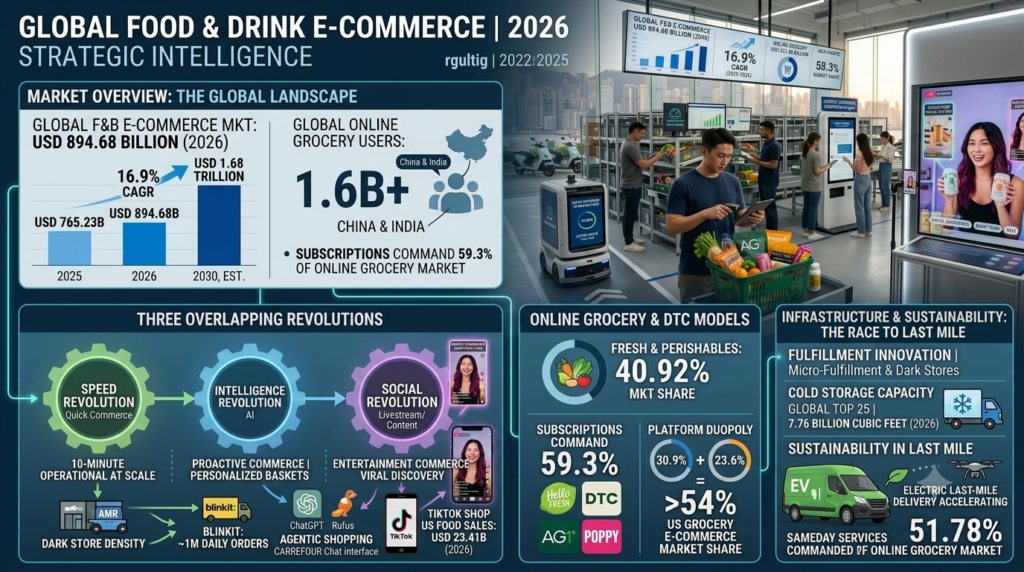
Table of Contents
1. Market Overview: The Scale of F&B E-Commerce
Defining the Category
Food and beverage e-commerce encompasses every channel through which consumers purchase food, drink, and related products via digital platforms — including: retailer-owned online grocery platforms (Walmart.com, Tesco.com, Ocado), pure-play online grocery services (Amazon Fresh, Instacart, Shipt), quick commerce apps (Blinkit, Zepto, Gopuff, Getir), direct-to-consumer (DTC) food and beverage brands, meal kit subscription services (HelloFresh, Green Chef), food delivery aggregators (DoorDash, Uber Eats, Deliveroo), social commerce platforms (TikTok Shop, Instagram Shopping), and marketplace channels (Amazon Marketplace, Tmall, JD.com for food categories).
Global Market Valuation
The global food and beverages e-commerce market is valued at USD 894.68 billion in 2026, representing 16.9% year-on-year growth from USD 765.23 billion in 2025. The Business Research Company estimates USD 1.69 trillion by 2030 at a 17.2% CAGR — a near-doubling in four years. The global food e-commerce market is valued at USD 468.33 billion in 2026 by Business Research Insights, growing to USD 2.24 trillion by 2035 at an 18.97% CAGR. The online grocery sub-segment is valued at USD 522.40 billion by Coherent Market Insights, growing to USD 1.34 trillion by 2033 at 14.4% CAGR.
The scale of the opportunity is captured by the 2026 consumer behaviour data: over 1.6 billion people globally have purchased groceries online at least once. In China alone, over 520 million consumers engaged in e-grocery purchases, while India recorded more than 310 million online grocery users. The average frequency of online grocery orders increased from 2.1 times per month in 2022 to 3.4 times per month by mid-2024 — reflecting the maturation of online grocery from occasional convenience to habitual default.
Platform Ecosystem Overview
The global F&B e-commerce platform ecosystem can be understood through four structural layers:
Layer 1 — Established retailer-owned platforms: Walmart.com, Tesco.com, Kroger.com, Carrefour, Meituan — traditional retailers who have built digital channels atop their physical store and distribution infrastructure.
Layer 2 — Platform aggregators and enablers: Instacart, which powers digital commerce for over 1,400 retail banners across North America; DoorDash and Uber Eats, which enable restaurant and grocery delivery through independent platform infrastructure; and Ocado, which licenses its automated fulfilment technology to multiple retail partners globally.
Layer 3 — Quick commerce pure-plays: Blinkit, Zepto, Gopuff, Getir, Gorillas, and their regional equivalents — operating dense networks of dark stores for sub-30-minute delivery.
Layer 4 — Social and discovery commerce: TikTok Shop, Instagram Shopping, Whatnot, and the emerging livestream commerce ecosystem that converts entertainment engagement directly into food and beverage purchases.
2. Online Grocery: The Core Category
Market Structure and Platform Leadership
The online grocery market is the largest and most commercially significant segment of F&B e-commerce globally. By product category, fresh and perishable goods hold 40.92% of online grocery market share — the largest single product segment — reflecting the extraordinary consumer willingness to trust digital platforms with the quality-critical fresh food categories that were once assumed to be the exclusive domain of physical retail. Packaged foods are projected to grow at the fastest CAGR of 18.85% through 2031. By delivery model, same-day services commanded 51.78% of the online grocery market in 2025, with instant delivery growing fastest at 17.92% CAGR.
Subscriptions command 59.3% of the online grocery market in 2026 — reflecting the extraordinary commercial power of the recurring purchase model in the grocery category. A household that commits to a weekly grocery subscription generates three to five times the annual purchase value of an equivalent occasional shopper, with materially lower customer acquisition cost per repeat order. The subscription model is the most commercially important structural feature of the online grocery market.
The Walmart-Amazon US Duopoly
In the United States — the world’s most commercially significant individual F&B e-commerce market — Walmart dominates digital grocery with 30.9% of grocery e-commerce sales, with Amazon holding 23.6% and Kroger third at 9.1%. Together, Walmart and Amazon command over 54% of US grocery e-commerce — a duopoly that regional supermarket chains must navigate through technology partnerships, specialisation, and niche positioning rather than frontal competition.
Walmart’s structural advantage stems from the combination of its unrivalled physical footprint (90% of the US population lives within 10 miles of a Walmart store), its Walmart Connect retail media network, its Vizio smart TV acquisition that closes the loop between product discovery and purchase, and the Walmart+ subscription programme that drives disproportionate e-commerce purchasing frequency.
Amazon’s grocery e-commerce advantage derives from its Amazon Prime ecosystem (which creates purchasing frequency across all categories including food), its Amazon Fresh store network, the Whole Foods integration, and the extraordinary SKU depth of Amazon’s marketplace particularly in shelf-stable food categories. Out of all grocery retailers, grocery e-commerce sales grew fastest by 26.4% annually over 2019 to 2023 at Amazon.
Click-and-Collect: The Profitability Sweet Spot
Click-and-collect — where consumers order online and collect in-store or at the kerb — remains the most profitable fulfilment model in online grocery, eliminating last-mile home delivery costs while capturing the digital basket size and shopping frequency advantages of digital ordering. Walmart’s curbside pickup infrastructure is the most commercially mature click-and-collect system in the world, serving millions of weekly transactions from its existing store footprint.
3. Quick Commerce: The 10-Minute Revolution
The Dark Store Model
Quick commerce — ultra-fast grocery and food delivery in 10–30 minutes through networks of dark stores positioned within urban neighbourhoods — has moved from a venture capital-funded experiment to the defining commercial format of urban food convenience globally. The quick commerce model relies on a network of dark stores: small, delivery-only warehouses located in high-density urban areas, stocking 2,000–4,000 of the most frequently ordered SKUs. This tight network structure reduces the cost of last-mile delivery — typically the most expensive part of logistics — by dramatically shortening delivery distances.
Blinkit (Zomato) reached 58.9 million downloads in 2025 — a staggering 55.9% growth rate — and is processing close to a million daily orders in India. Blinkit is the closest to profitability among Indian quick commerce platforms. Zepto achieved 70.58 million app downloads in 2024, with revenue growing over 1,000% in 2023. Zepto’s AI-powered ultra-fast fresh food delivery — with AI systems predicting what specific neighbourhood residents will order before they open the app — is the most technologically sophisticated quick commerce operation globally.
Flipkart (Walmart), crossed 800 dark stores and is aiming to double its network by end of 2026 per UBS estimates — a scale of investment that signals Walmart’s recognition that dark store density is the defining competitive infrastructure of urban food convenience.
The Indian Quick Commerce Ecosystem
India has become the world’s most advanced and commercially intense quick commerce market — a fact that reflects the extraordinary combination of population density, smartphone penetration, a young urban population with high convenience expectations, and the competitive intensity of platforms including Blinkit (45% market share), Swiggy Instamart (25–27%), Zepto (21–29%), and Amazon Fresh.
The success of Blinkit in India is a precursor to a global shift toward hyper-fast delivery. The quick commerce model — once considered possible only in the densely populated markets of Asia — is being adopted by Western platforms as the consumer expectation of speed escalates globally.
Blinkit’s strategic ambition extends well beyond grocery delivery. The platform is attempting to replace Amazon for “instant needs” — customers can now order a PlayStation 5, a ceiling fan, or a printer and receive it in 10 minutes. Because Blinkit is owned by Zomato (which has massive data on eating habits and restaurant ordering), it has a cross-platform data advantage that allows it to predict what Blinkit customers will want based on their Zomato food delivery behaviour.
US Quick Commerce: Profitable Outliers and Platform Consolidation
In the US, quick commerce market was valued at USD 8.78 billion in 2025, growing 8.2% annually. Instacart turned profitable with USD 457 million in net income in 2024 — the most commercially significant profitability milestone in US quick commerce. DoorDash produced USD 10.72 billion in revenue in 2024, reporting its first-ever annual profit of USD 117 million. Uber Eats reported a total order value of USD 74.6 billion in 2024, a 10% gain year-on-year.
Most US quick commerce pure-plays remain unprofitable — Gopuff losing USD 400 million in 2023 — reflecting the structural challenge of building dense dark store networks in the lower population density, higher labour cost environment of American cities compared to Asian urban markets.
4. Direct-to-Consumer (DTC) Food and Beverage
The DTC Revolution
The pandemic era created an extraordinary window for direct-to-consumer food and beverage brands — when retail distribution was disrupted, consumers were searching online for new food products, and brands could reach target consumers through digital channels with unprecedented efficiency. The legacy of that window is a permanent structural shift in how innovative food and beverage brands go to market.
DTC food brands win by owning their customer relationships instead of renting them from third-party retail platforms. First-party data — collected from direct consumer interactions including purchases, email engagement, subscription behaviour, and product reviews — enables the personalisation, loyalty, and lifetime value optimisation that third-party retail cannot replicate. Selling across multiple channels creates powerful discovery and conversion opportunities, while owned channels like email and SMS drive repeat sales at low marginal cost.
The most successful DTC food and beverage brands in 2026 include: Olipop and Poppi (prebiotic sodas), Athletic Greens (AG1 comprehensive nutrition), Seed Health (probiotics), LMNT (electrolytes), Liquid Death (water), and the broader ecosystem of functional food and beverage brands that have built loyal subscriber communities through digital-first strategies. Brands using social platforms for discovery while relying on owned channels like email and SMS to drive repeat sales achieve the lowest customer acquisition costs and highest lifetime values in the category.
Subscription Commerce: The Recurring Revenue Engine
Subscription food and beverage commerce — regular deliveries of coffee, wine, meal kits, health supplements, pet food, and specialty food products — is one of the most commercially valuable e-commerce models in the food category. The subscription model converts one-time buyers into predictable recurring revenue sources, dramatically reduces customer acquisition cost per repeat purchase, and creates the product and brand loyalty that conventional retail rarely achieves.
HelloFresh pioneered the meal kit subscription category globally and remains the world’s largest meal kit company. Subscription-based loyalty programmes — Amazon Prime for grocery convenience, Walmart+ for curbside and delivery benefits, Costco for warehouse club access — are the commercial infrastructure through which the world’s largest food retailers lock in their most valuable customers.
5. Social Commerce: Food Goes Viral and Converts
TikTok Shop: The Commerce Revolution in Entertainment
TikTok social commerce revenues are expected to surpass USD 100 billion globally for the first time in 2026. TikTok Shop will reach USD 23.41 billion in US e-commerce sales in 2026 — a 48% year-on-year increase — giving it larger US e-commerce sales than Target, Costco, Best Buy, or Kroger. Food ranks as the second-largest CPG category on TikTok Shop, reflecting the extraordinary convergence of food content culture and commerce.
The TikTok Shop food commerce dynamic operates through a distinctive mechanics: a creator shares a recipe or food review; viewers experience an emotional and sensory response to the content; the product featured appears as a shop link directly in the video; and the purchase journey from discovery to checkout takes under 60 seconds without leaving the platform. This compression of the discovery-to-purchase funnel — eliminating the traditional journey from social media to search engine to retail website to checkout — is one of the most commercially significant innovations in consumer commerce in a decade.
Social commerce is booming, especially for Gen Z. Social commerce adoption is growing — TikTok Shop and Instagram are emerging conversion points, and brands have opportunities to integrate social into discovery-to-checkout journeys. TikTok Shop processes nearly USD 6 billion in sales, with food ranking as the second-largest CPG category.
Livestream Shopping: The Entertainment Commerce Format
Live commerce is a rapidly evolving USD 68 billion US market projected for 2026, with conversion rates up to 30% — roughly 10 times higher than traditional e-commerce. The number of livestream buyers jumped more than 21% year-on-year in 2025. Amazon Live, TikTok live shopping, Instagram Live, and the standalone livestream platform Whatnot (which saw over USD 6 billion in consumer purchases in 2025 and recently raised USD 265 million at a USD 5 billion valuation) are building the entertainment-commerce infrastructure that food and beverage brands are leveraging for product launches, seasonal promotions, and community building.
In China — where the livestream commerce model originated and is most mature — platforms like Douyin (TikTok’s Chinese equivalent), Taobao Live, and JD Live process billions of dollars in food and beverage transactions through live video commerce daily. The Chinese model — where celebrity chefs, food influencers, and brand representatives conduct live cooking shows that seamlessly integrate product purchasing — is the template that Western markets are progressively adopting.
Social Proof and Influencer Commerce
58% of consumers over 18 have purchased products because of an influencer endorsement. Gen Z is 70% more likely than average to use vlogs for product research. 55% of consumers now make direct purchases from social media or livestream platforms for groceries. The convergence of social proof (peer recommendation) and instant purchasing (in-platform checkout) has created a commerce channel that is simultaneously the most effective awareness, consideration, and conversion vehicle for innovative food and beverage brands.
6. AI and Agentic Commerce: The Intelligence Revolution
Agentic Shopping: The Next Frontier
Agentic commerce — AI systems that autonomously execute the shopping journey on behalf of consumers — is transitioning from concept to commercial reality in 2026. Food industry eyes agentic shopping: while still in early days and niche at this stage, food retailers and suppliers are tracking the evolution of agentic technologies and preparing for a possible increase in consumer use of AI agents.
Carrefour announced in March 2026 that it is one of the first European grocery retailers to offer shopping capabilities directly through a ChatGPT interface — allowing customers in France to browse, receive personalised recommendations, build shopping baskets, and select delivery options through conversational AI, with final purchase completed on Carrefour’s site. Carrefour CEO Alexandre Bompard personally demonstrated the experience in a TikTok video in March 2026.
Kroger’s AI consumer agent helps families find meal ideas, plan weekly menus through conversation, and build grocery baskets faster than traditional search-based journeys. Tesco, Albertsons, and Walmart have deployed AI-powered shopping assistants that convert a meal question into a ready-to-checkout grocery basket.
Amazon’s Rufus features Auto Buy — which authorises autonomous purchases when items hit target prices. AI platforms already account for USD 20.9 billion in US retail e-commerce sales in 2026, nearly quadrupling 2025 figures. Exploding Topics data shows search interest in “AI agent” has tripled in the past year.
AI Demand Forecasting and Personalisation
64% of consumers have at least tried Gen AI, and more than half have used AI for food-related activities. AI is compressing the “shelf” to fewer, better-matched SKUs per view — with AI-powered recommendation engines showing each consumer a personalised version of the store that emphasises the products most likely to be purchased rather than the full category assortment that overwhelms decision-making.
AI demand forecasting across the online grocery value chain is reducing food waste by matching inventory precisely to predicted demand, reducing overstock situations that lead to spoilage and markdown, and improving in-stock rates for fast-moving categories. AI orchestrates warehouse robots for picking, sorting, and inventory management — reducing processing times by up to 60% in the most automated online grocery fulfilment centres.
Retail Media: The Grocery Platform’s High-Margin Business
US advertisers will spend USD 69.33 billion on retail media in 2026, up 17.9% from USD 58.79 billion in 2025. Amazon Ads and Walmart Connect dominate, capturing 89.5% of incremental spending. Retail media networks — advertising platforms built on top of grocery retailers’ first-party purchase data — are transforming the economics of online grocery retail. For grocery platforms, retail media revenue earned by charging CPG brands for digital advertising converts consumer purchase data into a high-margin revenue stream that generates 50–70%+ margins compared to the 2–5% EBITDA of conventional grocery.
Retail media is not supplementary to the grocery e-commerce business — it is increasingly the primary profit driver that justifies the capital investment in digital commerce infrastructure, making online grocery a more commercially sustainable long-term business model than the delivery cost economics alone would justify.
7. Fulfilment Infrastructure: The Race to Last Mile
Dark Store Networks and Micro-Fulfilment
The physical infrastructure of online food and beverage commerce is as strategically important as the digital platform layer. Micro-fulfilment centres — small, highly automated facilities positioned within urban population centres — are the critical infrastructure enabling same-day and quick commerce at commercial scale. The global top 25 cold storage capacity reached 7.76 billion cubic feet in 2026, with cold storage’s role in supporting online fresh food delivery growing rapidly.
Dark stores — facilities dedicated entirely to order fulfilment with no consumer-facing retail function — are proliferating across major urban markets globally, driven by the commercial logic that order assembly efficiency in a purpose-built dark store is materially superior to picking from live retail aisles.
Electric Last-Mile Delivery
The transition from diesel last-mile delivery vehicles to battery-electric alternatives is accelerating for food and grocery delivery, driven by urban emission zone regulations, rising diesel costs, and the sustainability commitments of the major platform operators. Amazon is actively deploying electric vehicles to reduce urban carbon emissions, aligned with regulatory requirements while achieving operational cost reductions. Suburban areas are increasingly serviced by electric van fleets, and long-haul grocery distribution is exploring hydrogen refuelling hubs for heavy vehicles.
Same-Day and Scheduled Delivery Economics
Same-day delivery — the fulfilment promise that positions online grocery as genuinely competitive with the convenience of physical retail — commands a price premium over next-day or scheduled delivery that varies by market from USD 5–15 per order. The economics of same-day delivery depend critically on order density in the delivery zone, average basket size, and the efficiency of route optimisation. Markets with high population density and large average basket sizes — urban China, India’s metro cities, New York, London — can support commercially viable same-day delivery; lower-density suburban markets require click-and-collect or scheduled delivery models to achieve acceptable unit economics.
8. Meal Kits and Specialty Food Subscriptions
The Meal Kit Market
Meal kit subscriptions — services delivering pre-portioned, recipe-matched fresh ingredients to home cooks — represent one of the most commercially distinctive formats in F&B e-commerce. Subscribers receive pre-portioned ingredients and recipes; it saves time, reduces food waste, and allows trying new dishes. This model caters to busy lifestyles and the growing preference for healthy, easy-to-prepare options.
HelloFresh remains the global meal kit market leader, operating across North America, Europe, and Australia with multiple brand formats (HelloFresh, Green Chef, Factor, Everyplate) that serve different dietary preferences and price points. The meal kit category’s primary commercial challenge is high churn — consumers frequently cancel and restart subscriptions, creating acquisition cost pressure that makes subscriber lifetime value management the central strategic challenge.
The market is evolving beyond traditional meal kits into: fully prepared refrigerated meal delivery (Factor, by HelloFresh), heat-and-eat premium meal services, and AI-personalised nutrition plans delivered as weekly food packages. The intersection of meal kits with the GLP-1 medication trend — creating demand for protein-dense, calorie-controlled, nutritionally optimised meal delivery — is creating a new market segment with distinctive formulation and positioning requirements.
Specialty Food E-Commerce
Specialty food e-commerce — the online purchasing of premium, artisan, ethnic, functional, and specialty food products that are unavailable or poorly represented in conventional grocery retail — has been one of the most commercially dynamic segments of F&B e-commerce. The combination of the global specialty food culture movement, the DTC brand proliferation, and the ability of digital platforms to serve the long tail of consumer food preferences that physical retail cannot accommodate efficiently has created a thriving ecosystem.
Too Good To Go — a Danish app reducing food waste by allowing users to buy surplus food from restaurants and bakeries at a discount — reached 45.4 million downloads in 2025, representing 10.5% growth and signalling a broader consumer trend toward conscious consumption. The app’s extraordinary growth demonstrates that food e-commerce is not solely a convenience play — sustainability-motivated food commerce is a growing and commercially significant channel.
9. Regional Dynamics
Asia-Pacific: The World’s Largest F&B E-Commerce Market
Asia-Pacific dominates global F&B e-commerce with 58.3–60% of global online grocery market share. China alone has over 520 million e-grocery consumers. The region is home to the world’s most advanced quick commerce infrastructure (India), the world’s most mature social commerce ecosystem (China’s Douyin, Taobao Live, Pinduoduo), and the world’s most technologically sophisticated food delivery platform (Meituan).
China’s food e-commerce ecosystem — built around super-apps that integrate food delivery, grocery ordering, restaurant discovery, and social commerce in a single consumer interface — is the global model for integrated food commerce that Western platforms are progressively attempting to replicate. The Meituan platform processes hundreds of millions of food and grocery orders monthly and has built the most comprehensive urban food delivery infrastructure in the world.
India’s quick commerce revolution — with Blinkit, Zepto, and Swiggy Instamart building dense dark store networks across every major Indian city — is simultaneously the world’s most commercially intense competitive market and the clearest demonstration of what quick commerce can achieve at scale. Indian publishers and US publishers now control approximately 30% of the top ranks in the global food and drink app category.
North America: Technology Leadership and Profitable Scale
North America held 35.98% of online grocery market revenue in 2025 with a CAGR of 20.95% through 2031. The US market is the world’s most commercially valuable individual F&B e-commerce market, characterised by the Walmart-Amazon duopoly in digital grocery, the Instacart platform ecosystem serving regional grocery chains, the DTC subscription food brand ecosystem, and the fastest-growing social commerce channel in TikTok Shop.
Grocery e-commerce in the US remains the most dynamic retail channel — high US inflation has caused some short-term slowdown in sales growth, but long-term prospects remain bright given the time pressures consumers face. The structural transition from physical grocery shopping to digital ordering is a generational behaviour shift that will not reverse.
Europe: Omnichannel Maturity and Sustainability Focus
Europe is characterised by mature grocery e-commerce ecosystems led by Ocado (UK), Tesco.com and Sainsbury’s (UK), Carrefour (France/Spain), Picnic (Netherlands/Germany), and a growing ecosystem of quick commerce operators in major cities. Carrefour’s March 2026 ChatGPT shopping integration positions Europe’s largest retailer at the frontier of agentic commerce.
The European F&B e-commerce market is more heavily influenced by sustainability considerations — the Too Good To Go anti-food-waste platform, the rapid growth of organic and clean-label food e-commerce, and the regulatory emphasis on sustainable packaging in e-commerce — than other major markets.
10. Sustainability in F&B E-Commerce
The Carbon Challenge of Last-Mile Delivery
The expansion of online grocery and quick commerce creates a paradox: while individual trips to supermarkets are replaced by consolidated delivery routes, the proliferation of multiple small orders across multiple platforms can increase the total carbon footprint of food distribution relative to consolidated weekly grocery shopping trips. Sustainability is no longer a niche concern; it is a major driver of app downloads and consumer platform selection.
The platforms and DTC brands achieving the strongest sustainability credentials in F&B e-commerce are those who have invested in: electric vehicle fleets for last-mile delivery, optimised route planning to maximise delivery density, sustainable and minimal packaging, and consolidation of orders to reduce the number of individual delivery trips per consumer household per week.
Packaging Sustainability
The packaging requirements of online grocery — boxes, insulation, void fill, cold packs for fresh and chilled products — generate significantly more packaging waste per kilogram of food delivered than conventional retail. The industry is investing in returnable cold pack systems, paper-based insulation alternatives, right-sized automated packaging systems that eliminate void fill, and compostable packaging formats that maintain food safety during delivery without the environmental burden of conventional plastic insulation.
11. Critical Risks and Challenges
Last-Mile Economics and Path to Profitability
Despite the extraordinary growth of F&B e-commerce, the economics of home grocery delivery remain deeply challenging for many operators. Last-mile delivery costs — drivers, vehicles, fuel, failed delivery costs — represent 30–50% of total online grocery order costs. Q1 2026 ground parcel rates are 38.9% above the January 2018 baseline. For food products with low average selling prices and high perishability, the margin available to fund delivery costs is structurally thin.
Most US quick commerce firms remain unprofitable. The path to profitability requires one or more of: higher average order values (encouraging consumers to consolidate orders), delivery fees (which reduce demand elasticity among price-sensitive consumers), retail media revenue (which can generate 50–70% margins that subsidise delivery economics), or automation (which reduces picking and packing costs at scale).
Food Safety in Digital Commerce
The expansion of online fresh food commerce creates specific food safety challenges: maintaining cold chain integrity through the delivery process, ensuring that temperature-sensitive products (fresh meat, dairy, prepared meals) arrive in acceptable condition after potentially multiple hours of transit, and managing the quality expectations of consumers who cannot physically inspect fresh products before purchasing.
Consumer Trust and Digital Fraud
Concerns regarding online fraud and delivery delays affect around 41% of consumers, limiting market adoption. The digital food commerce ecosystem generates significant volumes of consumer data — purchase history, dietary preferences, health conditions, payment information — that creates both commercial value and serious privacy and security obligations for platform operators.
The Profitability Challenge of Pure-Play Quick Commerce
The dark store quick commerce model requires extraordinary capital investment in hyperlocal infrastructure — many dark stores across many cities, each stocked with a carefully curated SKU range — that creates high fixed costs and limited economies of scale until store density reaches commercial viability thresholds. The failure rate among quick commerce pure-plays in Europe — where Gorillas, Jiffy, Flink, and others have scaled back, merged, or exited — demonstrates the capital intensity and operational complexity of the model.
12. Strategic Outlook for Stakeholders
Actionable Recommendations
Build First-Party Data Infrastructure as a Commercial Priority: The most commercially durable advantage in F&B e-commerce is first-party consumer data — knowing precisely what an individual consumer buys, when, at what frequency, at what price point, and how their purchasing responds to recommendations and promotions. Every interaction through owned digital channels builds this data asset; every interaction through third-party platforms funds the data assets of the platform operator.
Integrate Social Commerce Into Core Distribution Strategy: 55% of consumers now make direct purchases from social media or livestream platforms for groceries. Food brands not present as purchasing options in TikTok Shop, Instagram Shopping, and the livestream commerce ecosystem are absent from the purchase journey of the most commercially valuable consumer demographic. The discovery-to-purchase compression of social commerce creates conversion rates (up to 30% for livestream) that conventional e-commerce cannot approach.
Prepare for Agentic Commerce Now: Food industry eyes agentic shopping — while still early days, it is niche but accelerating. AI agents that autonomously shop for consumers represent the most radical near-term restructuring of the food retail purchase journey. Brands and retailers who ensure their products are optimised for AI recommendation and autonomous purchase selection — through data quality, first-party relationships, and structured product information — will be structurally advantaged when agentic commerce scales.
Invest in Retail Media as a Revenue Priority: US retail media spend reached USD 69.33 billion in 2026 — and for food brands, the return on retail media investment is structurally superior to almost any other digital advertising channel because it reaches consumers with demonstrated purchase intent at the moment of the relevant category browsing. Building retail media capabilities — either as a platform operator or as a brand that invests intelligently in platform media — is a commercial priority.
Strategic Summary: The 2026 F&B E-Commerce Business Model
| Strategic Priority | 2020 Approach | 2026 Competitive Standard |
|---|---|---|
| Consumer Interface | Website and app | Conversational AI, social, agentic |
| Fulfilment Promise | Next-day delivery | 10-minute quick commerce in urban markets |
| Data Strategy | Third-party platform dependency | First-party data + retail media revenue |
| Social Commerce | Discovery channel only | Discovery + conversion + purchase in single platform |
| Subscription Model | Optional loyalty programme | Core recurring revenue architecture |
| Sustainability | Optional packaging upgrade | Required EV fleet, sustainable packaging, food waste reduction |
13. Leading Industry Companies
| Company | Region | Strategic Focus |
|---|---|---|
| Walmart Inc. | USA/Global | Dominant US digital grocery (30.9% share). Walmart+ subscription driving recurring grocery e-commerce. Walmart Connect retail media capturing 11% of US incremental retail media spend. Vizio acquisition closing the TV-to-purchase loop. |
| Amazon | USA/Global | 23.6% US digital grocery share. Amazon Fresh stores, Whole Foods integration. Rufus AI assistant with Auto Buy. Amazon Ads dominant in retail media. Prime ecosystem driving food purchasing frequency. |
| Blinkit (Zomato) | India | India’s leading quick commerce platform at ~45% market share. Close to a million daily orders. Expanding beyond grocery to instant everything. Leveraging Zomato food data for cross-platform intelligence. |
| Zepto | India | AI-powered ultra-fast delivery. 70.58 million app downloads. 1,000%+ revenue growth. Most technologically sophisticated quick commerce AI in operation. |
| Instacart | USA | Profitable quick commerce enabler with USD 457 million net income in 2024. Powers digital commerce for 1,400+ retail banners. Retail media network. Expanding AI shopping assistant capabilities. |
| DoorDash | USA/Global | USD 10.72 billion 2024 revenue. First annual profit USD 117 million. Expanding from restaurant delivery into grocery and convenience commerce. |
| Meituan | China | China’s dominant food delivery and quick commerce platform. Processing hundreds of millions of orders monthly. |
| HelloFresh | Germany/Global | World’s largest meal kit company. Multiple brands across dietary formats (HelloFresh, Green Chef, Factor, EveryPlate). Global subscription commerce leader. |
| Ocado Group | UK/Global | World’s most advanced automated online grocery fulfilment technology. Licensing Ocado Smart Platform to Kroger, ICA, Sobeys, and others globally. |
| Carrefour | France/Global | First major European retailer integrating ChatGPT agentic shopping in March 2026. “Carrefour 2030” AI strategy. 8+ million weekly digital customers. |
Related: As grocery retailers pivot toward hybrid shopping models, the integration of personalized digital loyalty and seamless omnichannel experiences is fundamentally changing the competitive landscape. Explore the key trends, growth projections, and shopper-behavior insights in our Global Grocery Retail Industry Report 2026.
Frequently Asked Questions (FAQ)
What is the global food and beverage e-commerce market size in 2026?
The global food and beverages e-commerce market is valued at approximately USD 894.68 billion in 2026, growing at a CAGR of 16.9% from USD 765.23 billion in 2025, projected to reach USD 1.68 trillion by 2030 at a 17.2% CAGR. The online grocery sub-segment is valued at USD 522.40 billion, growing at 14.4% toward USD 1.34 trillion by 2033. Over 1.6 billion people globally have purchased groceries online at least once. Asia-Pacific commands 58.3% of global online grocery market share. In the US, Walmart leads digital grocery with 30.9% share, Amazon holds 23.6%, and Kroger holds 9.1%. Subscriptions account for 59.3% of the online grocery market in 2026, reflecting the extraordinary commercial durability of recurring food e-commerce models. The F&B e-commerce sector represents approximately 9.1% of the total USD 9.79 trillion global food and beverage market, with the online retail channel growing at 5.63% CAGR within the broader food sector.
What is quick commerce and why is it transforming food retail?
Quick commerce — also called q-commerce or instant delivery — is the ultra-fast delivery of groceries and food essentials in 10–30 minutes through networks of small, hyperlocally positioned dark stores (delivery-only warehouses). It is transforming food retail by fundamentally reconfiguring the consumer’s expectation of delivery speed — making on-demand grocery the new urban default rather than a premium service. In India, Blinkit processes close to a million daily orders with a 10-minute delivery promise; Zepto deploys AI to predict neighbourhood-level demand before consumers open the app; Flipkart has crossed 800 dark stores aiming to double by end of 2026. The quick commerce model works commercially when order density within the dark store’s delivery radius is sufficient to absorb the cost of small individual deliveries, which requires either high population density (India, China, European capitals) or a willingness to charge delivery fees that cover the marginal cost. Most US quick commerce operators remain unprofitable; Instacart is the standout profitable exception with USD 457 million in 2024 net income.
How is TikTok Shop changing food and beverage commerce?
TikTok Shop is fundamentally restructuring food and beverage commerce by compressing the discovery-to-purchase funnel to under 60 seconds within a single entertainment platform. TikTok Shop will reach USD 23.41 billion in US e-commerce sales in 2026 — a 48% year-on-year increase that gives it larger US e-commerce sales than Target, Costco, Best Buy, or Kroger. Food ranks as the second-largest CPG category on TikTok Shop. The mechanism is commercially distinctive: a creator shares a food recipe, review, or taste reaction; the algorithm serves it to users with relevant interest signals; a shop link in the video allows immediate purchase without leaving the platform; and the conversion rates — up to 30% for livestream commerce — dwarf conventional e-commerce rates. For food and beverage brands, TikTok Shop is simultaneously a discovery channel, a review platform, and a direct sales channel — the most complete convergence of marketing and commerce in a single digital environment that has ever existed. 55% of consumers now make direct grocery purchases from social media or livestream platforms.
What is agentic commerce and how will it affect food purchasing?
Agentic commerce is the use of AI agents — autonomous systems — to independently execute the shopping journey on behalf of consumers, from deciding what products to buy through to completing the purchase without requiring active human input at each step. In food and grocery, agentic commerce is emerging as a transformative disruption: Carrefour became one of the first European retailers to offer grocery shopping through a ChatGPT interface in March 2026; Kroger’s AI agent builds grocery baskets through conversational meal planning; Amazon’s Rufus Auto Buy autonomously purchases items when they reach target prices. AI platforms already account for USD 20.9 billion in US retail e-commerce sales in 2026. The commercial implication for food brands is profound: when AI agents are making purchasing decisions on behalf of consumers, the purchase decision is no longer made at the shelf or at the digital product page — it is made by an algorithm that optimises against consumer preference data, price, availability, and recommendation model outputs. Brands that are well-positioned in AI recommendation systems and first-party consumer data relationships will benefit; brands that are not will face structural displacement from the purchase journey.
Who leads the global online grocery market in 2026?
Global online grocery market leadership varies significantly by geography. In the US, Walmart leads digital grocery with 30.9% of e-commerce sales, followed by Amazon at 23.6% and Kroger at 9.1%. In India, Blinkit leads quick commerce with approximately 45% market share, followed by Swiggy Instamart (25–27%) and Zepto (21–29%). In China, Meituan, JD.com, Alibaba’s Hema Fresh, and Pinduoduo are the dominant platforms. In the UK, Ocado, Tesco.com, and Sainsbury’s Delivery lead online grocery. In Europe more broadly, Carrefour (France), Picnic (Netherlands), and Rewe (Germany) are major operators. Globally, the technology infrastructure leader is Ocado Group — whose Smart Platform automated fulfilment technology is licensed to multiple major grocery retailers globally including Kroger in the US, ICA in Sweden, and Sobeys in Canada, making it the world’s leading automated grocery fulfilment technology company even though it is primarily known as a UK online grocery retailer.
What is a dark store and how does it enable quick commerce?
A dark store is a warehouse facility designed exclusively for order fulfilment — it has no consumer-facing retail function, no checkout lanes, and no public access. Instead of consumers entering the store to shop, picking operatives (human or robotic) assemble orders from the warehouse inventory and hand them to delivery riders for the last-mile journey to the consumer. Dark stores are positioned in high-density urban locations — typically 300–1,500 square metres — stocking 2,000–4,000 of the most frequently ordered SKUs for the surrounding neighbourhood. This hyperlocal stocking model enables the sub-30-minute delivery promises of quick commerce platforms, because the dark store is never more than 1–3km from most of the consumers it serves. The economics of dark stores improve with order density — more orders per hour from the same facility spreads the fixed cost of rent, staff, and inventory across more revenue. Flipkart had crossed 800 dark stores in 2026 with plans to double; Blinkit, Zepto, and Swiggy Instamart are each operating hundreds of dark stores across Indian cities; and the model is being adopted by major European and North American grocery platforms as the infrastructure for next-generation urban food commerce.
How is AI transforming online food and grocery shopping?
AI is transforming online food and grocery shopping simultaneously across six dimensions in 2026. First, personalisation — AI recommendation engines create an individualised “shelf” for each consumer, showing the products most likely to be purchased based on purchase history, health preferences, and behavioural patterns. Second, basket building — AI shopping assistants from Tesco, Albertsons, and Walmart convert a meal idea question into a ready-to-checkout grocery basket. Third, autonomous purchasing — agentic AI systems from Amazon, Carrefour, and Kroger are beginning to execute grocery orders without step-by-step consumer input. Fourth, demand forecasting — AI predicts what specific neighbourhoods, stores, and dark stores will need to stock at specific times, reducing both stockouts and food waste. Fifth, social commerce AI — AI agents handle thousands of simultaneous consumer questions during TikTok and Instagram livestream shopping events, maintaining conversion rates during high-traffic product launches. Sixth, retail media AI — AI optimises advertising targeting and placement across grocery retail media networks, improving both advertiser ROI and platform media revenue.
Sources and Additional References
- The Business Research Company: Food and Beverages E-Commerce Market Report 2026 — https://www.thebusinessresearchcompany.com/report/food-and-beverages-ecommerce-global-market-report
- Research and Markets: Food and Beverages E-Commerce Market Report 2026 — https://researchandmarkets.com/reports/5939677/food-beverages-e-commerce-global-market-report
- Folio3 FoodTech: 2026 Blueprint For Top Food And Beverage Ecommerce Trends — https://foodtech.folio3.com/blog/food-and-beverage-ecommerce-trends/
- Coherent Market Insights: Online Grocery Market Size and Forecast 2026–2033 — https://www.coherentmarketinsights.com/industry-reports/online-grocery-market
- Precedence Research: Online Grocery Market Size and Forecast 2026–2035 — https://www.precedenceresearch.com/online-grocery-market
- Mordor Intelligence: Online Grocery Market Size & 2031 Trends Report — https://www.mordorintelligence.com/industry-reports/online-grocery-market
- Business Research Insights: Food E-Commerce Market Size, Share & Analysis 2034 — https://www.businessresearchinsights.com/market-reports/food-e-commerce-market-100031
- Market Growth Reports: E-Grocery Market Industry Analysis Report 2035 — https://www.marketgrowthreports.com/market-reports/e-grocery-market-113090
- DemandSage: Quick Commerce Statistics & Market Size 2026 Global Data — https://www.demandsage.com/quick-commerce-statistics/
- ClickPost AI: Top 13 Quick Commerce Companies in India 2026 — https://www.clickpost.ai/blog/quick-commerce-companies
- Digital Yield Group: The 2026 Food & Drink App Ecosystem Analysis — Q-Commerce, AI and the New Era of Digital Delivery — https://digitalyieldgroup.com/blog/the-2026-food-drink-app-ecosystem-analysis-q-commerce-ai-and-the-new-era-of-digital-delivery/
- Storyboard18: Dark Stores — How Blinkit and Zepto Are Building Dense Networks for Quick Commerce Growth — https://www.storyboard18.com/trending/dark-stores-explained-how-blinkit-zepto-are-building-dense-networks-for-quick-commerce-growth-95233.htm
- WareIQ: Blinkit Case Study — Impact on Quick-Commerce Market 2026 — https://wareiq.com/resources/blogs/blinkit-case-study/
- Edgar Dunn: Agentic Commerce in Grocery — How AI Is Transforming Shopping 2026 — https://www.edgardunn.com/articles/grocery-shopping-is-about-to-get-interesting
- FMI (Food Marketing Institute): Digital Engagement Is Transforming Grocery Shopping 2026 — https://www.fmi.org/blog/view/fmi-blog/2026/04/29/digital-engagement-is-transforming-grocery-shopping
- eMarketer: FAQ on Digital Grocery — AI, Retail Media and Omnichannel Fulfillment 2026 — https://emarketer.com/content/faq-on-digital-grocery-how-ai-retail-media-omnichannel-fulfillment-reshaping-2026
- eMarketer: FAQ on Social Commerce — How Creators and Platforms Power Shopping in 2026 — https://www.emarketer.com/content/faq-on-social-commerce–how-creators–platforms-power-shopping-2026
- Shopify: Direct to Consumer (DTC) — How the Model Works 2026 — https://www.shopify.com/blog/what-is-direct-to-consumer
- Search Engine Land: Top Ecommerce Trends for 2026 — AI Agents, TikTok Shop & Livestream Shopping — https://searchengineland.com/guide/top-ecommerce-trends-2026
- BrainSpate: 10 Big Food eCommerce Trends — Tactics to Watch Out For — https://brainspate.com/blog/food-ecommerce-trends/
- Agriculture Canada: Distribution Channel Series — Grocery E-Commerce Market United States — https://agriculture.canada.ca/en/international-trade/market-intelligence/reports/distribution-channel-series-grocery-ecommerce-market-united-states
- Euka AI: Solving The New TikTok Challenge — How DTC Brands Can Rule The Future of eCommerce — https://www.euka.ai/blog/solving-the-new-tiktok-challenge-how-dtc-brands-can-rule-the-future-of-ecommerce
