
rgultig · June 9, 2026
The global coffee market is valued at USD 185.69–285 billion in 2026, growing at a CAGR of 4.49–6.5% toward USD 239–513 billion by 2031–2036 depending on research scope. The global tea market is valued at USD 14.82–159.53 billion in 2026, growing at a CAGR of 5.18–7.93% toward USD 22.74–215 billion by 2031–2034. Together, coffee and tea represent the two most consumed beverages on earth after water — with an estimated 2.25 billion cups of coffee and over 3 billion cups of tea consumed globally every single day.
The global coffee and tea industry in 2026 is navigating the most turbulent supply environment in its modern history while simultaneously experiencing extraordinary consumer-side innovation. On the supply side, Arabica futures surged to historic highs of USD 4.41 per pound in February 2025, driven by climate disruptions in Brazil and Vietnam and tight global inventories. US tariffs of up to 50% on coffee from Brazil — the world’s largest coffee producer — are disrupting well-established supply chains. And the structural long-term threat of climate change to coffee-growing regions is forcing every major roaster to fundamentally rethink supply chain resilience strategies.
On the demand side, consumers have never been more sophisticated, more adventurous, or more willing to pay premium prices for genuinely excellent coffee and tea. Specialty coffee culture has gone mainstream. Cold brew, nitro coffee, and functional coffee are keeping the category exciting for Gen Z. The matcha boom — driven by TikTok’s viral green drink culture — has taken a Japanese ceremonial tea ingredient to global mainstream relevance. And the intersection of tea with the gut health, adaptogen, and functional beverage trends is creating an entirely new generation of botanical tea products that sit at the boundary between beverage and supplement.
This report provides the most comprehensive publicly available analysis of the global coffee and tea industry in 2026 — covering market scale, supply chain and climate risk, product categories, specialty coffee, the RTD revolution, matcha and functional tea, sustainability, the China coffee story, related products, regional dynamics, key challenges, strategic outlook, and leading companies.
Executive Summary: The 2026 Coffee and Tea Landscape
The global coffee and tea industry in 2026 is defined by the tension between extraordinary consumer demand and a supply chain under structural stress. The world wants more and better coffee and tea; the climate, geopolitics, and logistics of producing and delivering it have never been more complex.
Key Takeaways for Stakeholders:
The combined global coffee and tea market represents approximately USD 345–445 billion in 2026 — one of the largest food and beverage segments globally, encompassing retail, foodservice, and RTD formats across all categories.
Arabica prices remain historically elevated: After peaking at USD 4.41/lb in February 2025, Arabica coffee prices are stabilising in 2026 but remain significantly above the five-year historical average, with US tariffs on Brazilian coffee and climate disruptions sustaining price floor pressure.
The KDP-JDE Peet’s combination reshapes the coffee landscape: Keurig Dr Pepper and JDE Peet’s announced a merger creating one of the world’s largest coffee companies, joining forces to build resilience through combined sourcing, scale, and global distribution capability. JDE Peet’s simultaneously acquired Maratá in Brazil in December 2025 to strengthen its South American presence.
Starbucks China transitions to joint venture: Starbucks completed its joint venture with Boyu Capital for China operations, with a global footprint of more than 41,000 company-operated and licensed coffeehouses as of 2026. Q2 FY2026 net revenues reached USD 6.89 billion, a 7% increase year-on-year.
China has overtaken the US as the world’s largest branded coffee shop market — with 18,330 net new stores opened in one year alone and total branded coffee outlets now exceeding 49,690.
Matcha is the defining tea trend of 2026: The global matcha market is valued at USD 3.91–4.41 billion in 2026, growing at a CAGR of 6.47–8.9%. Café chains increased matcha beverage offerings by 36% across urban markets.
RTD coffee is the fastest-growing coffee format at a CAGR of 7.52% through 2031, transforming from a convenience compromise into a premium category.
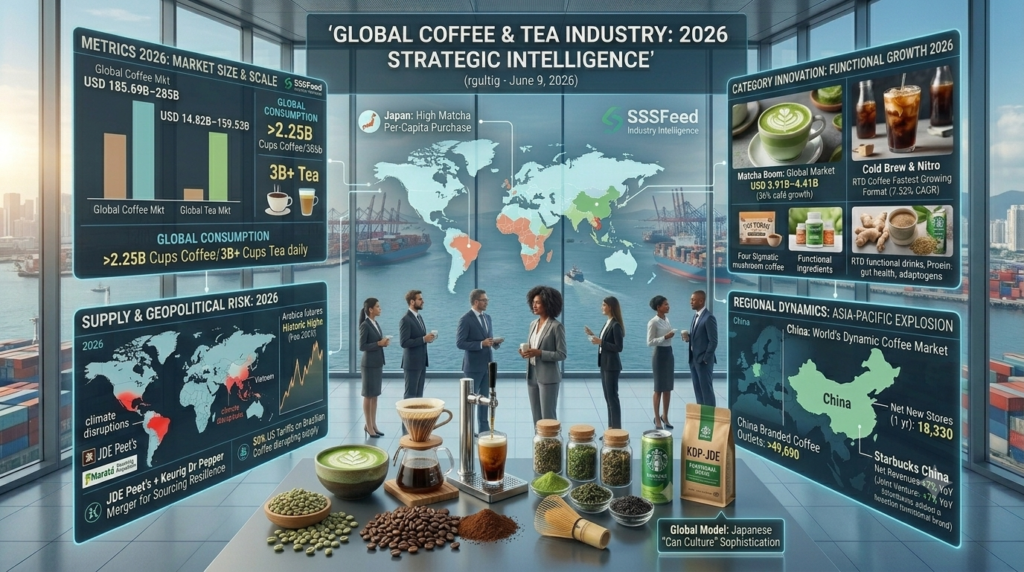
Table of Contents
1. Market Overview: The Scale of Coffee and Tea
The Global Coffee Market
The global coffee market is one of the most commercially complex in the food and beverage sector, encompassing: green coffee bean trade, roasting and processing, instant and soluble coffee production, capsule and pod systems, RTD coffee manufacturing, specialty and artisan roasting, coffee shop operations, and the related ecosystem of equipment, accessories, and services.
Mordor Intelligence values the global coffee market at USD 185.69 billion in 2026, growing to USD 238.99 billion by 2031 at a CAGR of 5.18%. Grand View Research estimates USD 249.34 billion in 2025, growing to USD 380.28 billion by 2033 at a CAGR of 5.4%. Fact.MR provides the broadest scope estimate at USD 284.8 billion in 2025, projected to reach USD 513.2 billion by 2036 at a CAGR of 5.5%. The consensus for the 2026 global coffee market is approximately USD 185–285 billion depending on whether the scope includes all value-added coffee products, foodservice revenue, and at-home premium segments.
Europe dominates the global coffee market with the largest revenue share of 32.5–35.58%, driven by Germany’s extraordinary coffee culture and the continent’s deep espresso traditions. North America is the second-largest market by value, while Asia-Pacific — particularly China — is the fastest-growing at a CAGR of 5.9% through 2033.
By product, roasted coffee accounted for the largest share of 53.5% of the global revenue in 2025, with ground coffee maintaining 33.02% share as the top revenue generator among specific product formats. RTD coffee is growing fastest at a CAGR of 7.52%.
The Global Tea Market
Tea is the world’s most consumed beverage after water — with an estimated 3 billion cups consumed daily, a rich cultural heritage spanning thousands of years, and a production and trade infrastructure that sustains the livelihoods of tens of millions of farmers, pickers, and processors across Asia, Africa, and Latin America.
The tea market estimates vary significantly across research sources reflecting differences in scope. Grand View Research estimates the global tea market at USD 69.51 billion in 2025, growing at a CAGR of 6.5% to USD 115.19 billion by 2033. Mordor Intelligence values the tea market at USD 159.53 billion in 2026, growing to USD 214.85 billion by 2031 at a CAGR of 5.18%. Market Data Forecast places the market at USD 14.82 billion in 2026, growing to USD 22.74 billion by 2034 — this narrower estimate appears to reflect packaged tea retail only.
Asia-Pacific leads the tea market with a 67.9% share of global market value in 2025, reflecting the region’s status as both the world’s dominant tea producer (China, India, Kenya, Sri Lanka) and its largest consumer base. Black tea holds the largest product segment share at 53.3%, though green tea, matcha, herbal, and specialty tea categories are growing significantly faster.
2. Coffee Product Categories: From Commodity to Craft
Specialty Coffee: The Third Wave Goes Mainstream
The third-wave coffee movement — characterised by an artisanal, craft approach to coffee that emphasises single-origin sourcing, precise roasting, skilled preparation, and the terroir of coffee the same way wine culture treats grapes — has completed its transition from niche to mainstream in 2026.
Specialty coffee is now consumed in every major market globally, with consumers in metropolitan areas across North America, Europe, and increasingly Asia willing to pay USD 5–8 for a precisely prepared single-origin pour-over, and USD 15–20 for flight experiences featuring multiple origins side-by-side. Specialty coffee shops — independently owned, barista-led, sourcing directly from farms or micro-lot importers — are among the most commercially dynamic format in the global coffee shop market.
The third-wave coffee movement has elevated standards for sensory analysis of volatile aromatic compounds, pushing the industry toward high-altitude Arabica and specialty robusta. Vertically integrated coffee roasters are focusing on traceability to secure their supply chains, while specialty brands are benefiting from consumers’ interest in unique flavours.
Competition in specialty coffee is increasingly defined by the ability to serve premium consumer demand through specialty sourcing, sustainable supply chains, and format innovation while maintaining distribution reach. Subscription-based direct-to-consumer roaster models — delivering freshly roasted single-origin beans to consumers’ doors weekly — are the fastest-growing distribution model in specialty coffee, creating direct consumer relationships and recurring revenue without the capital requirements of physical retail.
Instant and Soluble Coffee: Innovation Drives the Category Upward
Instant coffee — historically associated with low-quality, commodity-tier consumption — is undergoing a significant commercial reinvention driven by premium soluble formats and the extraction technology innovations of specialty freeze-dried instant coffee. Nestlé’s Nescafé maintains an estimated 15% global coffee market share through its instant coffee leadership, with the brand dominating instant consumption in emerging markets where brewing infrastructure and premium bean access are more limited.
The premium instant coffee segment — where brands like Voilà Coffee, Sudden Coffee, and Starbucks VIA deliver single-serve specialty-grade freeze-dried instant formats at premium price points — is growing rapidly, capturing the consumer who wants specialty coffee quality in the most convenient possible format. These products command prices 3–5x above commodity instant coffee while delivering taste profiles that were previously only achievable through brewing equipment.
Capsule and Pod Coffee: Scale and Sustainability
The coffee capsule and pod market — dominated by Nestlé’s Nespresso, JDE Peet’s Douwe Egberts capsule lines, and Keurig Dr Pepper’s K-Cup format in North America — represents the largest single driver of at-home premium coffee consumption in developed markets. The convenience, consistency, and minimal waste of individual-dose capsule brewing has made it the default premium coffee system for millions of households globally.
The capsule market’s primary sustainability challenge — the combination of aluminium, plastic, and organic waste in individual capsule formats creates recycling complexity — is being addressed through: dedicated capsule recycling programmes (Nespresso’s boutique-based collection system), certified compostable capsule alternatives, and refillable capsule innovations that allow consumers to use any coffee in a compatible brewing system.
Cold Brew and Nitro Coffee: Format Innovation Driving Premium Growth
Cold brew coffee — produced through a long, slow cold-water extraction process (typically 12–24 hours) rather than conventional hot extraction — delivers a naturally sweet, lower-acidity, higher-caffeine coffee concentrate that has become one of the most commercially exciting coffee formats in the global market. Cold brew has completed its transition from artisan coffee shop novelty to mainstream retail product, available in ready-to-drink formats in supermarkets globally.
Nitro coffee — cold brew infused with nitrogen gas to create a creamy, cascading texture similar to draft beer without added milk or sugar — is one of the most visually distinctive and experientially premium coffee formats in the market, available on draft at specialty coffee shops and in nitrogen-pressurised cans at retail. Major beverage companies including Keurig Dr Pepper and Coca-Cola are actively expanding their RTD coffee portfolios to capture convenience-driven demand from this premium cold format.
RTD Coffee: The Fastest-Growing Coffee Format
Ready-to-drink coffee is growing at a CAGR of 7.52% from 2026 to 2031 — faster than any other coffee format — driven by the same convenience and on-the-go consumption trends that are reshaping the entire beverage landscape. RTD coffee, once seen merely as a quick caffeine fix, is now undergoing a premium transformation — these coffees come from specific farms, feature specialty roasts, and are increasingly positioned as functional beverages with protein, collagen, or prebiotic fortification.
Starbucks’ Coffee and Protein — delivering 22 grams of protein and 5 grams of prebiotic fibre in an RTD coffee format — represents the most commercially significant functional RTD coffee launch of 2026, demonstrating that the function stacking trend is penetrating even the most established coffee occasion formats.
Functional Coffee: Where Wellness Meets Caffeine
Functional coffee — coffee products enriched with adaptogens, nootropics, mushroom extracts (lion’s mane, chaga, reishi), collagen, MCT oil, or probiotics — is one of the most dynamic innovation frontiers in the entire coffee category. Brands like Four Sigmatic (mushroom coffee), Bulletproof (MCT-enriched), and a growing ecosystem of DTC functional coffee brands are capturing health-conscious coffee consumers who want their daily caffeine ritual to simultaneously deliver cognitive enhancement, stress management, gut health, or beauty benefits.
3. The Coffee Supply Chain: Climate, Prices and Geopolitics
The Arabica Price Crisis
The most commercially impactful single development in the global coffee industry in 2025–2026 has been the extraordinary volatility and structural elevation of Arabica coffee prices. Arabica futures surged to historic highs of USD 4.41 per pound in February 2025, driven by climate disruptions in Brazil and Vietnam and tight global inventories. While 2026 is seeing some price stabilisation — Brazilian arabica producers expect slightly higher production volumes, and Vietnam estimates 2025/26 harvest volumes will increase 5–10% — prices remain significantly above historical averages.
“Price volatility is common in agriculture, like with pepper, coffee, Areca, tea, etc. The market will find its equilibrium, but it will definitely be higher than the low prices seen in the past.” The structural implication for the industry is significant: the era of cheap commodity Arabica coffee may be permanently over. Consumers will pay more for their coffee; roasters will compress margins; and the competitive pressure to justify premium pricing through genuine quality differentiation will intensify.
US Tariffs and Brazil
US tariffs on coffee imports — including 50% tariffs on coffee from Brazil, the world’s largest coffee producer — have reduced US imports from Brazil by 46% in August 2025 alone, disrupting well-established supply chains. Chief among the forces keeping prices elevated are heavy tariffs on key exporters like Brazil and tight supplies due to extreme weather and poor harvests. For US coffee roasters dependent on Brazilian green coffee, these tariffs represent a significant and potentially structural cost increase that must be absorbed through either price increases, margin compression, or supply chain diversification toward tariff-exempt origins.
Climate Change: Coffee’s Existential Challenge
Climate change represents the most profound long-term structural challenge facing the global coffee industry. Coffee cultivation — particularly Arabica, which requires specific temperature ranges (15–24°C), altitude conditions, and rainfall patterns — is acutely sensitive to the rising temperatures, shifting rainfall patterns, and increasing frequency of extreme weather events that climate change is producing in the world’s primary coffee-growing regions.
The vulnerability of the coffee supply chain due to climate change will likely keep prices elevated, pushing demand towards more resilient varieties like Robusta in bulk segments, while Arabica will dominate premium offerings. The industry’s response encompasses: investment in climate-resilient Arabica varieties that can tolerate higher temperatures and more variable rainfall; geographic expansion of coffee cultivation into higher altitudes and previously marginal growing regions; and the development of precision fermentation and alternative coffee technologies that could ultimately produce coffee-like beverages without the agricultural inputs.
The Keurig Dr Pepper — JDE Peet’s Combination
In one of the most significant coffee industry M&A transactions in years, Keurig Dr Pepper and JDE Peet’s announced their merger, hoping that scale will create resilience through a combined sourcing and procurement operation to manage commodity price volatility. JDE Peet’s simultaneously acquired Brazil’s Maratá in December 2025 — a company specialising in coffee and tea products — to strengthen its South American presence and Brazilian market position. These moves reflect the industry’s recognition that scale in sourcing, sustainability investment, and supply chain management is becoming a competitive necessity rather than merely an advantage in the face of climate and geopolitical supply disruption.
4. Tea Product Categories: Breadth, Depth and Health
Black Tea: The Volume Foundation
Black tea — fully oxidised tea leaves that produce the robust, brisk flavour profile of British afternoon tea, Indian chai, and the iced tea culture of the American South — commands the largest segment share of the global tea market at 53.3% in 2025. The black tea category is simultaneously the most commercially stable and the most challenged by the growth of premium and functional tea alternatives.
The black tea market is dominated by blended commodity tea in the mass-market tier (Lipton, Tetley, PG Tips, Dilmah), with significant premiumisation occurring through single-estate and single-origin positioning (Darjeeling First Flush, Ceylon high-grown, Assam estate teas) that commands dramatically higher per-unit prices in specialty tea retail. Vahdam Teas and Teabox — Indian DTC specialty tea brands — have leveraged digital marketing and global logistics networks to export to 90 countries, achieving annual growth rates exceeding 25%.
Green Tea: Health, Culture and the Matcha Revolution
The global green tea market is valued at USD 17.32–21.66 billion in 2026, growing at a CAGR of 6.57% through 2033. Green tea’s commercial momentum is driven by its extraordinary health credential foundation — drinking 2 to 4 cups of green tea daily can lower the risk of stroke by up to 24%, according to the Cleveland Clinic — combined with the viral cultural phenomenon of matcha and the growing Asian influence on global food and beverage culture.
China produces over 1.8 million metric tons of green tea annually — more than 85% of global output. Japan, the second-largest producer, contributes approximately 0.8 million metric tons, with sencha and bancha as the primary types. The global green tea market encompasses a vast range of formats from commodity tea bags to ceremonial-grade matcha at USD 50+ per 30g tin.
Matcha: The Decade’s Defining Tea Trend
Matcha — finely ground powder produced from shade-grown Camellia sinensis leaves, distinguished by its vibrant green colour, high L-theanine content, and concentrated catechin profile — has undergone one of the most remarkable commercial transformations in global food and beverage. The global matcha market is valued at USD 3.91–4.41 billion in 2026, growing at a CAGR of 6.47–8.90% toward USD 5.35–8.72 billion by 2031–2034.
Café chains increased matcha beverage offerings by 36% across urban markets in 2025. Online grocery platforms contributed 35% of US green tea purchases. Functional beverages infused with green tea extracts represented 27% of immunity-support beverage launches in the American beverage sector. Matcha-based beverages increased by 31% across café chains and foodservice outlets, and individual consumers aged 18–35 represent 51% of premium green tea purchases.
Matcha’s commercial success is built on a unique convergence of health credentials (L-theanine for calm focus, catechins for antioxidant activity, chlorophyll for detox associations), visual appeal (the vibrant green colour is one of the most photogenic and TikTok-optimised beverages ever created), culinary versatility (matcha lattes, matcha baked goods, matcha chocolate, matcha ice cream), and cultural cachet (authentic Japanese ceremony heritage elevated by global food culture).
The culinary grade segment holds 56.4% of the matcha market share in 2026 with its extensive versatility in food and beverage manufacturing, where its robust flavour profile and cost-effectiveness make it ideal for mass-market products. Ceremonial grade — the highest quality, shade-grown, stone-milled matcha traditionally used for the Japanese tea ceremony — commands the premium tier.
Oolong Tea
Oolong tea — partially oxidised between green and black tea, producing a complex flavour range from floral and fruity to creamy and woody depending on oxidisation level — occupies the most artisanal and culturally specific segment of the global tea market. Taiwanese high mountain oolongs (Li Shan, Alishan, Da Yu Ling) and Chinese Dan Cong oolongs from Guangdong command extraordinary prices — exceptional examples reaching USD 500+ per kilogram — in the premium tea collector market.
Herbal and Botanical Tea
The global herbal tea market is growing at a CAGR of 7.2%, with revenue increasing from USD 4.3 billion in 2025 to an estimated USD 4.7 billion in 2026, projected to reach USD 6.9 billion by 2032. The herbal tea category encompasses an extraordinary diversity of ingredients — chamomile, peppermint, ginger, hibiscus, echinacea, lemongrass, rooibos, turmeric, and hundreds of botanical ingredients — creating flavour and functional benefit combinations that bridge the traditional tea category and the functional beverage segment.
The intersection of herbal tea with the adaptogen and gut health trends is generating significant innovation activity: TranquiliTea’s blend of lion’s mane, ashwagandha, lemon balm, chamomile, and magnesium in a jasmine tea-based carbonated drink exemplifies how herbal tea formats are being elevated into premium functional beverage territory.
Bubble Tea (Boba)
Bubble tea — the Taiwanese-originated drink combining tea, milk, and chewy tapioca pearls — is one of the most significant global foodservice format trends of the past decade, having expanded from its Taiwanese and Chinese origins into a truly global beverage category with dedicated chains in every major market. The global bubble tea market is valued at approximately USD 3.5–4 billion in 2026 and growing at one of the fastest CAGRs in the broader tea category, driven by its extraordinary appeal among Gen Z consumers for whom the visual, textural, and social sharing dimensions of bubble tea are as important as the taste.
Chains including Gong Cha, Tiger Sugar, Koi Thé, and Mixue Bingcheng have expanded globally, while Western QSR and café chains have launched boba-inspired limited editions. The premiumisation of bubble tea — from mass-market powder-based formulations toward fresh brewed tea, real fruit, and premium topping combinations — mirrors the third-wave coffee movement’s elevation of commodity products into craft experiences.
RTD Tea
The ready-to-drink tea market is one of the most commercially significant and fastest-growing segments within the broader tea category, encompassing both traditional iced tea formats (Arizona Iced Tea, Nestea, Lipton Iced Tea) and the premium, health-focused RTD tea formats that are driving category growth. AriZona Beverage Company, ITO EN, and Suntory are among the dominant RTD tea operators, with the market being disrupted by a new generation of premium RTD teas incorporating functional ingredients, reduced sugar, organic certification, and artisan tea source stories.
5. Related Products: The Coffee and Tea Ecosystem
Coffee Equipment: The At-Home Brewing Renaissance
The at-home coffee equipment market — encompassing espresso machines, coffee makers, capsule systems, pour-over equipment, French presses, moka pots, cold brew systems, and accessories — has experienced extraordinary growth following the pandemic-driven shift to at-home coffee preparation. At-home coffee preparation now accounts for over 70% of all coffee drinking globally.
Premium home espresso machines from De’Longhi, Breville, Jura, and Sage (the Breville brand outside North America) are among the most commercially significant categories in the home appliance market, with flagship models from Jura and Miele commanding USD 2,000–4,000+ at retail. The bean-to-cup segment — machines that grind, tamp, and extract fresh coffee automatically — is growing fastest as consumers seek barista-quality results without barista training.
Coffee subscriptions — delivering freshly roasted beans to consumers’ homes on a weekly or biweekly basis — have created a new commercial model that combines premium product quality with DTC convenience. Atlas Coffee Club, Trade Coffee, and a growing ecosystem of specialty roaster subscription services are building recurring revenue businesses that compound consumer lifetime value in ways that traditional retail cannot match.
Tea Equipment and Accessories
The tea equipment market — encompassing teapots, tea infusers, matcha whisks (chasen), tea ceremonies sets, gaiwan, kyusu, and the growing category of smart tea makers — is growing alongside the premiumisation of tea culture. The Japanese gongfu tea ceremony — a meditative, precise preparation ritual using specific teaware — is gaining global followership among tea enthusiasts who treat tea preparation as a mindfulness practice as much as a beverage occasion.
Matcha preparation equipment — ceremonial bamboo whisks (chasen), matcha bowls (chawan), and bamboo scoops (chashaku) — is experiencing strong commercial growth as the matcha category’s premiumisation creates demand for authentic preparation accessories. Electric matcha frothers and dedicated matcha preparation tools are expanding the accessible end of the ceremonial equipment market.
Coffee Liqueurs and Spirits
Coffee liqueurs — including Kahlúa (the world’s best-selling coffee liqueur), Tia Maria, and a growing roster of craft artisan coffee liqueurs — represent an important adjacent category for the coffee industry, leveraging the flavour intensity and cultural cachet of specialty coffee in an alcoholic format. The premiumisation of coffee liqueurs — with craft brands positioning cold brew extract, single-origin coffee, and detailed flavour tasting notes as differentiators — mirrors the speciality coffee movement’s influence on every adjacent category.
Coffee cocktails — espresso martinis, Irish coffees, coffee old fashioneds — have become some of the most commercially significant cocktail categories in premium bar and foodservice, directly driving demand for quality espresso extraction capability and premium coffee liqueur products. The espresso martini’s extraordinary cultural resurgence over the past three years is simultaneously a coffee category driver, a cocktail trend, and a premium spirits opportunity.
Tea-Infused Spirits and Cocktails
The intersection of premium tea and spirits — tea-infused gins (Hendrick’s uses rose petal and cucumber; Singapore’s Tanglin uses tropical botanicals including tea), matcha spirits, and the growing category of non-alcoholic tea-based cocktail alternatives — is creating new commercial opportunities at the boundary between the tea and beverages categories.
Seedlip’s plant-based distilled non-alcoholic spirits frequently incorporate tea and botanical ingredients; Lyres non-alcoholic spirits include tea-inspired formulations; and the growing no/low alcohol movement is creating significant demand for premium tea-based cocktail alternatives that deliver the complexity and ceremony of cocktail preparation without alcohol.
Coffee and Tea Skincare and Beauty
Coffee extract — rich in caffeine, antioxidants, and exfoliating properties — is a commercially significant ingredient in the skincare and beauty sector. Frank Body pioneered the coffee scrub category, growing from a small Australian startup to a globally distributed beauty brand. Coffee-based skincare products leverage the genuine clinical evidence for caffeine’s effects on circulation, cellulite reduction, and puffiness reduction to build credible functional beauty positioning.
Green tea extract — rich in EGCG catechins with established antioxidant and anti-inflammatory properties — is among the most commercially significant skincare ingredients globally, appearing in everything from luxury serum formulations to mass-market moisturisers. The convergence of the functional beverage and functional skincare trends is creating new product categories where the same ingredients (matcha, green tea, adaptogens) appear simultaneously in drinks and topical formulations.
6. The China Coffee Story: The World’s Fastest-Growing Market
China has overtaken the US as the world’s largest branded coffee shop market — with 18,330 net new stores opened in one year alone and total branded coffee outlets now exceeding 49,690. This extraordinary statistic captures the scale of China’s coffee revolution — a market that has transitioned from a predominantly tea-drinking culture to the world’s most dynamic and commercially intense coffee market in under a decade.
Luckin Coffee — China’s domestic coffee chain — has grown from its 2017 founding to become one of the world’s largest coffee chains by store count, operating a delivery-first, technology-enabled model that has no Western equivalent. Its partnership with the Australian Open demonstrates its growing international brand ambition. Luckin’s success challenges Starbucks’ long-assumed dominance of the Chinese premium coffee market, while simultaneously demonstrating the extraordinary scale of Chinese coffee demand.
Starbucks completed its joint venture with Boyu Capital for China operations in 2026, with CEO Brian Niccol’s “Back to Starbucks” transformation strategy. As of Q2 FY2026, Starbucks had USD 6.89 billion in net revenues — a 7% year-on-year increase — from a global footprint of more than 41,000 company-operated and licensed coffeehouses. The China JV represents Starbucks’ commitment to the world’s fastest-growing coffee market while sharing the significant capital investment of China expansion with a well-capitalised local partner with deep regulatory and consumer knowledge.
The rapid rise in domestic consumption is also forcing Vietnam and Indonesia — historically primarily coffee exporting nations — to import Brazilian beans to meet their growing domestic demand, fundamentally changing the global coffee trade balance.
7. Sustainability: Coffee and Tea’s Green Imperative
Certifications and Standards
The coffee and tea industries are among the most certification-intensive in the global food sector, with a broad ecosystem of sustainability standards — Fairtrade, Rainforest Alliance (UTZ), Organic, Bird Friendly, Direct Trade, and Shade Grown — that attempt to address the social and environmental impacts of commodity production. Growing consumer awareness of environmental and social impact is driving demand for ethically sourced and sustainably packaged products.
Compliance with deforestation-free supply chain rules is projected to increase administrative costs by up to 10% for importers without automated traceability systems. The EU Deforestation Regulation — which requires coffee, cocoa, soy, and other commodities to demonstrate they are not associated with recent deforestation — is creating significant compliance investment requirements for coffee and tea importers into the EU market.
JDE Peet’s is recognised as a sustainability leader by the Dow Jones Sustainability Europe Index — the only coffee company featured — and its Common Ground Sustainability program with new SBTi (Science Based Targets initiative) targets planned for 2030 reflects the industry’s ambition to move from certification to measurable emissions reduction. Nestlé continued expanding its Nescafé Plan sustainability program targeting responsible sourcing, regenerative agriculture, and farmer welfare across its global supply base.
The Tea Sustainability Paradox
The global tea industry faces a specific sustainability challenge: most of the world’s tea is produced by smallholder farmers in developing countries — India, Kenya, Sri Lanka, Rwanda — where the poverty of farmers, the age and condition of tea bushes, and the climate vulnerability of growing regions create a complex social and environmental sustainability challenge that simple certification systems struggle to adequately address.
A global tea glut is currently affecting Indian tea prices and exports — with overproduction in some markets creating the paradoxical situation of depressed farmgate prices that undermine the very farmer welfare that sustainability programmes attempt to address.
8. Regional Dynamics
Europe: The Coffee Cultural Heartland
Europe dominated the global coffee market with the largest revenue share of 32.5–35.58% in 2025, representing the world’s most sophisticated and commercially significant coffee consumer base. Germany leads European coffee consumption — a country with an extraordinary breadth of coffee culture, from the mass-market dominance of JDE Peet’s Jacobs and Melitta brands to the thriving specialty scene in Berlin, Hamburg, and Munich. Italy’s espresso tradition — the cultural foundation of global coffee shop culture — remains one of the most commercially and culturally influential food traditions in the world. Italy’s Lavazza and illycaffè are among the most globally recognised premium coffee brands, commanding significant premium pricing through their Italian heritage positioning.
North America: The Specialty and Convenience Battlefield
North America’s coffee market is characterised by the simultaneous dominance of the Starbucks café format, the extraordinary commercial intensity of the specialty coffee movement, and the growing RTD and convenience coffee segment. The US market generates approximately USD 48 billion in coffee retail and foodservice revenue annually, making it the world’s largest single-country coffee market by value.
An overwhelming preference for Arabica in North America is continuing to keep prices elevated, even as the robusta supply expands. The US consumer’s preference for Arabica over Robusta — in contrast to European markets where Robusta blending is common — creates a structural cost premium that US coffee operators must manage through pricing or supply chain innovation.
Asia-Pacific: The Growth Engine
Asia Pacific is projected to grow at a CAGR of 5.9% for coffee and is already the dominant region for tea at 67.9% market share. China’s transformation into the world’s largest branded coffee shop market represents the single most significant geographic market development in the global coffee industry, while Japan remains Asia’s most sophisticated coffee culture with the world’s highest per-capita specialty coffee consumption outside of Scandinavia.
India — with 1.4 billion people, a traditionally tea-drinking culture, and a rapidly growing urban coffee culture — represents one of the most significant long-term growth opportunities in the global coffee market. Café chains including Café Coffee Day, Blue Tokai, and Third Wave Coffee are building the domestic specialty infrastructure while Starbucks and international chains expand their Indian footprints.
9. Critical Risks and Challenges
Climate Change and Supply Security
The vulnerability of the coffee supply chain due to climate change is the industry’s most significant long-term structural challenge. Coffee leaf rust (Hemileia vastatrix) — a fungal disease that devastates Arabica crops — is spreading into higher altitudes as temperatures rise. Extended droughts and unpredictable rainfall in Brazil’s Minas Gerais — the world’s most important coffee-growing region — create year-to-year production volatility that translates directly into global price spikes.
For tea, the equivalent challenge is the disruption of established growing conditions in Darjeeling, Assam, and Sri Lanka — where the specific microclimate conditions that create the unique flavour profiles of the world’s most prized teas are being altered by temperature increases and rainfall pattern changes.
Consumer Value Perception Under Elevated Prices
Coffee prices at historically elevated levels are creating consumer pressure at every point in the value chain. For roasters and traders, elevated input costs further squeeze margins, especially as operational costs continue to rise. For cafés, the transmission of higher coffee costs into retail prices risks reaching the consumer resistance ceiling in markets where a USD 7–8 specialty coffee was already perceived as expensive.
Authenticity and Greenwashing
The proliferation of sustainability claims — organic, Fairtrade, Rainforest Alliance, Direct Trade, Regenerative, Shade Grown — in coffee and tea marketing has created significant consumer confusion and growing scrutiny of whether labels reflect genuine practices. Greenwashing risk is highest in the premium segment where sustainability credentials most directly justify price premiums.
10. Strategic Outlook for Stakeholders
Actionable Recommendations
Build Supply Chain Resilience Through Origin Diversification: The combination of climate change and geopolitical tariff risk is making single-origin dependence commercially dangerous. Coffee roasters who have not already diversified their green coffee sourcing across multiple origins and hemispheres — building the flexibility to shift volumes between Brazil, Colombia, Ethiopia, Vietnam, Indonesia, and Central America depending on pricing and availability — are exposed to increasingly frequent supply disruption events.
Invest in RTD as a Core Product Strategy: Ready-to-drink coffee growing at 7.52% CAGR is the fastest-growing format in the category. Coffee companies without a credible RTD strategy are ceding the fastest-growing consumption occasion — on-the-go premium coffee — to brands that entered the format earlier. The function stacking opportunity (protein + prebiotic fibre + quality coffee) represents the highest-value RTD innovation territory.
Build the Matcha Opportunity Proactively: The matcha category is growing at 8.9% CAGR from a USD 4.41 billion 2026 base — faster than virtually any established beverage category. For food and beverage companies not yet positioned in matcha, the window to establish credible presence before the category saturates is narrowing. The opportunity extends beyond beverages into food, beauty, and functional nutrition.
Treat Climate Adaptation as Sourcing Infrastructure, Not CSR: The companies building genuine climate adaptation capability in their sourcing — investing in climate-resilient variety development, agroforestry programmes, and direct farmer relationships that build adaptive capacity — are building sourcing resilience that will compound into competitive advantage as climate impacts intensify.
Strategic Summary: The 2026 Coffee and Tea Business Model
| Strategic Priority | Traditional Approach | 2026 Competitive Standard |
|---|---|---|
| Supply Chain | Single or dual origin dependency | Multi-origin diversification with climate resilience |
| Product Innovation | Incremental SKU additions | Functional stacking + RTD + format innovation |
| Sustainability | Certification labels | Measurable emissions targets + traceability |
| Growth Markets | Western hemisphere focus | China, India, Southeast Asia priority investment |
| Distribution | Retail and foodservice | DTC subscription + RTD + digital commerce |
| Pricing Strategy | Cost-plus pricing | Value-based premium built on provenance and function |
11. Leading Industry Companies
| Company | Region | Strategic Focus |
|---|---|---|
| Nestlé S.A. | Switzerland/Global | Estimated 15% global coffee market share through Nescafé (instant leadership), Nespresso (premium capsule), and Starbucks at-home products (licensing). Nescafé Plan sustainability programme targeting responsible sourcing and regenerative agriculture. Advancing RTD and cold brew portfolio globally. |
| Starbucks Corporation | USA/Global | 41,000+ coffeehouses globally. Q2 FY2026 net revenues USD 6.89 billion (+7% YoY). 22,744 company-operated stores in the Americas. China joint venture with Boyu Capital completed. “Back to Starbucks” transformation strategy under CEO Brian Niccol. Coffee and Protein RTD launch 22g protein + 5g prebiotic fibre. |
| JDE Peet’s N.V. | Netherlands/Global | Merging with Keurig Dr Pepper to create scale and sourcing resilience. Acquired Maratá (Brazil) December 2025. Common Ground Sustainability programme — only coffee company on Dow Jones Sustainability Europe Index. Brands: Jacobs, Douwe Egberts, Peet’s Coffee, L’OR. |
| Keurig Dr Pepper | USA | Merging with JDE Peet’s. Dominant in US at-home pod coffee through K-Cup. Expanding RTD coffee portfolio to capture convenience demand. |
| Lavazza S.p.A. | Italy/Global | Premium Italian coffee heritage brand. Strong across espresso, capsule, and coffee shop channels. International expansion building on Italy’s cultural coffee authority. |
| Luckin Coffee | China | China’s largest domestic coffee chain by store count. Delivery-first, technology-enabled model with no Western equivalent. Partnership with Australian Open reflects growing international ambition. |
| ITO EN Ltd. | Japan/Global | Japan’s leading green tea and RTD beverage company. Pioneer of the RTD green tea category globally. Strong matcha and specialty Japanese tea portfolio. |
| Tata Consumer Products | India/Global | Leading tea company through Tata Tea and Tetley brands. Strong position in India’s domestic tea market and growing international presence. Investing in premium tea and functional beverage formats. |
| Unilever (Ekaterra / Lipton) | UK/Netherlands | Following the Ekaterra tea business sale to CVC Capital Partners (now operating as Lipton Teas and Infusions), the portfolio encompasses Lipton, PG Tips, Brooke Bond, and international brands serving the mass-market tea segment globally. |
| HiPP / Vahdam Teas / Teabox | India/Global | Premium DTC Indian tea brands. Vahdam and Teabox have built global DTC businesses exporting to 90+ countries with 25%+ annual growth rates, demonstrating the scale of premium Indian tea export opportunity. |
Related: As the global beverage market grapples with supply chain volatility and evolving regulatory requirements, companies must balance operational efficiency with the demand for premium, diverse product portfolios. We analyze the competitive landscape and industry projections in our Global Beverage Industry Report 2026.
Frequently Asked Questions (FAQ)
What is the global coffee market size in 2026?
The global coffee market is valued at approximately USD 185.69–285 billion in 2026, depending on the scope of measurement. Mordor Intelligence estimates USD 185.69 billion for packaged and processed coffee; Grand View Research places the broader coffee market at approximately USD 261 billion; Fact.MR estimates USD 284.8 billion including all coffee formats and value-added products. The market is growing at a CAGR of 4.49–6.5% and is projected to reach USD 239–513 billion by 2031–2036. Europe leads with approximately 32–36% of global market share, driven by Germany, Italy, and France’s deep coffee culture. North America is the largest single market by value, while Asia-Pacific — led by China — is the fastest-growing region at a CAGR of approximately 5.9% through 2033. By product, roasted coffee holds the largest share at 53.5%, while RTD coffee is growing fastest at 7.52% CAGR.
What is the global tea market size in 2026?
The global tea market is valued at approximately USD 14.82–159.53 billion in 2026, with the wide range reflecting significant differences in research scope. Grand View Research estimates USD 75 billion; Mordor Intelligence estimates USD 159.53 billion including all tea formats; Market Data Forecast estimates USD 14.82 billion for packaged retail tea. The tea market is growing at a CAGR of 5.18–7.93% toward USD 22–215 billion by 2031–2034. Asia-Pacific commands approximately 67.9% of global tea market value, reflecting the region’s dominance as both producer (China, India, Kenya, Sri Lanka) and consumer. Black tea holds 53.3% of market share by product type, though green tea, matcha, herbal, and specialty teas are growing significantly faster. The matcha sub-market alone is valued at USD 3.91–4.41 billion in 2026, growing at 6.47–8.90% CAGR.
Why are coffee prices so high in 2026?
Coffee prices remain historically elevated in 2026 for three compounding structural reasons. First, climate-driven supply disruption — Arabica coffee futures reached USD 4.41 per pound in February 2025 — the highest price in decades — driven by climate disruptions including extended drought in Brazil’s Minas Gerais (the world’s most important coffee-growing region) and adverse weather in Vietnam. Second, US tariffs — including tariffs of up to 50% on coffee from Brazil — have disrupted well-established supply chains and reduced US imports from Brazil by 46% in August 2025 alone, forcing supply chain restructuring with associated costs. Third, structural demand growth exceeding production capacity growth in Arabica — as global coffee consumption grows faster than new Arabica production can come online, and as climate change progressively reduces the viable growing area for Arabica in traditional regions, supply-demand balance is shifting structurally. While 2026 is seeing some price moderation from the 2025 peaks, coffee prices are expected to remain above historical averages for the foreseeable future.
What is the matcha trend and why is it commercially significant?
Matcha is a finely ground powder produced from shade-grown Camellia sinensis leaves, distinguished by its vibrant green colour and high concentration of L-theanine and catechins. Unlike standard green tea, matcha involves consuming the entire leaf, creating a unique nutritional profile that delivers both the calm focus effect of L-theanine and the antioxidant activity of green tea catechins. The global matcha market is valued at USD 3.91–4.41 billion in 2026, growing at a CAGR of 6.47–8.90%. Café chains increased matcha offerings by 36% across urban markets in 2025, and matcha-based beverages increased by 31% across café chains and foodservice. Matcha’s commercial significance extends beyond the tea category — it is a crossover ingredient in baked goods (matcha croissants, matcha cookies), functional beverages, ice cream, chocolate, and even skincare. TikTok and Instagram have been significant commercial accelerants, as matcha’s vivid green colour is one of the most visually photogenic and share-worthy beverages available. From a business perspective, matcha commands premium pricing (ceremonial grade commanding significantly higher prices than commodity tea), is growing faster than virtually any established beverage category, and has genuine health credential foundations that sustain consumer interest beyond initial trend adoption.
What is the difference between specialty coffee and commodity coffee?
Specialty coffee and commodity coffee differ across the entire supply chain, from farm to cup. Commodity coffee is produced for mass-market consumption, typically blended from multiple origins to achieve consistency at scale, processed using standard methods, and roasted to achieve a generic flavour profile suitable for broad consumer acceptance. It is traded as a fungible commodity on exchanges, priced per the ICE Arabica futures contract, and sold primarily on price. Specialty coffee is produced with an emphasis on quality, traceability, and unique flavour characteristics at every stage. Specialty coffees are graded by the Specialty Coffee Association (SCA) and must score 80 or above on a 100-point quality scale. They are typically single-origin or micro-lot, with full traceability from a specific farm, farmer, and harvest. Processing methods — washed, natural, honey, anaerobic fermentation — are carefully controlled to enhance specific flavour profiles. Specialty coffees are sold at significant premiums over commodity pricing, with exceptional micro-lots commanding prices of USD 20–100+ per kilogram at the green coffee level versus USD 4–6/lb for commodity Arabica.
How is sustainability changing the coffee and tea industry?
Sustainability is transforming the coffee and tea industry across three dimensions simultaneously. On the supply side, the EU Deforestation Regulation requires coffee importers to demonstrate their products are not associated with recent deforestation — creating significant compliance investment requirements and accelerating the adoption of digital traceability systems and geospatial mapping. JDE Peet’s has become the only coffee company on the Dow Jones Sustainability Europe Index, with SBTi-aligned emissions reduction targets for 2030, representing the industry’s ambition to move from certification labels to measurable climate commitments. On the consumer side, growing awareness of environmental and social impact is driving demand for ethically sourced products — customers are no longer satisfied with a simple cup of coffee; increasingly, they want to do good with every dollar. On the product side, sustainability is driving innovation in packaging (compostable capsules, paper-based packaging), in ingredient sourcing (regenerative agriculture programmes, direct trade relationships with farmers), and in the development of climate-resilient coffee varieties that can sustain production as growing conditions change.
Who are the leading coffee and tea companies globally in 2026?
The global coffee market is led by Nestlé — which holds approximately 15% global coffee market share through Nescafé (instant), Nespresso (premium capsule), and Starbucks at-home licensing — alongside Starbucks (41,000+ coffeehouse locations globally, USD 6.89 billion in Q2 FY2026 revenues), and JDE Peet’s (Jacobs, Douwe Egberts, Peet’s, L’OR, merging with Keurig Dr Pepper). Italy’s Lavazza and illycaffè are the leading premium European brands, while Luckin Coffee is China’s domestic market leader. In the tea segment, ITO EN (Japan) leads in green tea and RTD tea globally, Tata Consumer Products (Tata Tea, Tetley) leads in the Indian and UK markets, Unilever’s Lipton Teas and Infusions portfolio serves the global mass-market tea segment, and the premium DTC Indian brands Vahdam Teas and Teabox are the most commercially significant emerging players in the global specialty tea export market.
Sources and Additional References
- Grand View Research: Coffee Market Size, Share & Trends Industry Report 2033 — https://www.grandviewresearch.com/industry-analysis/coffee-market
- Mordor Intelligence: Coffee Market Size, Share & Industry Growth Report 2031 — https://www.mordorintelligence.com/industry-reports/coffee-market
- Precedence Research: Coffee Market Size to Hit USD 397.54 Billion by 2035 — https://www.precedenceresearch.com/coffee-market
- Technavio: Coffee Market Growth Analysis — Size and Forecast 2026–2030 — https://www.technavio.com/report/coffee-market-industry-analysis
- Fact.MR: Coffee Market Global Analysis Report 2026–2036 — https://www.factmr.com/report/249/coffee-market
- Grand View Research: Tea Market Size, Share & Trends Industry Report 2033 — https://www.grandviewresearch.com/industry-analysis/tea-market
- Mordor Intelligence: Tea Market Size, Share & Growth Report 2031 — https://www.mordorintelligence.com/industry-reports/global-tea-market
- Market Data Forecast: Tea Market Size, Share, Trends & Growth Report 2034 — https://www.marketdataforecast.com/market-reports/tea-market
- The Business Research Company: Tea Market Size, Share, Industry Analysis 2026 to 2035 — https://www.thebusinessresearchcompany.com/report/tea-global-market-report
- Mordor Intelligence: Matcha Market Size Growth Analysis and Market Trends — https://www.mordorintelligence.com/industry-reports/matcha-market
- Market Data Forecast: Matcha Market Size, Share, Trends and Analysis 2034 — https://www.marketdataforecast.com/market-reports/matcha-market
- Straits Research: Green Tea Market Size, Share, Trends, Demand, Forecast 2034 — https://straitsresearch.com/report/green-tea-market
- Business Research Insights: Green Tea Market Size, Share Research Report to 2035 — https://www.businessresearchinsights.com/market-reports/green-tea-market-128549
- Media Market.us: Herbal Tea Statistics and Facts 2026 — https://media.market.us/herbal-tea-statistics/
- SkyQuestt: Specialty Tea Market Size, Share and Growth Analysis — https://www.skyquestt.com/report/specialty-tea-market
- Perfect Daily Grind: Last Year Was Difficult for the Coffee Industry — Will 2026 Be Different? — https://perfectdailygrind.com/2026/02/will-2026-be-different-coffee-industry-challenges/
- Beverage Daily: KDP, JDE Peet’s and Nestlé — Global Coffee Market Shake-Up — https://www.beveragedaily.com/Article/2025/08/28/kdp-jde-peets-and-nestle-global-coffee-market-shake-up/
- Entegra Procurement Services: The Tea on Coffee — Market Volatility, Sustainability and the 2026 Outlook — https://www.entegraps.com/articles-and-insights/news-and-insights/tea-coffee-market-volatility-sustainability-and-2026
- Accio: Trending 2026 Coffee and Tea — What’s Next? — https://www.accio.com/business/trending-2026-coffee-and-tea
- Seeking Alpha: Coffee Outlook 2026 — Supply Risks Keep Arabica Prices Supported — https://seekingalpha.com/article/4854967-coffee-outlook-2026-supply-risks-keep-arabica-prices-supported
- Research and Markets: Coffee and Tea Market Report 2026 — https://www.researchandmarkets.com/reports/5939609/coffee-tea-market-report
- CoffeeExplore: Coffee Statistics Global Trends and Consumption for 2026 — https://coffeexplore.com/coffee-statistics/
- STiR Coffee and Tea Magazine: Quick News Links 2026 — https://stir-tea-coffee.com/quick-news-links/
- Starbucks Corporation SEC Form 8-K FY2026 — Q2 2026 Earnings Release — https://www.sec.gov/Archives/edgar/data/0000829224/000082922426000078/sbux-03292026xearningsrele.htm
- Starbucks Corporation SEC Form 8-K FY2026 — China JV Completion — https://www.sec.gov/Archives/edgar/data/829224/000082922426000064/sbux-04022026xexhibit991.htm
