
June 9, 2026
The global AI in food and beverages market is valued at USD 18.34 billion in 2026, growing from USD 13.39 billion in 2025, and is projected to reach USD 88.37 billion by 2031 at a CAGR of 36.96% — making it one of the fastest-growing technology applications in the global food economy. The food robotics market is growing at a CAGR of 20.07% from 2026 to 2035. The global food automation market is valued at USD 15.15 billion in 2026, growing at an 11.3% CAGR. Industrial automation in food and beverage is valued at USD 13.2 billion in North America alone in 2025, growing at 6.4% CAGR.
The food and beverage industry — the world’s largest industry by employment and one of its largest by economic output, with a combined value chain approaching USD 10 trillion — is undergoing its most profound technological transformation in history. Artificial intelligence and robotics are not incrementally improving existing food production and distribution systems. They are redesigning them from the ground up — from the agricultural field where drones survey crop health with machine precision, to the processing plant where computer vision detects microscopic defects at speeds no human inspector can match, to the dark store where robots assemble grocery orders in minutes, to the restaurant where autonomous cooking systems prepare consistent meals 24 hours a day.
In 2026, the global food and beverage industry has reached what one industry platform describes as “technological escape velocity” — a point where AI and robotics have transitioned from experimental pilots to core operational necessities. The global food and beverage landscape has reached a technological escape velocity in 2026. Driven by persistent labour shortages, the need for hyper-efficiency, and a shift toward “phygital” (physical and digital) consumer experiences, AI and robotics have transitioned from experimental pilots to core operational necessities.
The drivers are both structural and immediate. Persistent labour shortages across every node of the food supply chain — from farm harvesting through processing, warehousing, and foodservice — have made automation no longer optional but commercially necessary. Rising energy and input costs have elevated the business case for AI-driven optimisation that delivers measurable yield, waste, and energy savings. And the extraordinary pace of AI technology advancement — particularly in computer vision, large language models, generative AI, and physical AI systems — is expanding the range of food production and service tasks that automation can perform reliably and economically.
This report provides the most comprehensive publicly available analysis of AI and robotics across the global food and beverage value chain in 2026 — from precision agriculture through food processing and manufacturing, quality control, supply chain management, warehousing, foodservice and restaurants, retail, consumer-facing applications, and the regulatory and ethical dimensions of this technological transformation.
Executive Summary: The 2026 AI and Robotics in F&B Landscape
The AI and robotics transformation of the global food and beverage industry in 2026 is defined by four simultaneous revolutions happening across every node of the value chain: the intelligence revolution (AI systems that learn, adapt, and optimise continuously), the perception revolution (computer vision and sensor systems that see what humans cannot), the physical revolution (robots that can handle the delicate, variable, and challenging physical environments of food production), and the prediction revolution (models that anticipate demand, failure, contamination, and consumer behaviour before they occur).
Key Takeaways for Stakeholders:
The AI in food and beverages market is valued at USD 18.34 billion in 2026, growing at 36.96% CAGR to USD 88.37 billion by 2031 — the fastest-growing technology application in the food sector.
Computer vision leads by technology at 41.95% market share — deployed across food sorting, grading, defect detection, and quality inspection at speeds and precision levels impossible for human inspectors.
Robotics and automation is the fastest-growing segment at 41.15% CAGR — driven by labour shortages, food safety requirements, and the expanding capability of physical AI systems.
Nestlé reduced manual quality inspection checks by 80% using AI-powered vision systems — the most cited single deployment demonstrating AI’s operational impact in food manufacturing.
Flippy 2 robotic cooking systems are operating in fast-food chains with 95% cooking accuracy, reducing workplace injuries and demonstrating the commercial viability of kitchen automation at QSR scale.
AI-powered drones and IoT sensors can predict crop yields with up to 95% accuracy, transforming precision agriculture and reducing chemical use while boosting sustainability.
Companies using AI report up to 40% reduction in unplanned downtime and 30% better defect detection in manufacturing — measurable ROI that is accelerating investment.
KUKA launched iiQKA.OS2 in April 2025 — its next-generation robot operating system with AI-supported programming and a virtual robot controller — simplifying automation deployment for food producers who previously required specialist robotics engineers.
Asia-Pacific leads AI adoption with 33.70% revenue share in 2025, projected to grow at 40.25% CAGR — the fastest regional AI in food adoption rate globally.
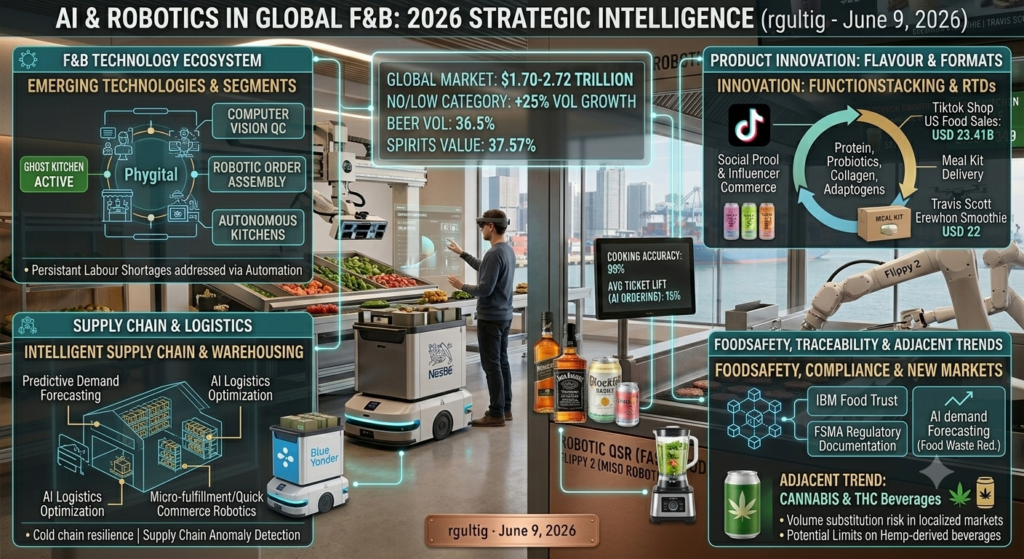
Table of Contents
1. Market Overview: The Scale of AI and Robotics in F&B
Global Market Valuation
The AI and robotics transformation of the food and beverage industry is creating multiple commercially significant technology markets that are growing simultaneously. The AI in food and beverages market stands at USD 18.34 billion in 2026, growing from USD 13.39 billion in 2025 at a CAGR of 36.96% toward USD 88.37 billion by 2031. Research and Markets places the market at USD 19.38 billion in 2026, growing at 42.8% CAGR to USD 79.38 billion by 2030.
The food robotics market is growing at a CAGR of 20.07–20.25% from 2026 to 2035, projected to reach nearly USD 15 billion by 2034. The global food automation market is valued at USD 15.15 billion in 2026, growing at 11.3% CAGR toward USD 22.64 billion by 2028. The industrial automation in food and beverage market in North America alone is valued at USD 13.2 billion in 2025, growing to USD 20.4 billion by 2033 at a CAGR of approximately 6.4%.
The AI-driven foodtech market more broadly — encompassing AI in product development, consumer personalisation, restaurant technology, and supply chain intelligence — is projected to grow at 34.5% annually, reaching USD 27.73 billion by 2029.
Why Now? The Structural Drivers
Several structural forces are simultaneously accelerating AI and robotics adoption across the food and beverage value chain in 2026:
Labour shortages — every node of the food supply chain faces acute and structural labour market challenges: agricultural harvesting (physically demanding, seasonal, rural), food processing (repetitive, cold, hygienic environments), warehouse operations (heavy, repetitive, cold or frozen environments), and foodservice (high turnover, demanding hours, labour-intensive). AI and robotics directly address labour availability and cost challenges.
Food safety requirements — global food safety regulations (FSMA, EU food law, China’s food safety standards) demand traceability, consistency, and documentation standards that human-managed systems struggle to deliver reliably at scale. AI-powered quality control and blockchain-based traceability provide the documentation infrastructure that regulatory compliance demands.
Energy and input cost pressure — AI-driven optimisation of energy consumption, ingredient usage, yield, and waste generates measurable cost savings that fund technology investment payback. Companies using AI report up to 40% reduction in unplanned downtime and 30% better defect detection in manufacturing.
Consumer expectation — the rising consumer expectation for personalisation, freshness, transparency, and convenience is creating product and service requirements that only AI-enabled systems can deliver at commercial scale.
Industry Structure
The AI and robotics ecosystem serving the food and beverage industry comprises four distinct participant categories: specialist food robotics companies (Chef Robotics, Nala Robotics, Flippy/Miso Robotics), industrial automation majors with significant food vertical capability (ABB, KUKA, FANUC, YASKAWA, Kawasaki, Universal Robots), food industry technology platform specialists (IBM Food Trust, SAP, Blue Yonder, Siemens, Rockwell Automation), and food company internal AI teams (Nestlé, Unilever, Mars, Tyson Foods). Tariffs have influenced the AI in food and beverages market by increasing costs for imported sensors, robotics, and automation systems, promoting local equipment sourcing and regional automation solutions.
2. Precision Agriculture: AI at the Farm Gate
AI-Powered Crop Intelligence
The transformation of agricultural production through AI and sensor technology represents the upstream anchor of the food and beverage industry’s AI transformation. AI-powered drones, IoT sensors, and machine learning algorithms are enabling farmers to optimise irrigation, detect pests early, and predict crop yields with up to 95% accuracy, reducing chemical use and boosting sustainability.
AI in food production helps monitor crop health, optimise irrigation, and predict yields based on weather and soil conditions. Through precision agriculture, smart sensors and machine learning algorithms can track product growth and alert farmers when action is needed, reducing resource consumption and enabling targeted interventions.
In September 2023, GrubMarket — a food tech and e-commerce company operating in the Canadian and US food supply chains — launched Farm-GPT, a generative AI product that supplies farmers and growers with data-driven insights for boosting earnings and improving crop selection. Farm-GPT represents the arrival of large language model (LLM) technology in agricultural decision-making — providing natural language interfaces that make sophisticated agronomic data analysis accessible to farmers without specialist technical training.
Drone Technology and Remote Sensing
Agricultural drones equipped with multispectral cameras, thermal sensors, and AI image analysis are providing farmers with crop health intelligence that was previously available only through expensive satellite imagery or time-intensive ground surveys. AI systems that analyse drone imagery can identify: early-stage pest infestation before visible symptoms appear, water stress patterns enabling targeted irrigation, nitrogen deficiency maps enabling precision fertiliser application, and disease spread modelling enabling preventive treatment.
The commercial deployment of agricultural AI is advancing fastest in the world’s largest agricultural producers — the US, Brazil, Australia, China, and increasingly India — where the scale of operations creates compelling ROI for technology investment and where labour costs make automation increasingly attractive relative to human labour.
Smart Irrigation and Resource Management
Precision irrigation — using soil moisture sensors, weather forecast models, and AI-driven control systems to apply exactly the right amount of water to each section of a field at the optimal time — is reducing agricultural water consumption by 20–40% in deployments across California, Israel, Australia, and other water-stressed agricultural regions. For food and beverage companies with ambitious agricultural sustainability programmes (Nestlé, Danone, AB InBev), AI-driven irrigation optimisation is one of the highest-impact sustainability interventions available in their upstream agricultural supply chains.
3. Food Processing and Manufacturing: The Smart Factory
Computer Vision Quality Control
Computer vision — AI systems that analyse camera feeds and other sensor data to make quality assessments — is the most commercially mature and widely deployed AI application in food manufacturing, accounting for 41.95% of the AI in food and beverages market in 2025. AI-powered computer vision systems slash defect rates more than 25% in meat, produce, and bakery lines.
Nestlé reduced manual quality inspection checks by 80% using AI-powered vision systems — one of the most significant and widely cited single AI deployment outcomes in the global food industry. This achievement demonstrates the scale of impact possible when AI vision replaces human visual inspection: faster processing speeds, more consistent detection, 24/7 operation without fatigue, and full documentation of every inspection event.
Computer vision applications in food processing include: surface defect detection on baked goods, produce, and meat; fill-level verification on packaged products; label accuracy verification; foreign object detection; colour grading of fresh produce and protein products; and automated dimensional measurement for portion control.
Predictive Maintenance
Predictive maintenance — AI systems that analyse equipment sensor data to identify patterns preceding mechanical failures, enabling pre-emptive maintenance intervention — is growing at a CAGR of 41.05% through 2031, the fastest of any specific AI application in food processing. Unplanned downtime costs can exceed USD 50,000 per hour in high-volume food processing operations, making predictive maintenance among the highest-ROI AI investments available in manufacturing.
ABB uses intelligent robots and digital twin technology to optimise picking, packing, and processing in real time, ensuring production line continuity. Rockwell Automation leverages connected data platforms, model predictive control, and integrated analytics to optimise production lines in real time. Siemens provides digital twins and energy management systems to enhance visibility, maintenance, and operational efficiency.
Process Optimisation and AI Control Systems
AI technologies have enhanced automation in food processing by streamlining complex tasks such as mixing, fermenting, and heat treatment. Predictive control frameworks and reinforcement learning algorithms enable dynamic adjustments to processing equipment, improving precision in operations like extrusion, dehydration, and pasteurisation. The integration of robotics with AI ensures seamless coordination of automated machinery, reducing human intervention and operational errors.
Model predictive control (MPC) — AI systems that optimise multiple process parameters simultaneously based on real-time sensor data and quality targets — is being deployed in brewing, dairy processing, snack manufacturing, and baking operations to improve energy efficiency, product consistency, and yield simultaneously.
Collaborative Robots (Cobots) in Food Production
Collaborative robots — designed to work alongside human workers rather than replacing them entirely — are emerging as the most practically deployable automation technology for the complex, variable, and hygienically demanding environments of food processing. In April 2025, KUKA launched its next-generation robot operating system iiQKA.OS2, which features AI-supported programming and a virtual robot controller, simplifying automation for food producers and dramatically reducing the specialist robotics engineering capability previously required for deployment.
Doosan Robotics launched its E-SERIES — an NSF-certified collaborative robot line created specifically for the food and beverages industry — in April 2023, offering the flexibility to handle a wide range of food and beverage items while meeting the high safety and hygiene standards that food production environments demand.
4. Food Safety and Traceability: AI as the Compliance Infrastructure
AI-Powered Contamination Detection
Food safety is the application domain where AI’s impact is most directly connected to human health outcomes. AI is transforming food safety through real-time contaminant detection, predictive modelling, and automated compliance systems. By 2031, AI-enhanced systems are expected to be the standard for food safety, using sensors and predictive analytics to track ingredients from farm to fork in real time, helping monitor contamination risks and ensuring compliance with safety regulations.
Computer vision systems that scan every unit on a production line for physical contaminants, discolouration, or anomalies that could indicate microbial or chemical contamination are achieving detection rates that exceed human inspection by significant margins while creating the full digital documentation trail that FSMA and global food safety regulations require.
Blockchain Traceability and IBM Food Trust
IBM uses AI-driven blockchain, cloud analytics, and machine learning to enable end-to-end traceability, secure data sharing, and rapid recall capabilities across food supply chains. The IBM Food Trust platform — deployed by major food retailers and manufacturers — creates an immutable blockchain record of a food product’s journey from farm through processing to retail, enabling targeted recalls within hours rather than days when food safety incidents occur.
IBM blockchain technology applied to Walmart’s leafy greens supply chain reduced the time to trace the source of a food contamination event from 7 days to 2.2 seconds — a reduction that represents not just operational efficiency but the difference between a targeted recall affecting a single farm lot and a broad recall affecting multiple suppliers and millions of consumers.
Regulatory Compliance Automation
FSMA Section 204’s electronic traceability requirements, the EU’s food safety regulations, and China’s digital clearance requirements for food imports are all driving investment in AI-powered compliance systems. AI systems that automatically generate, validate, and file the regulatory documentation required for food safety compliance are reducing the administrative burden of compliance while improving documentation accuracy and completeness.
5. Supply Chain Management: The Intelligent Value Chain
AI Demand Forecasting
AI demand forecasting across the food supply chain is reducing food waste by matching inventory precisely to predicted demand, reducing overstock situations that lead to spoilage and markdown, and improving in-stock rates for fast-moving categories. In an industry where the cost of forecasting error is measured in tonnes of wasted food and lost sales, AI-powered forecasting is the highest-value operational investment available.
Blue Yonder — a leading supply chain AI platform — deploys machine learning models that incorporate weather data, promotional calendars, social media sentiment, economic indicators, and historical sales patterns to predict demand with materially greater accuracy than conventional statistical forecasting. SAP’s integrated supply chain management systems combine AI demand forecasting with production scheduling, procurement, and logistics optimisation to create end-to-end supply chain intelligence.
CJ Food — one of the world’s largest food companies — uses AI across the full end-to-end innovation and operations cycle, from insights generation and concept development to product development and operations. On the consumer insights side, CJ uses AI-driven intelligence platforms to interpret global flavour trends, category disruptions, and micro-level textural preferences.
AI-Powered Logistics Optimisation
AI route optimisation systems are reducing food transportation costs and emissions by identifying the most efficient delivery routes, consolidating shipments, and dynamically rerouting around disruptions. For food companies managing complex multi-node supply chains with time-sensitive, perishable products, AI logistics optimisation reduces both cost and the carbon footprint of food distribution.
Autonomous AI agents in logistics management are beginning to handle routine procurement and logistics decisions without human intervention — automatically reordering inventory when stock levels reach thresholds, renegotiating carrier rates based on market data, and coordinating delivery schedules across multiple suppliers and distribution centres.
6. Cold Chain and Warehousing: Robotic Fulfilment at Scale
Lineage Eye AI and Temperature Management
Lineage Logistics’ proprietary “Lineage Eye” AI platform has reduced temperature deviations by 78% in pilot facilities by using predictive analytics to identify patterns preceding equipment failures and temperature excursions, enabling pre-emptive maintenance before product is compromised. This represents one of the highest-impact single AI deployments in the food supply chain — preventing product loss, food safety incidents, and the regulatory consequences of cold chain failures at commercial scale.
IoT sensors transmitting temperature data every 1–5 minutes across refrigerated warehouse and transport networks are feeding AI systems that monitor for anomalies and trigger alerts before temperature deviations become quality or safety events. The combination of continuous IoT monitoring and AI anomaly detection is transforming cold chain management from reactive incident response to proactive quality assurance.
Automated Storage and Retrieval Systems
ASRS — computer-controlled robotic systems that automatically place and retrieve goods from defined storage locations — are achieving 60% increases in storage capacity and reducing error rates to below 0.1% in food warehouse deployments. NewCold’s fully automated refrigerated warehouse in North America improved storage efficiency by 40% compared to conventional operations, setting the benchmark for the food cold chain automation.
Amazon’s deployment of 750,000 robots across more than 11,000 smart warehouses globally — including food and grocery fulfilment facilities — is achieving a 40% improvement in same-day shipment performance while reducing labour costs by 3% annually. The scale of Amazon’s warehouse robotics deployment makes it the largest single proof point in the world for robotic food fulfilment capability.
Micro-Fulfilment and Quick Commerce Robotics
The Ocado Smart Platform — the world’s most advanced automated grocery fulfilment technology — deploys robotic grid systems where hundreds of robots simultaneously retrieve products from three-dimensional storage structures to assemble grocery orders in minutes. Zepto’s AI-powered ultra-fast delivery uses AI systems predicting what specific neighbourhood residents will order before they open the app — the most technically sophisticated quick commerce AI in operation globally.
7. Foodservice and Restaurant Technology: The Automated Kitchen
Robotic Cooking Systems
Robotic chefs like Flippy 2 are already operating in fast-food chains, cooking with 95% accuracy and reducing workplace injuries. Flippy — developed by Miso Robotics — is deployed in White Castle, Jack in the Box, and other QSR chains to handle frying and grill cooking tasks with consistent timing and temperature control that reduces both food safety risk and operational labour requirements.
In November 2024, Nala Robotics launched BIRYANIMAN — the world’s first robotic biryani maker — capable of cooking 100 varieties of biryani with consistent quality, combining advanced robotics and AI to ensure precise flavour and texture, suitable for both home and commercial kitchens. Nala Robotics also plans to open a 24-hour robotic restaurant at the University of Northern Texas, extending the fully autonomous kitchen concept from QSR deployment to full restaurant format.
Chef Robotics has advanced its bi-manual physical AI system for prep table food assembly powered by a Food Foundation Model — a specialised AI model trained on the physical properties, handling requirements, and assembly processes of food products. The company’s intelligent, adaptable automation for food manufacturers enables meal assembly at scale across frozen prepared meals, fresh prepared meals, and meal kit delivery applications.
In January 2026, SoftBank Robotics supported pilot deployments of service and handling robots in commercial foodservice and centralised kitchen operations to optimise labour efficiency — the latest indication that foodservice robotics is moving from isolated QSR pilots into broader commercial kitchen deployment.
AI in Restaurant Operations and Customer Experience
AI is powering voice assistants and chatbots for seamless ordering and customer service in fast food and café formats. The shift toward AI-driven ordering systems — kiosks, mobile apps, and drive-through voice ordering — is simultaneously improving order accuracy, reducing labour requirements, and enabling the personalisation engines that lift average ticket values and customer retention.
Generative AI menu design tools are enabling restaurant operators to rapidly prototype new menu items based on current ingredient costs, trending flavour profiles, and consumer preference data — compressing new menu development cycles from weeks to days. The most sophisticated restaurant operators are combining AI-driven menu analytics with kitchen robotics to create closed-loop systems where menu items are designed for robotic assembly efficiency as well as consumer palatability.
Ghost Kitchens and Centralised Production
Ghost kitchens — delivery-only food production facilities with no consumer dining space — are natural deployment environments for food robotics, as their lack of consumer-facing service requirements removes the human interaction constraints that limit automation in traditional restaurant settings. Robotic cooking systems in ghost kitchens can operate 24 hours a day with consistent output quality, making them the most commercially compelling near-term application for fully autonomous food preparation.
8. Food Product Development: Generative AI and the Innovation Acceleration
AI-Driven Formulation
AI-driven generative product development enables food and CPG companies to design products faster by using data, machine learning, and optimisation models to explore vast formulation possibilities while balancing cost, nutrition, taste, and regulatory compliance. NotCo applies generative AI and proprietary food science data to accelerate formulation and scale-up — its Giuseppe AI platform has compressed the development timeline for plant-based products from months to weeks.
Zucca connects formulations, costs, and regulatory data in a unified workspace, enabling real-time collaboration and reducing development cycles. FlavorWiki provides real-time sensory and consumer feedback to refine and validate product concepts. These tools are compressing the traditional 18–24 month food product development cycle toward 6 months or less for AI-assisted formulation projects.
Symrise’s Symvision platform debuted in November 2025, enabling flavour scientists to model consumer preference, ingredient compatibility, and taste profiles computationally before a single physical prototype is produced — a technology that is becoming commercially essential in sauces, condiments, and beverage categories where trend cycles move faster than traditional R&D timelines can accommodate.
Nature-Inspired and AI-Assisted Protein Design
Generative AI models — including generative adversarial networks (GANs) and transformer models adapted from protein structure prediction — are being applied to the design of plant-based proteins, precision fermentation ingredients, and novel food compounds. The ability to use AI to design proteins with specific structural properties that mimic the texture and taste of animal products is one of the most commercially significant applications of AI in the alternative protein industry.
Research published in Nature-partner journal npj Science of Food documents how AI is beginning to make notable impact in plant-based and cultured product development, precision fermentation quality improvement, and the systematic reduction of experimental trials required to achieve target food properties — potentially cutting development costs by 50–70%.
Consumer Insights and Trend Prediction
AI platforms that analyse social media, food review databases, restaurant menus, and e-commerce search patterns to identify emerging consumer flavour and product trends months before they reach mainstream retail awareness are becoming standard tools for the NPD (new product development) teams of major food companies. The “macro to micro” intelligence capability — from global flavour trend identification down to regional and demographic preference differentiation — is enabling food companies to make more targeted, faster, and lower-risk innovation investments.
9. Retail and Consumer-Facing AI
AI in Grocery Retail
Carrefour announced in March 2026 that it is one of the first European grocery retailers to offer shopping directly through a ChatGPT interface — enabling conversational AI grocery shopping. Kroger’s AI agent builds grocery baskets through conversation. Tesco, Albertsons, and Walmart have deployed AI-powered shopping assistants that convert a meal question into a ready-to-checkout grocery basket. AI platforms already account for USD 20.9 billion in US retail e-commerce sales in 2026 — nearly quadrupling 2025 figures.
In grocery stores themselves, AI-powered systems are transforming inventory management (automatic shelf scanning drones detecting out-of-stock situations), dynamic pricing (AI systems adjusting near-expiry product prices in real time to minimise food waste), and the cashierless checkout experience pioneered by Amazon Go.
Personalised Nutrition AI
Apps like SNAQ predict glucose responses before meals, while platforms like Spoon Guru tailor dietary recommendations using AI. InsideTracker’s blood biomarker AI delivers personalised supplement and nutrition recommendations. These consumer-facing AI applications are creating a data-connected relationship between individual consumers, their food choices, and their health outcomes — the commercial foundation of the personalised nutrition industry’s long-term growth.
10. Sustainability: AI as the Food System’s Carbon Calculator
Waste Reduction at Scale
One third of all food produced globally is wasted — approximately 1.3 billion tonnes annually. AI-driven waste reduction — through improved demand forecasting, optimised inventory management, predictive quality deterioration monitoring, and precision production control — is one of the most commercially and environmentally impactful applications of AI in the food system.
Too Good To Go uses AI to match surplus food from restaurants and bakeries with consumers, having reached 45.4 million downloads in 2025. AI-powered food waste analytics platforms are enabling food companies to identify and quantify waste at every node of their value chains and target the highest-impact intervention points.
The upcycled food products market — converting food processing by-products and waste streams into valuable food ingredients — is projected to reach USD 53 billion by 2027, with AI playing a critical role in identifying and developing the most commercially viable upcycled ingredient opportunities.
Precision Fermentation and Alternative Protein
AI is central to the advancement of precision fermentation — the use of programmed microorganisms to produce specific proteins, fats, and functional ingredients without conventional agricultural inputs. Companies are developing AI-enhanced yeast strains providing up to 28% more protein than conventional sources. The combination of AI-designed organisms, AI-optimised fermentation processes, and AI-powered downstream processing is accelerating the development of animal-identical dairy proteins, meat-flavour compounds, and functional food ingredients with dramatically lower environmental footprints.
11. Regional Dynamics
Asia-Pacific: The Fastest-Growing Adoption Region
Asia Pacific led AI in food and beverages adoption with 33.70% revenue share in 2025 and is forecast to grow at 40.25% CAGR — the fastest regional AI adoption rate in the food sector globally. Asia-Pacific is experiencing rapid expansion in food robotics led by large food production bases, rising labour cost pressures, and increasing automation in packaged food and beverage industries.
Japan’s industrial automation in food and beverage market was valued at USD 4.2 billion in 2024, growing to USD 6.2 billion by 2033 — reflecting the country’s advanced robotics culture and the high labour cost environment that makes automation ROI compelling. South Korea’s focus on smart factories and high-tech food processing lines exemplifies advanced automation adoption in premium food manufacturing.
China’s food AI adoption is driven by its extraordinary food production scale, rapidly escalating labour costs in coastal manufacturing regions, and the government’s Made in China 2025 industrial policy that explicitly targets food processing automation as a strategic priority.
North America: Scale Deployment and Technology Leadership
North America leads the food AI and robotics market with over 32% revenue share and is characterised by the largest single-company automation deployments globally (Amazon’s 750,000 warehouse robots), the most commercially advanced agricultural AI (precision farming in California, the Midwest, and the South), and the most active foodservice robotics deployment (Flippy in QSR chains, Ocado platform for Kroger fulfilment).
The North American industrial automation in food and beverage market was valued at USD 12.5 billion in 2024, projected to expand to USD 20.4 billion by 2033. Tariffs on imported automation components are promoting local equipment sourcing, regional automation solutions, and long-term investments in AI-driven food production systems — potentially accelerating the development of domestically manufactured food robotics alternatives.
Europe: Food Safety, Sustainability, and Regulatory Leadership
Europe’s food AI and robotics adoption is shaped by the continent’s most demanding food safety regulatory framework globally, the EU’s Farm to Fork sustainability strategy that is creating direct incentives for precision agriculture and waste reduction technology, and Europe’s strong industrial robotics manufacturing tradition through KUKA (Germany), ABB (Switzerland), and Universal Robots (Denmark).
The Europe food robotics market size was USD 940 million in 2025, anticipated to reach USD 5.94 billion by 2035 at a CAGR of 20.25% — growing faster than the North American market from a lower base as European food manufacturers accelerate automation investment.
12. Critical Risks and Challenges
Data Quality and System Integration
Despite these advancements, challenges related to data quality, system integration, computational demands, and ethical considerations remain. The fundamental constraint of AI deployment in food manufacturing is data — AI systems require large volumes of high-quality, labelled training data to achieve reliable performance. Many food manufacturers lack the digital infrastructure to generate and manage the data volumes that AI systems require, and integrating new AI platforms with legacy manufacturing control systems and ERP infrastructure presents significant technical and operational challenges.
The Skills Gap
The key constraint is the need for internal super users who understand both the tools and the context of large-scale food innovation. The food industry’s workforce — trained in food science, manufacturing operations, and supply chain management — needs significant upskilling to deploy, operate, and continuously improve AI systems. Many tools are black boxes that generate statistical guesses without explaining the underlying mechanism — creating both a trust challenge and a skills requirement for food industry professionals who need to understand their AI systems’ limitations.
The Explainability Challenge
Food safety regulators, food safety professionals, and quality managers require not just accurate AI outputs but explainable AI outputs — systems whose recommendations and detections can be interrogated, validated, and documented in ways that regulatory authorities accept as evidence of food safety compliance. Black-box AI systems that cannot explain why they flagged a product as potentially contaminated, or why they recommended a particular production parameter adjustment, face adoption barriers in food safety-critical applications.
Cost and ROI Barriers for SMEs
While large food manufacturers and retailers are deploying AI and robotics at scale with compelling ROI, the capital costs of automation — particularly robotic production line equipment — remain significant barriers for the small and medium-sized food producers that represent the majority of the global food industry by enterprise count. The emergence of robotics-as-a-service (RaaS) models — where robot manufacturers provide equipment under subscription arrangements rather than requiring capital purchase — is beginning to address this barrier.
13. Strategic Outlook for Stakeholders
Actionable Recommendations
Start with Computer Vision Quality Control for Immediate ROI: Computer vision leads AI in food and beverages at 41.95% market share because it delivers the clearest and most measurable ROI of any AI application in food manufacturing — faster inspection, higher defect detection, full documentation, and direct food safety regulatory compliance benefits. For food manufacturers new to AI, computer vision quality control is the most commercially validated entry point.
Invest in Predictive Maintenance Before the Next Unplanned Outage: Predictive maintenance growing at 41.05% CAGR reflects the industry’s recognition that unplanned downtime costing USD 50,000+ per hour makes predictive AI investment a high-priority insurance purchase. Every food manufacturer with continuous production lines should evaluate predictive maintenance AI against their actual unplanned downtime frequency and cost.
Build Data Infrastructure as the Foundation for All AI Investments: AI systems are only as good as the data they learn from. Food manufacturers investing in AI should treat data infrastructure — IoT sensor deployment, ERP integration, production data capture, quality event documentation — as a prerequisite to AI deployment rather than an afterthought. The quality of an AI system’s performance depends almost entirely on the quality and volume of the data available for training.
Consider Robotics-as-a-Service for Initial Automation Investment: The RaaS model — providing food robotics under subscription arrangements rather than capital purchase — dramatically reduces the upfront investment barrier for food manufacturers who want to pilot automation without the capital commitment of outright purchase. Chef Robotics and other food-specific robotics companies are building RaaS business models specifically for the food industry’s unique requirements.
Develop AI Talent as a Strategic Priority: The skills gap — the shortage of food industry professionals with AI competency — is the most limiting factor on the pace of AI deployment in the food sector. Investment in upskilling existing food science, manufacturing, and supply chain teams with AI literacy and in recruiting AI-skilled talent into food industry roles is as important as the technology investment itself.
Strategic Summary: The 2026 F&B AI and Robotics Value Chain
| Value Chain Node | Traditional Technology | 2026 AI/Robotics Standard |
|---|---|---|
| Agriculture | Manual scouting, scheduled irrigation | AI drones, precision IoT, 95% yield prediction |
| Processing/Manufacturing | Human QC inspectors, scheduled maintenance | Computer vision defect detection, predictive maintenance AI |
| Cold Chain/Warehousing | Manual temperature checks, human picking | Lineage Eye AI, ASRS robots, autonomous guided vehicles |
| Supply Chain Management | Spreadsheet planning, intuition-based forecasting | AI demand forecasting, autonomous procurement agents |
| Foodservice/Restaurants | Human cooks, manual ordering, paper inventory | Flippy robotic cooking, AI ordering, ghost kitchen robots |
| Retail | Manual shelf scanning, fixed pricing | Drone inventory, AI dynamic pricing, cashierless checkout |
| Consumer/Personalisation | Generic product recommendations | AI personalised nutrition, glucose prediction, agentic shopping |
14. Leading Companies
| Company | Sector | Strategic Focus |
|---|---|---|
| ABB Ltd. | Industrial Automation | Intelligent robots and digital twin technology for food picking, packing, and processing optimisation. Comprehensive food robotics portfolio across processing, packaging, and palletising. |
| KUKA AG | Industrial Robotics | Launched iiQKA.OS2 in April 2025 with AI-supported programming, simplifying food automation deployment. Strong food and beverage sector robotics including E-SERIES for hygienic environments. |
| FANUC Corporation | Industrial Robotics | DR-3iB stainless steel series for hygienic food processing. High-speed, reliable robots for automated food inspection, sorting, and packaging. |
| Universal Robots | Collaborative Robotics | World’s leading cobot manufacturer. Flexible, easy-to-program collaborative robots ideal for food production environments requiring human-robot collaboration. |
| Miso Robotics (Flippy) | Foodservice Robotics | Flippy 2 robotic cooking systems deployed in White Castle, Jack in the Box, and other QSR chains. 95% cooking accuracy. Leading foodservice automation platform. |
| Chef Robotics | Food Manufacturing Robots | Physical AI for food manufacturers. Bi-manual robot system with Food Foundation Model. RaaS model for meal assembly across frozen, fresh, and meal kit operations. |
| IBM (Food Trust) | AI/Blockchain | IBM Food Trust blockchain traceability platform reducing contamination trace time from 7 days to 2.2 seconds. AI-driven supply chain transparency and food safety compliance. |
| Blue Yonder | Supply Chain AI | AI demand forecasting, supply chain optimisation, and inventory management across food and beverage supply chains. Machine learning-powered demand planning. |
| Siemens | Digital Factory | Digital twin and energy management systems for food factories. Industry 4.0 integration for food manufacturing visibility and operational efficiency. |
| Rockwell Automation | Process Automation | Connected data platforms, model predictive control, and integrated analytics for food production line optimisation and real-time quality management. |
| NotCo | Generative AI/Food | Giuseppe AI platform applying generative AI to plant-based protein formulation, compressing development timelines from months to weeks. |
| Lineage Logistics | Cold Chain AI | Lineage Eye AI platform reducing temperature deviations by 78%. World’s largest temperature-controlled warehousing company with 14%+ global cold storage share. |
| Nala Robotics | Restaurant Robotics | BIRYANIMAN world’s first robotic biryani maker. Plans for 24-hour robotic restaurant. Autonomous commercial kitchen systems for diverse cuisine types. |
| GrubMarket | AgriTech AI | Farm-GPT generative AI for farmers and growers — data-driven insights for crop selection and earnings optimisation across US and Canadian food supply chains. |
Related: As the industry accelerates toward higher automation and sustainable material compatibility, packaging lines are undergoing a major technological transformation. Explore the advancements in high-speed machinery and smart systems driving efficiency in our Food & Beverage Packaging Equipment Industry Report 2026.
Frequently Asked Questions (FAQ)
What is the AI in food and beverages market size in 2026?
The global AI in food and beverages market is valued at USD 18.34 billion in 2026, growing from USD 13.39 billion in 2025, at a CAGR of 36.96% toward USD 88.37 billion by 2031. Research and Markets provides a complementary estimate of USD 19.38 billion in 2026, growing at 42.8% CAGR to USD 79.38 billion by 2030. The food robotics market is growing at a CAGR of 20.07% from 2026, reaching nearly USD 15 billion by 2034. The food automation market is valued at USD 15.15 billion in 2026, growing at 11.3% CAGR. Asia-Pacific leads adoption with 33.70% revenue share and a 40.25% projected CAGR — the fastest-growing regional market. By technology, computer vision accounts for 41.95% of the market; robotics and automation is the fastest-growing segment at 41.15% CAGR. By application, food sorting and grading leads at 29.75% share; predictive maintenance is growing fastest at 41.05% CAGR. By end user, food-processing manufacturers hold the largest share at 37.10%; quick-service and cloud kitchens are growing fastest at 38.95% CAGR.
How is AI being used in food manufacturing?
AI is transforming food manufacturing across six major application areas. First, computer vision quality control — AI camera systems inspecting every product unit for defects, contaminants, fill levels, and label accuracy at production speeds impossible for human inspectors, with Nestlé reducing manual quality inspection checks by 80% and AI systems achieving 25%+ defect rate reductions in meat, produce, and bakery. Second, predictive maintenance — AI algorithms analysing equipment sensor data to identify failure patterns before breakdown, preventing unplanned downtime costing USD 50,000+ per hour. Third, process optimisation — AI control systems dynamically adjusting temperature, pressure, mixing, and fermentation parameters to optimise energy use, yield, and product consistency. Fourth, demand forecasting — AI predicting production requirements with greater accuracy than conventional statistical methods, reducing overproduction waste. Fifth, robotics and automation — robots handling repetitive, physically demanding, and hygiene-critical production tasks with greater consistency and at lower labour cost than human operators. Sixth, traceability and compliance — AI systems automatically generating, validating, and filing food safety documentation, and blockchain platforms providing immutable farm-to-fork tracking.
What are robotic cooking systems and where are they deployed?
Robotic cooking systems are autonomous or semi-autonomous machines designed to perform specific cooking tasks — grilling, frying, dispensing, and assembly — with consistent timing, temperature control, and portion accuracy. The most commercially deployed robotic cooking system globally is Flippy 2, developed by Miso Robotics, which operates in fast-food chains including White Castle and Jack in the Box, achieving 95% cooking accuracy while reducing workplace injuries from burns and repetitive strain. In November 2024, Nala Robotics launched BIRYANIMAN — the world’s first robotic biryani maker — capable of cooking 100 varieties with consistent quality. In January 2026, SoftBank Robotics supported pilot deployments in commercial foodservice and centralised kitchen operations. Chef Robotics provides a bi-manual physical AI system for food manufacturers producing frozen and fresh prepared meals and meal kit assembly. The commercial deployment of robotic cooking is concentrated in three environments: QSR (where volume, consistency, and labour cost are the primary drivers), ghost kitchens (where 24-hour operation without shift constraints provides maximum ROI), and centralised production kitchens (where batch cooking at scale benefits from robotic consistency).
What is the impact of AI on food waste reduction?
AI is addressing food waste — which amounts to approximately 1.3 billion tonnes annually, roughly one third of all food produced — at multiple points across the value chain. In agriculture, AI-powered drones and sensors identify crop health issues, optimise irrigation, and predict yields with up to 95% accuracy, reducing the post-harvest losses that occur when crop quality degrades after suboptimal growing conditions. In manufacturing, AI quality control and process optimisation reduce production waste by catching defects early and maintaining production parameters within optimal ranges. In supply chain management, AI demand forecasting reduces overproduction and overstock by matching production and procurement precisely to predicted demand — eliminating the excess inventory that expires before sale. In retail, AI dynamic pricing systems automatically mark down near-expiry products in real time, maximising sale of product that would otherwise be wasted. In foodservice, AI inventory management and menu demand forecasting reduce food prep waste. Consumer-facing platforms like Too Good To Go — which reached 45.4 million downloads in 2025 — use AI to match surplus food from restaurants and bakeries with consumers. The upcycled food products market, projected to reach USD 53 billion by 2027, is being accelerated by AI systems identifying commercially viable uses for food processing by-products.
How is AI changing food product development?
AI is compressing the traditional 18–24 month food product development cycle toward 6 months or less through four key capabilities. First, generative formulation AI — systems like NotCo’s Giuseppe AI and Symrise’s Symvision platform use machine learning to explore vast formulation possibility spaces and identify optimal ingredient combinations balancing taste, nutrition, cost, and regulatory compliance, without requiring each possibility to be physically prototyped. Second, consumer trend prediction — AI platforms analysing social media, restaurant menus, and e-commerce data to identify emerging flavour trends months before they reach mainstream retail, enabling more targeted and better-timed innovation investment. Third, sensory validation AI — FlavorWiki and similar platforms providing AI-powered consumer feedback systems that validate product concepts with target consumers before physical production, reducing costly late-stage reformulations. Fourth, precision fermentation design — generative AI models designing microorganism strains and fermentation processes for producing specific food ingredients, dramatically reducing the experimental trial and error of conventional fermentation development. CJ Food’s use of AI across the full innovation cycle — from insights generation through concept development to product development and operations — demonstrates the integrated, end-to-end AI-powered innovation model that leading food companies are building.
What are the biggest challenges in implementing AI in the food industry?
Five major challenges constrain AI deployment in the food industry. First, data quality and availability — AI systems require large volumes of high-quality training data, and many food manufacturers lack the digital infrastructure to generate and manage the data volumes AI requires. Second, the skills gap — food industry professionals need significant upskilling in AI competency, and the need for internal super users who understand both the tools and the context of large-scale food innovation is the critical limiting constraint identified by practitioners. Third, system integration — integrating new AI platforms with legacy manufacturing control systems, ERP, and supply chain software presents significant technical complexity and cost. Fourth, explainability and trust — black-box AI systems that cannot explain their recommendations face adoption barriers in food safety-critical applications where regulatory documentation and human oversight are required. Fifth, cost barriers for SMEs — while large manufacturers can justify AI investment ROI, the capital costs of robotics and AI systems remain significant barriers for small and medium food producers, though the emergence of robotics-as-a-service models is beginning to address this constraint.
What is the outlook for AI and robotics in food and beverages through 2031?
The AI in food and beverages market is projected to reach USD 88.37 billion by 2031 at a CAGR of 36.96% — one of the fastest technology market growth trajectories in any industry globally. By 2031, AI-enhanced systems are expected to be the standard for food safety, using sensors and predictive analytics to track ingredients from farm to fork in real time. Autonomous systems and machine customers will redefine supply chains and the retail experience. The market for food robotics alone is projected to grow significantly, potentially reaching nearly USD 15 billion by 2034. Key developments expected through 2031 include: agentic AI agents autonomously managing procurement, logistics, and inventory across food supply chains; physical AI robots capable of handling the full diversity of food products in unstructured production environments; AI-designed precision fermentation ingredients achieving commercial-scale production parity with conventional agricultural inputs; personalised nutrition AI delivering individually optimised food and supplement recommendations based on continuous biomarker monitoring; and cashierless, fully autonomous retail formats becoming mainstream in urban grocery markets globally.
Sources and Additional References
- Mordor Intelligence: AI In Food & Beverages Market Size, Share, Growth & Research Report 2031 — https://www.mordorintelligence.com/industry-reports/artificial-intelligence-in-food-and-beverages-market
- Research and Markets: AI in Food & Beverages Market Report 2026 — https://www.researchandmarkets.com/reports/5851111/ai-in-food-beverages-market-report
- Grand View Research: AI In Food & Beverages Market Size & Share Report 2030 — https://www.grandviewresearch.com/industry-analysis/ai-food-beverages-market-report
- Verified Market Reports: Industrial Automation in Food and Beverage Market Size and Forecast 2026–2034 — https://www.verifiedmarketreports.com/product/industrial-automation-in-food-and-beverage-market-size-and-forecast/
- Precedence Research: Food Robotics Market Size, Share and Trends 2026 to 2035 — https://www.precedenceresearch.com/food-robotics-market
- Global Market Insights: Food Robotics Market Size, Share & Forecast Analysis 2032 — https://www.gminsights.com/industry-analysis/food-robotics-market
- IMARC Group: Food Robotics Market Size, Share, Trends, Report 2033 — https://www.imarcgroup.com/food-robotics-market
- OpenPR / DataM Intelligence: Food Robotics Market 2026–2033 — AI Robotics, Quality Control — https://www.openpr.com/news/4513830/food-robotics-market-2026-2033-ai-robotics
- Tastewise: AI-Powered Food Automation — How It’s Reshaping The Industry — https://tastewise.io/blog/ai-powered-food-automation
- ESSFeed: AI & Robotics in Foodservice and Grocery 2026–2031 — https://essfeed.com/ai-robotics-foodservice-grocery-trends-2031/
- Food and Drink Digital: Top 10 AI in Food Manufacturing — https://fooddigital.com/top10/top-10-ai-in-food-manufacturing
- XenonStack: AI in Food Industry Applications and Its Future Trends — https://www.xenonstack.com/blog/ai-food-industry-applications
- Software Mind: AI in Food Industry — Latest Trends — https://softwaremind.com/blog/how-ai-is-transforming-the-food-industry/
- ExpoFoodTech: Smart Food Revolution — How AI Is Transforming the Food Industry — https://www.expofoodtech.com/ai-food-industry-smart-revolution/
- Future Food-Tech San Francisco 2026: How AI Is Accelerating Innovation Across the Food System — https://futurefoodtechsf.com/articles/ai-accelerating-innovation-food-system
- Springer Nature Discover AI: Artificial Intelligence in the Food Industry — Innovations and Applications — https://link.springer.com/article/10.1007/s44163-025-00296-8
- Nature npj Science of Food: AI for Food — Accelerating and Democratizing Discovery and Innovation — https://www.nature.com/articles/s41538-025-00441-8
- Precedence Research: AI in Food Market Size, Share, Report By 2035 — https://www.precedenceresearch.com/ai-in-food-market
- Chef Robotics: Physical AI for the Food Industry — https://www.chefrobotics.ai/
- AI Chef Pro: 10 Food Tech Trends That Will Dominate the Next Decade — https://blog.aichef.pro/en/10-food-tech-trends-that-will-dominate-the-next-decade/
