
In 2026, the global beef industry remains the most significant yet scrutinized segment of the animal protein sector. Currently valued at approximately USD 485 billion, the industry is undergoing a structural transformation. Producers are balancing record-high global demand—driven by the expanding middle classes in emerging economies—with intense pressure to decarbonize supply chains, adopt regenerative practices, and navigate increasingly volatile feed costs and climate-related production disruptions.
Executive Summary: The 2026 The Global Beef Industry Landscape
The global beef industry in 2026 is defined by a “resilience-first” strategy. As production matures into a more data-integrated global supply chain, stakeholders are no longer competing on volume alone. Instead, the focus has shifted toward traceability, methane reduction, and supply chain reliability. The industry is navigating the delicate tension between maintaining global food security and adhering to stricter international sustainability mandates.
Key Takeaways for Stakeholders:
- Decarbonization as a License to Operate: Methane reduction initiatives (feed additives, genetics) are moving from voluntary pilot programs to mandatory operational standards in key export markets.
- Supply Chain Transparency: Consumers and regulators are demanding “farm-to-plate” traceability, forcing producers to adopt blockchain and IoT tracking to prevent deforestation and ensure welfare compliance.
- The Protein Diversification Pivot: Conventional beef is increasingly being positioned as a “premium” product, with producers diversifying their portfolios to include integrated plant-cell hybrid proteins to capture the flexitarian market.
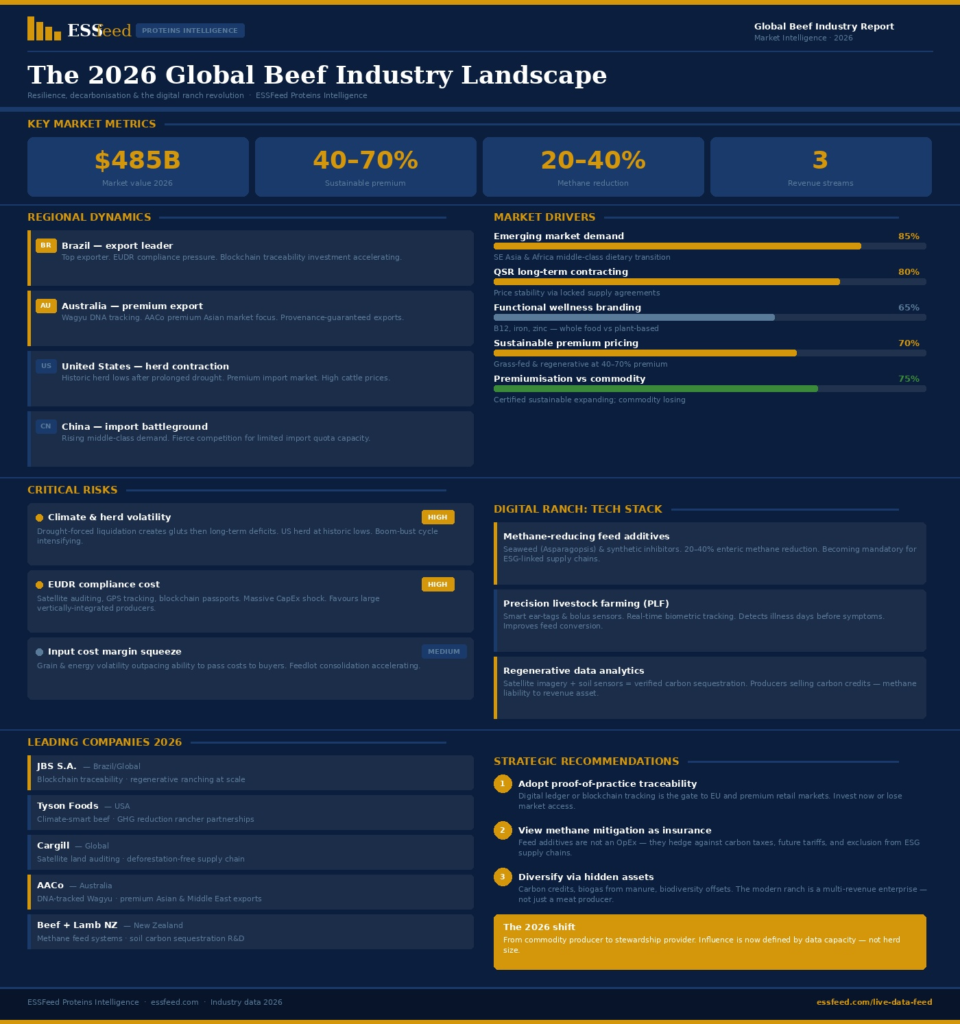
Table of Contents
1. Market Overview: The Global Beef Industry Landscape In 2026
In 2026, the global beef industry is characterized by:
- Diverging Regional Dynamics: While production in North America faces cyclical herd contraction, Brazil and Australia continue to dominate export volumes, albeit under heavy environmental compliance pressure.
- Industrial Standardization: Global beef markets are standardizing quality benchmarks, enabling clearer pricing and easier trade flow between high-demand markets like China and major producers.
- Premiumization: The widening gap between commodity beef and “certified sustainable” or “grass-fed/regenerative” beef continues to grow, with the latter commanding significant price premiums.
In 2026, the global beef industry is undergoing a structural realignment driven by supply constraints, evolving trade dynamics, and a pronounced shift in consumer behavior. This evolution is characterized by three primary drivers:
Diverging Regional Dynamics
The global beef supply landscape in 2026 is defined by a dichotomy between major producing regions experiencing inventory stabilization and those positioned for aggressive export growth.
- North American Contraction: North America, particularly the U.S. and Canada, remains deep in a cyclical herd liquidation and rebuilding phase. Driven by several years of drought and economic pressure, the U.S. beef cow herd hit historic lows in early 2026. This has resulted in tightened domestic supplies, historically high cattle prices, and a strategic shift where the region is increasingly reliant on imports to satisfy robust domestic demand, transforming North America into a “premium” protein market that prioritizes high-value products over export volume.
- Export Dominance in the Southern Hemisphere: Brazil and Australia have consolidated their positions as the world’s leading beef exporters, acting as the primary suppliers to bridge the North American supply gap and satisfy rising demand in China and Southeast Asia. However, these nations face intensifying environmental and regulatory pressures. In Brazil, the need to comply with international sustainability standards—such as deforestation-free supply chain mandates—has become a prerequisite for maintaining access to high-value markets. Similarly, both nations are currently grappling with export quota pressures in key markets like China, where domestic domestic producers are struggling, leading to fierce competition for limited import capacity.
Industrial Standardization and Trade Flow
To manage the volatility inherent in 2026’s supply-constrained environment, the global beef market is moving toward greater industrial standardization.
- Standardizing Benchmarks: As international trade becomes more complex due to diverse environmental and quality regulations, there is an industry-wide push to unify quality benchmarks, such as grading standards, health certifications, and traceability protocols.
- Optimizing Trade: This standardization is facilitating more efficient trade flows between massive import markets (notably China) and major exporting powerhouses. By aligning on shared metrics—such as verified animal welfare and specific beef grading—exporters can better navigate volatile trade policies and reduce the friction that often leads to border disruptions, ensuring that beef can move more predictably to where demand is highest.
Premiumization and the Sustainability Gap
A widening valuation gap has emerged between generic commodity beef and verified high-attribute products, signaling a long-term change in consumer purchasing habits.
- The “Sustainable Premium”: The market is increasingly bifurcated. Commodity beef, sensitive to price fluctuations, is losing ground in mass-market consumption as consumers migrate toward more affordable proteins like poultry and pork. Conversely, the market for “certified sustainable,” “grass-fed,” and “regenerative” beef is expanding rapidly.
- Value-Driven Consumption: These premium products now command significant price premiums—often 40% to 70% above conventional alternatives—and are increasingly standard in major retail formats across developed markets. This premiumization is fueled by millennial and Gen Z cohorts who prioritize provenance, nutritional profile (such as higher Omega-3/CLA content), and environmental stewardship. For these consumers, beef is increasingly viewed as an occasional, high-quality “whole food” rather than a daily commodity, making demand in this segment relatively inelastic even during periods of high inflation.
2. Key Growth Drivers
- Rising Global Protein Demand: Growing middle-class populations in Southeast Asia and Africa represent the primary engines for volume growth.
- Foodservice Resilience: Quick-service restaurants (QSRs) and the hospitality sector have successfully stabilized beef prices through long-term contracting, insulating them from mid-term market shocks.
- Functional Branding: Beef is being marketed more aggressively for its nutrient density (B12, iron, zinc), appealing to wellness-focused consumers who prioritize whole foods over highly processed alternatives.
2. Key Growth Drivers
The global beef market in 2026 is bolstered by a convergence of rising demographic demand, evolving foodservice strategies, and a reinvigorated consumer focus on nutritional integrity.
Rising Global Protein Demand
The primary volume growth engine for the beef industry continues to shift toward emerging economies, particularly in Southeast Asia and Africa.
- The Middle-Class Expansion: As disposable incomes rise in these regions, beef—historically considered an aspirational or occasional protein—is becoming a staple component of the dietary transition. This demographic cohort views beef as a premium, protein-rich whole food that signifies rising living standards.
- Diversified Demand: Growth is no longer concentrated solely in luxury segments; there is a significant uptick in demand for versatile beef products, such as ground beef and secondary cuts, which are increasingly featured in local cuisines, hotpot formats, and modern convenience-oriented dining across major urban hubs.
Foodservice Resilience and Strategic Contracting
The foodservice sector, specifically Quick-Service Restaurants (QSRs) and mid-range hospitality operators, has become a stabilizing force for the global beef value chain.
- Insulating Against Volatility: In the face of persistent supply tightening and fluctuating cattle prices, QSR leaders have leaned heavily into long-term procurement contracts. These agreements provide essential price predictability for both restaurant operators and large-scale processors, effectively dampening the impact of mid-term market shocks.
- Volume Stability: By locking in supply volumes at fixed price points, these contracts ensure that beef remains a permanent and affordable feature on menus, even during periods of broader inflationary pressure. This “contract-driven stability” ensures that retail and foodservice demand remains resilient, protecting producers from the sharper demand contractions typically seen in other protein segments.
Functional Branding: The Wellness Narrative
In 2026, the marketing of beef has undergone a strategic shift from generic commodity branding to a functional, science-backed nutritional narrative.
- Nutrient Density as a Competitive Edge: Producers are capitalizing on beef’s status as a “complete protein” and a bioavailable source of essential micronutrients, specifically Vitamin B12, iron, and zinc. As consumers increasingly scrutinize the ultra-processed nature of many plant-based meat alternatives, beef marketing campaigns are highlighting its simplicity and natural density.
- The “Whole Foods” Appeal: This approach resonates strongly with wellness-focused consumers, including Gen Z and Millennials, who prioritize “clean label” and bioavailable whole foods. By emphasizing the “meat factor”—the synergistic ability of beef to increase the absorption of nutrients from other plant-based foods in a meal—the industry is positioning itself as an essential partner in a balanced, health-conscious diet, successfully differentiating itself from highly engineered meat substitutes.
Key Drivers Summary
| Driver | Market Impact | 2026 Status |
| Emerging Middle Class | Volume expansion in Asia/Africa | Strong/Accelerating |
| QSR Contracting | Price stability and supply flow | High/Critical |
| Functional Marketing | Premium/Health-focused demand | High/Growing |
3. Critical Risks and Challenges
- Climate & Herd Volatility: Periodic droughts and heatwaves continue to force early slaughter cycles, causing short-term supply gluts followed by long-term inventory shortages.
- Regulatory Headwinds: The “deforestation-free” supply chain requirement (notably the EU Deforestation Regulation) is forcing a massive capital expenditure for producers to map and audit land usage.
- High Input Costs: Feed (grains) and energy costs remain volatile, squeezing margins for feedlot operators who cannot pass full costs to consumers.
While global beef industry demand remains resilient, the industry faces structural hurdles in 2026 that threaten both supply continuity and profit margins. These challenges are increasingly interconnected, with climate and regulatory pressures compounding traditional economic volatility.
Climate & Herd Volatility: The “Boom-Bust” Cycle
Climate change has transitioned from a long-term threat to an immediate operational disruptor. In 2026, the industry is witnessing intensified climate-driven volatility that forces producers into reactive management.
- Forced Liquidation: Persistent regional droughts and unprecedented heatwaves in major cattle-producing regions (such as the U.S. Great Plains and parts of South America) have forced early slaughter cycles. Producers, unable to sustain herds due to pasture depletion and exorbitant water/feed costs, are forced to sell cattle earlier than intended.
- The Long-Term Inventory Deficit: These “supply gluts” provide a temporary dip in retail beef prices but create devastating long-term inventory shortages. Once the emergency liquidation ends, the reduced breeding stock slows the herd recovery timeline significantly, resulting in prolonged periods of supply tightening and higher price floors for cattle.
Regulatory Headwinds: The Cost of Compliance
In 2026, the regulatory landscape is shifting toward extreme transparency, most notably through the EU Deforestation Regulation (EUDR). This has redefined the cost of doing business for global exporters.
- Auditing the Supply Chain: Producers in major exporting nations like Brazil, Argentina, and even parts of the U.S. and Australia are now mandated to prove that their beef products are not sourced from land deforested after a specific cutoff date.
- Capital Expenditure (CapEx) Shock: This requirement necessitates massive investment in high-tech verification tools—such as satellite imagery auditing, GPS-enabled livestock tracking, and blockchain-based digital passports. For small-to-mid-sized producers, these audit costs are significant, creating a barrier to entry that favors large, vertically integrated multinationals capable of absorbing the technological compliance costs.
High Input Costs: Margin Compression
Feedlot operators are currently navigating a “margin squeeze,” where the volatility of inputs is consistently outpacing the ability to adjust retail pricing.
- Input Volatility: Feed costs—primarily driven by global grain prices (corn and soy)—remain highly sensitive to weather-induced crop failures and geopolitical supply chain disruptions. In 2026, energy costs for transportation and processing facilities remain elevated, adding further layers to the per-unit production cost.
- Retail Resistance: Unlike the highly inelastic demand for household staples, beef faces increasing pushback from retail and foodservice buyers when producers attempt to pass on these increased costs. This “price resistance” means that feedlot operators must often absorb the margin compression, leading to significant financial stress and, in some cases, the consolidation of smaller, independent feedlot operations.
Risk Impact Matrix
| Risk Factor | Primary Operational Impact | 2026 Mitigation Strategy |
| Climate Volatility | Supply inconsistency & herd loss | Herd management flexibility & water-resilient forage |
| EUDR/Regulation | High administrative & audit costs | Blockchain-verified “Farm-to-Plate” traceability |
| Input Costs | Margin compression | Energy-efficient processing & feed optimization |
4. Technology and Innovation: The Digital Ranch
Innovation in 2026 focuses on mitigating environmental impact and increasing efficiency:
- Methane-Reducing Feed Additives: The widespread adoption of feed additives (such as seaweed-based compounds and synthetic inhibitors) is now a standard practice in large-scale feedlots.
- Precision Livestock Farming (PLF): The use of ear-tags with integrated sensors allows for real-time monitoring of animal health, stress levels, and location, reducing loss and optimizing feed conversion rates.
- Regenerative Data Analytics: Producers are using satellite imagery and soil health sensors to prove the “carbon sequestration” potential of their land, turning a historical liability into a potential revenue stream via carbon credits.
5. Technology and Innovation: The Digital Ranch
In 2026, the “Digital Ranch” is no longer an experimental concept; it is the industry standard for remaining competitive in a carbon-constrained global market. Technology is effectively decoupling production volume from resource intensity, allowing producers to do more with less while simultaneously addressing sustainability mandates.
Methane-Reducing Feed Additives
The shift toward enteric methane mitigation has moved from R&D trials to industrial-scale implementation.
- Standardized Application: Large-scale feedlots are now routinely incorporating methane inhibitors—such as Asparagopsis (seaweed) extracts and synthetic enzyme inhibitors—into daily rations.
- Economic Impact: While these additives represent an additional cost, they are increasingly subsidized or mandated by supply chain ESG requirements. The industry is seeing a measurable reduction in enteric methane emissions (often ranging from 20% to 40% per head), which is becoming a vital metric for maintaining “sustainable” certification and gaining entry into carbon-sensitive export markets.
Precision Livestock Farming (PLF)
PLF has revolutionized herd management by moving from “whole-herd” observation to “individual-animal” management.
- Integrated IoT Infrastructure: Smart ear-tags and bolus sensors track biometric data—such as body temperature, rumination activity, and activity levels—in real-time. This allows managers to detect sub-clinical illnesses, such as bovine respiratory disease, days before physical symptoms appear.
- Efficiency Gains: By precisely identifying the health and growth stage of every animal, feedlot operators can optimize nutrition, minimizing waste and improving “feed conversion ratios” (FCR). This data-driven precision is reducing mortality rates and significantly lowering the environmental footprint of each kilogram of beef produced.
Regenerative Data Analytics: The “Carbon-Credit” Pivot
Perhaps the most significant innovation is the ability to monetize land management through regenerative data analytics.
- Satellite-Verified Sequestration: Producers are utilizing high-resolution satellite imagery combined with soil health sensors to create an immutable digital record of carbon sequestration. By demonstrating how rotational grazing and cover cropping restore soil health and increase carbon storage, producers can quantify the environmental services provided by their land.
- New Revenue Streams: This data-backed proof is allowing beef producers to participate in global carbon markets, selling verifiable carbon credits to corporations looking to offset their emissions. This effectively turns a historic “climate liability”—the methane produced by cattle—into a “climate asset,” where the carbon sequestered by the ranch creates a new, diversified income stream that helps hedge against cattle market price volatility.
Innovation Matrix: The 2026 Beef Tech Stack
| Technology | Core Objective | Industry ROI |
| Feed Additives | Direct Methane Reduction | Carbon compliance & Market Access |
| PLF Sensors | Individual Health Tracking | Lower mortality & Higher FCR Efficiency |
| Data Analytics | Soil Carbon Sequestration | Carbon credit revenue & Asset valuation |
6. Strategic Outlook for Stakeholders
Success in 2026 requires transitioning from commodity production to value-added stewardship.
Actionable Recommendations:
- Adopt “Proof-of-Practice”: Invest in verified traceability systems. Whether it is blockchain or simple digital ledger compliance, the ability to prove your product’s origin is now the most critical requirement for market access.
- Focus on Methane Mitigation: View methane-reducing feed additives not as an extra cost, but as an insurance policy against future carbon taxes and regulatory penalties.
- Diversify Revenue Streams: Explore secondary markets, such as carbon credit generation or biogas production from manure, to hedge against the inherent volatility of cattle market pricing.
7. Strategic Outlook for Stakeholders
In 2026, the global beef industry has moved past the era where volume alone guarantees profitability. Success is now predicated on value-added stewardship—a business model where production efficiency is inextricably linked to environmental compliance and digital transparency. For stakeholders, the transition from being a “commodity provider” to a “stewardship provider” is the defining shift of the decade.
Actionable Recommendations
- Adopt “Proof-of-Practice” as a Non-Negotiable: Traceability is no longer a marketing “value-add”—it is an infrastructure requirement.
- Implementation: Stakeholders must move beyond manual paper logs. Investing in digital-ledger compliance or blockchain-integrated supply chains allows for the seamless, verifiable tracking of cattle from birth to processing.
- Market Access Advantage: In a world dominated by stringent import regulations like the EUDR, producers who can present a “Digital Passport” for their beef will command priority access to high-margin markets, effectively insulating them from the regulatory exclusion faced by non-transparent competitors.
- View Methane Mitigation as Strategic Insurance: The cost of carbon is increasingly being internalized into the beef value chain through taxes, trade tariffs, and sustainability-linked financing.
- Implementation: View feed additives (such as seaweed-derived compounds) not as an operating expense (OpEx) that shrinks margins, but as a proactive “insurance policy.”
- Competitive Edge: By lowering the carbon intensity of their herd today, producers future-proof their operations against inevitable carbon pricing schemes. Companies that demonstrate a measurable reduction in enteric methane today will secure better lending terms, lower insurance premiums, and preferred status within the supply chains of global QSR giants.
- Diversify via “Hidden Assets”: The modern ranch is now a multi-revenue enterprise. Volatility in cattle prices can be offset by leveraging the ecosystem services inherent in land management.
- Implementation: Stakeholders should aggressively pursue revenue streams outside of meat sales. This includes participating in carbon-offset markets through soil sequestration, installing anaerobic digesters for biogas production from manure, or leveraging biodiversity credits.
- Economic Hedging: By generating “non-beef” revenue, producers create a financial cushion that dampens the impact of cattle market cycles. This holistic approach shifts the business profile from a high-risk commodity player to a diversified agricultural energy and environmental services provider.
Strategic Summary: The 2026 Beef Business Model
| Strategic Focus | Traditional Mindset (2020s) | Stewardship Mindset (2026+) |
| Market Positioning | Commodity/Volume-focused | Value-added/Provenance-focused |
| Supply Chain | Opaque/Manual tracking | Digital/Blockchain-verified |
| Risk Strategy | Weather/Feed hedging only | Carbon/Climate/Energy diversification |
| Revenue Source | Cattle sales (Primary) | Cattle + Carbon + Energy (Multi-stream) |
8. Leading Industry Influencers
In 2026, the competitive landscape of the beef industry is increasingly defined by technological agility and environmental compliance. The influencers below are setting the global standards for how to transition from high-volume commodity production to sustainable, verified value chains.
| Company/Entity | Region | Strategic Focus |
| JBS S.A. | Brazil/Global | Scaling Regenerative Practices: Leveraging massive operational scale to implement blockchain traceability (“JBS Transparency Platform”) and drive regenerative cattle ranching across South America. |
| Tyson Foods | USA | Climate-Smart Beef Leadership: Investing heavily in “Climate-Smart Beef” programs that partner with U.S. ranchers to quantify and reduce greenhouse gas emissions through standardized practice improvements. |
| Cargill | Global | Logistics & Deforestation Compliance: Dominating the global supply chain, Cargill is currently setting the industry standard for satellite-based land auditing and deforestation-free supply chain enforcement. |
| Australian Agricultural Co. | Australia | Premium Wagyu & Traceability: Leading the premiumization trend by utilizing advanced DNA tracking and blockchain to guarantee the provenance and quality of high-end Wagyu beef for Asian and Middle Eastern export markets. |
| Beef + Lamb NZ | New Zealand | Low-Carbon Research: Serving as the global technical standard-bearer, focusing on the research and validation of methane-reducing feed systems and soil carbon sequestration measurement for export-grade livestock. |
Industry Note: The Rise of Vertical Integration
The influencers listed above are increasingly practicing “Supply Chain Integration.” By owning or tightly contracting the entire process—from feedlot nutrition to transport and processing—these firms are insulating themselves against the volatility that plagues smaller, fragmented producers.
- The Shift in Influence: In previous years, “influence” was defined by herd size and slaughter capacity. In 2026, influence is defined by data capacity. The ability to collect, process, and certify data regarding an animal’s life—from birth to plate—has become the primary currency for maintaining market access to the European Union and North American retail giants.
10. Conclusion: The Path Forward
The global beef industry in 2026 is moving toward a more transparent and tech-enabled future. While persistent challenges like feed cost volatility and environmental regulation will continue to cause short-term friction, the long-term outlook remains robust. Stakeholders who prioritize operational efficiency, embrace digital traceability, and adapt their land-management practices to satisfy climate requirements will be best positioned to thrive in the coming decade.
Related: As the global meat industry faces both structural production shifts and evolving trade dynamics, staying ahead of market volatility is critical. Get the latest insights on export surges, pricing trends, and supply chain updates in our Global Meat Industry Outlook June 2026.
10. FAQ
1. What is the current market value and status of the global beef industry in 2026?
The global beef industry is currently valued at approximately USD 485 billion. It is undergoing a significant “resilience-first” transformation, shifting away from a volume-only competition model toward one centered on data integration, sustainability, and supply chain reliability.
2. Why is North America experiencing a “supply tightening” phase?
North America is currently in a cyclical herd contraction phase. Several years of drought and economic pressure have led to historic lows in the U.S. beef cow herd. This has transformed the region into a “premium” protein market that relies more on imports to satisfy robust domestic demand rather than prioritizing massive export volumes.
3. What is the “Sustainable Premium” in the beef market?
There is an increasing bifurcation in the market. Conventional commodity beef is facing price sensitivity, whereas “certified sustainable,” “grass-fed,” and “regenerative” beef command price premiums of 40% to 70% over conventional products. These products are increasingly viewed by consumers as high-quality “whole foods” rather than daily commodities.
4. How does the “GLP-1 Effect” and functional branding apply to beef?
As consumers shift focus toward metabolic health and nutrient density, the industry has rebranded beef as a “complete protein.” Marketing efforts now emphasize the bioavailable micronutrients—Vitamin B12, iron, and zinc—that are often lacking in highly processed plant-based alternatives, appealing to a wellness-conscious demographic.
5. What is the impact of the EU Deforestation Regulation (EUDR) on global trade?
The EUDR is a primary driver of operational costs in 2026. It mandates that beef products be verified as “deforestation-free” through GPS-enabled livestock tracking, satellite imagery, and blockchain-based digital passports. This has effectively raised the barrier to entry, favoring large, vertically integrated multinationals that have the capital to absorb these compliance costs.
6. How is “Precision Livestock Farming” (PLF) changing ranch management?
PLF utilizes IoT infrastructure—such as smart ear-tags and bolus sensors—to track animal health in real-time. By monitoring rumination activity and biometrics, producers can detect illnesses sub-clinically, drastically lowering mortality rates and optimizing feed conversion ratios (FCR) to reduce the environmental footprint of each animal.
7. Can beef producers actually generate revenue from carbon credits?
Yes. Through “Regenerative Data Analytics,” producers are using satellite imagery and soil sensors to create digital records of carbon sequestration. By demonstrating how rotational grazing and cover cropping improve soil health, producers can sell verifiable carbon credits on global markets, turning a historical “climate liability” into a new, diversified income stream.
8. What are “methane-reducing feed additives” and are they mandatory?
These are compounds, such as seaweed extracts (e.g., Asparagopsis) and synthetic enzyme inhibitors, that reduce enteric methane emissions by 20% to 40%. While they represent an added cost, they are increasingly becoming mandatory for maintaining ESG-linked supply chain contracts and avoiding future carbon taxes.
9. How do QSRs (Quick-Service Restaurants) contribute to market stability?
Large QSR chains act as a stabilizing force by utilizing long-term procurement contracts. By locking in supply volumes at fixed price points, they provide producers with essential price predictability, which helps dampen the “boom-bust” cycles typically seen in cattle pricing.
10. What is the “Digital Passport” concept for beef?
The “Digital Passport” is a verifiable digital record (enabled by blockchain or cloud ledgers) that tracks an animal from birth to processing. In 2026, possessing this data is the “currency” required to maintain market access, particularly in high-margin regions like the European Union.
9. Sources and References
- Fortune Business Insights: Global Beef Market Size, Share & Growth Report, 2034
- USDA Economic Research Service: Livestock, Dairy, and Poultry Outlook: April 2026 (LDP-M-382)
- FAO: COAG Sub-Committee on Livestock – Fourth Session (June 2026)
- Rabobank: Global Beef Quarterly Report Q2 2026
- Meat & Livestock Australia (MLA): Australian Cattle Industry Projections 2026
