
Introduction
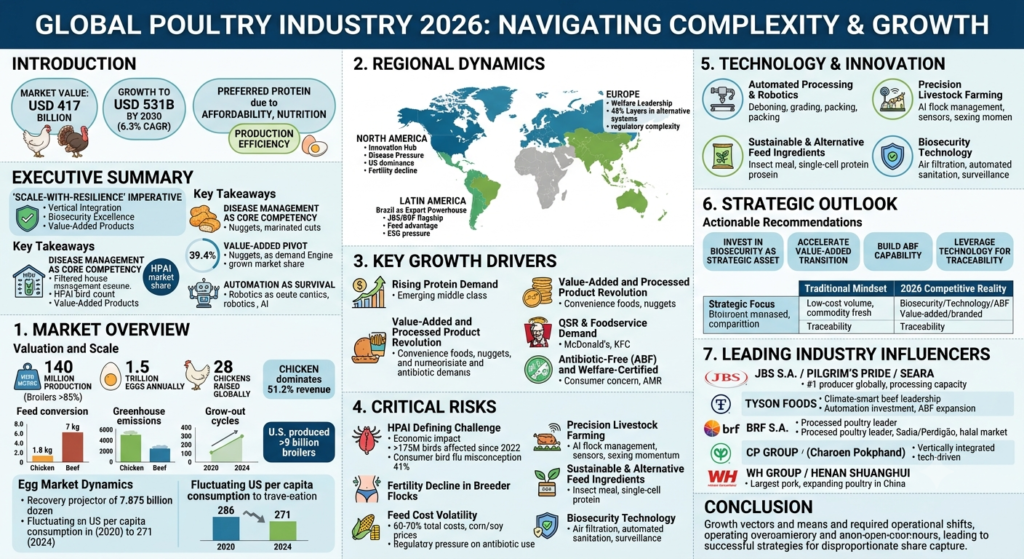
The global poultry industry 2026 stands as the world’s largest and most dynamic animal protein sector. Valued at approximately USD 417 billion in 2026, the market is on a strong growth trajectory, expected to reach USD 531 billion by 2030 at a compound annual growth rate of 6.3%. Poultry — encompassing broiler chicken, turkey, duck, and egg production — has cemented its position as the world’s preferred animal protein, driven by its unmatched combination of affordability, nutritional density, and production efficiency compared to beef and pork.
Yet 2026 is also a year of significant operational complexity. The industry is simultaneously navigating the most persistent wave of Highly Pathogenic Avian Influenza (HPAI) in recorded history, accelerating consumer demand for value-added and antibiotic-free products, a structural shift toward automation and precision farming, and intensifying sustainability mandates across major export markets. The producers, processors, and supply chain operators that successfully manage these competing pressures will define the next decade of global protein supply.
Executive Summary: The Global Poultry Industry 2026
The poultry industry in 2026 is defined by a “scale-with-resilience” imperative. The sector has moved beyond the era of pure volume competition. Success now requires vertical integration, biosecurity excellence, technological investment, and the ability to capture the rapidly expanding premium segment for processed, welfare-certified, and antibiotic-free products.
Key Takeaways for Stakeholders:
Disease Management as a Core Competency: HPAI is no longer a periodic shock — it is a permanent operational variable. With over 170 million birds lost since 2022 to HPAI outbreaks, biosecurity infrastructure has become the single most critical differentiator between resilient and vulnerable operations.
The Value-Added Pivot: The market is experiencing a structural shift toward higher-margin, value-added formats such as nuggets and marinated cuts, driven by increasing demand from quick-service restaurants. Commodity fresh meat is losing ground to processed, convenience-oriented products at every level of the supply chain.
Asia-Pacific as the Demand Engine: Asia Pacific dominated the poultry market with a market share of 39.4% in 2025, with China and India driving both production volume and the fastest growth in processed product demand.
Automation as a Survival Strategy: Labour shortages in processing facilities, combined with biosecurity requirements and margin pressure, are accelerating the adoption of robotics, AI-driven flock management, and precision nutrition systems across all major producing regions.
1. Market Overview: The Global Poultry Industry 2026 Landscape
Valuation and Scale
Global poultry meat production surpassed 140 million metric tons in 2023, with broiler chickens accounting for over 85% of output. The industry supports millions of smallholder farmers and rural workers globally, particularly in developing nations, making it as much a food security infrastructure as a commercial sector.
The global poultry market produces approximately 137 million metric tons of chicken meat and over 86 million metric tons of eggs annually. Egg production has surpassed 1.5 trillion units per year, driven by increasing demand for affordable protein in Asia-Pacific and Africa. As of 2024, over 28 billion chickens are raised globally at any given time, outnumbering humans by more than threefold.
Among species, chicken accounts for the largest revenue share at 51.20% of the global poultry market in 2026. Turkey, duck, and other poultry species make up the remainder, with turkey gaining market share as a leaner alternative particularly in Western diets.
The Chicken Dominance Thesis
Chicken’s dominance is structural, not cyclical. It offers the lowest feed conversion ratio of any major livestock protein — approximately 1.8 kg of feed per kilogram of meat, compared to 3 kg for pork and 7 kg for beef. Combined with a short grow-out cycle of 42–48 days for broilers, relatively low greenhouse gas emissions per kilogram of protein, and adaptability to virtually every cuisine globally, chicken is the default protein of the 21st century’s rising middle class.
The U.S. poultry industry alone produced more than 9 billion broilers last year. Broiler weights have trended higher in recent years to meet the broader demand for white meat that consumers prefer, and a significant amount of broiler chickens is being grown to meet specifications for restaurant chains, especially as wings and sandwiches became staples on menus.
Egg Market Dynamics
The egg segment is navigating its own structural realignment in 2026. After record-high wholesale prices driven by HPAI flock losses in 2024–2025, the market is in a recovery phase. The 2026 egg production projection is 7.875 billion dozen, up 7.7% from 2025, reflecting expectations that the flock will be rebuilt and that there will be no further confirmations of HPAI. However, per capita egg consumption in the United States has declined from 286 eggs in 2020 to 271 in 2024, suggesting that the extreme price spikes of the prior period have had a lasting impact on consumption habits that the industry must work to reverse.
2. Regional Dynamics: A Diverging Global Landscape
Asia-Pacific: The Production and Consumption Epicentre
Asia-Pacific holds the largest market share in global poultry, with growth driven by rising incomes and urbanisation in countries like China and India. China produces more than 24 million metric tons of chicken and over 500 billion eggs annually. Consumption is expanding rapidly in Southeast Asia, with Vietnam, the Philippines, and Indonesia seeing double-digit growth. Rapid urbanisation and cold chain expansion are improving market penetration for chilled and frozen poultry products.
India deserves particular attention as a structural growth driver. With a population exceeding 1.4 billion, growing disposable incomes, and cultural acceptance of chicken across religious demographics, India is on a trajectory to become one of the top three global poultry markets before 2030. The expansion of organised retail and quick-service restaurant chains is accelerating the formalisation of what has historically been a fragmented, live-bird-market-driven supply chain.
Religious preferences, such as Halal certification in Indonesia and Malaysia, shape production standards across the region, creating a significant premium market for certified Halal poultry products that is driving investment in dedicated processing infrastructure across Southeast Asia and the Middle East.
North America: Innovation Hub Under Disease Pressure
The United States remains the world’s most technologically advanced poultry producer and a dominant global exporter, holding approximately 21% of the global market share. US broiler production is expected to reach 47.6 billion pounds in 2026, though falling hatch fertility rates and persistent avian flu outbreaks could slow output and lift prices later in the year.
The US industry is navigating two structural headwinds simultaneously: the ongoing HPAI crisis, and a fertility decline in breeder flocks that is tightening the chick supply pipeline. Broiler farms can recover relatively quickly from HPAI, while breeder flocks can take more than a year, and the losses ripple throughout the production chain and to prices at grocery stores.
Despite these challenges, North American producers are leading global investment in automation, AI-driven biosecurity systems, and the development of antibiotic-free production protocols — areas in which they hold a significant competitive advantage over lower-cost but less technologically advanced producers in Southeast Asia.
Latin America: The Export Powerhouse
Brazil dominates the global poultry export market, supplying the Middle East, Asia, and increasingly Africa with competitively priced broiler products. BRF S.A. and JBS’s Seara brand are the flagship operators, leveraging Brazil’s vast soy and corn production base to maintain feed cost advantages over competitors in Europe and Asia.
However, Brazilian producers face growing scrutiny over sustainability practices, deforestation-linked soy sourcing, and animal welfare standards — particularly from EU buyers implementing stricter import requirements. The ability to demonstrate supply chain transparency and ESG compliance is becoming as commercially important as price competitiveness for Brazil’s long-term export market access.
Europe: Welfare Leadership and Regulatory Complexity
The EU produced 13.5 million metric tons of poultry meat in 2023, with France, Germany, and Poland as key contributors. Over 48% of layer hens are now in alternative housing systems such as free-range or organic. Consumer demand for slow-growing and heritage poultry breeds is increasing. Regulatory compliance with welfare and labelling standards drives innovation in housing, feed, and traceability systems.
Europe’s poultry sector is the global standard-setter for animal welfare, antibiotic stewardship, and traceability — but these standards come at a cost. European producers operate at higher cost structures than their Brazilian or US counterparts, making them vulnerable to import competition unless they can successfully command the welfare and provenance premiums that their domestic consumers are increasingly willing to pay.
3. Key Growth Drivers of The Global Poultry Industry 2026
Rising Global Protein Demand
The fundamental demand driver for poultry in 2026 is demographic and economic. Population growth concentrated in sub-Saharan Africa, South Asia, and Southeast Asia — combined with rising disposable incomes in these regions — is generating sustained, long-term demand for affordable animal protein. Poultry is the default answer to this demand given its price, religious accessibility, and production scalability.
Poultry serves as the most efficient source of animal protein, requiring less feed and generating lower greenhouse gas emissions per kilogram of meat compared to ruminants, giving it a structural competitive advantage as sustainability constraints tighten on beef and, to a lesser extent, pork.
The Value-Added and Processed Product Revolution
The global poultry industry is increasingly shifting from commodity fresh meat toward higher-margin processed poultry products, including ready-to-cook and ready-to-eat formats. Consumers are demanding convenience foods that reduce preparation time while maintaining nutritional value and affordability. This trend is particularly evident in urban markets where dual-income households and time-constrained lifestyles are accelerating demand for frozen poultry meals, marinated cuts, and portion-controlled packs.
For producers and processors, this shift represents a significant margin expansion opportunity. Commodity broiler meat generates thin margins highly sensitive to feed cost volatility. Value-added products — from breaded nuggets and marinated thighs to pre-seasoned rotisserie birds — command materially higher retail prices and are less exposed to raw commodity price swings. The largest global operators are investing heavily in processing capability to capture this margin.
QSR and Foodservice Demand
The quick-service restaurant sector remains a critical demand anchor for the global poultry industry. McDonald’s, KFC, Chick-fil-A, and their global equivalents collectively purchase enormous volumes of standardised chicken products under long-term supply agreements that provide processors with price predictability and volume stability. The ongoing global expansion of QSR chains — particularly across Asia, Africa, and the Middle East — is creating new, structural demand pools for consistent, food-safety-certified poultry products that local artisanal producers cannot reliably supply.
Antibiotic-Free and Welfare-Certified Premium Segments
Consumer concern about antimicrobial resistance (AMR) is driving rapid growth in antibiotic-free (ABF) and raised-without-antibiotics (RWA) poultry segments. The routine use of antibiotics in poultry farming to prevent disease and promote growth has raised global concerns about antimicrobial resistance, with resistant strains of Salmonella and Campylobacter linked to poultry responsible for a large number of human infections annually. In the European Union, the ban on antibiotic growth promoters has reduced overall veterinary antimicrobial use.
Producers who have invested in the management systems, nutrition protocols, and biosecurity infrastructure required to produce ABF poultry at scale are commanding significant price premiums — and securing preferred supplier status with major retailers and foodservice operators committed to antibiotic stewardship.
4. Critical Risks and Challenges
HPAI: The Industry’s Defining Challenge
Highly Pathogenic Avian Influenza remains the single most significant operational and financial risk facing the global poultry industry in 2026. Since the first detection of the current HPAI strain on February 8, 2022, there have been 1,710 detections in 50 states and one territory, affecting nearly 175 million birds.
The economic consequences are severe and multi-layered. Direct losses include the mandatory culling of infected flocks. Indirect losses include the disruption of breeder flock supply chains — which, unlike commercial broiler operations, can take 12–18 months to rebuild — the loss of export market access when importing nations impose bans on the affected origin country, and the consumer confidence impact of sustained media coverage associating poultry with disease.
A shocking 41% of consumers believe they can contract bird flu from properly cooked chicken, with nearly half of millennials sharing this dangerous misconception. This perception gap represents a significant commercial risk that requires sustained, coordinated industry communication to address. Properly cooked poultry poses zero risk of HPAI transmission to humans — but the industry has been slow to communicate this effectively at scale.
The United States is facing the largest outbreak of avian influenza in its history in 2026, with spring migration spreading the virus into backyard flocks, pet birds and commercial operations.
Fertility Decline and Hatchery Supply Chain Stress
A less-discussed but increasingly significant structural challenge is the decline in broiler breeder flock fertility rates across major producing regions. The US poultry industry produced more than 9 billion broilers, requiring 12 billion eggs to meet capacity — but would require 15 billion eggs to hatch 9 billion viable broiler chicks if fertility rates continue to fall. This biological bottleneck in the breeder-to-broiler pipeline represents a supply constraint that cannot be resolved quickly, and compounds the impact of any HPAI-related breeder flock losses.
Feed Cost Volatility
Heading into 2026, the global poultry industry faces trade uncertainty, labour constraints and ongoing HPAI outbreaks competing for attention alongside perennial concerns about input costs and food safety. Feed represents 60–70% of total broiler production costs, making corn and soybean price volatility — driven by weather disruptions, geopolitical supply chain disruptions, and competition from biofuel demand — the most significant margin variable in the industry.
Producers in regions without domestic grain production — such as the Middle East, Southeast Asia, and parts of Africa — are particularly exposed, as they must absorb both the underlying commodity volatility and currency translation risks on imported grain.
Antimicrobial Resistance and Regulatory Pressure
The global regulatory trajectory on antibiotic use in poultry production is unambiguously toward restriction. The EU’s elimination of antibiotic growth promoters has been followed by increasing restrictions in the US, Canada, and major Asian markets. Producers who have not invested in the alternative management systems — probiotics, prebiotics, bacteriophages, improved biosecurity, and nutritional optimisation — required to maintain production performance without routine antibiotic use face both regulatory risk and competitive disadvantage as ABF premiums widen.
5. Technology and Innovation: The Precision Poultry Era
Automated Processing and Robotics
Labour shortages in poultry processing facilities — driven by the physically demanding, repetitive nature of the work and immigration policy changes in major producing countries — are accelerating investment in processing automation. Robot-assisted deboning, AI-powered carcass grading, and automated packing lines are moving from pilot installations to industry-standard infrastructure at the largest integrated processors.
The return on investment is compelling: automated processing reduces per-unit labour costs, improves consistency and yield, reduces food safety risk from human contamination, and operates continuously without fatigue-related quality degradation.
Precision Livestock Farming and AI-Driven Flock Management
Chick sexing is gaining momentum across the industry, consistently delivering measurable results in production efficiency and profitability. Sexing at hatch allows for tighter control across the value chain, with greater flock uniformity and reduced live weight variability. This improves feed conversion ratios, enables more precise machine calibration at the processing plant, and results in fewer carcass downgrades.
AI-driven flock monitoring systems — using computer vision, environmental sensors, and acoustic analysis — can now detect early signs of disease, welfare compromise, or suboptimal growth performance in broiler houses with thousands of birds, enabling intervention before issues escalate to flock-level losses. These systems are transitioning from premium add-ons to standard infrastructure requirements for biosecurity-focused operations.
Sustainable and Alternative Feed Ingredients
The poultry industry’s dependence on corn and soybean meal creates both cost vulnerability and sustainability challenges — particularly given the deforestation associations of Brazilian soy production. In 2026, investment in alternative feed ingredients is accelerating:
Insect meal (primarily Black Soldier Fly larvae) is emerging as a commercially viable, high-protein, circular economy feed ingredient — consuming organic waste streams and producing a protein-rich meal with a fraction of the land and water footprint of soy.
Single-cell proteins derived from fermentation are entering commercial-scale poultry feed formulations, offering amino acid profiles competitive with fishmeal at declining cost points.
Precision fermentation-derived feed additives — enzymes, organic acids, and functional ingredients — are enabling producers to reduce or eliminate antibiotics without performance penalties.
Biosecurity Technology
HPAI has driven unprecedented investment in biosecurity infrastructure and technology. Air filtration systems capable of filtering out airborne viral particles, positive-pressure housing designs, automated boot-washing and disinfection systems, and AI-powered visitor management and vehicle tracking platforms are being deployed at scale across commercial poultry operations globally.
Surveillance technology — including environmental PCR testing of farm surroundings and wild bird monitoring networks — is providing earlier warning of HPAI risk, allowing producers to implement enhanced protocols before an incursion occurs rather than after.
6. Strategic Outlook for Stakeholders
The poultry industry in 2026 rewards operators who combine biological excellence with operational technology and supply chain integration. The era of competing on feed cost and grow-out efficiency alone is over.
Actionable Recommendations
Invest in Biosecurity as a Strategic Asset, Not a Cost Centre: HPAI has demonstrated that a single flock loss can eliminate multiple quarters of profit. Investment in biosecurity infrastructure — from housing design to staff protocols to environmental monitoring — should be evaluated as insurance against a probable rather than a possible event.
Accelerate the Value-Added Transition: The margin differential between commodity broiler meat and processed, branded poultry products is widening. Processors who have not yet invested in value-added capability are competing in an increasingly commoditised, price-sensitive segment while higher-margin opportunities are captured by vertically integrated competitors.
Build Antibiotic-Free Production Capability: The regulatory and consumer trajectory is clear. ABF production commands premium pricing today and will be the minimum entry standard for premium retail and foodservice channels within five years. Operators who invest in the transition now — while it still commands a premium — will be ahead of the curve when it becomes a baseline requirement.
Diversify Feed Sourcing: Operators with the scale and supply chain flexibility to incorporate insect meal, single-cell protein, and alternative ingredient streams are building resilience against corn and soy price volatility while simultaneously improving their sustainability credentials.
Leverage Technology for Traceability: Major retail and foodservice buyers are demanding farm-to-fork traceability as a procurement prerequisite. Digital ear-tag and flock management systems that generate an immutable record of an animal’s production history — from hatch to processing — are becoming table stakes for premium channel access.
Strategic Summary: The 2026 Poultry Business Model
| Strategic Focus | Traditional Mindset | 2026 Competitive Reality |
|---|---|---|
| Competitive Advantage | Low-cost production volume | Biosecurity, technology, and ABF capability |
| Product Mix | Commodity fresh cuts | Value-added, processed, branded formats |
| Market Access | Price-led commodity supply | Welfare, traceability and ABF certification |
| Risk Management | Feed cost hedging | HPAI insurance, fertility management, supply chain diversification |
| Revenue Model | Broiler meat sales | Meat + eggs + value-added products + carbon/welfare premiums |
7. Leading Industry Influencers
| Company/Entity | Region | Strategic Focus |
|---|---|---|
| JBS S.A. / Pilgrim’s Pride / Seara | Global | The #1 global poultry producer in terms of capacity, with aggregate daily processing capacity of more than 14 million chickens. Operations in the US, Brazil, UK, Mexico, Puerto Rico and Europe. Food and Nutrition Journal Investing USD 150 million in a Middle East multiprotein hub. |
| Tyson Foods | USA | Climate-smart poultry leadership. Major investment in processing automation and ABF product line expansion. Dominant QSR supply chain partner. |
| BRF S.A. | Brazil/Global | Global processed poultry leader. Sadia and Perdigão brands distributed across 120+ countries. Focused on value-added product expansion and halal market development. |
| CP Group (Charoen Pokphand) | Thailand/Asia | Asia’s dominant vertically integrated poultry operator. Setting the benchmark for large-scale, technology-driven broiler production across Southeast Asia. |
| WH Group / Henan Shuanghui | China | Largest pork and expanding poultry operator in China. Critical to domestic supply security for the world’s largest consumer market. |
8. Conclusion: The Path Forward
The global poultry industry in 2026 is at an inflection point. Demand fundamentals are stronger than at any point in history — driven by demographic growth, urbanisation, rising incomes, and the structural price competitiveness of chicken versus all alternative proteins. Yet the industry faces an equally strong set of operational, biological, regulatory, and sustainability headwinds that will separate the well-capitalised, technology-forward integrated operators from the fragmented, commodity-dependent producers they are gradually displacing.
HPAI is here to stay as an operational variable. Value-added and ABF products are the growth vector. Asia-Pacific is the demand engine. Automation is the productivity solution. And traceability is the market access requirement.
The operators who internalise these realities today — and invest accordingly — will not only survive the current period of volatility but will capture disproportionate share of the most valuable segments of the world’s largest animal protein market.
Related: As the global meat industry faces both structural production shifts and evolving trade dynamics, staying ahead of market volatility is critical. Get the latest insights on export surges, pricing trends, and supply chain updates in our Global Meat Industry Outlook June 2026.
What is the global poultry market size in 2026?
The global poultry market is valued at approximately USD 417 billion in 2026, making it the world’s largest animal protein sector by volume and value. It is projected to reach USD 531 billion by 2030, growing at a CAGR of approximately 6.3%. Chicken accounts for over 51% of total poultry market revenue, followed by eggs, turkey, and duck.
Why is poultry the world’s most consumed animal protein?
Poultry — particularly chicken — has become the default global protein for several structural reasons. It has the lowest feed conversion ratio of any major livestock at approximately 1.8 kg of feed per kilogram of meat, compared to 3 kg for pork and 7 kg for beef. It has a short grow-out cycle of 42–48 days, is religiously accessible across most of the world’s major faiths, and is consistently the most affordable animal protein at retail. Combined with its lean nutritional profile, it is the natural protein of choice for the world’s growing middle class.
How serious is HPAI (bird flu) for the poultry industry in 2026?
HPAI is the single most significant operational risk facing the industry in 2026. Since February 2022, nearly 175 million birds have been lost in the United States alone across 1,710 confirmed detections. The 2026 outbreak is the largest in US history. The financial impact extends beyond direct flock losses to include breeder flock supply chain disruption — which can take 12–18 months to recover — export market bans, and consumer confidence damage. Critically, properly cooked poultry poses zero risk of bird flu transmission to humans, but industry surveys show 41% of consumers incorrectly believe otherwise.
Which region dominates the global poultry market?
Asia-Pacific is the world’s largest poultry market, accounting for approximately 39% of global market share. China is the dominant producer, generating more than 24 million metric tons of chicken and over 500 billion eggs annually. India is the fastest-growing major market, driven by population growth, rising incomes, and expanding QSR chains. Southeast Asia — particularly Vietnam, Indonesia, and the Philippines — is experiencing double-digit consumption growth as urbanisation accelerates and cold chain infrastructure expands.
What is driving the shift to value-added poultry products?
Three forces are converging to accelerate the shift from commodity fresh chicken to processed, value-added formats. First, urbanisation and dual-income households are reducing the time consumers have for meal preparation, creating demand for ready-to-cook and ready-to-eat products. Second, QSR expansion globally is creating institutional demand for standardised, portioned, coated, and marinated chicken products at enormous scale. Third, value-added products generate significantly higher margins for processors — insulating them from the feed cost volatility that squeezes commodity broiler margins. The trend is most pronounced in Asia-Pacific and the Middle East but is accelerating across all major markets.
What does antibiotic-free (ABF) poultry mean and why does it matter?
Antibiotic-free poultry refers to birds raised without the routine use of antibiotics for growth promotion or disease prevention — a practice that has raised global alarm about antimicrobial resistance (AMR). ABF production requires investment in superior biosecurity, nutritional management using probiotics and organic acids, and housing design that reduces stress and pathogen load. The EU has banned antibiotic growth promoters entirely, and major US retailers and QSR chains are increasingly requiring ABF certification from suppliers. ABF products command significant price premiums at retail and represent the fastest-growing segment of the premium poultry market.
Who are the largest poultry companies in the world in 2026?
JBS N.V. — through its Pilgrim’s Pride and Seara brands — is the world’s largest poultry producer by processing capacity, with daily capacity exceeding 14 million chickens across operations in the US, Brazil, UK, Mexico, and Europe. Tyson Foods is the dominant US operator and a major QSR supply partner. BRF S.A. leads global processed poultry exports through its Sadia and Perdigão brands, distributed across 120+ countries. CP Group (Charoen Pokphand) is Asia’s dominant vertically integrated poultry operator, setting the benchmark for large-scale broiler production across Thailand and Southeast Asia.
What are the biggest opportunities in the poultry industry over the next five years?
Four opportunity areas stand out for the 2026–2031 period. First, value-added and processed product expansion in Asia-Pacific and the Middle East, where growing urban populations and QSR proliferation are creating structural demand. Second, the ABF and welfare-certified premium segment in developed markets, where consumers are demonstrating sustained willingness to pay premiums for ethically produced poultry. Third, alternative and sustainable feed ingredients — particularly insect meal and single-cell proteins — which offer both cost resilience and improved sustainability credentials. Fourth, biosecurity technology — from AI-driven flock monitoring to air filtration systems — where investment now represents both risk mitigation and a competitive differentiator as HPAI becomes a permanent operational variable.
Sources and References
- Fortune Business Insights — Global Poultry Market Report 2026–2034 https://www.fortunebusinessinsights.com/poultry-market-112188
- Mordor Intelligence — Global Poultry Meat Market 2026–2031 https://www.mordorintelligence.com/industry-reports/global-poultry-meat-market
- USDA / Texas A&M AgriLife Extension — Broiler Production & HPAI Outlook, March 2026 https://agrilifetoday.tamu.edu/2026/03/03/experts-expect-shift-in-chicken-prices-amid-fertility-bird-flu-concerns/
- USDA APHIS — HPAI Confirmations in Commercial and Backyard Flocks https://www.aphis.usda.gov/livestock-poultry-disease/avian/avian-influenza/hpai-detections/commercial-backyard-flocks
- Feed Strategy — 2026 Poultry Feed Survey: Rising Costs & HPAI Challenges https://www.feedstrategy.com/animal-feed-additives-ingredients/article/15819913/2026-poultry-feed-survey-rising-costs-hpai-challenges
- The Poultry Site — Predictions for Poultry Production in 2026 https://www.thepoultrysite.com/articles/predictions-for-poultry-production-in-2026
- Market Data Forecast — Global Poultry Market 2026–2034 https://www.marketdataforecast.com/market-reports/poultry-market
- JBS N.V. SEC Form 6-K Filings 2026 https://www.sec.gov/cgi-bin/browse-edgar?action=getcompany&CIK=0001791942&type=6-K&dateb=&owner=include&count=40
- American Farm Bureau Federation — Avian Influenza Market Intel https://www.fb.org/market-intel/avian-influenza-detections-drop-but-fall-migration-looms
- Coherent Market Insights — Global Poultry Market 2026–2033 https://www.coherentmarketinsights.com/market-insight/poultry-market-1230
