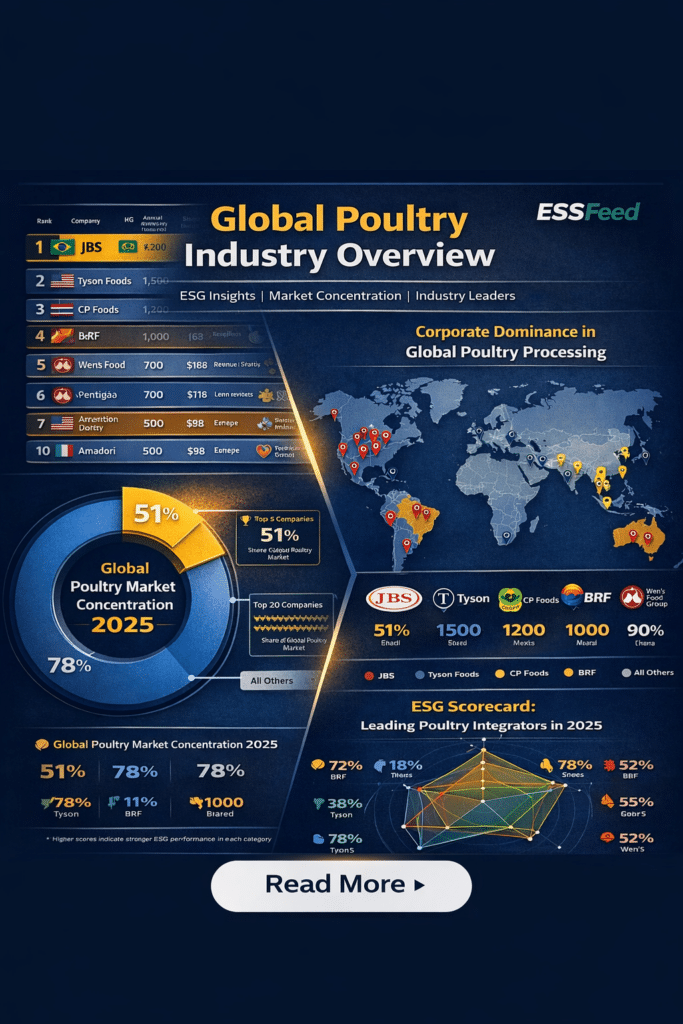
The global poultry industry is one of the most efficient, scalable, and internationally traded protein markets in the food and beverage sector. Poultry meat—primarily chicken—has become the world’s most consumed animal protein due to its affordability, relatively low environmental footprint, fast production cycles, and broad cultural acceptance.
This hub presents visual market insights into the global poultry industry, supported by data-driven infographics covering production volumes, export flows, and import demand by country. Together, these visuals help explain where poultry is produced, how it moves through global trade, and which markets drive consumption growth.
Industry snapshot: 2025 Projected Global Poultry Meat Production. This visual summary compares market share, country rankings, and regional growth across the top 10 global producers.
Get the complete 2025 poultry production report. Analyze market share, country rankings (China, USA, Brazil), and regional hubs in this data-driven industry overview.
Thumbnail preview of ESSFeed’s Global Poultry Market 2025 hub, combining visual elements of top integrators, market concentration, corporate footprint, and ESG scorecard. Click to view full detailed infographics.
Why Poultry Matters in the Global Protein Market
Poultry plays a critical role in global food security and protein availability:
It has the shortest production cycle among major animal proteins
Requires less feed per kilogram of meat than beef or pork
Is widely accepted across cultures and religions
Scales efficiently in both developed and emerging economies
As a result, poultry dominates global meat consumption growth and is often the first animal protein to expand when incomes rise.
Global Poultry Production Landscape
Worldwide poultry production exceeds 130 million metric tons annually, with output concentrated among a small group of high-volume producers. Production is driven by access to feed grains, vertically integrated farming systems, processing efficiency, and domestic consumption demand.
Key characteristics of global poultry production:
Highly industrialized in the US, Brazil, and the EU
Rapidly expanding in Asia and Latin America
Increasing investment in biosecurity and disease control
Strong links to corn and soybean markets
Poultry Trade and Export Markets
Only a portion of global poultry production enters international trade, but exports are highly concentrated. A small number of countries dominate global shipments due to cost advantages, scale, and disease-free status.
Leading poultry exporters benefit from:
Competitive feed costs
Strong cold-chain logistics
Established trade agreements
Ability to supply halal-certified products
Brazil and the United States consistently rank among the top exporters, while the European Union operates as both a major exporter and importer depending on product type.
Poultry Import Demand and Consumption Growth
Poultry imports are driven by population growth, limited domestic production, and price sensitivity. Many countries rely heavily on imports to stabilize supply and control food inflation.
Common drivers of poultry imports:
Rapid urbanization
Rising middle-class consumption
Limited feed availability
Climate constraints on local production
Key import markets include parts of the Middle East, Asia, Africa, and select high-income economies seeking specific cuts.
Poultry Products Traded Globally
International poultry trade is not limited to whole birds. Product segmentation plays a major role:
Whole frozen chickens
Chicken breasts and fillets
Wings, drumsticks, and leg quarters
Mechanically deboned meat (MDM)
Processed and value-added poultry products
Different regions import different cuts depending on local preferences, pricing, and foodservice demand.
Poultry Industry Challenges
Despite its growth, the poultry sector faces persistent risks:
1. Avian Influenza
Outbreaks can rapidly disrupt production, trigger trade bans, and reduce export volumes.
2. Feed Price Volatility
Corn and soybean prices directly impact poultry margins and consumer pricing.
3. Trade Restrictions
Sanitary regulations, tariffs, and disease-related bans affect market access.
4. Sustainability Pressures
Water use, emissions, animal welfare, and antibiotic use are under increasing scrutiny.
Poultry Market Trends Shaping the Future
Several structural trends are reshaping the industry:
Expansion of plant-based feed alternatives
Growth in processed and ready-to-eat poultry
Increased focus on traceability and transparency
Investment in automation and processing efficiency
Rising demand for halal-certified poultry
Emerging markets are expected to account for the majority of consumption growth over the next decade.
Industry snapshot: 2025 Projected Global Poultry Meat Production. This visual summary compares market share, country rankings, and regional growth across the top 10 global producers.
Get the complete 2025 poultry production report. Analyze market share, country rankings (China, USA, Brazil), and regional hubs in this data-driven industry overview.
Thumbnail preview of ESSFeed’s Global Poultry Market 2025 hub, combining visual elements of top integrators, market concentration, corporate footprint, and ESG scorecard. Click to view full detailed infographics.
Frequently Asked Questions (FAQ)
Which country produces the most poultry in the world?
The United States and China are consistently among the largest poultry producers globally, followed closely by Brazil and members of the European Union.
Why is poultry traded more than other meats?
Poultry is cheaper to produce, freezes well, has fewer cultural restrictions, and benefits from efficient global logistics.
What drives poultry import demand?
Population growth, rising incomes, limited domestic production, and food security concerns are the main drivers.
How do disease outbreaks affect poultry trade?
Avian influenza outbreaks often result in immediate export bans, supply shortages, and price volatility.
Is poultry consumption still growing globally?
Yes. Poultry remains the fastest-growing animal protein globally, particularly in emerging markets.
Author: Robert Gultig in conjunction with ESS Research Team
Robert Gultig is a veteran Managing Director and International Trade Consultant with over 20 years of experience in global trading and market research. Robert leverages his deep industry knowledge and strategic marketing background (BBA) to provide authoritative market insights in conjunction with the ESS Research Team.
If you would like to contribute articles or insights, please join our team by emailing support@essfeed.com.