
Why some drugs cost pennies per dose and others cost tens of thousands per patient—and how those economics reshape procurement, negotiation and supply chain risk.
Two patients walk into two different pharmacies. One fills a prescription for metformin (a small molecule), paying $10 for a month’s supply. The other fills one for adalimumab (a biologic), paying $6,000 for a month’s supply — or rather, paying a copay while the insurance company writes a check for several thousand more. The difference is not better science or higher efficacy alone. It is fundamental chemistry, and the supply chain implications are more consequential to a procurement officer than the price itself.
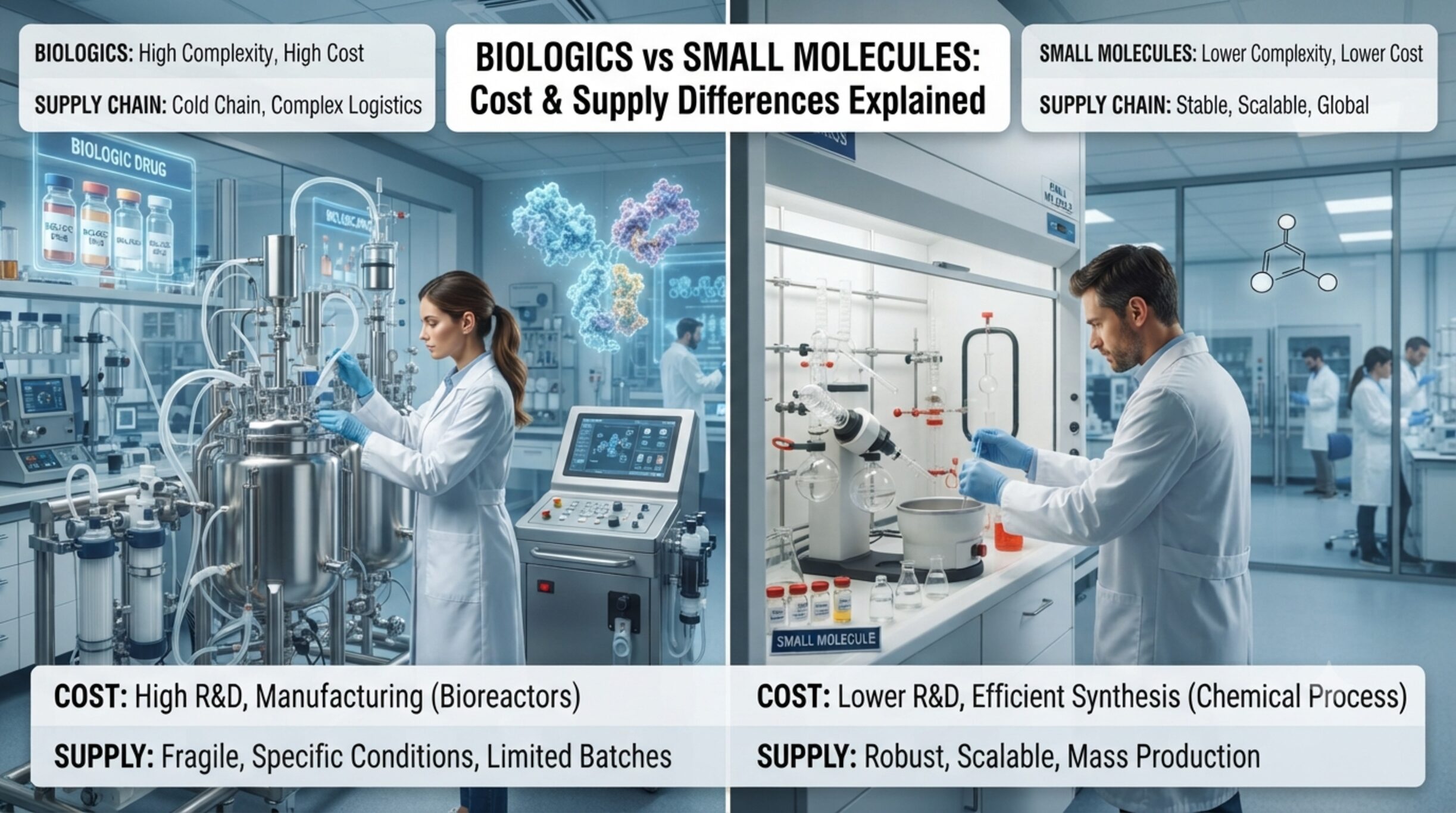
This report explains what biologics and small molecules are, why the cost structures are so different, what happens to supply chains when manufacturing is complex, and what biosimilars might and might not fix.
Table of Contents
The basic difference: Size and how it’s made
A small molecule is a compact chemical compound, typically weighing between 0.1 and 1 kilodalton (one-thousandth of a gram per unit mass). Aspirin, metformin, and atorvastatin are small molecules. They are made by organic chemistry — a series of chemical reactions that build the target molecule atom by atom from starting materials.
A biologic is a large, complex molecule derived from living cells or made through biological processes. Most biologics are proteins, which are built from amino acids linked together. A monoclonal antibody — the most common biologic in use — typically weighs 150 kilodaltons, making it roughly 150 times larger than a typical small molecule. It is made by growing cells (often mammalian cell lines like Chinese hamster ovary cells) that have been engineered to produce the desired protein, then harvesting and purifying that protein.
The size difference is not incidental. Because they are large, biologics cannot be absorbed through the digestive system (the stomach would break them down), so they must be injected or infused — a supply and administration headache that small molecules do not have. And because biologics are proteins, they fold into precise three-dimensional shapes that determine their specificity and potency. Get the shape wrong, even slightly, and the biologic may stop working or cause immune reactions. Small molecules have the same chemical identity regardless of how they are synthesized; biologics are process-dependent, meaning different manufacturing methods can produce subtly different versions of the same intended protein.
Manufacturing: The 12x cost gap
An analysis by Boston Consulting Group found the average manufacturing cost per pack was $5 for small molecules and $60 for biologics — roughly a 12-fold difference at production scale.
Small molecule manufacturing is mature, scalable, and commoditized. A chemical synthesis facility producing, say, a statin, runs at thousands of tons per year. The chemistry is straightforward: feed in starting materials, run them through sequential reactions, isolate and purify the product, test it for identity and purity. A typical small molecule API costs cents to dollars per gram at manufacturing scale. Once the process is locked down, it is reproducible across facilities and suppliers.
Biologic manufacturing is capital-intensive and proprietary. Growing cells to produce a monoclonal antibody requires:
- Bioreactors (large fermentation tanks), often in the thousands-of-liter scale
- Cell culture media (specialized nutrient broths) specific to the producing cell line
- Chromatography equipment and columns for purification — expensive, single-use consumables
- Sterile fill-finish operations and vials designed for injectables
- Analytics and quality control testing for characterization of a complex protein
A single biopharmaceutical manufacturing facility costs $500 million to $1 billion to build. Once operational, a facility might produce one or a handful of biologic products, unlike a chemical plant that can produce multiple small molecules. Production timelines stretch to months; small molecule synthesis happens in days or weeks.
Because of this complexity, manufacturing cost per gram for monoclonal antibodies has fallen from several thousand dollars per gram two decades ago to roughly $10-100 per gram today — a dramatic improvement driven by continuous bioprocessing and automation. But that is still vastly higher than small molecules, and the floor is set by capital and complexity, not competition.
The cold chain penalty: More supply chain risk
Small molecules are stable. Aspirin lasts years at room temperature. Metformin tablets sit in warehouses in cardboard boxes. Even if conditions drift from ideal, the molecule survives.
Biologics are fragile. Most require refrigeration at 2-8°C. Some require ultra-cold storage at –20°C or colder. This constraint ripples through the supply chain.
A single vial of a biologic cannot travel the same route as a small molecule. It needs specialized packaging (insulated boxes with ice packs or dry ice), temperature monitoring (data loggers in each shipment), and logistics coordination with refrigerated transport. If a vial sits in a warm warehouse for hours, it may denature and become useless. The patient cannot be told “your drug is delayed” and wait two weeks; they might miss a critical injection window.
For cell and gene therapies — the newest generation of biologics — the complexity is orders of magnitude higher. Some cell therapies are personalized (manufactured specifically for one patient from their own cells), requiring patient-specific manufacturing, cryogenic shipping to the treatment center, and no room for error in the cold chain. If a cryogenic container fails en route, the therapy is lost and must be manufactured again — a months-long delay.
The cold chain also creates geographic bottlenecks. Not every pharmacy can store or handle biologics. Specialty pharmacies, which can maintain cold storage and train staff, become critical chokepoints. A hospital or insurer cannot simply switch a patient from one biologic provider to another without ensuring the new facility has cold-chain infrastructure.
Why biologic prices are so high (and why they stay high)
List prices for monoclonal antibodies run in the tens of thousands per month:
- Humira (adalimumab): $5,500-7,000/month
- Enbrel (etanercept): $3,000-4,000/month
- Keytruda (pembrolizumab): $10,000+/month
These prices reflect several layers: manufacturing cost (now $10-100 per gram after decades of optimization), R&D recovery (biologic development costs $1-2 billion and takes 10-15 years), regulatory burden, and — in the US market — a pricing strategy that exploits rebate mechanisms and formulary leverage.
But the prices also reflect a real constraint: no cheap competition. Unlike small molecules, which can be synthesized by competing manufacturers anywhere, biologics require FDA approval of the manufacturing process itself. The same biologic made by two different manufacturers may be slightly different in post-translational modifications (the chemical tags and sugar chains added during manufacturing). Each facility must be qualified, licensed, and inspected.
This is why, when a biologic’s patent expires, the market does not flood with generic biologics. Instead, biosimilars enter — products that are “highly similar” but not identical to the reference product. A biosimilar is not automatically interchangeable with the original; it requires its own clinical trials, FDA approval, and (in many cases) physician and patient consent to switch.
Biosimilars: Competition without generics
The FDA has approved 63 biosimilars as of 2026, with 41 launched in the US market. These include biosimilars of key molecules like adalimumab (12 biosimilars in market as of 2023), etanercept (3-4 biosimilars), and aflibercept (3 biosimilars).
Biosimilars are typically priced 25-35% below the reference product list price — less of a discount than generics offer (which run 50-90% off), but still meaningful when the reference product costs thousands per month.
The Humira story illustrates what happens when biosimilars enter. The reference product list price was roughly $6,400/month. When biosimilars launched in 2023 (after years of patent litigation), they entered at $3,500-4,500/month — a 30-35% discount. The reference product stayed on the market and is still used for roughly 20% of adalimumab prescriptions. Within 18 months of biosimilar entry, they captured 80% of new prescriptions, but the market is not binary: some patients and physicians prefer the original, and switching vials takes manual effort.
Biosimilar pricing discipline varies globally. In Europe, where governments tightly control prices and require substitution, biosimilar uptake for drugs like Humira exceeds 70% in many countries. Discounts are steeper — ranging to 60-90% off list price in some markets. In the US, pricing is entangled in rebate contracts and PBM formulary politics, so adoption is sticky.
What this means for supply chain resilience
Small molecules: Commoditized. You can dual-source from two different manufacturers, each producing the same API through the same chemistry. If one facility shuts down, you have a backup. Switching is a procurement conversation. Cost is predictable.
Biologics: Process-dependent. Even if two manufacturers have approved facilities to produce the same biologic, they might produce slightly different versions (different glycosylation patterns, say), creating a de-facto switching cost for patients and physicians. You cannot easily triple-source a monoclonal antibody the way you can a generic statin.
Cell and gene therapies: Nearly unique. Many are manufactured in a single facility for a specific patient, or in a handful of centralized manufacturing locations. There is no real redundancy. If the facility shuts down or encounters a quality failure, patients have no backup.
This concentration risk is why supply chain diversification for biologics is so difficult. A hospital can reduce its dependence on any single manufacturer of small molecules by working with three or four suppliers. With biologics, particularly newer modalities, redundancy is hard to achieve and expensive to maintain.
The patent cliff for biologics
Dozens of blockbuster biologics are losing or have lost patent protection between 2024 and 2028. Humira (adalimumab), Enbrel (etanercept), Remicade (infliximab), Stelara (ustekinumab), and Keytruda (pembrolizumab) are among them.
When a biologic loses patent protection, biosimilars typically launch within 1-3 years. The pricing pressure is real but not as dramatic as with generics. Payers estimate biosimilars could save the US healthcare system $250 billion over the next decade, but actual adoption is throttled by physician inertia, PBM incentive misalignment (rebates often favor the expensive reference product), and switching costs.
For procurement teams, the implication is both opportunity and risk. Biosimilar entry can negotiate reference product pricing down, but not automatically. And if a facility has been running on a single biologic for years, the switching logistics (cold chain infrastructure at the new provider, staff retraining, patient and physician education) are non-trivial.
Cell and gene therapies: The new supply chain frontier
Cell and gene therapies represent the extreme of biologic complexity. The cell and gene therapy manufacturing market is projected to grow from $17.7 billion in 2026 to $47.1 billion by 2030 at a 26.3% CAGR.
These therapies have shorter shelf lives than antibodies (often measured in hours or days, not months), extreme temperature sensitivity, and patient-specific manufacturing for autologous therapies (those made from the patient’s own cells). A single vial can cost $50,000-600,000+.
Supply chain for these products is not linear (manufacturer to pharmacy to patient) but circular (patient to manufacturer back to patient), time-critical, and cryogenic. A patient receiving CAR-T cell therapy must be enrolled in a treatment center, provide a blood sample, have their cells manufactured, cryogenically shipped back, and infused — all within a narrow window. If the cold chain breaks, months of manufacturing time are lost.
Logistics costs for cell and gene therapy products are estimated at 5-15% of product cost, compared to <1% for traditional pills. This is a structural constraint on access and scaling.
What this means for buyers
For hospital systems: Biologic suppliers are not interchangeable. If your rheumatology department standardizes on Humira, switching to an adalimumab biosimilar is not a line-item procurement change — it requires physician education, infusion center coordination (if infused on-site), and patient consent. Negotiate hard on price with reference products, but understand your switching costs before assuming biosimilars will fix the economics.
For health plans: Formulary leverage with biologics is real but limited. You can exclude a drug, but the clinical consequences (worsening disease, patient adherence problems) are high. Rebate negotiations with biologics work, but the rebate base is higher and rebate depth is often masked. Push for net-price transparency, not just list price.
For pharma and biotech: The industry is pivoting toward biologics because they are protected from generic competition. As biosimilars mature and cell/gene therapies scale, the industry will face margin pressure it has never experienced. Companies with single-facility or single-supplier manufacturing will be at risk.
For supply chain professionals: Cold chain is not just logistics, it is supply chain architecture. A facility that cannot maintain 2-8°C is a facility that cannot carry biologics. Plan accordingly.
Frequently asked questions
Can a patient switch from one biologic to another?
Switching is medically possible but operationally complex. Different biologics target different mechanisms (a TNF inhibitor vs an IL-6 inhibitor, say), so clinical efficacy may differ. Administratively, switching requires physician approval, often a new prior authorization, and retraining on a different injection device. It can take weeks.
Are biosimilars really the same as the original?
No. Biosimilars are “highly similar” but not identical. They are made by different cell lines using different processes, so post-translational modifications (sugar chains, phosphorylation) can vary. The FDA requires clinical trials showing no clinically meaningful difference, but subtle variations can exist. Most patients will not notice; some will.
Why do biosimilar prices not drop as much as generic prices?
Three reasons: (1) biosimilar development costs $250-500 million, vs $5-10 million for a generic. (2) Physician and patient inertia favors the original. (3) PBM rebate structures often favor the expensive reference product. A rebate on the reference product might be 60% off list, while a biosimilar discount is only 30-35% off. The net price gap is smaller than the list price gap.
What happens if a biologic manufacturing facility shuts down?
Patients on that biologic will need to switch. The FDA keeps a list of approved facilities, and switching to a biosimilar is one option, but that switch takes time and physician engagement. If it’s a biologic with no approved biosimilar, patients and their physicians must find an alternative mechanism — often a different biologic class entirely. There is no generic fallback.
Are cell and gene therapies more affordable as manufacturing scales?
Slightly. Manufacturing cost per dose will decline as volume increases and automation improves. But logistics and distribution complexity will remain high — the cold chain and patient-specific manufacturing create hard floor for cost. Expect prices to drift down from $300,000-600,000 to $100,000-200,000 over a decade, not to $1,000.
Sources
- Pharma Manufacturing — Pharma Shift to Biologics, Away from Small Molecules: https://www.pharmamanufacturing.com/production/scale-up/article/55381087/pharma-shift-to-biologics-away-from-small-molecules-impacts-manufacturing
- PatentPC — Biologics vs. Small Molecule Drugs: Market Share and Growth Trends: https://patentpc.com/blog/biologics-vs-small-molecule-drugs-market-share-and-growth-trends-latest-data
- PeptideJournal — Peptide vs. Small Molecule vs. Biologic Drugs: https://www.peptidejournal.org/reference/peptide-vs-small-molecule-vs-biologic-drugs
- ScienceDirect — Biologics vs. Small Molecules: Drug Costs and Patient Access: https://www.sciencedirect.com/science/article/pii/S2590098620300622
- Synerg BioPharma — Biologics vs Small Molecules: A New Era in Drug Development: https://synergbiopharma.com/blog/biologics-vs-small-molecules/
- Grand View Research — Biologics Manufacturing Market Size Report: https://www.grandviewresearch.com/industry-analysis/active-pharmaceutical-ingredients-market
- Nature — Full Article: Cost and Supply Considerations for Antibody Therapeutics: https://www.tandfonline.com/doi/full/10.1080/19420862.2025.2451789
- Research and Markets — Biosimilar Monoclonal Antibodies Market Report: https://www.researchandmarkets.com/reports/5733881/biosimilar-monoclonal-antibodies-market-report
- Towards Healthcare — Biosimilar Monoclonal Antibodies Market Trends: https://www.towardshealthcare.com/insights/biosimilar-monoclonal-antibodies-market-sizing
- Grand View Research — Cell and Gene Therapy Manufacturing Market Report: https://www.grandviewresearch.com/industry-analysis/cell-gene-therapy-manufacturing-market
- Fortune Business Insights — Cell and Gene Therapy Market Report: https://www.fortunebusinessinsights.com/cell-and-gene-therapy-market-114130
- Rx Almanac — Cell & Gene Therapy Commercialization Vendors 2026: https://rxalmanac.com/articles/cell-gene-therapy-commercialization-services/
- Fishman Richard Center — Biologics and Biosimilars Landscape 2024: https://www.fr.com/insights/thought-leadership/blogs/biologics-and-biosimilars-landscape-2024-ip-policy-and-market-developments
- IntuitionLabs — Drug Patents Expiring in 2026: https://intuitionlabs.ai/articles/drug-patent-expirations-2026
- Value in Health — The Price Effects of Biosimilars in the United States: https://www.valueinhealthjournal.com/article/S1098-3015(25)00086-5/fulltext
- Future Biosimilars — Upcoming Patent Expirations and Market Entry: https://chinapathology.org/future-biosimilars-upcoming-patent-expirations-and-market-entry
- Life Science Daily News — Biosimilar Approvals 2026: https://lifesciencedaily.news/biosimilar-approvals-2026-whats-approved-and-what-s-next
- Optum — Blockbuster Drug Patent Expirations in 2026: https://business.optum.com/en/insights/blockbuster-drug-patent-expirations-2026-what-they-mean.html